
Best 35 Liter Travel Backpacks – 2026 Reviews

The 35-liter mark is where travel backpacks stop being daypacks and start being actual luggage. It’s enough for four or five days of clothing if you pack with some discipline, and it’s still small enough that many airlines treat it as a standard cabin bag rather than a checked item. That overlap is why one-bag travelers keep landing on this size.
The problem is that “35 liters” on a product page can mean very different things. One bag has a structured backpanel, a suspended laptop sleeve, and compression straps. The next is a nylon stuff sack with thin shoulder straps that folds into a fist. Both get sold under the same label, and both can be the right purchase – just not for the same trip.
So we looked at the category through two lenses: how usable the stated capacity really is, and how well the bag carries once it’s full. Everything below is a cross-brand look at what’s actually on the market, organized around the trip you’re taking rather than one company’s lineup.
Best 35 Liter Travel Backpacks – 2026 Reviews
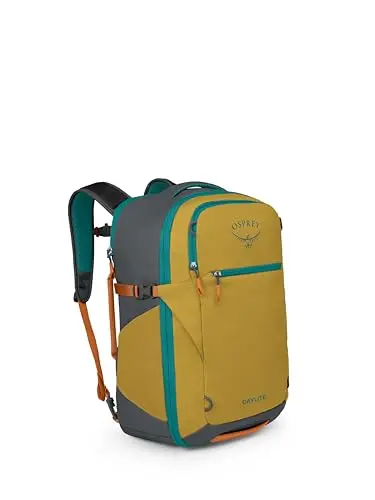
Daylite 35L Travel Pack – Carry-On Ready With a Laptop Sleeve
Osprey’s Daylite 35 is the closest thing here to a purpose-built 35-liter travel pack. It pairs a padded, TSA-friendly laptop sleeve with an AirScape mesh backpanel, a trolley pass-through, and dimensions that clear most cabin limits. At just over two pounds, it’s light enough to haul through a terminal all day.
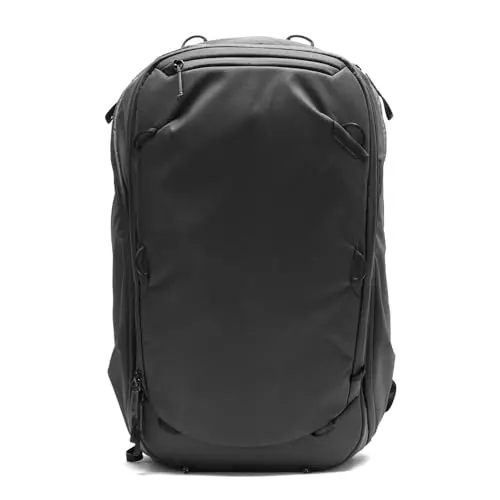
Travel Backpack 45L – Expandable 35-45L One-Bag Carry
Peak Design’s Travel Backpack expands from 35 to 45 liters, so it can pass as a compact cabin bag on short trips and then open up for longer ones. A weatherproof 400D recycled nylon shell, a burly #10 UltraZip, and rear, top, and side access points make it the most over-built pack here.
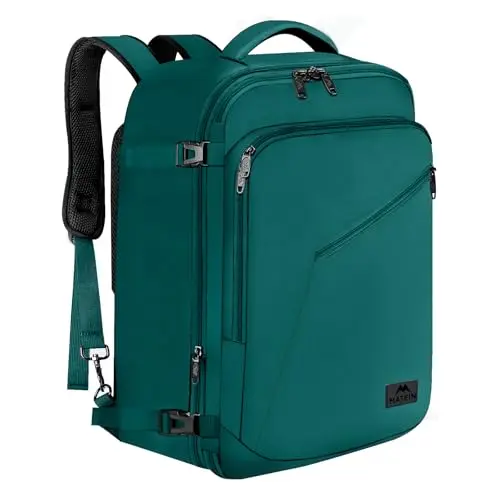
1159PBU Travel Backpack – Cabin Bag That Grows to 45L
MATEIN’s carry-on backpack starts at 35 liters and unzips to roughly 45, giving you a cabin-sized bag that grows when you buy too much on the way home. Hideaway padded shoulder straps convert it into a duffle or briefcase carry, and a trolley sleeve lets it ride on rolling luggage.
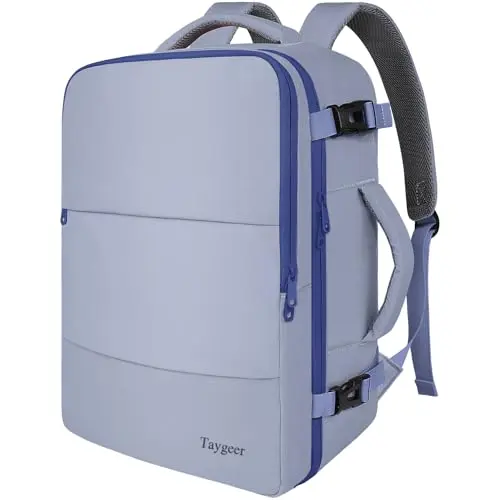
35L Carry-On Backpack – TSA-Flat Opening With Shoe Bag
The Taygeer 35-liter opens a full 180 degrees for security screening and packs in a surprising amount of organization for the money: a dedicated laptop sleeve, a bonus shoe bag, and a wet pocket for swimsuits or toiletries. Dual padded handles and adjustable straps let it work as a handbag or a backpack.
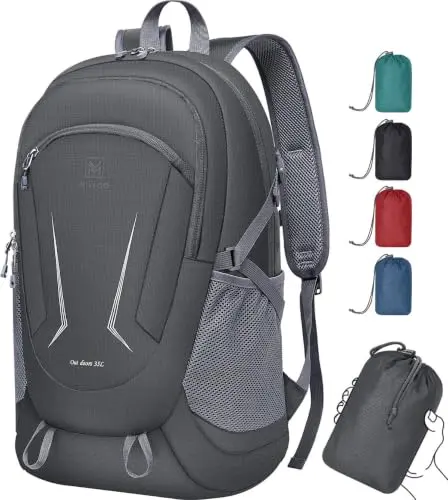
Ultralight Packable Daypack – Wet Pocket and Anti-Theft Clips
The MIYCOO is a foldable 35-liter daypack that stuffs into its own inner pocket and weighs under a pound. Water-resistant fabric, a wet compartment, anti-theft zipper clips, and a survival whistle round out a bag built to disappear into a suitcase and deploy at the destination.
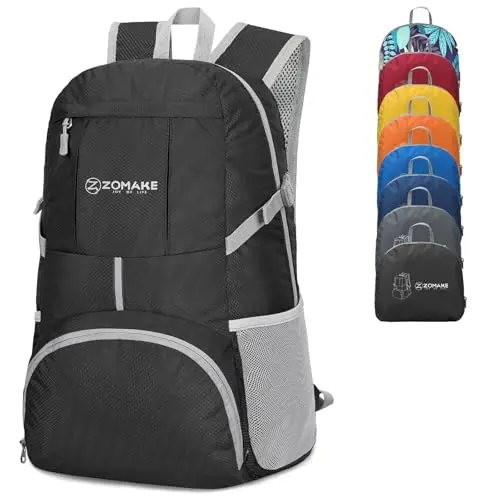
Lightweight Packable Backpack – 35L That Folds to Palm Size
The ZOMAKE is the classic packable 35-liter daypack: light nylon, a five-pocket layout, and a folded footprint small enough to live in a coat pocket. A chest buckle, safety whistle, and buckled side pockets cover the basics for day hikes, shopping runs, and shore excursions.
How We Evaluated These 35 Liter Travel Backpacks
We didn’t put these packs through a full year of airports, train platforms, and hotel-room repacking. What we did: cross-referenced six 35-liter travel backpack models from six distinct brands across five decision axes – measured dimensions and usable capacity, harness and backpanel comfort, access and compartment layout, carry-on compliance, and shell and hardware durability. We triangulated published specifications, packed-item checklists, feature sets, and owner feedback where available, then mapped every model against representative traveler profiles: the business flyer living out of a cabin bag, the weekend leisure traveler, and the hiker who wants a stuffable second bag. Where listed capacity and listed dimensions disagreed, we treated the dimensions as the more honest signal.
The scoring framework weighted real-world fit (70%) – how well each pack handles its stated job once it’s actually loaded – against feature differentiation (30%) – the design choices that make one model the better answer for a specific trip. We have no commercial relationship with any of the brands here, and recommendations track fit and differentiation, not brand preference. Two of the six are packable daypacks rather than load-bearing travel packs, and we scored them on those terms instead of penalizing them for being different. If you want a properly structured cabin pack, the Daylite 35L Travel Pack is the most complete answer; if you’d rather buy once and scale capacity up or down, the Travel Backpack 45L earns its premium.
How to Choose the Right 35 Liter Travel Backpack
1. What a 35 Liter Travel Backpack Can Actually Hold
Thirty-five liters lands in a useful middle ground. It’s roughly enough for four to six days of clothing plus a laptop, a dopp kit, and a pair of shoes – the length of most work trips and long weekends. It’s also small enough that many airlines will treat it as a standard carry-on rather than a checked bag, which is the entire point of traveling this way.
Push toward the 40-liter-plus end and you start running into sizer bins on stricter carriers. Drop to 25 or 30 liters and you’re packing for a long weekend, not a week. The trick is remembering that liters describe volume, not fit: a stuffable 35-liter pack and a structured one of the same rating behave nothing alike once they’re on your back.
2. Measured Dimensions Beat the Liter Rating Every Time
Bag dimensions vary more than the liter ratings suggest. The Osprey Daylite 35 measures 19.3 x 10.2 x 14.6 inches; the Peak Design Travel Backpack measures 22 x 13 x 9.5. Both carry a 35-liter load, but only one is likely to slide under a seat without a fight. Always check the listed depth and height against the sizer for the airline you actually fly.
It’s also worth knowing that stated capacity often includes exterior pockets, expansion gussets, and stretch mesh. A 35-liter bag with a big front pocket and two bottle sleeves can leave less usable main-compartment room than a leaner model. If your packing style leans on cubes and a flat, wide clamshell, favor measured volume in the main compartment over the headline number.
This is where the Daylite 35L Travel Pack earns its keep: the measured footprint is honest and it clears most cabin limits without a squeeze.
3. Harness, Backpanel, and Load Comfort
A loaded 35-liter bag can weigh 20 to 25 pounds, and that’s where harness design separates the field. Look for a ventilated backpanel – mesh over foam – rather than a flat padded slab, and check whether the sternum strap adjusts vertically. A strap fixed in one position only fits one torso.
Shoulder straps should be contoured rather than straight and at least an inch of foam thick. Hip belts are a genuine differentiator at this size: a real belt transfers weight off your shoulders on a long walk to the gate, while a webbing strap with a buckle is mostly decoration. Tuck-away harnesses are worth the trade if you plan to check the bag or carry it like a duffle.
4. Access, Compartments, and Packing Layout
Two schools here. Clamshell and panel-loading bags open flat so you can see everything at once; top-loading packs carry better but turn packing into a retrieval mission. For travel specifically, a full-length opening is usually the friendlier choice, especially in a small hotel room.
Then look at the details that solve real problems: a dedicated shoe bag or separated bottom compartment, a wet pocket for a damp swimsuit, a laptop sleeve that sits against your back rather than in the middle of your clothes, and external compression straps to keep a half-empty bag from collapsing. The Taygeer’s 180-degree opening and the MATEIN’s front organizer pocket are good examples of layout doing actual work.
If you routinely come home with more than you left with, the expansion in the 1159PBU Travel Backpack from 35 to 45 liters is worth the extra weight.
5. Packable vs. Structured: Two Very Different 35 Liter Travel Backpacks
A packable daypack folds into its own pocket, weighs under a pound, and costs less than dinner for two. It has no frame, no padding, and thin straps. A structured travel pack has a backpanel, a real harness, compression, and a laptop sleeve, and it costs several times more. Both get called a 35-liter travel backpack, and that mismatch causes most of the disappointing purchases in this category.
Buy the structured pack if the bag is your primary luggage. Buy the packable if it’s a supplement – for day hikes, market runs, or the souvenirs you didn’t plan on. Plenty of travelers carry both: a structured cabin bag plus a folded daypack that takes up almost no room. For that role, the Ultralight Packable Daypack covers the bases with a wet compartment and zipper clips.
6. What Each Price Tier Actually Buys You
The entry-level tier is dominated by packable daypacks and simple carry-on backpacks: light fabric, basic zippers, minimal padding. You get genuine utility, and you accept a shorter service life. Most of these will handle a few trips a year without complaint.
The mid-range tier is where a properly designed harness, a TSA-friendly laptop sleeve, and a trolley pass-through start showing up in the same bag – the point where it stops being a sack with straps. Above that, the premium tier buys weatherproof shells, heavier hardware, expandable volume, and multi-point access, plus the kind of build that survives a decade of baggage handlers.
None of that is a rule. A well-chosen entry-level bag beats an over-featured one that doesn’t suit your body or your packing style. Match the tier to how often you actually fly.
Frequently Asked Questions
1. Are all 35 liter travel backpacks actually carry-on sized?
No. The liter rating describes internal volume; the airline cares about linear inches. A tall, deep 35-liter pack can exceed a stricter carrier’s sizer even though the number on the label looks safe, while a shallower bag of the same volume slides in easily.
Check the listed height, width, and depth against the specific airline you’re flying, not against a general carry-on rule. If you fly budget carriers often, favor bags in the 19 to 20 inch height range with a depth under 10 inches. And remember that a full bag is bigger than an empty one – compression straps matter more than most shoppers expect.
2. What's the difference between the Osprey Daylite 35L and the Peak Design Travel Backpack?
They solve different problems. The Daylite 35 is a fixed-capacity pack built for flying: light, honest dimensions, an AirScape backpanel, and a TSA-friendly laptop sleeve. It’s the easier bag to carry all day and the simpler one to pack.
The Peak Design Travel Backpack is a system. It expands from 35 to 45 liters, opens from the top, side, and rear, and wears a weatherproof 400D recycled nylon shell with heavier hardware. That flexibility costs weight and money, and the internal footprint is narrower than some packers expect. Choose Osprey for straightforward cabin travel; choose Peak Design if you want one bag that also handles a two-week trip.
3. How does the MATEIN 1159PBU compare with the Taygeer 35L Carry-On Backpack?
Both chase the same shopper: someone who wants an organized cabin bag without spending much. The MATEIN 1159PBU leans on expandable volume – 35 liters for the outbound flight, closer to 45 when you unzip it – plus hideaway straps that convert it into a duffle and a trolley sleeve for rolling luggage.
The Taygeer leans on organization: a 180-degree TSA opening, a bonus shoe bag, a wet pocket, and a dedicated laptop sleeve. It’s the friendlier bag at security and the tidier one inside. The trade is a shallower, more compact shell and stitching that won’t last forever. If you want the 1159PBU Travel Backpack to grow with your trip, it’s the pick; if you want fast security lines and separated dirty gear, take the Taygeer.
4. Is a packable 35 liter daypack like the ZOMAKE or MIYCOO enough for a real trip?
As your only bag? Rarely. Both are stuff sacks with shoulder straps – light, water-resistant, and inexpensive, with no frame, no padding, and thin straps. Load one past 20 pounds and you’ll feel every ounce of it.
As a second bag, they’re excellent. The ZOMAKE folds to palm size and carries a day’s clothing and a towel; the Ultralight Packable Daypack adds a wet compartment, anti-theft zipper clips, and a survival whistle. Toss either into a suitcase and use it for hikes, markets, and the souvenirs that won’t fit on the way home. Just don’t expect either to survive a decade of hard use.
5. Do I need a hip belt on a 35 liter travel backpack?
It depends on how you travel. If your bag mostly rides on a rolling suitcase or sits in an overhead bin, a hip belt is dead weight. If you walk 20 minutes from a train station to your hotel with the bag fully loaded, a real belt makes a noticeable difference.
Look for a padded belt with its own buckle rather than a webbing strap, and check that it’s removable or tuckable so it isn’t dangling at the airport. At this size, a good sternum strap and contoured shoulder straps often do more for comfort than a minimal belt does.
Final Verdict
For most travelers, the Daylite 35L Travel Pack is the answer. It’s the one bag here designed from the ground up as a 35-liter cabin pack – honest dimensions, a comfortable ventilated harness, a TSA-friendly laptop sleeve, and a trolley pass-through for longer trips. It doesn’t try to be everything.
If you want more capacity for less money, the 1159PBU Travel Backpack covers the essentials and expands when your trip outgrows 35 liters. If you’d rather buy once and handle two weeks plus bad weather, the Travel Backpack 45L justifies its premium. And if you just need a second bag that disappears into your suitcase, the Ultralight Packable Daypack solves that problem for the price of a meal.
