
Best Affordable Commercial Espresso Machines – 2026 Reviews

The machine behind a café counter is a different species: plumbed into a water line, running twin boilers, driving a rotary pump that pulls shot after shot without flinching. You do not need any of that in a home kitchen. You do need a machine that borrows the parts that actually change how coffee tastes – a commercial-size basket, real temperature control, and steam dry enough to make microfoam.
That gap is exactly where this category gets messy. Budget machines cut corners precisely where you notice: temperature swings that make the same beans taste sour one morning and bitter the next, steam wands that spit water into your milk, portafilters so small that good baskets and tampers will not fit. The options that hold up spend their money on two things – thermal stability and the group head – and go cheap almost everywhere else.
So the useful question is not which machine is most commercial, but how much commercial hardware you can get while the price stays reasonable. Below we sort the current market into tiers: genuine 58mm builds, all-in-one machines with integrated grinders, and entry-level picks that still pull a respectable shot. Each entry says what it gives up and which buyer it actually fits.
Best Affordable Commercial Espresso Machines – 2026 Reviews
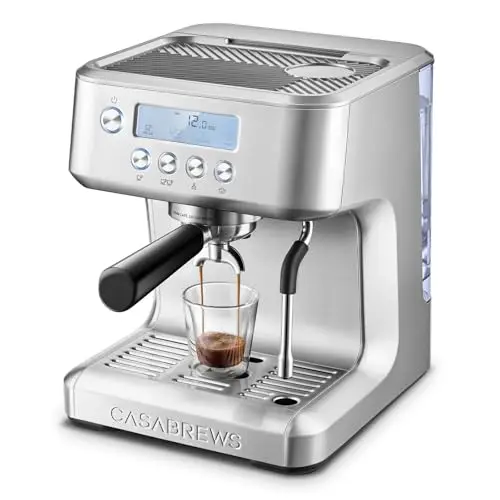
Ultra – 58mm Portafilter and Custom Brew Temp
A semi-automatic built around a 58mm portafilter, with an LCD panel, four brewing temperature settings, and a 73 oz removable tank. The control panel covers steam, hot water, and pre-programmed single or double shots, and the steam wand is designed for microfoam rather than bubbles.
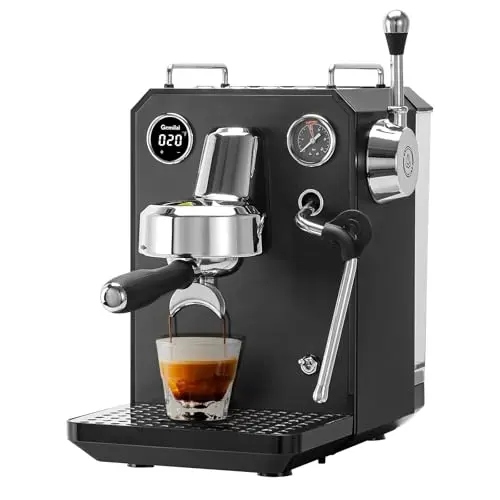
Owl G3006 – Commercial 58mm Group Head with PID
A semi-automatic built on a genuine 58mm commercial portafilter, with an active PTC saturated brew head, PID control, and a dual display tracking temperature and extraction time in real time. Temperature is adjustable from 176F to 215F, with pre-infusion and a side-lever steam wand on a 360-degree swivel.
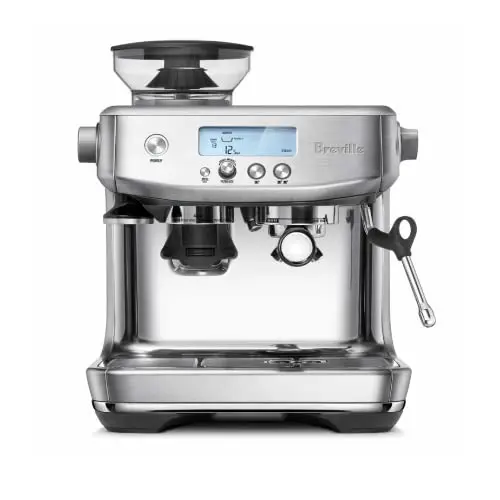
Barista Pro – Built-In Grinder, Near-Instant Heat
A bean-to-cup machine with an integrated conical burr grinder, ThermoJet heating that reaches extraction temperature in about three seconds, and PID regulation within a couple of degrees. The box includes single and dual wall baskets, a Razor dose trimming tool, a 480 ml milk jug, a cleaning kit, and a water filter.

EM3131 – Compact 20-Bar with PID Control
A compact 20-bar semi-automatic with a 1350W heating system that reaches brew temperature in about 30 seconds, PID control within ±2C, and a steam wand that swivels a full 360 degrees. One-touch buttons cover single, double, or a custom extraction time for controlling strength.
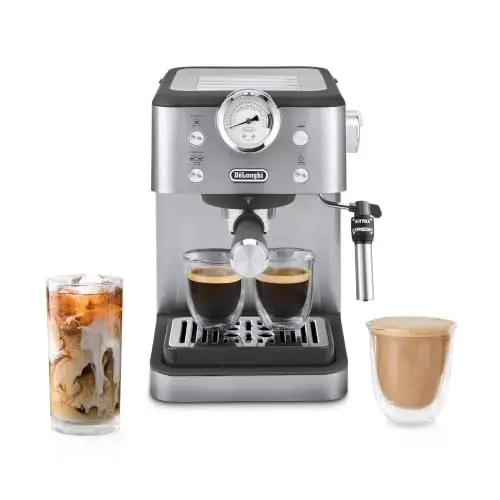
Classic Signature EM450M – Adjustable Steam Wand
A compact stainless-steel semi-automatic with a 15-bar Italian pump, Thermoblock heating, a visible pressure gauge, and an adjustable two-setting steam wand. Preset single and double shot recipes can be customized, and the machine shuts off automatically when idle.
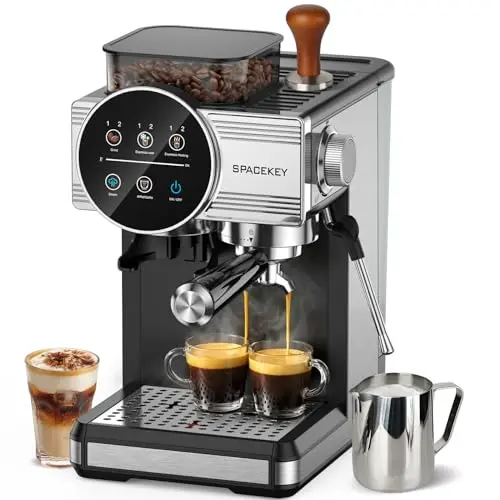
CM5510 – Built-In Grinder and Cold Brew
A semi-automatic combining a built-in conical burr grinder with 30 grind settings, a 20-bar pump, PID temperature control, pre-infusion, and a dedicated cold brew function. The LED touchscreen handles volume and temperature, and the 51mm portafilter ships with a wooden tamper and dosing ring.

PE3670U – Compact 20-Bar with Temp Display
A compact 20-bar semi-automatic with a 1350W boiler, a temperature display, low-pressure pre-infusion, and a steam wand for milk drinks. The stainless body is space-saving, and the box includes a 51mm portafilter, pressurized single and double baskets, a scoop, and a dosing funnel.
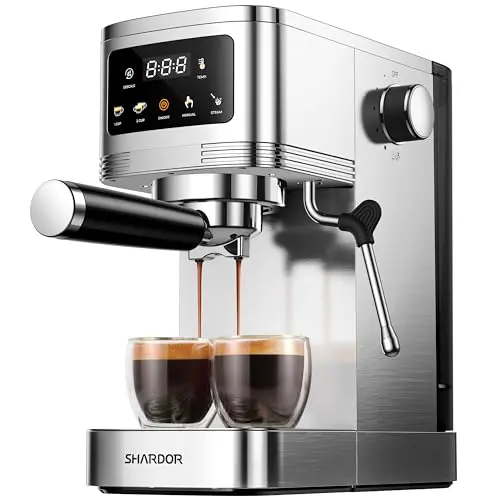
CM1661 – Touchscreen and One-Touch Descaling
A compact 20-bar semi-automatic with a touchscreen LED panel covering single and double shots, manual mode, steam, temperature, and one-touch descaling. Three temperature settings, a 45 oz removable tank, a cup warmer, and auto shutoff after 15 minutes idle.
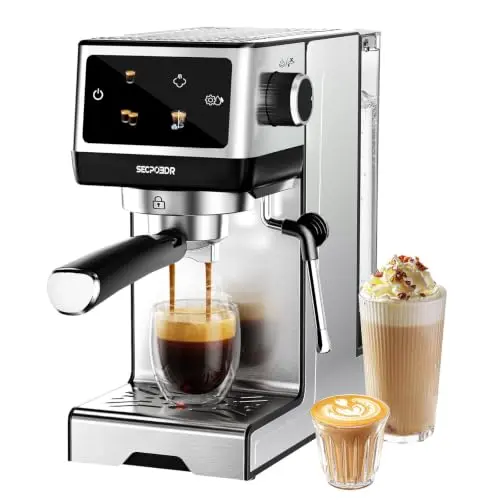
CM6952 – Slim PID Espresso with Cold Brew
A slim 20-bar semi-automatic with PID temperature control, low-pressure pre-infusion, a touchscreen for adjustable volume, and a cold brew function alongside standard espresso. The stainless body measures 6.65 inches wide, with a 45 oz removable tank and a detachable drip tray.
How We Evaluated These Affordable Commercial Espresso Machines
Writing an honest review of this category means being upfront about what we compared and what we did not. We didn’t pull shots onto a scale, run refractometer readings, or steam milk side by side in a lab. What we did: cross-referenced 9 espresso machines from 9 distinct brands across six decision axes – group head and basket standard, temperature control, pump pressure and pre-infusion, steam wand design, capacity and footprint, and included accessories. We triangulated published specifications, mapped feature sets against how home baristas actually brew, and weighed owner feedback where available, especially on temperature consistency and long-term reliability.
The scoring framework weighted real-world fit (70%) – how reliably a machine delivers a stable, repeatable shot and usable microfoam in a home kitchen – against feature differentiation (30%) – the hardware that separates one option from the next, like a 58mm group head, a saturated brew head, or an integrated grinder. That lens matters: not what a spec sheet claims in isolation, but what the hardware changes about the coffee in your cup. We have no commercial relationship with any of the brands featured; recommendations track fit and differentiation, not brand preference. If you want the closest thing to café hardware on a mid-range budget, the Casabrews Ultra is the pick; if a genuine 58mm commercial group head matters more than anything else, the Gemilai Owl G3006 is your machine.
How to Choose the Right Affordable Commercial Espresso Machines
1. What Commercial Really Means on an Affordable Espresso Machine
The machine behind a café counter is plumbed into a water line, runs two boilers, and uses a rotary pump that shrugs off shot after shot. You are not getting that at a home price point, and you do not need it. What the affordable commercial espresso machine tier actually delivers is a deliberate subset: a 58mm group head, some form of temperature control, pre-infusion, and a steam wand that makes genuine microfoam.
The dividing line is thermal stability. A small boiler that swings ten degrees between the start and end of a shot will make the same beans taste sour on Monday and bitter on Tuesday. Everything else – pressure, wattage, tank size – is secondary to keeping the brew head at a consistent temperature.
2. 58mm vs 51mm Portafilters and Why Group Head Size Matters
58mm is the commercial standard, and it is the single spec that most changes how a machine feels to own. A 58mm basket holds a proper dose, accepts the same tampers, distribution tools, and precision baskets used on café equipment, and gives you room to refine puck prep. Smaller 51mm baskets work fine, but the aftermarket is thinner and upgrades are harder to find.
If you plan to grow into the hobby, a 58mm machine saves you from buying twice. The Gemilai Owl G3006 is the clearest example in this lineup, pairing a genuine 58mm commercial portafilter with a saturated brew head.
3. PID, Thermoblock, and Saturated Heads: Reading Temperature Specs
PID control holds water temperature inside a tight window – on the machines here it is typically ±2C – and it is the feature most worth paying for. A Thermoblock heats water on demand, which is why some machines are ready in seconds, but simpler implementations can drift between shots. A saturated brew head adds thermal mass so the group stays stable, which is why it shows up on the more commercial-leaning designs.
None of this shows up in a great cup on day one. It shows up on day thirty, when your shots are still consistent and you are not chasing the grinder every morning to compensate for temperature swings.
4. Built-In Grinder or Standalone: The Hidden Cost of an Entry-Level Espresso Machine
Freshly ground coffee matters more than pump pressure, and that is the argument for a built-in conical burr grinder. A machine that grinds on demand removes stale pre-ground coffee from the equation entirely, and dose-by-time grinding keeps the amount consistent shot to shot.
If you skip the integrated grinder, budget for a separate burr grinder – not a blade grinder, which produces uneven particle sizes that no amount of pre-infusion can rescue. The Breville Barista Pro is the lineup’s all-in-one example and the simplest path to consistent results if you do not already own a grinder. Keep in mind that pressurized baskets, which many entry machines include, are designed to compensate for inconsistent grind – useful at the start, limiting once you want to dial in.
5. Steam Wands, Milk Texture, and the Latte Test
Most people shopping this tier are making milk drinks, so the steam wand deserves as much attention as the pump. Dry steam builds microfoam – dense, glossy, pourable – while wet steam injects water and leaves a thin, bubbly layer that collapses within a minute. A two-setting wand or a lever-operated valve makes it easier to modulate.
Practical detail: a 360-degree swivel wand is easier to angle into a small jug for a single latte, and a wand that runs wet will make you fight the milk every time. It is the most common weak point on inexpensive machines.
6. Counter Space, Tank Size, and Daily Routine
Measure your counter before anything else. Depth matters as much as width, and machines with a rear removable water tank need clearance behind them. A 45 oz tank covers a few days of espresso for one person; 70 oz or more stretches that further.
Warm-up time is the spec you feel every morning. Fast-heating systems are ready in seconds to a minute; others want five. Descaling is the other routine task, and one-touch programs make it painless – skipping it is a leading cause of premature failure. If counter space is the binding constraint, the AMZCHEF EM3131 is the narrowest serious option here.
Frequently Asked Questions
1. Are affordable commercial espresso machines actually commercial-grade?
No, and it is worth being clear about that. A true commercial machine is plumbed into a water line, runs dual boilers and a rotary pump, and recovers instantly between shots. What the affordable commercial espresso machine category delivers is a subset of that hardware: a 58mm group head, PID temperature control, pre-infusion, and a steam wand capable of real microfoam.
For one or two drinks at a time in a home kitchen, that subset covers nearly everything that affects taste.
2. What is the difference between the Casabrews Ultra and the Gemilai Owl G3006?
Both use a 58mm commercial portafilter, which is why they sit at the top of this list. The Casabrews leans toward simplicity: an LCD panel, four brew temperature settings, and a larger 73 oz tank. The Gemilai leans toward hardware: a saturated brew head, a wider 176F to 215F range, a dual display tracking time and temperature, and a side-lever steam wand.
The Casabrews is the easier first machine; the Gemilai Owl G3006 rewards someone who wants to dial in recipes shot by shot.
3. How does the Breville Barista Pro compare with the Spacekey CM5510?
Both have built-in conical burr grinders, so both solve the freshness problem. The Barista Pro uses ThermoJet heating that reaches temperature in about three seconds plus PID control within ±2C, and it carries a two-year warranty. The Spacekey counters with 30 grind settings, a cold brew function, and pre-infusion at a lower price tier, but with a newer and less proven track record.
If reliability and support matter most, take the Breville. If versatility and value matter most, the Spacekey CM5510 is the more interesting machine.
4. De'Longhi Classic Signature vs Neretva 20 Bar – which suits a first-time buyer?
They trade different strengths. The De’Longhi Classic Signature EM450M gives you a two-setting steam wand, customizable presets, a pressure gauge, and an established support network, on a 15-bar pump with no PID. The Neretva counters with a 20-bar pump, a temperature display, and low-pressure pre-infusion at a lower price tier, but with more reports of lukewarm shots and a shorter service life.
For a beginner who wants a machine that works out of the box and has backup when it does not, De’Longhi is the safer call.
Final Verdict
For most buyers, the Casabrews Ultra is the answer – a real 58mm portafilter and adjustable brew temperature on your counter without commercial pricing. If the group head is the priority above everything else, the Gemilai Owl G3006 takes the same commercial-size portafilter and adds a saturated head, PID, and a lever steam wand. On a tight budget, the AMZCHEF EM3131 delivers PID control and a 30-second heat-up in a footprint that fits almost anywhere. And if you would rather not buy a separate grinder, stretch for the Breville Barista Pro – fresh-ground dosing and near-instant heat in one machine. Whichever you pick, budget for fresh beans; they will change your results more than the machine will.
