
Best Air Purifiers For Cigarette Smoke – 2026 Reviews

Cigarette smoke doesn’t settle politely. It drifts into curtains, coats walls, and leaves behind a sharp odor that a plain dust filter barely touches. That is why shopping for an air purifier for cigarette smoke is different from buying one for pollen or pet hair: you are dealing with both fine particles and the gases and odor compounds that make smoke linger.
The two specs that separate a useful smoke purifier from a mediocre one are smoke CADR and carbon filtration. Smoke CADR tells you how quickly the unit moves clean air for smoke particles, while the carbon stage determines whether it can make a dent in the smell and VOCs. Room size and auto mode matter too, because a purifier that is undersized or always running on low will not keep up with a daily smoking habit.
This guide surveys the market across brands and focuses on real cigarette-smoke scenarios: a bedroom used by one smoker, a living room with lingering odor, or a home office where smoke drifts in from another room. We will help you match the purifier to the space and the severity of the problem, not just the biggest coverage number on the box.
Best Air Purifiers for Cigarette Smoke – 2026 Reviews
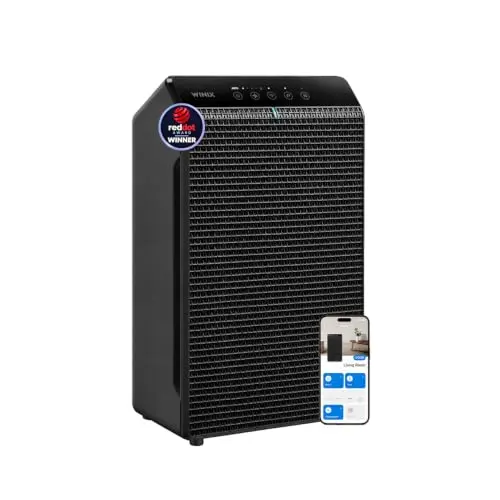
5520 – High-Capacity Smoke and Odor Control
The Winix 5520 is built for larger rooms that need serious smoke and odor control. Its True HEPA layer pairs with a high-deodorization carbon filter, and the auto mode uses onboard sensors to ramp up when air quality drops.
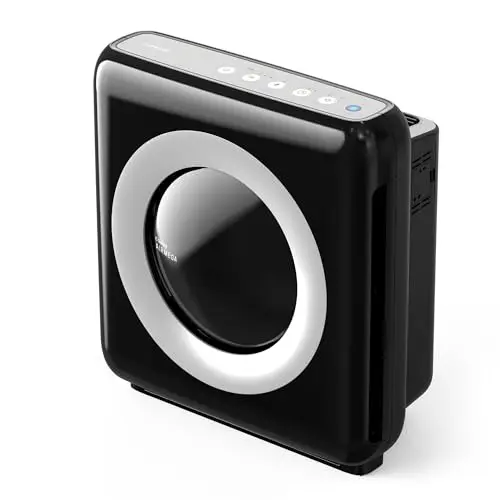
Mighty AP-1512HH – Four-Stage Smoke and Odor Control
The Coway Mighty AP-1512HH is a long-running four-stage design with a washable pre-filter, deodorization filter, bipolar device, and HEPA layer. Auto mode and a real-time air quality indicator keep operation simple.
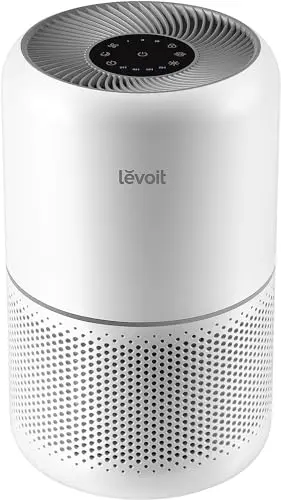
Core 300-P – Compact Smoke-Focused HEPA
The Levoit Core 300-P is a compact bedroom purifier with an AHAM Verifide smoke CADR of 143 CFM. It pairs a three-stage filter with a quiet sleep mode and a low-profile footprint.
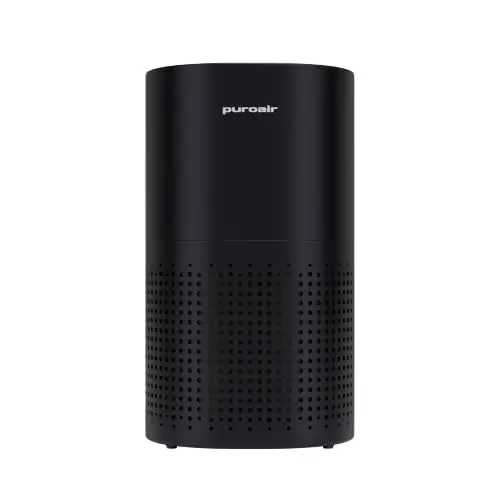
240 – Carbon-Enhanced Room Cleaner
The PuroAir 240 combines a pre-filter, HEPA layer, and activated carbon in a tall tower with a PuroIQ sensor and auto mode. It is aimed at rooms up to 1,000 sq ft.
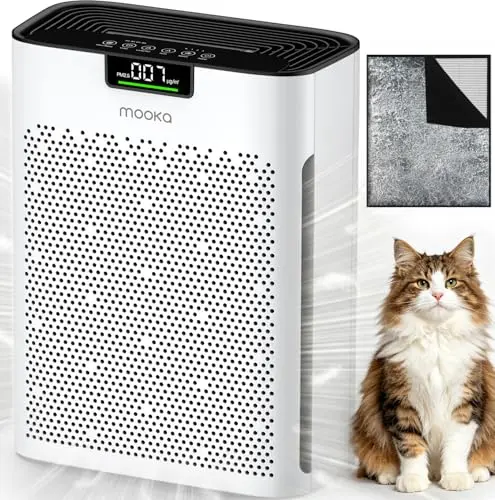
KJ190H – Large-Room Smoke and Pet Filter
The MOOKA KJ190H is a large-coverage budget purifier with a washable pre-filter, carbon-enhanced three-stage filtration, PM2.5 display, auto mode, and child lock.
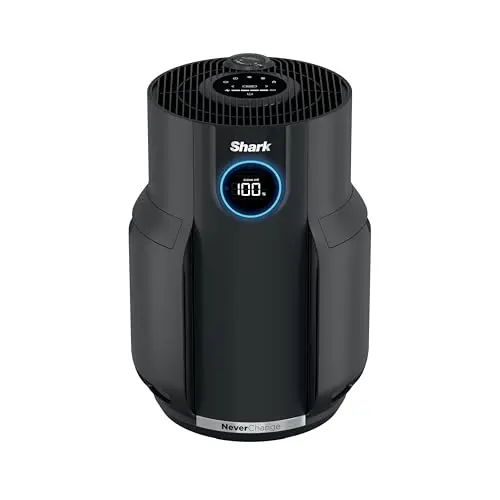
NeverChange HP152 – Odor-Focused Compact Purifier
The Shark NeverChange HP152 uses an HEPA-exceeding NanoSeal filter, a debris-defense washable screen, and an Odor Neutralizer cartridge. CleanSense IQ shows air quality in real time.
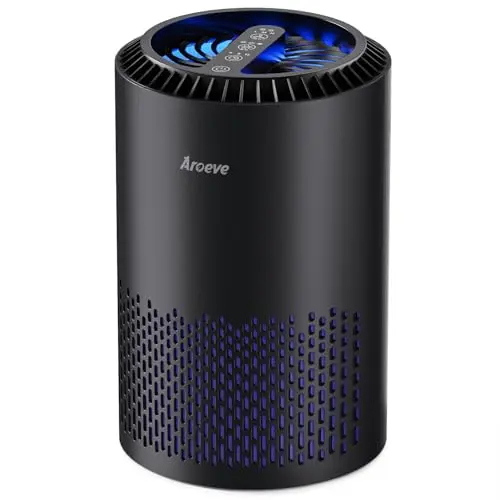
MK01A – Compact Bedroom Smoke Filter
The AROEVE MK01A is a small, low-cost purifier with 360-degree inlets, a smoke-rated filter, 22dB sleep mode, and an aromatherapy pad. It is aimed at bedrooms and small rooms.
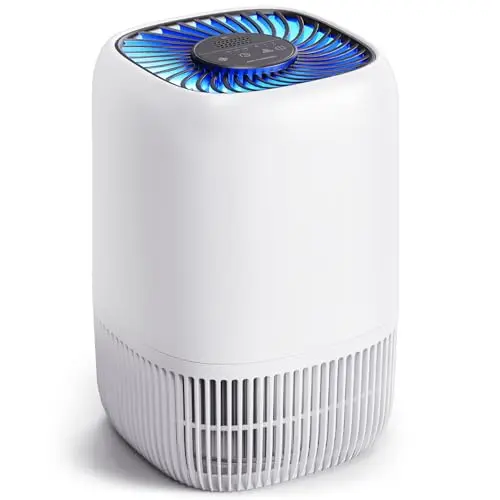
DH-JH12 – Budget Compact Air Cleaner
The VOOPNU DH-JH12 is a compact budget purifier with 360-degree intake, triple-layer filtration, three speeds, a timer, and an essential oil tray. It is best suited to small rooms.
How We Evaluated These Air Purifiers for Cigarette Smoke
We did not run controlled smoke-chamber tests or measure CADR ourselves. What we did: cross-referenced 8 air purifier models from 8 distinct brands across six decision axes – smoke CADR, carbon filtration, room-size fit, noise, maintenance, and automation. We triangulated published specifications, feature sets, owner feedback where available, and use-case fit for cigarette smoke. We then mapped each unit to a realistic room size and smoke pattern, because a purifier that is undersized for a smoky living room will disappoint no matter how good its filter is.
The scoring framework weighted real-world fit and performance (70%) – how well each purifier handles smoke particles, odors, and daily operation – against feature differentiation (30%) – unique filtration, sensor, and convenience advantages. We weighed carbon filter design heavily because cigarette smoke is both particulate and gaseous; a HEPA-only spec sheet does not tell the whole story. We also factored replacement costs and filter availability into the maintenance axis. We audited coverage claims against the common one-air-change-per-hour rating, which is why a unit with a huge headline room size can still be a poor fit for dense smoke.
We have no commercial relationship with any brand here; recommendations track fit and differentiation, not brand preference. If you want the most complete smoke-and-odor package, the Winix 5520 is the pick; for a smaller bedroom, the Levoit Core 300-P is the fit.
How to Choose the Right Air Purifiers for Cigarette Smoke
1. Why Cigarette Smoke Needs Both HEPA and Carbon Filtration
Cigarette smoke is a two-part problem. The particulate matter – the visible and invisible particles – is what a HEPA filter is designed to capture. The gases, VOCs, and odor molecules are a different challenge, and they need activated carbon or a specialized odor filter. A purifier that only advertises HEPA filtration may clean the haze while leaving the stale smoke smell behind.
Carbon quality matters more than the word ‘carbon” on the box. A thin carbon sheet is mostly a token layer; a substantial carbon filter or a dedicated deodorization stage gives the purifier more capacity to adsorb smoke odors before the media saturates. Avoid units that rely on ozone or ionizers as a smoke solution, since ozone is a lung irritant and not a substitute for filtration.
2. Match Smoke CADR and Room Size Before You Buy
Smoke CADR is the clean-air delivery rate for smoke particles, and it is the most useful single number for comparing purifiers in this use case. Coverage claims need context: many ‘up to” room sizes assume one air change per hour, which is a light-duty standard. For a room with daily cigarette smoke, aim for a unit that can give you multiple air changes per hour in the actual room, not just the marketing ceiling.
Auto mode is worth prioritizing because smoke levels rise and fall. A sensor that ramps the fan when air quality drops keeps the purifier useful without constant manual adjustment. If you want a verified smoke CADR in a compact bedroom unit, the Levoit Core 300-P is the clearest fit.
3. Air Purifier Odor Control: Carbon, Neutralizers, and Aromatherapy
An odor neutralizer cartridge can help with smoke smell, but it is not the same as a large carbon filter. Neutralizers are useful as a supplement, especially in compact rooms, while carbon does the heavier lifting on VOCs and odor compounds. Aromatherapy features simply add fragrance; they do not remove smoke and can mask a problem instead of solving it.
If odor is your main complaint, look for a purifier that names a deodorization filter, activated carbon, or a high-capacity carbon stage. Then check how often that filter needs replacement, because saturated carbon stops helping.
4. Air Purifier Placement and Auto Mode for Smoke-Prone Rooms
Placement changes real-world results. Put the purifier near the smoke source when possible, keep it away from curtains and furniture that block airflow, and give it enough clearance to pull air from all sides. A purifier tucked into a corner is working harder for less return.
Auto mode and a visible air-quality indicator make smoke management less manual. For a large smoke-prone living room with app control, the Winix 5520 is the pick. If you need the unit to disappear into a bedroom, prioritize a low sleep-mode noise rating and dimmable or defeatable lights.
5. Air Purifier Filter Costs and Maintenance
A washable pre-filter is a practical feature for smoke because it catches larger debris and helps protect the HEPA filter. The carbon filter is the part that matters most for odor, and it usually needs more frequent attention than the HEPA layer in a smoky home. Check the filter reminder system and replacement availability before you commit.
Budget for filters as part of the purchase, not an afterthought. A lower-priced purifier with expensive or hard-to-find filters can cost more over time than a mid-range unit with predictable replacement costs.
6. Cross-Brand Tradeoffs: Winix vs Coway vs Levoit
The Winix 5520 is the most automated large-room option here, with app control and a high-deodorization carbon stage. The Coway AP-1512HH is the simpler long-term choice, with a four-stage design, a strong warranty, and no app dependency. The Levoit Core 300-P is the bedroom specialist: smaller, quieter, and built around a verified smoke CADR.
If you are choosing between them, start with room size and smoke intensity. A large living room with daily smoke favors the Winix or Coway; a single bedroom favors the Levoit. Do not buy a small purifier for a large smoke problem and expect auto mode to fix the mismatch.
Frequently Asked Questions
1. Do air purifiers really remove cigarette smoke?
They can remove a meaningful share of the particulate matter in cigarette smoke, and a carbon filter can adsorb some odor-causing gases and VOCs. What they cannot do is replace ventilation or source removal; opening a window and eliminating the source still matters. For a smoke-focused purifier, look for a HEPA layer plus a substantial carbon filter, not just a particle filter.
2. What's the difference between the Winix 5520 and Coway AP-1512HH for cigarette smoke?
The Winix 5520 leans harder into odor control with a high-deodorization carbon filter, app control, and a larger coverage claim. The Coway AP-1512HH uses a four-stage design with a dedicated deodorization filter and a longer 3-year warranty, but it keeps controls simple and skips app connectivity. If you want the more automated large-room package, the Winix 5520 is the pick; if you prefer a straightforward set-and-forget purifier, the Coway is the calmer choice.
3. Is the Levoit Core 300-P enough for a smoky bedroom?
Yes, for a typical bedroom. Its smoke CADR of 143 CFM is a published, verified figure, and the compact body is easy to place near the bed. It is not the right tool for a large open-plan room with heavy smoke, though; the single-air-change coverage is much smaller than the headline number suggests. If your smoke problem is confined to one bedroom, the Levoit Core 300-P is a strong fit.
4. How long does it take an air purifier to clear cigarette smoke?
It depends on the smoke CADR, the room size, and how much smoke is being produced. A purifier with a higher smoke CADR will clean the air faster, but it still needs multiple air changes to make a noticeable difference. Auto mode helps because the unit can ramp up when smoke is detected, and running the purifier continuously is more effective than short bursts. Source control remains the fastest fix.
5. What's the difference between the PuroAir 240 and MOOKA KJ190H?
The PuroAir 240 emphasizes a PuroIQ sensor and auto mode, with a tall tower design and activated carbon for odor. The MOOKA KJ190H counters with a washable pre-filter, a PM2.5 display, child lock, and a larger coverage claim for less money. If you want a more automated set-and-forget unit, the PuroAir is the simpler pick; if you want lower running costs and more controls, the MOOKA makes more sense.
Final Verdict
For most smoky rooms, the Winix 5520 is the pick that balances particle capture, odor-focused carbon, and automation without pushing into the premium tier. If you want a simpler purifier with a longer warranty, the Coway AP-1512HH is the calmer long-term choice. For a bedroom-sized smoke problem, the Levoit Core 300-P is the value standout, with a verified smoke CADR and quiet sleep mode. And if odor is the main complaint in a compact room, the Shark HP152 and its dedicated odor neutralizer deserve a look. Start with the room size and the smoke intensity, then choose the unit that matches; a smaller purifier run continuously beats an oversized one run occasionally.
