
Best Air Purifiers For Cooking Smoke And Kitchen Odors – 2026 Reviews

You sear a steak, the kitchen fills with smoke, and twenty minutes later the haze is gone but the smell has moved into the curtains. That’s the split personality of cooking smoke: the visible part clears fast, and the invisible part – the aerosolized oil and the gases that actually carry the odor – hangs around long after you’ve propped a window open. A purifier that handles pollen beautifully can still leave you with a kitchen that smells like last night’s dinner.
Two things separate the options that work from the ones that don’t. The first is carbon: how much of it is in there, and whether the manufacturer treated odor as a real filtration stage or as a checkbox on the spec sheet. The second is honest airflow for the volume you actually have – a kitchen that opens onto a living room is one big space whether or not the box says so.
We compared the models worth cross-shopping for this specific job, across brands and across price tiers, and the picks below are arranged by which cooking-smoke problem each one solves best. Some are built to move a lot of air, some are built to be tuned toward smoke and fumes, and one or two are simply the right size for a small kitchen that doesn’t need a tower.
Best Air Purifiers for Cooking Smoke and Kitchen Odors – 2026 Reviews
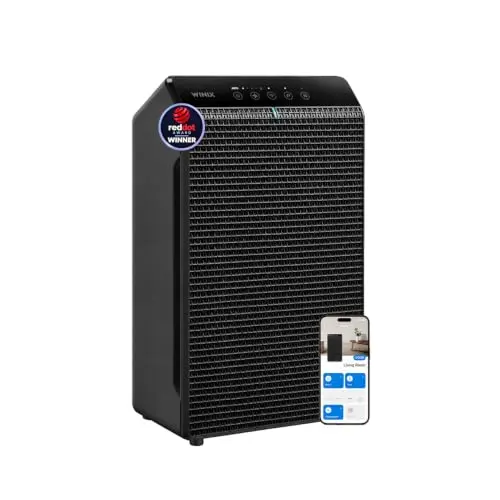
5520 – Heavy-Carbon Odor Control
A large-room HEPA purifier built around a heavier deodorization carbon stage, with a real-time air quality indicator, smart auto mode, and app control. On paper it is the most explicitly odor-focused unit in this lineup.
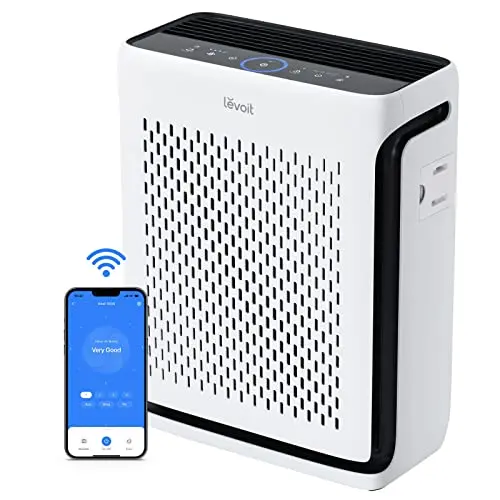
Vital 100S-P – Smart Odor-Focused Filtration
A slim smart purifier with a washable pre-filter, app scheduling, and a filter ecosystem that includes swap-in smoke and VOC-focused cartridges.
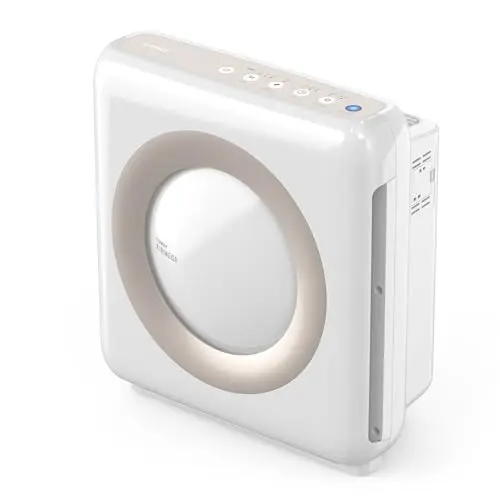
Mighty AP-1512HH – Large-Room Workhorse
The long-running reference point in this category: a four-stage purifier with a dedicated deodorization stage, a pollution sensor, and coverage that dwarfs its footprint.
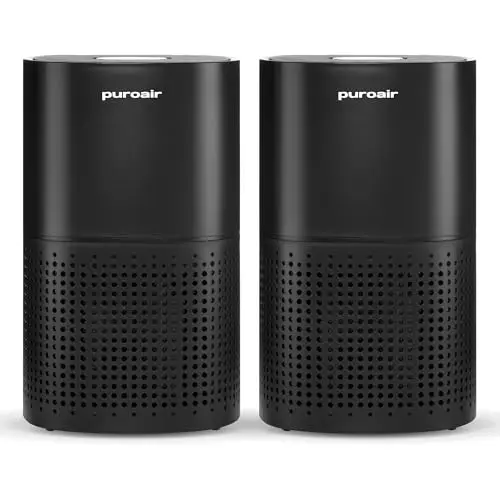
240 2-Pack – Sensor-Driven Multi-Room Coverage
A two-pack of sensor-driven HEPA purifiers with a three-layer stack and an activated carbon stage, sized for a kitchen plus an adjacent room.
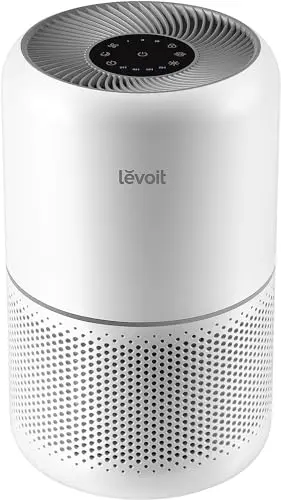
Core 300-P – Compact Verified Value
A compact, independently verified HEPA purifier with strong smoke CADR for its size and a genuinely quiet sleep mode.
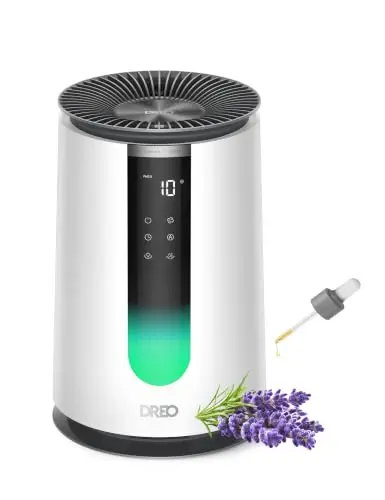
DR-HAP008 – Compact Purifier with PM2.5 Readout
A compact purifier with a numeric PM2.5 readout, turbo mode, and a scent diffuser, verified to a modest room size.
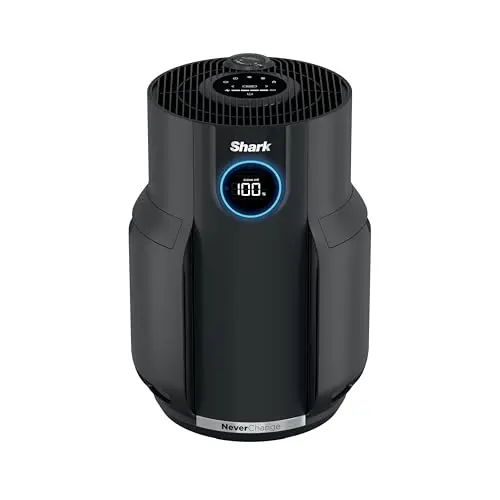
NeverChange HP152 – Low-Maintenance Odor Defense
A compact purifier built around long-life filtration, washable debris screens, and an odor-neutralizer cartridge.

B-D02L – Entry-Level True HEPA
A budget true-HEPA purifier with an activated carbon stage, an aromatherapy pad, and a very quiet low setting.
How We Evaluated These Air Purifiers for Cooking Smoke and Kitchen Odors
We didn’t fill a sealed test kitchen with pan smoke and log particle decay with a counter. What we did: cross-referenced 8 air purifier models from 7 distinct brands across 5 decision axes – smoke CADR relative to room volume, carbon media depth for odors and VOCs, pre-filter serviceability, noise behavior, and how convincingly auto and sleep modes handle a sudden smoke pulse. We triangulated published CADR ratings where brands list them, filter specifications, and owner feedback where available, then mapped each unit against the specific realities of a kitchen: grease-laden air, bursts of smoke from searing or broiling, and odors that creep into the next room and settle there. Running cost and filter lifespan factored in as well, since odor media in a kitchen wears out faster than the manual implies.
Scoring weighted real-world fit at 70% – how convincingly a unit clears cooking smoke and odor for the space it claims – against feature differentiation at 30%, covering washable pre-filters, swappable carbon blends, sensor quality, and scheduling that lets the fan be running before the pan gets hot. A quiet unit that’s undersized for your space loses to a louder one that’s correctly sized. We have no commercial relationship with any brand included, and recommendations track fit and differentiation rather than brand preference. If odor is your primary complaint, the Vital 100S-P is the most tunable answer here; if raw air movement for a large open kitchen matters more, the 5520 is the one to shortlist.
How to Choose the Right Air Purifiers for Cooking Smoke and Kitchen Odors
1. Why Cooking Smoke Needs a Different Air Purifier Than Allergy Season Does
Cooking smoke is two problems in one. There’s the particulate half – the fine soot and aerosolized oil that makes a kitchen hazy – and there’s the gas half, the VOCs and odor molecules that keep the smell alive hours after the haze clears. A HEPA filter is excellent at the first and essentially useless at the second.
That’s why a purifier that’s brilliant for pollen can be underwhelming next to a hot pan. You need both halves covered: real particle filtration plus enough carbon to adsorb the gases. Grease is the third variable, and it’s the one that quietly wrecks purifiers placed too close to a stove.
2. Carbon Media Is the Real Odor Filter
Almost every purifier claims a carbon filter. What varies enormously is how much carbon is actually inside. A thin fabric sheet sprayed with carbon is a token gesture and saturates in weeks in a kitchen. A proper deodorization stage built on real granular activated carbon is what genuinely adsorbs cooking fumes, and it’s the first thing worth checking on a spec sheet.
Filter flexibility is the next tier up. Some units let you swap in an optional smoke-specific cartridge or a VOC-focused blend; the Vital 100S-P is the clearest example in this lineup. If you cook hard and often, that kind of modularity is worth more than an extra fan speed.
3. Sizing an Air Purifier for Kitchen Smoke and Open-Plan Living
Coverage numbers are the most abused spec in this category. The big number on the box usually assumes one air change per hour – roughly what a quiet room needs, not what a kitchen mid-sear needs. Look for the CADR rating and the room size listed at a higher number of air changes per hour; that’s the honest figure for smoke.
If your kitchen opens onto a living area, size for the combined volume, not the kitchen alone. That’s where a genuinely high-output unit earns its footprint – the Coway AP-1512HH moves enough air to pull down a whole open-plan space rather than just the cooking zone.
4. Pre-Filters, Grease, and the Maintenance Step Everyone Skips
A washable pre-filter matters more in a kitchen than anywhere else in the house. It’s the stage that catches grease, lint, and hair, and if it isn’t washable you’re either replacing it constantly or letting the carbon and HEPA stages absorb the load and die early.
Rinse it monthly if you cook daily. And expect carbon to wear out faster here than the manual suggests – odor media saturates quietly, and a purifier that has stopped removing smells usually has a carbon problem, not a fan problem.
5. Where to Put an Air Purifier for Cooking Smoke and Kitchen Odors
Placement matters more than most people expect. Too close to the stove and you’ll coat the pre-filter in grease; across the room and you’ll miss the plume entirely. A spot a few feet from the cooking zone, with clear airflow around the intake, is the sweet spot.
In an open plan, two smaller units often outperform one large one – one covering the kitchen, one in the adjacent room where odors settle into soft furnishings. That’s the logic behind the PuroAir 240 two-pack, and it’s a strategy worth copying even with mismatched units.
6. What Budget, Mid-Range, and Premium Air Purifiers Actually Buy You
Stepping up in price mostly buys three things: carbon depth, sensor quality, and coverage per dollar. Budget units give you HEPA and a thin carbon layer – fine for a small kitchen if you accept more frequent filter changes.
Mid-range adds a real auto mode and a better deodorization stage. Premium buys large-room airflow, longer filter life, and app scheduling that lets the unit be running before you start cooking. What it rarely buys is a shortcut around maintenance – filter costs land on you either way.
Frequently Asked Questions
1. Where should I place an air purifier for cooking smoke?
A few feet from the cooking zone, with the intake facing open floor rather than a cabinet wall. Too close and grease coats the pre-filter fast; too far and the plume disperses before the unit ever sees it. Keep clearance on all sides so the fan isn’t starved, and avoid tucking it into a corner behind a door.
In an open plan, put the primary unit in the air path between kitchen and living space and a second unit in the room where the smell actually ends up.
2. What's the difference between the Winix 5520 and the Coway AP-1512HH?
Both are large-capacity units with a serious odor stage, but they’re tuned differently. The Winix 5520 leans harder on deodorization carbon and adds app control with scheduling, which is genuinely useful for running it before you cook. The Coway relies on a four-stage stack with a dedicated deodorization filter and a three-year warranty, but it has no app and a fixed filter lineup.
Take the Winix if you want to schedule and tune odor filtration. Take the Coway if you want maximum air movement from a proven design and don’t care about connected features.
3. How does the PuroAir 240 compare to the Levoit Core 300-P?
They solve the problem at different scales. The PuroAir 240 is a two-unit set with a particle sensor and auto mode, so you can cover the kitchen and an adjacent room at the same time. The Core 300-P is a single compact unit with AHAM-verified airflow and a lower entry point – better if your kitchen is small and one spot covers it.
If smoke migrates through your home, the pair wins. If you cook in a closed, modest kitchen, the single unit is the more efficient buy.
4. How long does it take an air purifier to clear cooking smoke?
Particles clear fastest – often within fifteen to thirty minutes at high fan speed in a normal kitchen, assuming the unit is correctly sized for the volume. Odor takes longer, because carbon adsorption is slower than mechanical filtration and soft furnishings hold smell and release it back into the room.
The practical approach: run it on high or turbo while you cook, then leave it on a lower setting for twenty to thirty minutes afterward. That second stretch is what most people skip, and it’s the one that stops the smell from settling in.
5. Do air purifiers actually remove cooking odors, or just smoke particles?
Both, but by different mechanisms. HEPA captures smoke particles; activated carbon adsorbs the odor molecules and VOCs. A purifier with a token carbon sheet will clear the haze and leave the smell behind.
Carbon is consumable – it saturates and then stops working, usually well before a filter indicator suggests. If smells linger, replacing the carbon stage is the first thing to try.
Final Verdict
For most kitchens, the Winix 5520 is the answer. It pairs a genuinely heavy carbon stage with enough airflow to pull down an open-plan space, and auto mode means you don’t have to think about it while you’re searing. If you’d rather tune filtration around smoke specifically and keep the footprint small, the Levoit Vital 100S-P is the more adaptable machine. And if your kitchen opens onto a big living area where smoke drifts, the Coway AP-1512HH still moves more air than anything else here – no app, no scheduling, just volume.
Small-kitchen cooks on a tighter budget should look at the Core 300-P instead. It covers a compact space with verified airflow and won’t dominate your countertop.
