
Best Air Purifiers For Mold And Allergens – 2026 Reviews

Mold and seasonal allergies have a way of making a room feel stuffy even when the windows are closed. The fix isn’t just a higher fan setting; it’s a purifier that can move enough air through a true HEPA filter and keep working through pollen season, damp basements, and dusty bedrooms. The useful split in this category is between small-room units that quietly handle a bedroom and larger machines with sensors and carbon stages for whole living areas.
For mold and allergens specifically, the specs that matter are filtration media, CADR-to-room-size fit, and how well the unit maintains airflow as the filter loads up. Carbon is a supporting player for odors and VOCs, not a substitute for HEPA. We cross-shopped dedicated air purifiers across brands and focused on models that make sense for allergy-prone and damp-prone rooms.
Best Air Purifiers for Mold and Allergens – 2026 Reviews
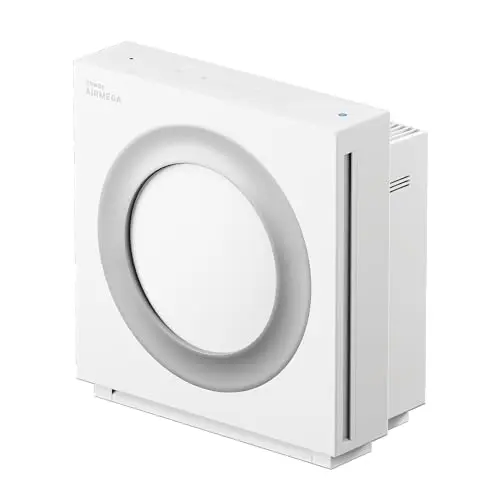
Airmega Mighty2 – Large-Room Mold and Allergen Coverage
The Airmega Mighty2 is the most complete package here for larger, mold-prone rooms. It pairs a washable pre-filter with a 2-in-1 HEPA and active carbon filter, uses a laser sensor for PM1, PM2.5, and PM10, and can automatically shift into Eco or Sleep mode based on air quality and light. Coverage is rated for large spaces, and the filter-life display takes the guesswork out of maintenance.
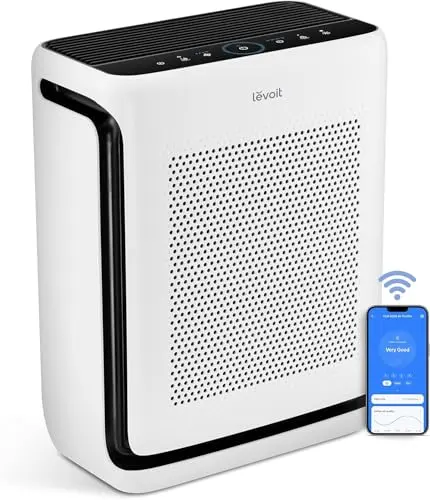
Vital 200S-P – Allergy-Focused Large-Room Purifier
The Vital 200S-P is Levoit’s allergy-focused large-room model, with AHAM Verifide CADR ratings, a U-shaped secondary intake for pet hair, and app control. It’s a strong fit for bedrooms and living rooms where pollen, dander, and dust are the main triggers, and the quiet sleep mode keeps it usable overnight.
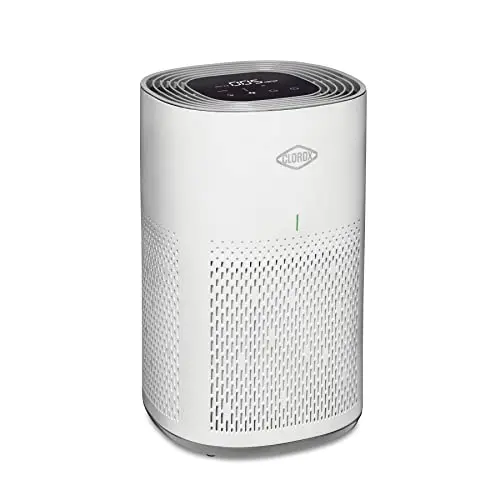
Medium Room True HEPA – Mold-Focused Air Cleaner
Clorox’s medium-room purifier is the most explicit mold-focused option in the lineup, with a true HEPA filter rated to capture 99.97% of allergens and particulates and 99.9% of viruses and bacteria. A 360-degree intake, carbon stage, and PM2.5 display with auto mode make it easy to run without babysitting.
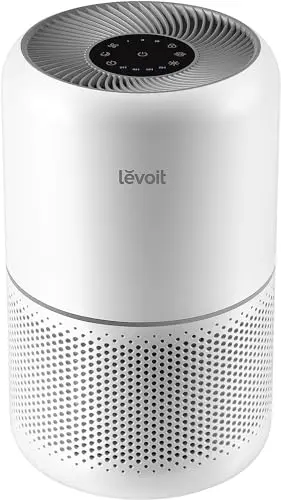
Core 300-P – Quiet Bedroom HEPA Value
The Core 300-P is the value-oriented Levoit for bedrooms and offices, with a 3-in-1 HEPA-grade filter, AHAM Verifide CADR ratings, and a sleep mode that drops to near-silent operation. It’s a simple, proven shape for allergen and dust control in smaller spaces.
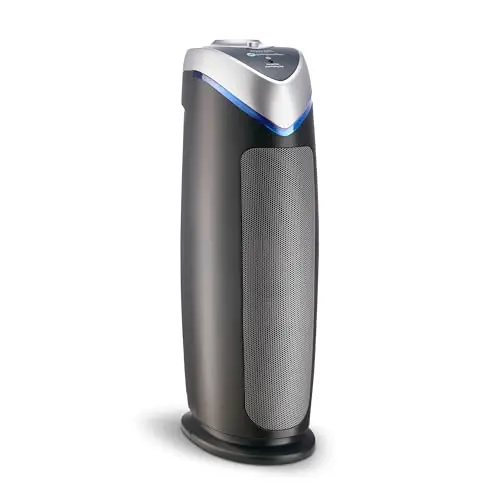
AC4825E – Budget Tower with UV-C
GermGuardian’s AC4825E is a tall tower with HEPA filtration, an optional UV-C light, and a carbon pre-filter for odors. It’s one of the more affordable ways to add HEPA and UV-C to a bedroom or office, though the tradeoffs are manual controls and a mixed noise picture.
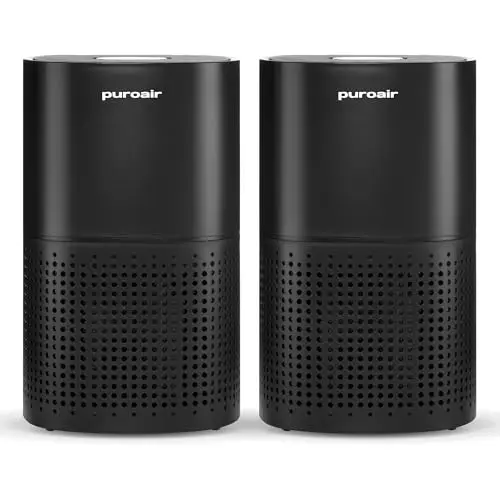
240 – Smart-Sensor Two-Pack
The PuroAir 240 is sold as a two-pack with a smart particle sensor, auto mode, and a 3-layer HEPA and carbon filter. It’s a practical way to cover two rooms with the same purifier, though the sensor display is simpler than the premium picks.
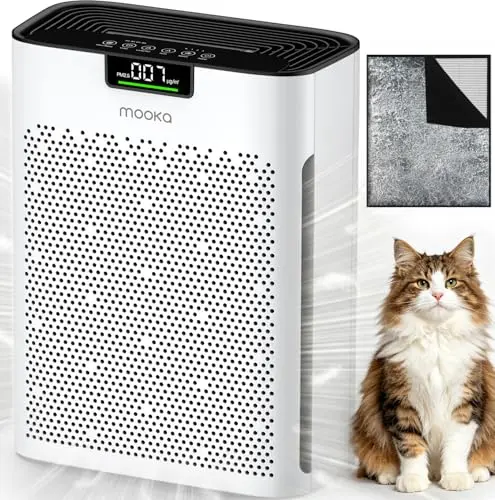
KJ190H – Large-Coverage Budget Purifier
The MOOKA KJ190H is a budget-friendly large-room purifier with a washable pre-filter, PM2.5 display, auto mode, and a 20 dB sleep setting. It’s designed to handle pet hair and smoke, and the washable pre-filter helps stretch replacement intervals.
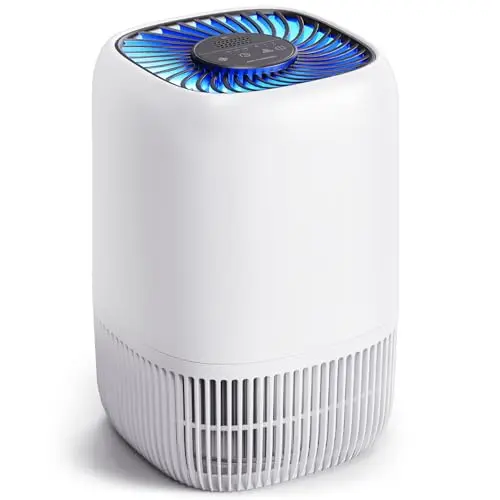
DH-JH12 – Compact Quiet Air Cleaner
The VOOPNU DH-JH12 is a compact, ultra-affordable purifier with 360-degree intake, a three-layer filter, and an essential-oil tray. It’s best suited to a desk, nursery, or small bedroom where space and budget are tight.
How We Evaluated These Air Purifiers for Mold and Allergens
We didn’t run controlled particle-count tests in a sealed lab or track filter performance over a full year. What we did: cross-referenced 8 air purifier models from 7 brands across six decision axes – HEPA and carbon filtration media, CADR and room-coverage claims, mold and allergen capture language, sensor and auto-mode behavior, sleep-mode noise, and filter maintenance or warranty support. We triangulated published specifications, mapped each unit to realistic room sizes, and weighed owner feedback where available for setup quirks and long-term satisfaction. We also checked whether each unit’s mold or allergen claims were explicit or implied, and whether the filter stack included a pre-filter that could be cleaned.
Coverage figures were treated as a starting point, not a promise, because real rooms have doors, furniture, and varying air exchange. The scoring framework put real-world fit and performance at 70% – how well each purifier handles the room size and allergen load it’s aimed at – and feature differentiation at 30% – sensor quality, filter design, smart modes, and maintenance details. We have no commercial relationship with the brands here; recommendations track fit and differentiation, not brand preference. If you’re dealing with a damp, mold-prone living area, the Coway Airmega Mighty2 is the strongest all-around match. If allergies in a bedroom are the priority, the Levoit Vital 200S-P is the better fit.
How to Choose the Right Air Purifiers for Mold and Allergens
1. Why HEPA Filtration Matters for Mold and Allergens
Mold spores and common allergens are particles, so the first question is whether a purifier uses a true HEPA filter or a HEPA-grade filter with a credible efficiency claim. Look for a stated capture rate around 99.97% of particles at 0.3 microns, and check whether the manufacturer mentions mold explicitly or only lists dust, pollen, and pet dander. A washable pre-filter helps in damp or dusty rooms because it catches larger debris before the HEPA stage loads up.
Carbon is the supporting layer, not the main event. It helps with mold odors and VOCs, but it does not replace particle filtration. For a large, mold-prone living space, the Coway Airmega Mighty2 is the pick because it pairs a HEPA and carbon filter with a washable pre-filter and a sensor that reacts to fine particles.
2. Match CADR and Room Coverage to the Space
CADR is the clean-air delivery rate, and it matters more than a dramatic square-footage number. A purifier that claims a huge room but has a modest CADR for smoke, dust, and pollen will struggle in a real bedroom with a closed door. Match the unit to the room where it will actually run, then add a margin if the room is damp, carpeted, or full of soft furnishings.
For a basement or open living area, prioritize higher CADR and a 360-degree intake so the unit can pull from more than one direction. For a small bedroom, a compact purifier with a lower coverage ceiling can be enough if it runs continuously.
3. Carbon Filtration and Mold Odors: What Actually Helps
Activated carbon is what addresses musty smells, cooking odors, and some VOCs. It won’t kill mold or stop it from growing in a damp wall, but it can make a room feel fresher while the HEPA stage handles airborne spores and allergens. If odor is the main complaint, look for a purifier with a carbon stage and a filter-change reminder rather than a thin carbon sheet.
If mold odor is the main complaint in a medium room, the Clorox Medium Room True HEPA is the straightforward match, with a true HEPA filter, carbon stage, and auto mode tied to a PM2.5 sensor.
4. Sensors, Auto Mode, and Sleep Settings
A particle sensor and auto mode are convenience features, but they matter in rooms where air quality changes quickly. A sensor that reads PM2.5 and PM10 can tell the purifier to ramp up when smoke, dust, or pollen spikes. Sleep mode should drop noise and dim or shut off display lights; otherwise, a bedroom purifier becomes a bedside light you didn’t ask for.
For an allergy-focused bedroom where you want app control and a quiet overnight mode, the Levoit Vital 200S-P is the pick. It has AHAM Verifide CADR ratings, a dual intake design, and a sleep mode that runs quietly.
5. Filter Maintenance and Long-Term Cost
Every purifier is a filter subscription in disguise. Check the replacement interval, the cost of the HEPA and carbon filter, and whether the pre-filter can be washed. A washable pre-filter is especially useful in pet homes and damp basements because it extends the life of the more expensive filter. A filter-life indicator is a small feature that prevents the common mistake of running a loaded filter for months.
6. Air Purifiers for Mold and Allergens: Common Buying Mistakes
The biggest mistake is buying a tiny purifier for a large mold-prone room and expecting the same result as a larger unit. The second is treating a purifier as a fix for active mold growth; it helps with airborne spores and allergens, but the moisture source still needs attention. Look for a CARB-certified unit with a clear CADR rating, a real HEPA stage, and a filter design you’ll actually maintain.
Frequently Asked Questions
1. Do air purifiers actually remove mold spores and allergens?
A purifier with a true HEPA filter can capture a meaningful share of airborne mold spores, pollen, dust, and pet dander, but it won’t solve a mold problem at the source. The unit needs to be sized for the room, run continuously enough to cycle the air, and use a HEPA stage that is not bypassed by a loose filter seal. Carbon filtration helps with odors and some VOCs, but it is not a moldicide. Treat purification as one part of the fix alongside moisture control and cleaning.
2. What's the difference between the Coway Airmega Mighty2 and Levoit Vital 200S-P for mold and allergens?
The Coway Airmega Mighty2 is the stronger pick for a large, damp living area because it pairs a HEPA and active carbon filter with a MegaScan laser sensor, a washable pre-filter, and a long warranty. The Levoit Vital 200S-P leans more toward allergy-focused bedrooms, with AHAM Verifide CADR ratings, a U-shaped secondary intake for pet hair, and quiet app-connected operation. Choose the Coway for broader coverage and sensor detail; choose the Levoit for a quieter, more connected bedroom setup.
3. Is the Clorox True HEPA or GermGuardian AC4825E better for mold?
The Clorox Medium Room is the more explicit mold pick because its true HEPA stage is rated for 99.97% of allergens and particulates and 99.9% of viruses and bacteria, and the 360-degree intake suits a closed medium room. The GermGuardian AC4825E is a budget tower with HEPA Pure filtration and an optional UV-C light, but it is better suited to a small bedroom or office. For mold specifically, the Clorox’s PM2.5 auto mode and carbon stage make it the more focused choice.
4. How do I choose an air purifier for mold and allergens in a bedroom?
Start with the room size and a CADR rating that can cycle the bedroom’s air several times per hour. Then look for a true HEPA filter, a washable pre-filter if dust or pets are factors, and a sleep mode that dims lights and quiets the fan. A particle sensor is useful but not essential in a bedroom; consistent airflow and a clean filter matter more. If the room is damp, fix the moisture source first, then let the purifier handle airborne spores and allergens.
Final Verdict
For most people shopping for mold and allergens, the Coway Airmega Mighty2 is the answer. It has the strongest combination of large-room coverage, explicit mold and allergen filtration, a useful laser sensor, and a long warranty. If the problem is concentrated in a medium room with musty odors, the Clorox Medium Room True HEPA is the more targeted mold pick. For an allergy-heavy bedroom, the Levoit Vital 200S-P gives you quiet operation, app control, and strong CADR ratings. And if you need two matching units for a bedroom and basement, the PuroAir 240 two-pack is the practical route. Start with the room that bothers you most, size the purifier to that space, and run it consistently.
