
Best Air Purifiers For Mycotoxins – 2026 Reviews

The musty smell shows up weeks after the leak. You’ve cut out the wet drywall, run the fans, maybe painted over the stain, and the room still smells like a damp basement every time the door opens. That’s usually the moment people start shopping for an air purifier. It’s also the moment a lot of them buy the wrong one.
Mold is two problems wearing one name. Spores and broken-down mold material are particles, and a competent HEPA filter handles those. Mycotoxins are chemical compounds – they ride on those particles or drift through the room as part of that gassy, musty mix, and particle filtration does close to nothing about them. Most purifier listings spend an entire spec sheet on particles and mention carbon in a footnote.
So the two things actually worth comparing are how fine a particle the unit claims to catch, and how much real carbon sits behind that filter. Coverage matters too, but a single-pass square-footage number is marketing, not cleaning power. Below we’ve sorted the market by how completely each model handles both halves of a mold problem, and we’ve been straight about where each one runs out of road.
Best Air Purifiers for Mycotoxins – 2026 Reviews
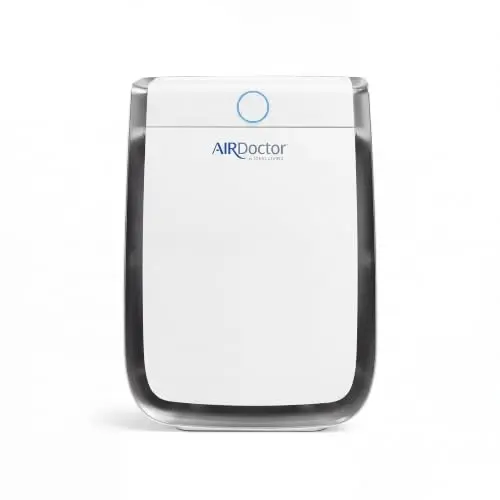
AD3500 – Sub-Micron HEPA With Real Carbon
The AD3500 is the only pick here whose particle spec goes well below standard HEPA. AirDoctor’s UltraHEPA is rated to capture 99.99% of airborne particles at 0.003 microns, which the company describes as 100 times smaller than the HEPA standard. Behind it sits a premium activated carbon filter built from activated carbon and potassium permanganate to absorb and break down gases, fumes, and VOCs rather than just trap odors. A PM2.5 sensor drives Auto Mode and a color-coded Halo display, and the unit moves serious air: 630 square feet in 15 minutes, up to a stated 2,520 square feet in an hour.
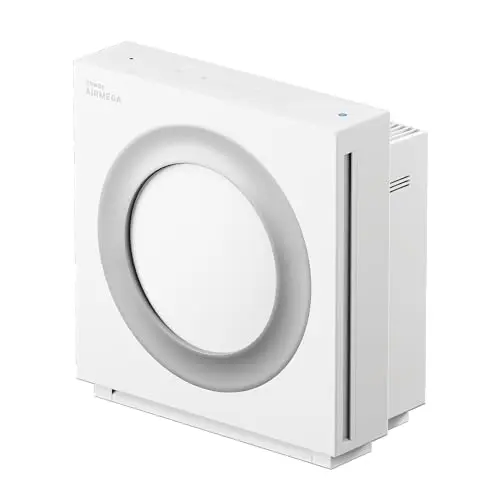
Airmega Mighty2 – Gas-Phase Filtration With Live Sensing
The Mighty2 pairs a washable pre-filter with a 2-in-1 HEPA and Active Carbon Max2 filter. Coway rates it for 99.97% of particles down to 0.3 microns and for more than 99.5% of volatile organic compounds and fumes such as ammonia and acetaldehyde. A MegaScan laser sensor reads PM1, PM2.5, and PM10 in real time and feeds Smart Mode, which adjusts airflow automatically and slips into Eco Mode when the air is clean. CADR lands at 242 for dust, 240 for smoke, and 249 for pollen, and the unit cleans 900 square feet in half an hour.
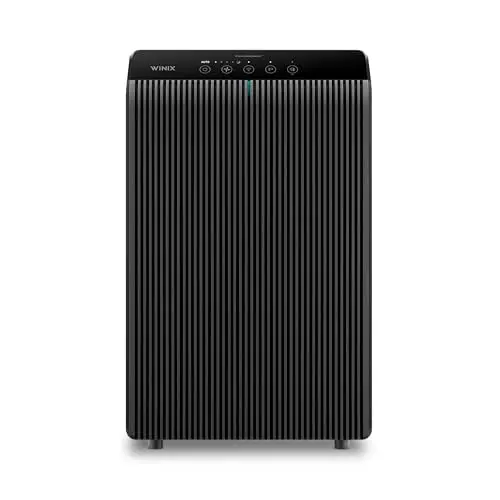
5510 – Fine-Particle Capture With Odor Carbon
The 5510 is the current generation of Winix’s 5500 series, now with app support. True HEPA is rated to capture 99.99% of airborne allergens as small as 0.01 microns, and an advanced odor-control carbon filter is designed to reduce VOCs and household odors while extending the HEPA’s service life. A washable fine-mesh pre-filter handles the big debris first. Air quality shows as an LED indicator, Auto Mode adjusts fan speed from the built-in sensor, and a light sensor flips the unit into a quiet sleep mode when the room goes dark.
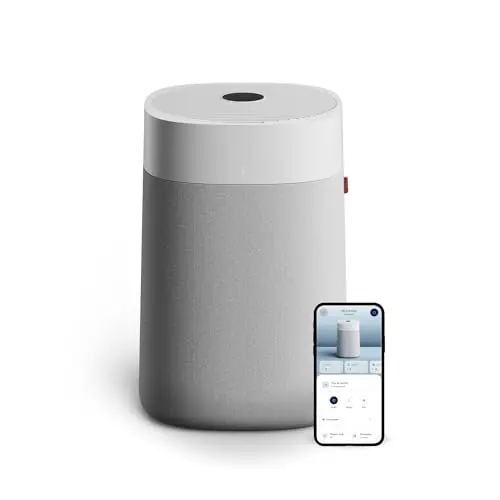
Blue Pure 211i Max – Big-Room Particle Specialist
Blueair’s HEPASilent dual filtration is rated to capture 99.97% of airborne particles down to 0.1 microns, including dust, pollen, pet dander, mold particles, and smoke. The 211i Max is the big-room version: a stated 3,235 square feet in an hour, or 674 square feet in roughly twelve and a half minutes, pulled in through a 360-degree intake. Built-in sensors drive Auto Mode, and the Blueair app handles monitoring, scheduling, and filter-life tracking. A washable pre-filter sits in front of the main cartridge.
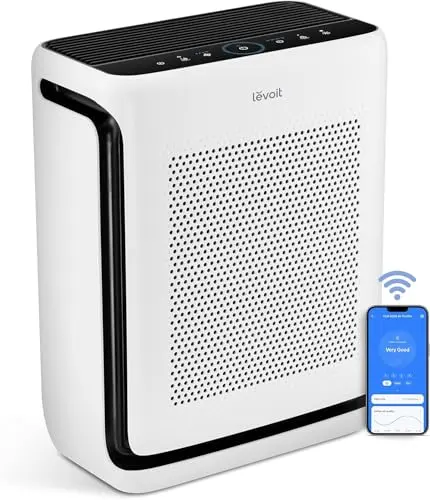
Vital 200S-P – Dual-Intake Cleaning for Dusty Rooms
The Vital 200S-P is Levoit’s allergy-focused large-room unit, rated for spaces up to 1,875 square feet with CADR figures of 250 CFM for smoke, 254 for dust, and 289 for pollen. A traditional front inlet plus a U-shaped secondary inlet pull air from two directions so pet hair and dust don’t clog one intake. AHAM Verifide testing backs the performance claims, and app integration lets you run it from a phone.
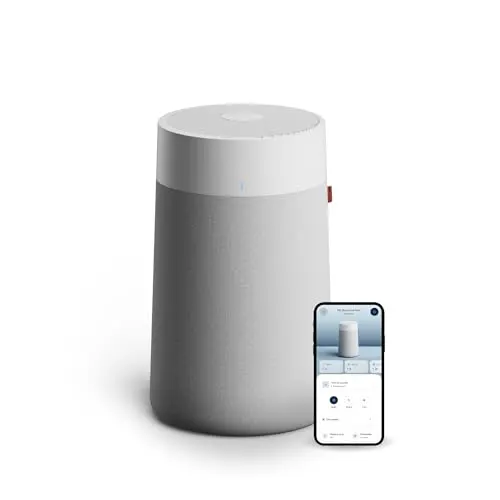
Blue Pure 311i Max – Quiet, Design-Led Airflow
The 311i Max is the mid-size member of Blueair’s current lineup, cleaning 439 square feet in about twelve and a half minutes and a stated 2,107 square feet in an hour. HEPASilent dual filtration captures 99.97% of airborne particles down to 0.1 microns, including mold particles, and the 360-degree intake keeps circulation even. Sensors drive Auto Mode, the app tracks air quality and filter life, and QuietMark certification backs up the low-noise claim.
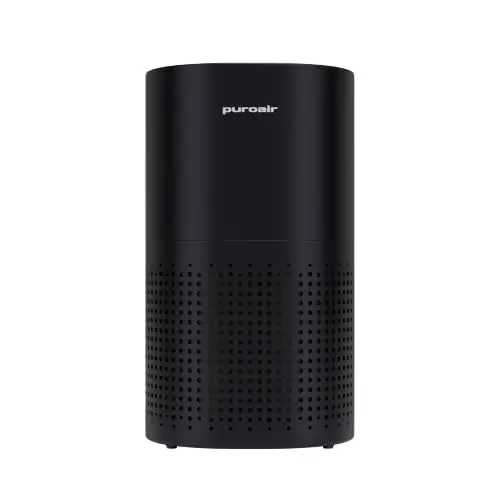
240 – Sensor-Driven All-Rounder
PuroAir’s 240 uses a three-layer stack – pre-filter, HEPA, and activated carbon – to filter up to 99.9% of pollutants including dust, pollen, smoke, pet dander, and VOCs, with a stated 1,000 square feet of coverage in one hour. A smart particle sensor monitors air quality and raises fan speed when levels climb, and a sleep mode keeps it quiet overnight. It’s certified by CARB, ETL, ISO, and UL and backed by a two-year warranty.
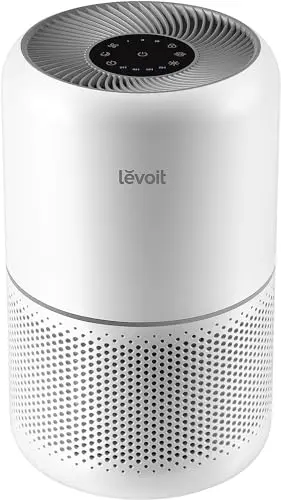
Core 300-P – Compact HEPA for One Room
The Core 300-P is the compact option: a 3-in-1 filter with a 56W motor and CADR of 143 CFM for smoke, 153 for dust, and 167 for pollen. Levoit rates it to refresh a 222 square foot room 4.8 times per hour, or a stated 1,073 square feet once per hour, and lists VOCs and wildfire smoke among its filtration targets. Sleep Mode drops noise to a near-silent 24 dB and the display can be switched off entirely. A 2/4/6/8-hour timer and filter-change indicator handle the housekeeping, and the whole unit weighs under eight pounds.
How We Evaluated These Air Purifiers for Mycotoxins
We didn’t run spore-plate cultures, mycotoxin assays, or controlled chamber tests for gas removal. What we did: cross-referenced eight air purifier models from six brands across five decision axes – published particle-retention specs, gas-phase filter design and carbon media, CADR and room-coverage ratings, sensing and automation features, and owner feedback where available.
For this topic, we weighted a listing’s willingness to publish gas-phase numbers as heavily as its HEPA claim. A purifier can be excellent at capturing particles and still be the wrong tool for a musty, chemically-tinged room, so the lineup is ordered by how completely each unit addresses both halves of the problem. We also mapped each model’s realistic coverage against the spaces people actually remediate – a bedroom, a finished basement, an open living area.
The scoring framework weighted real-world fit for a mold-affected room (70%) – particle capture depth, carbon capacity, and coverage – against feature differentiation (30%) – sensing, filtration staging, automation, and long-term ownership details. We have no commercial relationship with any of the brands featured; recommendations track fit and differentiation, not brand preference. If you want the most complete particle-plus-gas package, the AD3500 is the match. If you’d rather spend less and still get published gas-removal figures plus a three-year warranty, the Airmega Mighty2 makes more sense.
One honest limit up front: no air purifier is a remediation tool. Filtration manages what’s already airborne; it doesn’t dry out a wall cavity, kill mold at the source, or undo water damage. We treated every pick as a supporting piece of a broader fix, which is why coverage and carbon depth counted for more with us than decorative features.
How to Choose the Right Air Purifiers for Mycotoxins
1. Mold Spores and Mycotoxins Need Two Different Kinds of Filtration
Mold in a home creates two separate air quality problems, and they don’t respond to the same filter media. Spores and fragmented mold material are particles – some large enough to settle on a shelf, some small enough to hang in the air for hours. That half is a HEPA job, and most competent purifiers do it well.
Mycotoxins are different. They’re chemical compounds produced by certain mold species, and they reach the air either bound to spores and fine dust or as part of the musty, gassy mix that lingers long after visible mold is gone. A HEPA spec sheet tells you nothing about that second half. Gas-phase capture is a carbon job, which is why the picks in this guide are sorted by what they do beyond particles.
2. What to Look For in an Air Purifier for Mycotoxins
Three things separate a genuinely useful pick from a generic bedroom unit. First, a particle retention claim below the 0.3-micron HEPA baseline – 0.1, 0.01, or 0.003 microns – because the fragments that carry toxins aren’t the easy stuff to catch. Second, a published gas-removal number rather than a vague carbon-filter line. Coway, for instance, publishes VOC, ammonia, and acetaldehyde reduction figures on the Airmega Mighty2, while AirDoctor pairs a sub-micron particle rating with a treated carbon stage. Third, coverage you won’t outgrow – buy for the room as it actually is, not the optimistic number on the box.
3. Carbon Capacity Is the Real Differentiator
Most purifiers include some activated carbon. The question is how much, and what kind. A thin carbon sheet bonded to a HEPA cartridge mainly handles light odors and gives up quickly. A dedicated carbon canister or multi-stage carbon filter holds far more media and keeps adsorbing gases for months rather than weeks. If you’re chasing strong chemical or musty odors, look for treated carbon – the AD3500, for example, uses activated carbon plus potassium permanganate to break down gases rather than merely trap them.
Budget for replacement, too. Carbon saturates rather than regenerates, and a spent filter is worse than useless if you’re relying on it. AirDoctor lists a six-month carbon interval and a twelve-month UltraHEPA interval; units with washable pre-filters stretch their main cartridges noticeably further.
4. Sizing and Placement for a Mold-Affected Room
Coverage claims are usually quoted two ways, and they’re not equivalent. The 222-square-foot figure on the Core 300-P assumes 4.8 air changes per hour; its 1,073-square-foot claim is a single pass. For a mold concern, work from the higher-circulation end of a unit’s range and place the purifier where air actually moves – near the affected wall if it’s open to the room, but not jammed against it. Closed doors help too: cleaning one volume of air beats half-cleaning a whole floor.
5. Why an Air Purifier Alone Won't Fix a Mold Problem
A purifier recirculates air; it doesn’t stop the source. If there’s active moisture – a slow leak, condensation on a cold wall, a damp crawlspace – mold will keep producing spores and gases no matter what filter you run. Source control comes first: fix the moisture, dry the materials, and remove porous items that can’t be salvaged.
Keep indoor humidity in the 30 to 50 percent band with a dehumidifier or ventilation, and be skeptical of ozone generators – they’re marketed hard to mold-anxious buyers, but they’re an irritant rather than a fix. Treat filtration as the last layer, running continuously in the room where you spend the most time.
6. What Ownership Actually Costs Over a Few Years
Air purifiers split into rough tiers. Budget units cost little up front but use small cartridges you’ll replace more often, and their carbon layer is thin. Mid-range models are the sweet spot for most buyers: bigger filters, real sensors, and washable pre-filters that cut replacement frequency. Premium units cost the most and buy you deeper particle specs and heavier carbon, which is where the money goes if mold is the actual reason you’re shopping.
Before you commit, confirm that genuine replacement filters are easy to find and reasonably priced, and note which parts are separate. A carbon stage on its own replacement schedule adds up differently than a single combined cartridge, and off-brand filters can cost you performance.
Frequently Asked Questions
1. Do air purifiers actually remove mycotoxins from the air?
Partly, and it’s worth being precise. No purifier has a mycotoxin setting, and no manufacturer publishes a mycotoxin removal figure. What a good unit does is remove the spores and fine particles that toxins travel on, plus a share of the gaseous compounds behind that persistent musty smell, via activated carbon. How much of the gas phase it handles comes down to carbon volume and how fresh that carbon is.
The honest framing: filtration lowers the airborne load. It doesn’t neutralize what’s already in your walls.
2. What's the difference between the AirDoctor AD3500 and the Coway Airmega Mighty2?
They attack the same problem from different angles. The AD3500 leans on the deepest published particle spec in this lineup – 0.003 microns – plus a carbon stage that uses potassium permanganate to break down gases, and it’s a big, heavy floor unit. The Coway Airmega Mighty2 uses a more conventional 0.3-micron HEPA but pairs it with published VOC, ammonia, and acetaldehyde reduction figures, a PM1-through-PM10 sensor, a smaller footprint, and a three-year warranty.
If lingering chemical odors are the main complaint, the AirDoctor’s carbon is the stronger tool. For routine monitoring in a normal-size room, the Coway is easier to live with.
3. Is a HEPA filter alone enough for a mold problem?
Not for the part of mold that smells. HEPA media is designed for particles, and it does that job well – spores, fragmented growth, and the dust carrying both. But mycotoxins are chemicals, and a particle filter passes gases straight through.
If the room still smells after remediation, you need carbon media in meaningful quantity plus source control. A HEPA-only unit is better than nothing; it’s just solving half the problem.
4. How much carbon filtration do you need for a musty room?
More than a token sheet. Look for a dedicated carbon stage – a canister or a separate cartridge – rather than a thin layer bonded to the HEPA. Then watch the cadence: carbon saturates rather than regenerates, so a filter that’s been running for months in a damp basement has likely spent most of its capacity.
Most manufacturers list a six-to-twelve-month replacement window for carbon, and heavy odor loads shorten that. Treated carbon, such as media with potassium permanganate, is worth seeking out for stubborn chemical smells.
5. What's the difference between the Winix 5510 and the Blueair 311i Max?
The Winix 5510 is the more complete package for a mold concern: 0.01-micron True HEPA, an odor-control carbon filter aimed at VOCs, app control, and a light-triggered sleep mode. The Blueair 311i Max is the more design-forward unit, with HEPASilent filtration down to 0.1 microns, a 360-degree intake, and QuietMark-certified low noise – but Blueair doesn’t publish gas-phase numbers, so treat it as a particle specialist.
Choose the Winix if odors are part of the complaint. Choose the Blueair if the room is visible and quietness is the priority.
6. Where should a purifier sit in a mold-affected room?
Somewhere with unobstructed airflow on all sides and, ideally, on the side of the room where the damage was. Running it continuously on a mid-to-high setting for the first few weeks beats blasting it for an hour a day.
If the unit has a PM2.5 or PM10 display, let the numbers tell you whether the room is settling, and keep the door closed so you’re cleaning one volume of air instead of the whole house.
Final Verdict
For most people dealing with a mold issue, the AirDoctor AD3500 is the answer. It’s the only pick here that pairs a sub-micron particle rating with a genuinely heavy, chemistry-forward carbon stage – the combination a mycotoxin concern actually calls for. If that’s more machine than your situation warrants, the Coway Airmega Mighty2 gets you published gas-removal figures, real-time sensing, and a three-year warranty in a friendlier footprint. And if you want the sensible middle, the Winix 5510 delivers fine-particle capture plus odor-control carbon for noticeably less.
Whichever you choose, fix the moisture first. The best filter in this lineup is still a supporting player.
