
Best Airline Travel Backpacks – 2026 Reviews

The gate agent’s sizing frame is the least forgiving piece of furniture in air travel. A bag that measured fine on your bedroom floor suddenly looks ambitious, and the gap between a smooth boarding and a checked-bag fee often comes down to two or three inches of depth you never thought about. Airline travel backpacks live or die on that margin.
There’s a second axis that matters just as much, and it’s the one shoppers overlook: how the bag behaves at security. A pack that hinges open flat with the laptop sleeve facing up gets you through the line in one motion. A top-loading bag forces you to unpack half your clothes into a plastic tray while the queue sighs behind you.
We looked across the market rather than inside one brand’s catalog, from budget-friendly underseat packs to premium carry-on-sized haulers. Below you’ll find where each one lands on sizing honesty, checkpoint layout, and comfort during the long walk to a far gate, so you can match a bag to how you actually fly.
Best Airline Travel Backpacks – 2026 Reviews
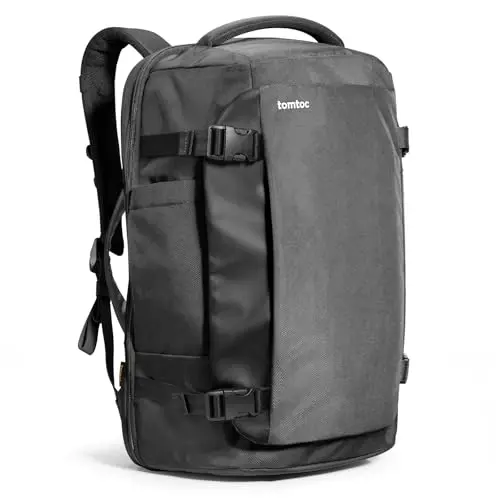
Navigator-T66 40L – Lay-Flat Carry-On for Frequent Flyers
A 40L carry-on built around the security checkpoint. The laptop bay opens flat for scanning, the main body unzips suitcase-style, and the hardware is a step above the budget crowd.
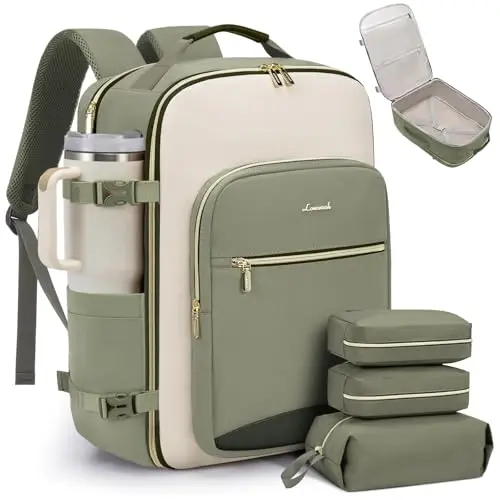
40L Carry-On Backpack – Packing Cubes Included
A 40L carry-on that ships with three packing cubes, two storage bags, and a shoe bag, so you’re organized before you pack. Four main compartments, a built-in wet pocket, a padded 17-inch laptop sleeve, and a luggage strap complete it.
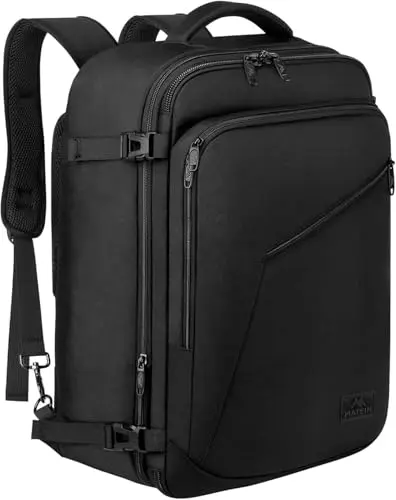
Expandable 40L Carry-On – Converts to Duffle or Briefcase
An expandable 40L carry-on that unzips to 45L when the return trip gets heavier. Hideaway shoulder straps convert it from backpack to duffle or briefcase, and four compression straps keep it tame in transit.
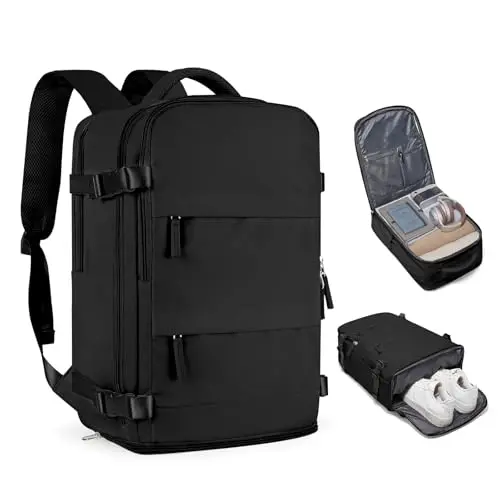
Underseat Travel Backpack – Shoe Pocket Built In
A 25L underseat pack built for short trips: separate shoe compartment, waterproof wet pocket, padded 15.6-inch laptop sleeve, and a body that opens 180 degrees like a small suitcase. Two pounds makes it easy to carry through a connection.
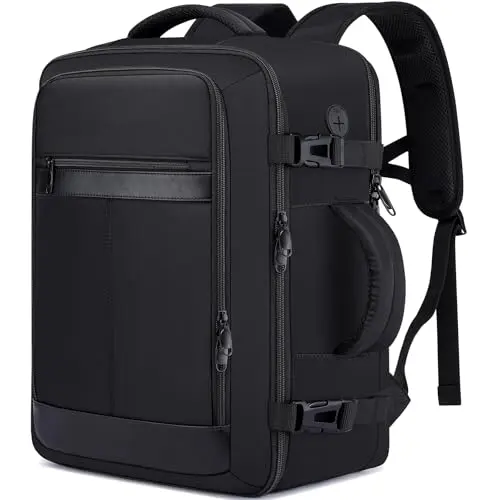
8296 Underseat Carry-On – 25L Personal Item
A 25L underseat pack with a suitcase-style side opening, an anti-theft rear pocket, a USB pass-through port, and a lined wet compartment. A shoe bag is included and a 15.6-inch laptop fits the padded sleeve.
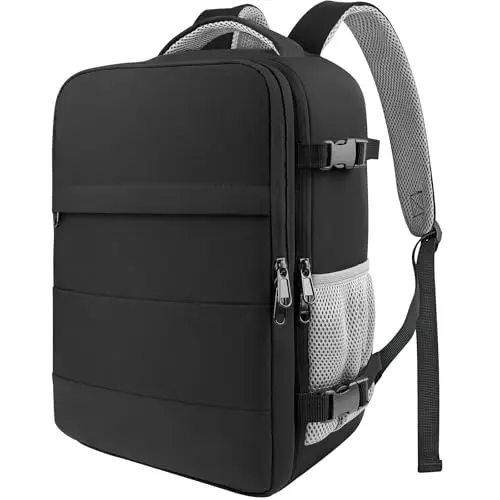
US11017 Cabin Bag – Just Over a Pound Empty
A 1.2-pound cabin bag with a suitcase-style main compartment, a wet pocket, a padded 15.6-inch laptop sleeve, and a luggage strap. The Oxford shell resists water, stains, and abrasion.
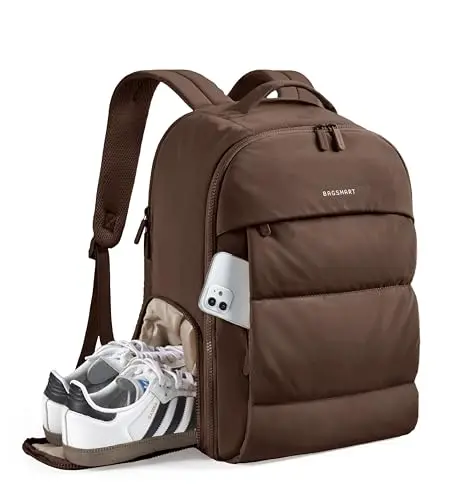
BM0301136 Travel Backpack – Gym-to-Gate Flexibility
A 30L travel pack that doubles as a gym bag: side shoe compartment, PVC-lined wet pocket, padded 15.6-inch laptop sleeve, and a back strap that slides over a suitcase handle.
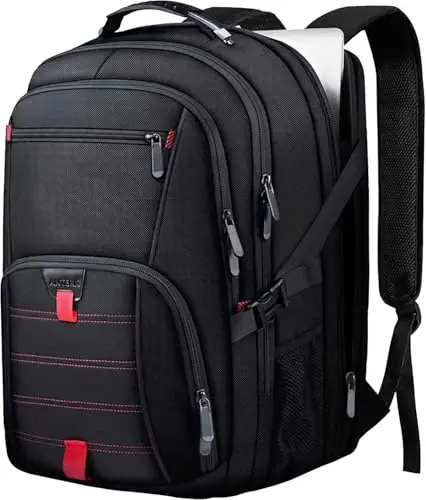
17.3-Inch Flight Backpack – Anti-Theft Layout
A 17.3-inch laptop hauler with a 180-degree TSA opening, anti-theft rear pocket, side compression straps, and a steel-cable top handle. Water-resistant polyester over a nylon lining.
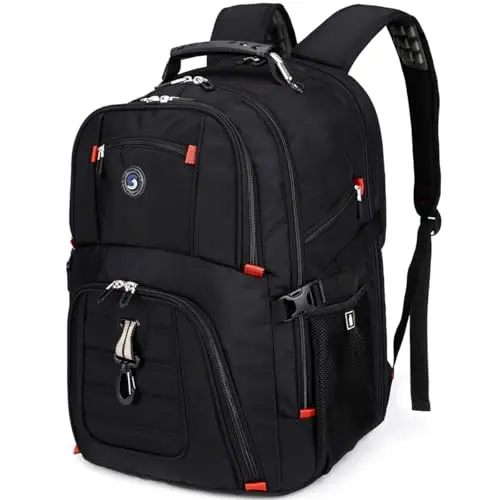
983035 Extra-Large 50L – Lockable Laptop Hauler
A 50L travel pack with a combination lock, three main compartments, a padded 17-inch laptop sleeve, and a 180-degree opening. Padded ventilated back panel and wide mesh shoulder straps handle a heavy load.
How We Evaluated These Airline Travel Backpacks
A few things we can’t tell you: how a shoulder strap feels on hour nine of a long layover, or whether a zipper still runs smoothly after two years of overhead-bin abuse. What we can tell you is how these bags are built on paper and how that maps to real air travel. We cross-referenced 9 airline travel backpack models from 9 distinct brands across six decision axes – published carry-on dimensions, checkpoint layout, carry comfort, packing organization, materials and hardware, and empty weight relative to stated capacity.
We triangulated manufacturer specifications, feature lists, and owner feedback where available, then pressure-tested each bag against the scenarios that actually matter: a weekend under the seat, a week in the overhead bin, and the security line where you’re the one holding everyone up. We compared stated capacity against stated dimensions rather than trusting either figure alone. The scoring framework weighted real-world travel fit (70%) – does the bag clear a sizer, pack a week, and carry comfortably – against feature differentiation (30%), meaning the layout choices and hardware that separate one pack from another.
We have no commercial relationship with any of the brands featured here, and recommendations track fit and differentiation rather than brand preference. If you fly often and want the most considered checkpoint layout, the Navigator-T66 is the bag we’d hand a frequent flyer. If you’d rather spend as little as possible without giving up the essentials, the MATEIN expandable carry-on is the value play.
How to Choose the Right Airline Travel Backpack
1. Why Carry-On Sizing Is the First Check for Any Airline Travel Backpack
Marketing copy says flight approved on almost everything. The number that matters is the published carry-on dimensions, and the constraint that trips most shoppers up isn’t length or width – it’s depth. A pack that measures 9 inches deep clears most mainline sizers; one that bulges to 11 inches under a full load often won’t. Decide up front whether you need a carry-on that rides in the overhead bin or a personal item that has to fit under the seat, because those are different bags with different footprints.
Budget carriers draw the personal-item line tighter than mainline airlines and enforce it at the gate with a metal frame. If underseat is the goal, buy for the smallest allowance you’re likely to fly, not the most generous one. The coofay underseat backpack is built around that constraint, which is why its footprint is smaller than most of this lineup.
2. How the TSA Layout Changes Your Security Line Experience
A lay-flat laptop compartment that hinges to 90 or 180 degrees means the machine goes into the tray still in its sleeve while the rest of your bag stays packed. A 180-degree opening on the main body goes further, turning the pack into a flat, suitcase-like object you can repack in seconds instead of a tube you dig through.
This is the feature most worth paying for if you fly more than a few times a year, and it’s also the one budget bags most often fake. A side zipper that reaches the laptop sleeve is not the same as a compartment that opens flat on its hinges.
3. Packing Structure: Cubes, Compression, and Wet Compartments
Packing cubes change how a soft bag behaves. A 40L shell with cubes packs like a drawer system, and a bag that ships with them – like the LOVEVOOK 40L carry-on – saves you buying a set separately. Compression straps, internal or external, are the second lever: they stop a half-full bag from collapsing into a lump at the bottom of the overhead bin.
A dedicated wet pocket is worth hunting for. Whether it’s a damp towel, a swimsuit, or a toiletry bag that leaked at altitude, you want that separated by a waterproof lining rather than a hopeful zipper. Shoe compartments do the same job for footwear, and they’re the difference between arriving organized and arriving with sand in your shirts.
4. Carry Comfort on Long Airport Walks and Tight Connections
Weight distribution matters more than padding thickness. Look for a padded back panel with airflow channels, a sternum strap to stop the load swinging, and shoulder straps that are contoured rather than flat. A luggage pass-through – the sleeve that slides over a roller handle – is the feature frequent flyers notice most, because it lets you stop carrying the bag entirely between gates.
Convertible strap designs are the other trick worth knowing. Straps that tuck away let a backpack become a duffle or briefcase when the bag is heavy and the walk is short.
5. Materials and Hardware: What Actually Wears Out First
Almost every bag in this category claims water resistance; the meaningful differences sit in the zippers and the stress points. YKK zippers are a reasonable proxy for hardware quality – the tomtoc Navigator-T66 uses them alongside a shell woven from recycled PET, a combination that tends to outlast the generic alternatives.
Shell material is a secondary concern. Oxford fabric resists abrasion and staining better than thin polyester, while heavier nylons hold their shape under load. What fails first, in almost every case, is the seam where the shoulder strap meets the body or the handle’s plastic housing. Check those joints before anything else.
6. Budget, Mid-Range, and Premium Airline Travel Backpacks
At the entry level you get real capacity and the core layout, with thinner fabric and hardware that may not survive years of weekly travel. That trade is fine if you fly a few times a year. It’s a poor trade if the bag doubles as your commute.
The middle of the market buys better zippers, a sturdier back panel, and cleaner compartment design, and it’s where most travelers should land. Premium-leaning picks add hardware quality, recycled materials, and checkpoint-specific engineering. Worth it for frequent flyers, hard to justify for an annual trip.
Frequently Asked Questions
1. Are all airline approved travel backpacks actually carry-on compliant?
No. The phrase is marketing, not a certification, and plenty of packs that carry it are simply too deep once loaded. Check the published dimensions against your carrier rather than the capacity in liters, because a 50L bag and a 40L bag can look identical in a photo and behave very differently in a gate sizer.
Pay particular attention to depth, and decide whether you’re shopping for a carry-on or a personal item. Budget carriers set the personal-item bar considerably lower than mainline airlines do, so a bag sized for the strictest flight you take is the safest buy.
2. What's the difference between the tomtoc Navigator-T66 and the LOVEVOOK 40L backpack?
They aim at different priorities. The Navigator-T66 is engineered around the checkpoint: a lay-flat laptop bay, YKK zippers, and a recycled-fabric shell, at roughly 2.6 pounds and a longer 20.5-inch profile.
The LOVEVOOK is organized around packing instead. It arrives with three packing cubes and a shoe bag, uses a shorter 18-inch body, and leans on compartment count over hardware pedigree. Choose the tomtoc for frequent flying, the LOVEVOOK for longer trips where unpacking order matters.
3. Can a 40L airline travel backpack replace a roller bag for a week?
For most warm-weather trips, yes. Forty liters is roughly the usable volume of a small carry-on suitcase, and with packing cubes and a pair of shoes stowed in a dedicated compartment, a week of clothing fits without much drama.
The limit is bulk, not days. Anything structured – a bulky jacket, camera gear, a second pair of boots – eats volume fast. If you routinely travel with gear rather than clothes, step up in capacity and accept the sizer risk that comes with a larger footprint.
4. MATEIN expandable vs SHRRADOO extra-large: which is easier to fly with?
Easier is the MATEIN expandable carry-on. Its 19 by 13 by 8-inch body sits inside most mainline carry-on allowances, and the expansion zipper means you can keep the smaller profile on the outbound leg and open it up on the way home.
The SHRRADOO offers far more packed volume and a combination lock, but its 15-inch width and 11-inch depth push past what many carriers accept in the cabin. That’s a fine bag for road trips and a risky one for a strict gate.
5. Is a lay-flat laptop compartment worth prioritizing?
If you fly more than a handful of times a year, yes. A checkpoint-friendly sleeve means the laptop leaves the bag once, stays in its padding, and goes back in without repacking. Over a year of travel that adds up to real time and fewer cracked screens.
The feature also signals build quality. Bags that bother to hinge the laptop bay flat usually bother with padded back panels and reinforced stress points too. It’s a decent proxy for whether the rest of the layout was thought through.
Final Verdict
For most travelers, the Navigator-T66 is the answer. It gets the two things that actually decide whether a travel backpack works – it clears a sizer at 40L and it opens flat at security – and the YKK hardware and recycled shell suggest it will still be doing both in a few years. If you’d rather arrive organized than arrive fast, the LOVEVOOK 40L carry-on and its included packing cubes are the practical alternative. On a tight budget, the MATEIN expandable carry-on covers the essentials and grows when your trip does. And if you’re flying a budget carrier with nothing but a personal item, the coofay underseat backpack is purpose-built for that slot. Match the bag to how you actually fly, not to the longest feature list.
