
Best All-Stainless-Steel Electric Kettles With No Plastic – 2026 Reviews

A kettle spends more time in the hot-water path than almost any other appliance on the counter. If you’re trying to avoid plastic in that path, the label on the box rarely tells the whole story: a brushed steel body can still hide a plastic water window, a nylon filter, or a plastic-lined lid.
The useful split in this category is between kettles that are merely stainless on the outside and those that keep the interior, spout, inner lid, and filter stainless too. Capacity and pour style are the next filters: a 1.7-liter standard kettle suits tea rounds and kitchen tasks, while a compact gooseneck is built for slow, precise pours.
We compared the strongest all-stainless options across brands and focused on what actually touches your water. The goal is simple: help you pick a kettle that fits your daily brewing routine without compromising on the no-plastic promise.
Best All-Stainless-Steel Electric Kettles With No Plastic – 2026 Reviews
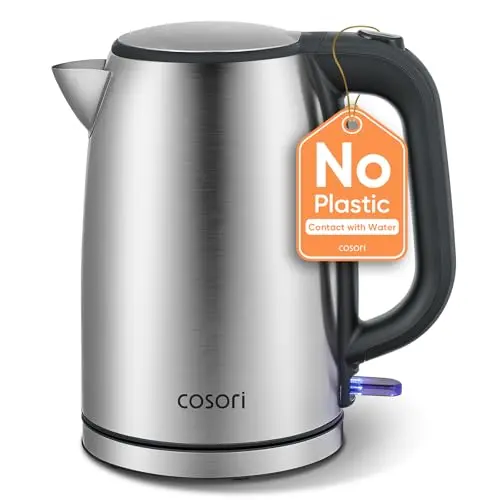
CEK-S152-VUS – 1.7L All-Stainless Daily Kettle
A 1.7-liter stainless steel kettle built around a plastic-free water path, with simple boiling controls, Strix auto shut-off, and a large opening for easier cleaning.
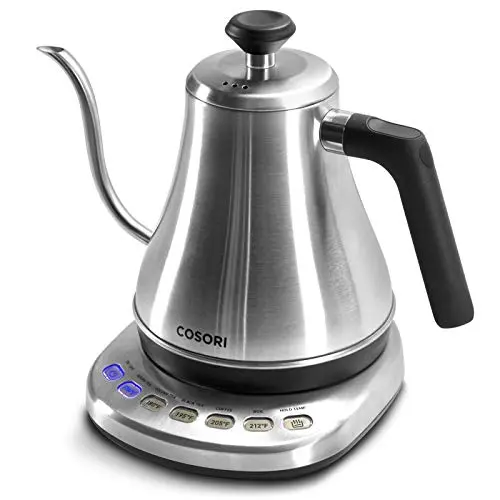
CO108-NK – Precise Pour-Over, No Plastic Contact
A compact gooseneck kettle with five presets, 60-minute keep-warm, and no plastic contact with water, aimed at pour-over coffee and temperature-sensitive tea.
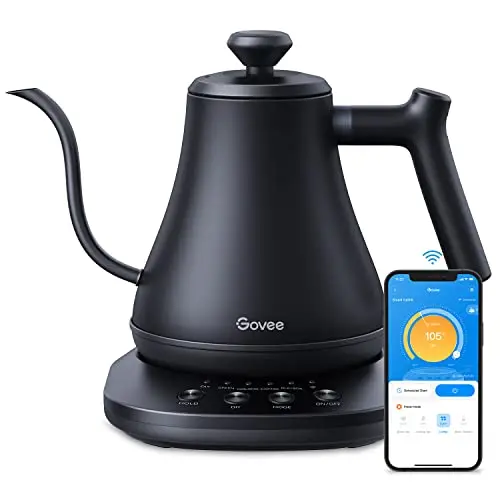
H7170 – WiFi Gooseneck for Scheduled Brews
A WiFi-enabled gooseneck kettle with app and Alexa control, broad temperature settings, two-hour keep-warm, and a 304 stainless steel water path.
How We Evaluated These All-Stainless-Steel Electric Kettles With No Plastic
We didn’t run lab-style boil-time trials or long-term durability tests. What we did: cross-referenced 3 all-stainless electric kettle models from 2 distinct brands across 5 decision axes – water-contact materials, capacity, temperature control, pour style, and cleaning routine. We triangulated published specifications, feature sets, and owner feedback where available, then mapped each option against representative buyer profiles for daily tea, pour-over coffee, and smart-kitchen use. We also audited how clearly each brand describes which parts actually touch water, because ‘BPA-free’ and ‘no plastic contact’ are not the same claim. That matters most in a category where the headline promise is about what the water touches.
The scoring framework weighted real-world fit (70%) – how well each kettle delivers on its stated job – against feature differentiation (30%) – unique controls, pour precision, and capacity advantages. We benchmarked capacity against typical kitchen routines, weighed preset accuracy and keep-warm usefulness, and pressure-tested the cleaning story for each design. We treated capacity, preset range, and spout geometry as practical decision points, not spec-sheet bragging rights. That kept the focus on daily use. We have no commercial relationship with any brand here; recommendations track fit and differentiation, not brand preference. If you want a straightforward all-stainless kettle for daily tea and coffee, the Cosori CEK-S152-VUS is the strongest match. If precise pour-over is the priority, the Cosori CO108-NK is the better route.
How to Choose the Right All-Stainless-Steel Electric Kettle With No Plastic
1. What 'All Stainless Steel, No Plastic' Should Actually Mean
In an electric kettle, the meaningful claim is no plastic contact with water, not just a stainless steel exterior. Look for a 304 food-grade stainless steel interior, spout, inner lid, and filter. A brushed steel body with a plastic water window or nylon filter can still put plastic in the hot-water path.
BPA-free is a weaker standard than plastic-free water contact. If your priority is avoiding plastic entirely, check the lid underside, spout, filter, and water-level indicator. The best all-stainless kettles are transparent about all four.
2. Capacity and Counter Footprint: Sizing an All-Stainless Kettle
1.7-liter kettles suit couples, tea rounds, and instant meals; 0.8-liter gooseneck models fit solo brewers and small counters. Capacity affects refill frequency, boil time, and how much counter space the base occupies.
If you mainly make one or two cups, a compact gooseneck is easier to handle. For families or French press, the larger Cosori CEK-S152-VUS is the more practical all-stainless choice.
3. Temperature Presets and Keep-Warm: When They Earn Counter Space
Temperature presets matter most for green tea, white tea, and pour-over coffee. A simple boil-only kettle is fine for black tea and instant foods, but variable temperature control gives you repeatable results without a thermometer.
Keep-warm modes range from short holds to multi-hour windows. Longer holds are convenient for entertaining, though they use more energy and can encourage over-brewing if you leave tea sitting.
4. Standard Spout vs Gooseneck: Pour Control for Daily Use
A standard spout is faster for filling mugs, French presses, and saucepans. A gooseneck spout slows the stream for pour-over coffee and precise tea brewing, but it takes longer to fill large vessels.
If pour-over is your routine, the Cosori CO108-NK pairs a controlled spout with presets and a plastic-free water path. For general kitchen duty, a wide standard spout is more versatile.
5. Cosori CEK-S152-VUS vs Govee H7170: Which All-Stainless Kettle Fits Your Counter?
The Cosori CEK-S152-VUS wins on capacity and simplicity: 1.7 liters, a wide opening, and straightforward boil controls. The Govee H7170 wins on scheduling and remote control, with WiFi, Alexa support, and a two-hour keep-warm window.
Choose the Govee H7170 if you want app-driven brewing and mostly make solo cups. Choose the Cosori if you want one kettle for tea, coffee, and cooking tasks. Both keep the water path stainless, so the decision comes down to capacity versus connectivity.
Frequently Asked Questions
1. What does 'no plastic contact with water' mean in an electric kettle?
It means the hot-water path – interior, spout, inner lid, and filter – is stainless steel rather than plastic. A stainless steel exterior alone doesn’t guarantee that. Check the water-level window and filter material too, since those are common plastic holdouts.
2. Cosori CEK-S152-VUS vs Govee H7170: Which is better for daily tea and coffee?
For most households, the Cosori CEK-S152-VUS is the better daily choice because its 1.7-liter capacity handles multiple cups and kitchen tasks. The Govee H7170 is more appealing if you want WiFi scheduling and mostly brew solo. Choose capacity first if the kettle will do more than coffee. The Cosori CEK-S152-VUS is the practical pick for shared kitchens.
3. Cosori CO108-NK vs Govee H7170: Which gooseneck kettle should you choose?
Both are 0.8-liter gooseneck kettles with stainless water paths. The Cosori CO108-NK is simpler and preset-driven; the Govee H7170 adds app control, Alexa, and a longer keep-warm window. If you like tuning brew variables from your phone, the Govee H7170 is the more flexible pick.
4. Are all-stainless kettles harder to clean?
Not really. Wide-mouth kettles are easier to descale, while gooseneck spouts need a brush and a little more attention. Use white vinegar or citric acid regularly, and avoid abrasive scrubbers that dull the brushed stainless finish.
Final Verdict
For most buyers, the Cosori CEK-S152-VUS is the all-stainless kettle to get. It combines a genuinely plastic-free water path with a useful 1.7-liter capacity and simple daily controls. If your routine revolves around pour-over coffee, the Cosori CO108-NK gives you a precise gooseneck, presets, and a compact footprint. And if you want scheduling, voice control, and a longer keep-warm window, the Govee H7170 is the smart pick. The common thread is that all three keep hot water away from plastic where it matters most. Choose based on capacity, pour style, and how much control you want – not on extra features you’ll never use.
