
Best Alpaca Compression Socks For Men – 2026 Reviews

Anyone who spends a long day on their feet eventually hits the same wall: calves that feel tight as guitar strings and ankles that leave a sock ring by evening. Compression socks are where most of us land, and once you’ve worn a decent pair through a flight or a twelve-hour shift, it’s hard to go back. What’s less settled is the fiber question. Wool-based compression has picked up real momentum, and alpaca is the one people ask about most, for good reason – it’s soft, it handles moisture well, and it doesn’t leave you itchy after eight hours.
Here’s the catch: genuine alpaca compression socks are a small slice of the market. Most of what’s on the shelf is a nylon and spandex blend, and the honest answer is that a well-made synthetic pair still does the job. So the two axes that separate a keeper from a regret are the fiber itself and the compression class – a mild 15-20 mmHg gradient behaves nothing like a firm 20-30 mmHg one. For men specifically, calf circumference and the shoe-size overlap are where most returns happen.
We cross-shopped the category with that in mind, pairing the strongest wool option with proven blends so you can weigh fiber against fit and price tier instead of guessing from a size chart. Below is what’s worth your money, and who each pair actually suits.
Best Alpaca Compression Socks for Men – 2026 Reviews

Alpaca Wool Compression Socks – 15-20 mmHg Knee-High Two-Pack
The alpaca option in this lineup: a two-pair set of knee-high compression socks built around a 15-20 mmHg graduated gradient with Lycra spandex for rebound. The wool-forward knit is aimed at travelers and long-sitters who want steady, subtle support rather than a clinical squeeze.

Compression Socks 20-30 mmHg – Five Calf Sizes up to XX-Large
A long-running staple in 20-30 mmHg graduated compression, offered across five calf bands from small to XX-large. It’s the widest size ladder in this lineup, and the main reason it keeps landing on wide-calf shortlists.
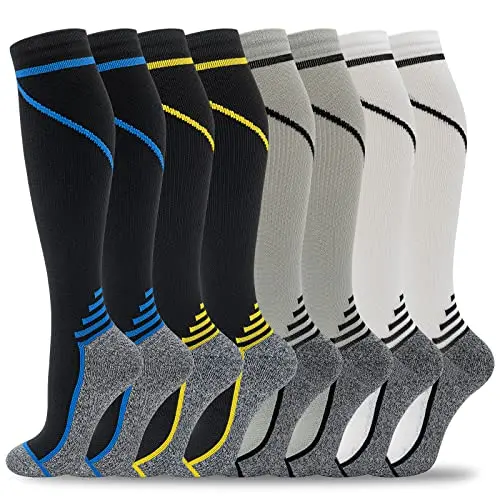
8-Pair Compression Socks – Machine-Washable Rotation Pack
An eight-pair multipack of 20-30 mmHg knee-highs in two size brackets, aimed at people who want a rotation rather than a single investment pair. Ribbed cuffs, thickened heel and toe, and a machine-washable knit keep the upkeep simple.
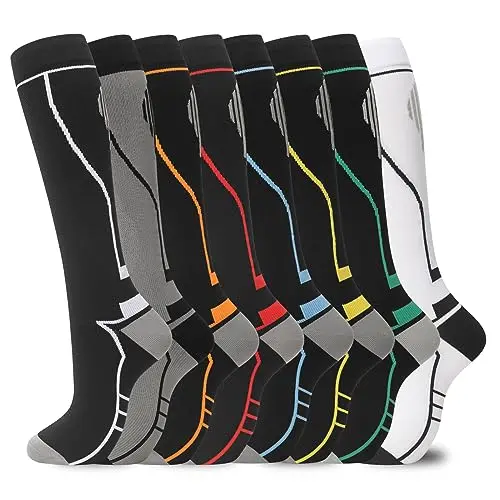
8-Pair Knee High Compression Socks – Wide-Calf-Friendly Multipack
Another eight-pair set, this one leaning on graduated medium compression and an L/XL bracket explicitly pitched at wide calves. The seamless, moisture-wicking knit has a softer hand than most firm-compression socks.
How We Evaluated These Alpaca Compression Socks for Men
A few things we can’t tell you: how these socks behave after a full season of daily wear, or what a laboratory pressure map would show at the ankle versus the upper calf. What we can tell you is how they stack up on the things that decide a purchase. We cross-referenced four compression sock models from four distinct brands across five decision axes – fiber composition, compression class, size range and calf fit, care requirements, and construction details like cuffs, cushioning, and arch support. Genuine alpaca construction is scarce here, so the lineup deliberately pairs the one wool option with established blends that serve the same jobs.
We triangulated published specifications, feature sets, and owner feedback where available, then mapped each sock against representative buyer profiles: the frequent flyer, the shift worker on hard floors, the runner chasing recovery, and the man whose calf measurement falls outside standard sizing. The scoring framework weighted real-world fit and performance (70%) against feature differentiation (30%), with compression class and calf sizing carrying the most weight because that’s where most returns originate.
We have no commercial relationship with any of the brands featured; recommendations track fit and differentiation, not brand preference. If alpaca fiber is the non-negotiable, the kelvna Alpaca Wool Compression Socks is your match. If you need firm 20-30 mmHg support with a calf size that actually lands, the SB SOX Compression Socks are the safer route.
How to Choose the Right Alpaca Compression Socks for Men
1. What Makes Compression Socks Genuinely Alpaca
Alpaca fiber earns its reputation honestly: it’s softer than most sheep wool, handles moisture well, and regulates temperature, which is why it turns up in socks for people who run hot and cold on the same flight. What it isn’t is elastic. Alpaca compression socks almost always blend the wool with spandex or nylon to achieve the graduated pressure and rebound that compression requires, so the fiber content line matters more than the marketing headline.
Read the blend before you buy. A listing that leads with alpaca but lists a composition dominated by synthetics is a wool-touched sock, not a wool sock. Look for alpaca near the top of the fiber list, and expect the knit to feel softer and less prickly than a comparable wool blend. Brands that lean on wool, like the kelvna Alpaca Wool Compression Socks, tend to be the ones worth the premium.
2. Compression Class: 15-20 mmHg vs 20-30 mmHg
The number on the box is the whole personality of the sock. 15-20 mmHg is mild, steady support – comfortable for travel, desk work, and general end-of-day heaviness. 20-30 mmHg is firm, and it’s what most people picture when they hear the word compression: a definite squeeze you feel through a long shift. Neither is better; they solve different problems.
If you’re buying a first pair and don’t know which side of that line you sit on, start mild. A firm sock that’s slightly too small is unwearable, while a mild sock that’s slightly loose still does something useful. Anyone managing significant swelling should be discussing class with a clinician rather than picking from a roundup.
3. How Men Should Measure for Compression Socks
Calf circumference is the measurement that matters, not shoe size. Wrap a tape around the widest part of the calf, measure early in the day before swelling builds, and cross-check against the brand’s own chart – the same nominal size varies between manufacturers. Shoe size is secondary and mostly tells you about foot length.
If you land on a boundary between two sizes, go up. Compression socks have almost no give in the cuff, and a too-tight band is the most common reason a pair ends up in a drawer. Brands that publish five or six calf bands are easier to fit accurately than two-size multipacks – the SB SOX Compression Socks are the clearest example of that in the group.
4. Alpaca Wool vs Nylon Blends: What Each Fiber Does for Men
Synthetic blends are the incumbent for a reason: nylon and spandex hold tension predictably, tolerate machine washing, and cost little enough to buy in multipacks. They breathe less than wool and can feel clammy by the end of a long day, but they deliver pressure reliably.
Alpaca-forward socks trade some of that easy care for softness, moisture handling, and temperature regulation. For men who find standard compression socks itchy or sweaty, the fiber difference is the entire point. For everyone else, a good blend is a perfectly rational choice – fit and compression class matter more than the fiber name.
5. Care and Rotation: Keeping Compression Socks in Shape
Compression socks die from heat and repetition, not from wear. Hot water and a hot dryer break down spandex faster than anything else, so wash cool, skip the dryer, and let them air dry flat. Hand washing stretches the life of a wool-forward sock further; machine-washable synthetics are more forgiving.
A rotation of several pairs keeps any single sock from being washed daily, which is the fastest way to kill its elasticity. Retire a pair when the cuff starts sliding or the pressure feels even from ankle to calf instead of graduated – that’s the elastic giving up.
6. Reading Compression Sock Price Tiers
Entry-level multipacks put several pairs in your drawer for very little and are the sensible way to test whether compression suits you. Expect thinner knits and coarser sizing. Mid-range single pairs buy better construction – cushioned heels, arch support, a wider size ladder – and are usually the sweet spot for daily wear.
Premium wool socks cost more per pair and deliver the fiber upgrade: softer hand, better moisture behavior, and often a more considered fit. Whether that’s worth it comes down to how many hours a day you’ll have them on.
Frequently Asked Questions
1. Do alpaca compression socks actually work as well as nylon ones?
They work differently rather than better or worse. Compression comes from the graduated knit and the elastic blended into it, not from the fiber itself, so an alpaca sock with a proper 15-20 mmHg or 20-30 mmHg gradient delivers the same mechanical support as a synthetic one. What alpaca adds is softness, moisture handling, and temperature regulation – real benefits if synthetic socks make you itch or overheat.
The caveat is durability and care. Wool-forward socks want cooler washing and gentler handling, and they can wear faster at high-friction points. If you want a hard-working sock you can machine wash without thinking about it, a good blend is the pragmatic call.
2. What's the difference between the kelvna alpaca socks and the SB SOX compression socks?
Fiber and firmness, mostly. The kelvna pair is alpaca-forward at 15-20 mmHg, sold as a two-pack, and built for travel and long sitting – soft, mild, and easy to pull on. The SB SOX is a firm 20-30 mmHg nylon-spandex sock with a five-band calf ladder running up to XX-large, so it fits more leg shapes and delivers a much more noticeable squeeze.
Pick the kelvna if wool against your skin is the goal and you want gentle support. Pick the SB SOX if you want firm pressure, a precise calf fit, or a single pair to trial firm compression before committing to more.
3. How do I size compression socks for men with wide calves?
Measure the widest part of the calf, then buy from the brand with the widest size ladder you can find rather than squeezing into a two-size pack. An XX-large calf band exists for a reason, and a sock stretched to its limit loses both comfort and gradient.
Measure early in the day, size up rather than down at a boundary, and treat shoe-size guidance as secondary once the calf measurement is settled. For a genuinely wide calf, the SB SOX Compression Socks and their five-band range are the easiest fit in this group.
4. How do the fenglaoda and hello momoya multipacks compare?
Both are eight-pair rotations with similar sizing brackets, but they lean different ways. The fenglaoda set runs firmer at 20-30 mmHg with a ribbed cuff and more grip, though some owners find the cuff slides by late afternoon. The hello momoya set is softer and more breathable, with medium graduated compression and an L/XL bracket explicitly pitched at wide calves.
Choose fenglaoda for pressure, hello momoya for comfort and a gentler squeeze.
5. How often should I replace compression socks?
Replace them when the sock stops doing its job, not on a calendar. The signals are a cuff that slides down, pressure that feels uniform from ankle to calf instead of graduated, and fabric gone thin at the heel. With cool washing and air drying, a rotated synthetic pair can last a long while; wool-forward socks often soften and relax sooner.
Keeping three or more pairs in rotation is the single biggest lever on lifespan, because it cuts down on repeated washing of the same sock.
Final Verdict
For most men shopping this corner of the market, the kelvna Alpaca Wool Compression Socks are the pick – real alpaca fiber, a mild 15-20 mmHg gradient that suits travel and long days at a desk, and a snug knit that stays put without a fight. If you need firm 20-30 mmHg support and a calf size that actually matches your leg, go with the SB SOX Compression Socks; that five-band size ladder is the real differentiator. Budget-minded buyers who want a full week of rotation should look at the fenglaoda 8-Pair Compression Socks, which trades some cuff grip for machine-washable convenience. Match the compression class to your day and the fiber to your skin, and you’ll land in the right pair.
