
Best Automatic Foaming Soap Dispensers – 2026 Reviews

There’s a specific kind of low-grade frustration that lives at the kitchen sink: one hand covered in raw chicken juice, the other trying to coax a pump bottle into giving up a decent lather. An automatic foaming dispenser solves that in about a quarter of a second. It also, if you pick badly, replaces one small annoyance with a bigger one – a unit that fires at shadows, dribbles onto the counter, or quits six weeks in.
The word “automatic” is doing a lot of work in this category. Sensing range varies from a couple of inches to a couple of dozen, and a dispenser that triggers when you merely reach past it is worse than no dispenser at all. The foaming side matters just as much: foam pumps are far pickier about soap viscosity than liquid pumps, so a model that happily froths thin foaming soap may clog on undiluted dish gel. Those two variables – sensor discipline and pump tolerance – separate the models worth owning from the ones that end up in a drawer.
We looked across the major brands selling these right now and sorted them by what they actually solve: the tiny powder-room sink, the family kitchen that empties a reservoir every fortnight, the rental bathroom where drilling a hole isn’t happening. Here’s how they stack up.
Best Automatic Foaming Soap Dispensers – 2026 Reviews
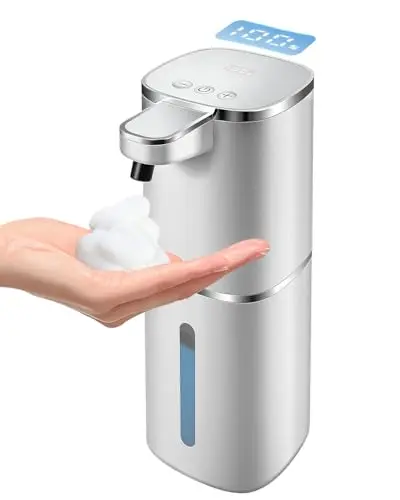
P20 Digital Display – Nine-Level Foam Control
A nine-level foaming dispenser in a silver round housing with a digital readout that shows your current foam setting and remaining battery at a glance. Controls are physical buttons rather than a touch panel, which is the detail that matters most once your hands are wet. Rechargeable, splash-resistant, and equally at home on the counter or stuck to the wall.
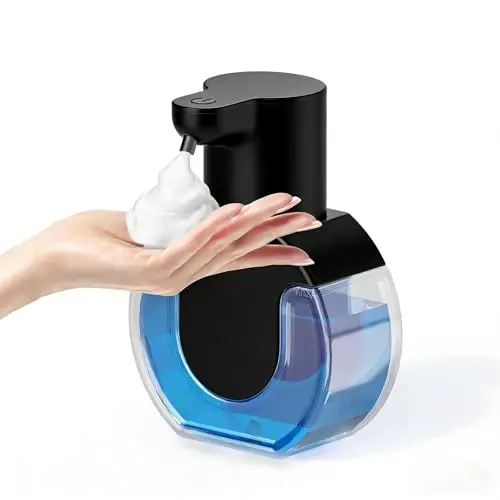
P10 – Biggest Reservoir in the Lineup
A compact oval dispenser built around a 420ml reservoir and a visible fill window, with four foam levels covering everything from a quick hand rinse to a heavy-duty dose. Charges over USB rather than swapping batteries, and ships with the hardware to sit on the counter or hang on the wall.
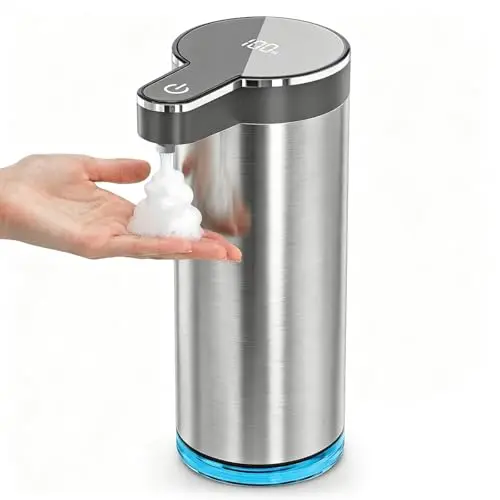
ST-01 – Stainless Steel Self-Cleaning
The only stainless steel body in this lineup, paired with a precision nozzle designed to cut the drip trail these dispensers usually leave behind. Four foam levels, USB-C charging, and a self-cleaning flush mode for when output starts to weaken.
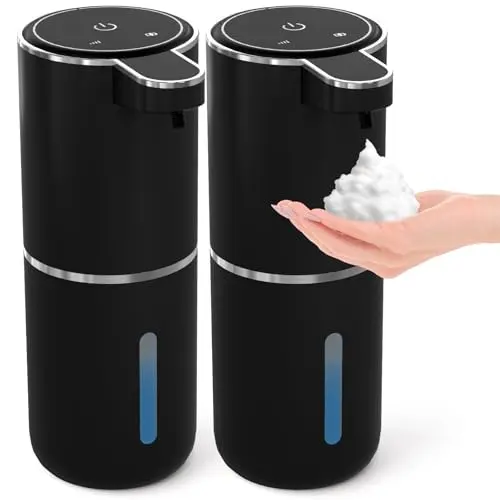
P11B 2-Pack – Two Sinks, One Box
Two identical 12.8oz dispensers in one box, each with four timed foam levels, USB recharging, and an IPX5 rating. Ships with adhesive mounts so both can go up without a drill.
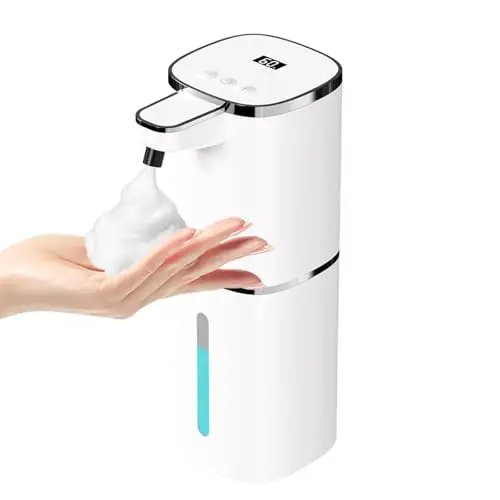
OFZYQWP20F – Nine Levels, Real Buttons
A white cylindrical dispenser with nine output levels, physical buttons, and a 1200mAh battery charged over USB-C. The 13.5oz tank has a fill window, and it works on the counter or mounted on the wall.
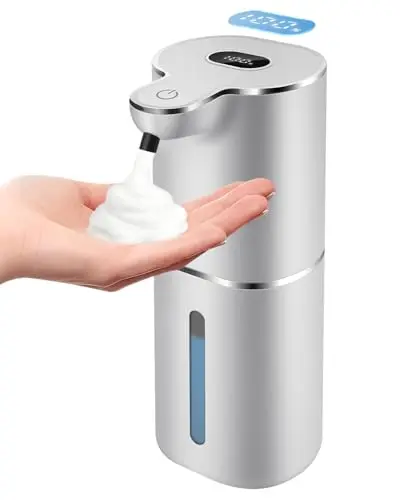
P15 Digital Display – Six Levels and a Ten-Second Flush
A six-level dispenser with a digital display, a 380ml reservoir, and a ten-second continuous mode for cleaning jobs. Silver finish, splash-resistant, and happy either on the counter or mounted to the wall.
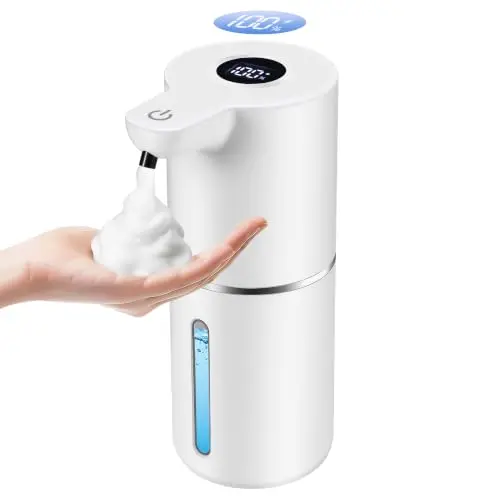
M1-A – Digital Readout in White
A clean white 350ml dispenser with a digital battery readout, four foam levels, and IPX5 water resistance. Charges by USB-C, runs on the counter or on included adhesive mounts, and ships with an unclogging bottle.
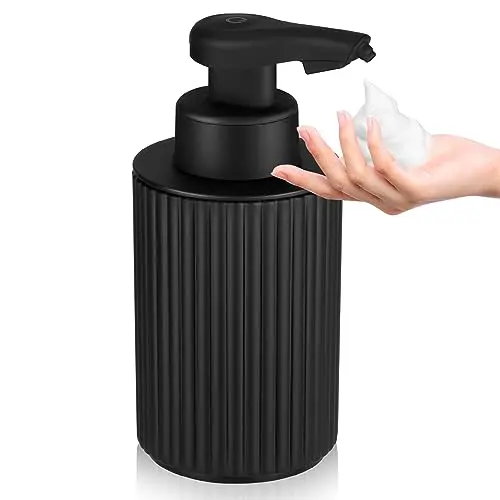
QP003 – Ribbed Compact for Small Counters
A compact 260ml dispenser with a ribbed matte body and a single-button control scheme. Charges over USB-C, and a double wave gets you a larger second dose when one isn’t enough.
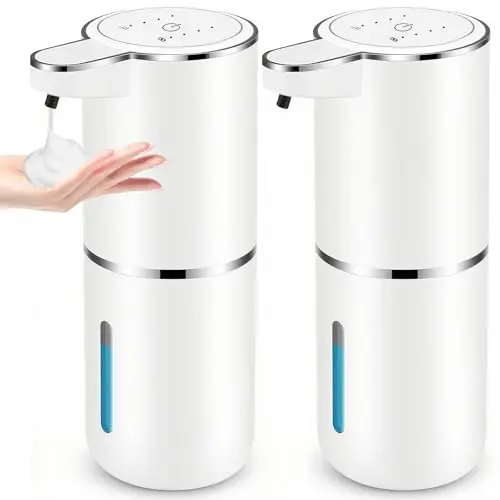
T90136 2-Pack – Two Dispensers for Two Sinks
A pair of white dispensers with four foam gears, IPX5 protection, and an adhesive wall bracket in the box. Charges over USB and is rated for up to 60 days of use per charge.
How We Evaluated These Automatic Foaming Soap Dispensers
We didn’t run a timed pump-cycling rig or a months-long clog trial on these dispensers. What we did: cross-referenced nine automatic foaming soap dispensers from eight distinct brands and mapped them across six decision axes – reservoir capacity, foam-level adjustability, control type, power and charging, mounting flexibility, and soap compatibility. We triangulated published specifications, feature sets, and owner feedback where available, compared advertised sensing behavior against the control scheme each unit actually uses, and audited the dilution guidance every brand publishes for its own pump. Then we pressure-tested each model against the buyer it suits: the powder-room sink that sees two hands a day, the family kitchen that empties a tank in a fortnight, the rental where drilling a hole isn’t an option.
The scoring framework weighted real-world fit (70%) – whether the dispenser delivers reliable foam, at the volume you actually want, in the spot you actually have – against feature differentiation (30%), meaning the things one unit does that its rivals simply don’t. A dispenser that misfires at shadows or clogs on your soap is worse than the bottle it replaced, so reliability signals carried real weight. We have no commercial relationship with any of the brands here; recommendations track fit and differentiation, not brand preference. If you want the most adjustable, best-instrumented option, the Cheftick P20 is the pick. If a big reservoir and a lower entry point matter more, the Ipefan P10 earns the nod.
How to Choose the Right Automatic Foaming Soap Dispensers
1. What Makes an Automatic Foaming Soap Dispenser Genuinely Automatic
Every unit here runs the same basic recipe: an infrared sensor watches for a hand, a small pump pushes soap through a foaming mesh, and a motor drives the whole thing. The difference between a good experience and a maddening one is sensor discipline. A sensing range of roughly two to three inches is the sweet spot – close enough that you have to mean it, wide enough that you aren’t slapping the unit to get a dose.
Then there’s the trigger behavior. Units with over-eager sensors will dispense when a shadow crosses them or when you wipe the counter, which burns through soap and leaves a puddle at the base. False triggers are the single most common complaint in this category, and they’re almost always a sensor-placement problem rather than a soap problem.
2. Soap Compatibility and the Dilution Trap
This is where most buyers get burned. Foaming soap – the pre-diluted stuff sold specifically for foam pumps – goes straight in. Regular liquid hand soap does not. It has to be cut with water first, because the viscosity is too high for the pump mesh to aerate.
Manufacturers quote wildly different dilution ratios across this lineup, from one part soap to four parts water down to mixes so thin they read like typos. Start with less water than recommended and adjust upward. Never put thick gel, body lotion, or scrub soap in one of these – the result is clogging that a flush cycle may not clear, and it’s the fastest way to void a warranty conversation.
3. Capacity, Fill Windows, and Refill Rhythm
Reservoir capacity in this category runs from about 260ml up to 420ml, and that gap matters more than it sounds. A 420ml tank at a busy family sink can go weeks between refills; a 260ml unit in the same spot needs topping up constantly. Pair capacity with a translucent window – a visible fill level is the difference between a calm refill and a mid-handwash surprise.
Also check the fill opening. A wide mouth makes refilling a ten-second job; a narrow one turns it into a funnel-and-paper-towel operation. If you want the longest stretch between refills, the Ipefan P10 and its 420ml tank is the one to beat.
4. Controls and Power: Buttons, Displays, and Battery Claims
Two control philosophies dominate. Physical buttons give you tactile confirmation and don’t misfire when wet hands brush the housing. Capacitive touch panels look cleaner and cost less to build, but they’re the first thing to misbehave in a steamy bathroom. A digital display is worth paying a little extra for – seeing the current level and remaining charge turns a mystery weak pump into an obvious one.
On power, USB-C charging has effectively replaced disposable batteries at this tier. Ignore headline runtime claims in isolation and look at the charge cycles figure instead: models quoting thousands of cycles from a full charge are giving you a more honest benchmark than a vague “months of use” number.
5. Wall Mount vs Countertop: Placement, Waterproofing, and Splash Zones
Most of these dispensers ship with both options, and both are worth using depending on the sink. Countertop placement keeps the unit within easy reach and makes refilling simple, but it eats deck space and parks the unit right in the splash zone. An adhesive mount clears the counter and puts the nozzle exactly where wet hands expect it – just mount it high enough that you aren’t reaching down into a full sink.
Wherever it goes, the IPX5 rating only covers splashes, and the charging port is the weak point on every model here. They all rely on a rubber plug to keep it dry. Leave that plug out and you’re shortening the life of the unit for no good reason.
6. Cheftick P20 vs Ipefan P10: Which Automatic Foaming Dispenser Fits Your Sink?
These two sit at the top of our list for different reasons, and the choice comes down to what your sink actually asks for. The Cheftick P20 wins on nine-level control and its digital readout – if you share a sink with people who want wildly different amounts of foam, or you want buttons that survive wet hands, that’s your unit.
The Ipefan P10 wins on endurance. Its 420ml reservoir is the largest here, which matters if you’re refilling weekly and resenting it. If you’d rather press a button nine times a year than fill a tank nine times a year, take the Cheftick; if the reverse is true, take the Ipefan.
Frequently Asked Questions
1. Do automatic foaming soap dispensers work with thick gel or dish soap?
Not as-is. Foaming soap is pre-diluted and goes straight in; regular liquid hand soap and dish soap have to be cut with water first or the pump mesh can’t aerate them. Brands in this lineup quote very different dilution ratios, so start conservatively and adjust. Thick gel, lotion, and scrub soap are a hard no – they cause clogging that even a flush cycle may not fix, and the damage usually shows up as weak, watery output.
2. What's the difference between the Cheftick P20 and the Ipefan P10?
The Cheftick P20 is the control-focused option: nine foam levels, a digital display showing battery and setting, and physical buttons that don’t care how wet your hands are. The Ipefan P10 trades some of that granularity for a 420ml reservoir – the largest in this roundup – and a simpler four-level scheme. If your sink is shared by people with very different foam preferences, take the Cheftick. If you just want to stop refilling, the Ipefan makes more sense.
3. How do the MTYGK and VZZNN two-packs compare?
Both give you two dispensers, but they solve different problems. The MTYGK P11B pair has larger per-unit reservoirs, four timed levels stretching up to two seconds, and a three-month charge claim – it’s the better pair if both units will live at hard-working sinks. The VZZNN pair runs on a smaller 500mAh battery with a 60-day rating, which makes it the sensible buy for a rental or a guest bathroom. Test both units in the first week either way; sensor reliability is the recurring weak point across this category.
4. Can you mount these dispensers without drilling?
Most of them, yes. The Cheftick, MTYGK, Ipefan, Beoedre, and VZZNN models all include adhesive mounts or a wall bracket with tape, and installation takes a couple of minutes on clean, dry tile. Two things to get right: mount high enough that the nozzle sits above a full sink, and leave the charging port plug in place. An IPX5 rating covers splashes, not a stream of water aimed at the port.
5. Why does the foam suddenly get weak or stop altogether?
Nine times out of ten it’s a partially clogged pump line or soap that’s too thick. Run the self-cleaning cycle if your model has one – on the Saertiloki ST-01 it’s a three-tap flush, and its included unclogging bottle handles heavier buildup. If that doesn’t fix it, empty the tank, rinse it, refill with properly diluted soap, and cycle the sensor a few times to reprime the pump. Persistent weak output on a heavily used unit usually points to the pump itself rather than the soap.
Final Verdict
For most sinks, the Cheftick P20 is the answer. Nine foam levels, a display that tells you what’s actually happening, and physical buttons that keep working when your hands are covered in soap – that combination is why it edges out the rest.
If capacity is your pain point, the Ipefan P10 and its 420ml tank will save you refills, and it asks for less money doing it. And if you want a dispenser that looks like it belongs on an open counter, with a flush mode and two-year backing to match, the Saertiloki ST-01 is purpose-built for that.
Skip all of them if a plain pump bottle still suits you. Otherwise, pick by which annoyance you want gone: refills, controls, or clutter.
