
Best Automatic Soap Dispensers For Kitchen Sink – 2026 Reviews

There’s a specific moment that sells a touchless dispenser: your right hand is holding a raw chicken thigh, your left is reaching for the soap bottle, and the bottle cap is already slick. A sensor pump solves a problem you didn’t know you had until you cooked something messy. But walk into any kitchen that’s had one installed for six months and you’ll hear the same two complaints – it quit pushing thick dish soap, or it chewed through batteries like a smoke alarm.
Those two failure points are where the category actually splits. The first is dispenser hardware: a nozzle designed for thin hand soap versus a pump built to move undiluted gel dish soap without clogging. The second is the power and refill setup, because a small tank plus a set of AAs creates a maintenance loop you’ll resent by week three. Everything else, from the finish to the sensor placement, is downstream of those two decisions.
Automatic also covers a wide spread of behaviors. Some units fire a fixed dose the instant they detect motion; others let you pick from nine levels, or control volume by how close your hand sits to the sensor. We surveyed the touchless dispensers built for kitchen duty across major brands and weighed what each one actually does at a working sink rather than on a showroom shelf. Here’s how they separate.
Best Automatic Soap Dispensers for Kitchen Sink – 2026 Reviews
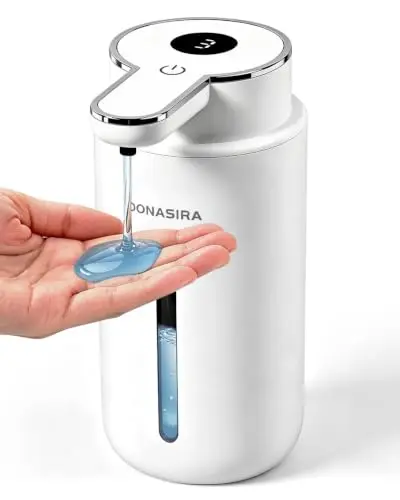
DON-P23-F-W – Clog-Free Pump for Dish Soap
A rechargeable touchless dispenser built around a clog-free pump that moves thick dish soap straight from the bottle without dilution. Six output levels, a digital readout for battery and dose, and both countertop and drill-free wall-mount setups.

Clearis-L – Gear-Pump Dispenser with Self-Cleaning Mode
A stainless, USB-C rechargeable dispenser with an upgraded gear pump and duckbill nozzle aimed at jam-free flow, plus a self-cleaning mode and three measured dose presets.

SY-915B – 15-Level Dial for Thick Dish Soap
A dial-controlled touchless dispenser that handles thick dish soap without dilution, with an elevated battery bay to keep moisture away from the cells.

350 ml Touchless Dispenser – Three-Level Wall-Mount Pick
A three-level touchless dispenser with a quiet release mechanism and a larger-than-average reservoir, designed to sit on the counter or mount to the wall.
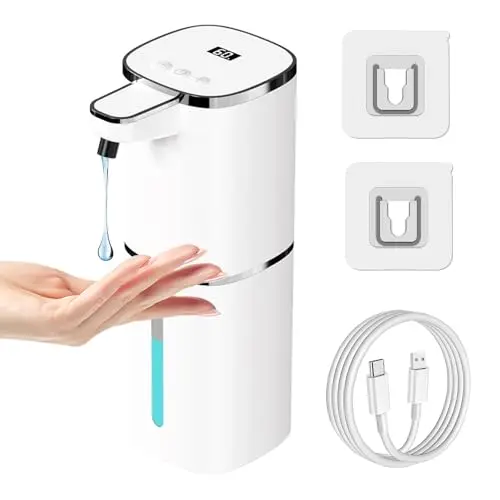
OFZYQWP20L – Nine-Level Rechargeable Dispenser
A 400 ml rechargeable dispenser with nine output levels, physical buttons, and a dedicated cleaning mode for flushing the line.
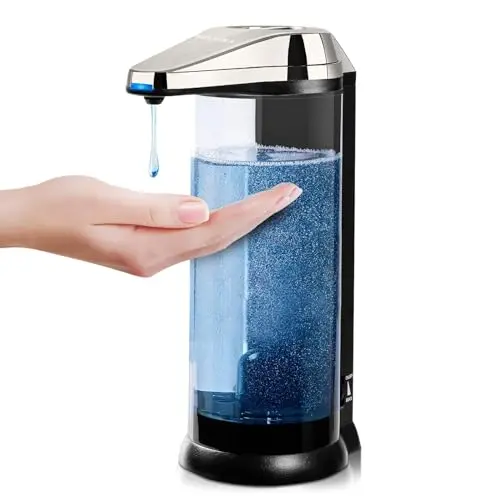
V-470 – 17 oz Tank with Volume Dial
A water-resistant touchless dispenser with a large tank and a dial for fine-tuning how much soap lands in your hand.
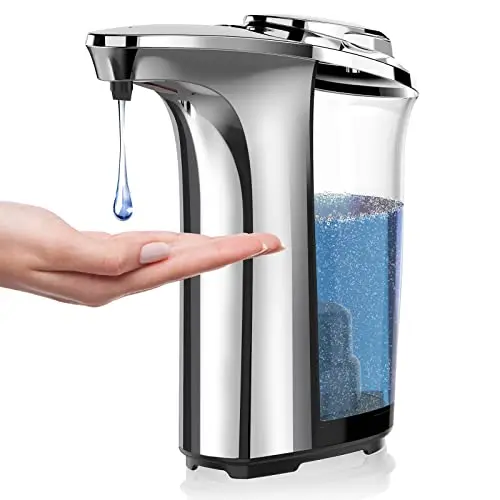
YM-201 – Big-Tank Budget Dispenser
A budget-friendly touchless dispenser with a large tank, five output levels, and a splash-resistant aluminum finish.

ST1082 Sensor Pump – Rechargeable and IP67 Rated
A rechargeable sensor pump with magnetic charging, an IP67 rating, and dispense volume that responds to how close your hand gets.

ST1023 Sensor Pump – Compact Brushed-Nickel Classic
The compact brushed-nickel sensor pump that popularized the category, with a no-drip silicone valve and near-instant dispensing.
How We Evaluated These Automatic Soap Dispensers for Kitchen Sink
We didn’t run controlled kitchen lab tests or multi-month reliability trials on these dispensers. What we did: cross-referenced 9 automatic soap dispensers from 8 distinct brands across five decision axes – reservoir capacity, thick-soap handling, dispense control, power source, and splash protection. We triangulated published specifications, feature sets, and owner feedback where available, then mapped each unit against the realities of a working kitchen sink: greasy hands, gel dish soap, and a wet counter that punishes weak seals.
The scoring framework weighted real-world kitchen performance (70%) – whether the pump actually moves undiluted dish soap and how often you’re stuck refilling or recharging – against feature differentiation (30%) – the technical choices that separate one model from the next. We have no commercial relationship with any of the brands featured; recommendations track fit and differentiation, not brand preference. If you want the most kitchen-specific design, the DON-P23-F-W is the pick; if you’d rather pay for pump refinement, the Clearis-L earns it.
One caveat worth stating plainly: sensor reliability and pump longevity are the two things that surface as complaints across every brand, and no spec sheet predicts either. Capacity, soap compatibility, and control scheme are the parts you can judge before you buy, so that’s where we put the weight.
How to Choose the Right Automatic Soap Dispenser for a Kitchen Sink
1. What Automatic Really Means at the Kitchen Sink
Touchless is a broad label. What actually varies is the trigger mechanism and the hardware behind the nozzle. Some units fire a fixed dose the moment they detect motion; others let you choose from up to fifteen levels, and a few use hand proximity to decide the dose. At a sink used for cooking, a wide trigger zone is a mixed blessing – convenient with floury hands, annoying when you reach past the spout for the faucet.
The dispensing hardware matters more than the sensor. A simple silicone valve shuts cleanly and stops drips, a gear pump is built for repeatable jam-free delivery, and a cheap nozzle is where most clogging complaints start.
2. Dish Soap Compatibility Is the Real Test for a Kitchen Sink Dispenser
Plenty of automatic dispensers are engineered around thin hand soap, and their manuals say so – thin formulas only, no lotion-style gels. If you’re filling one with the same thick, undiluted dish soap you squeeze onto a sponge, that restriction matters more than any other spec on the box.
Look for language about pumping thick soap without dilution, a wide-mouth opening for refills, and a nozzle you can rinse when flow slows. If your bottle holds a gel formula, the SY-915B is designed around exactly that use.
3. Tank Size and Refill Frequency for a Kitchen Soap Dispenser
Kitchen sinks burn through soap faster than bathroom vanities, so refill frequency is a real quality-of-life variable. An 8 oz body means topping up often; a 17 oz reservoir pushes that out to a weekly-or-less chore, at the cost of a taller footprint beside the faucet.
If counter space is tight, a wall-mount kit solves both problems at once – big tank, zero counter real estate. Check that the mount is drill-free if you rent, and that the sensor still sees your hand when the unit sits higher than the sink rim.
4. Batteries vs. USB-C Rechargeable Power
Alkaline AA batteries are convenient and replaceable in seconds, but some models refuse rechargeables outright because the lower voltage makes them misbehave. That’s an ongoing cost and an ongoing errand.
USB-C rechargeable units trade that for a cable and a charging habit, usually with weeks between top-ups. Battery compartment placement is the underrated detail: bays sitting low in the body are the ones that corrode when a drip runs down the side, so an elevated compartment is worth more than it sounds.
5. Sensor Range, Dispense Speed, and No-Drip Spouts
A sensor range that’s too long fires at shadows and passing arms; too short and you’re waving. Somewhere in the two-to-three-inch band is the comfortable zone for a sink. Dispense speed matters less than most marketing suggests – a fraction of a second either way – but a slow unit feels broken when your hands are coated.
The no-drip spout is the spec that keeps your counter clean. A clean cut-off between doses means no sticky ring under the nozzle and no soap pooling around the base.
6. What You Actually Get at Each Price Tier
Entry-level dispensers get you touchless operation, plastic bodies, and three to six output levels – enough for most households. The mid-range tier adds bigger reservoirs, dial-based control, and better seals around the battery bay. The premium tier buys metal finishes, gear pumps, higher water-resistance ratings, and rechargeable power.
None of that changes the core job: soap in your hand without touching anything. If you want the refinement end of the market, the Clearis-L is where that money goes.
Frequently Asked Questions
1. DON-P23-F-W vs. Clearis-L: which automatic soap dispenser suits a kitchen sink better?
They solve different problems. The DON-P23-F-W is built around thick undiluted dish soap, gives you a digital battery readout, and runs for months on a charge – the pragmatic kitchen choice. The Clearis-L is the refinement play, with a gear pump, three measured presets, and a self-cleaning mode, but a smaller tank means more refills.
Pick the first if your soap is thick and your priority is low maintenance. Pick the second if you’re happy refilling more often and want the smoothest dispense.
2. Can an automatic soap dispenser handle thick dish soap without dilution?
Some can, many can’t. A number of touchless models are explicitly rated for thin hand soap only, and their manuals warn that lotion-style or gel formulas will clog the pump. Others advertise no-dilution thick soap support with a wider internal line and a rinse-friendly nozzle.
If you plan to use the same dish soap you squeeze straight onto a sponge, check that specific claim before buying. Diluting thick soap yourself works as a workaround, but it changes the dose and can make the sensor’s volume settings feel inconsistent.
3. Secura V-470 vs. PZOTRUF YM-201: which big-tank dispenser is the better buy?
Both give you a large reservoir and a transparent window, so refills stay rare. The V-470 adds an adjustable volume dial, water resistance, and a two-year warranty, which is meaningful in a category where pumps fail early.
The YM-201 counters with five output levels, a rust-resistant aluminum finish, and a lower price tier. Expect faster battery drain and more variance between units. If warranty coverage matters to you, the Secura is the safer buy.
4. Do touchless soap dispensers work with rechargeable batteries?
Often no, and that surprises people. Several automatic dispensers are calibrated for the voltage of standard alkalines, and rechargeable cells run lower – which can make the unit dispense weakly or not at all. Some manuals say so outright.
If you want to stop buying disposables, look for a built-in USB-C battery rather than a AA-swap model. That route removes the voltage question entirely and typically gives weeks of use between charges.
5. How often will I refill a kitchen sink soap dispenser?
More often than you’d guess. Kitchen sinks dispense more soap per session than a bathroom vanity, so a small body can mean frequent top-ups during a cooking-heavy week. A large tank pushes refills out considerably.
Two design details soften the chore: a wide refill opening so you’re not funneling gel soap through a narrow neck, and a clear window so you can see the level before you commit to a refill mid-recipe.
Final Verdict
For most kitchen sinks, the DON-P23-F-W is the answer – it’s the only dispenser here built specifically around undiluted gel dish soap, and the rechargeable battery plus digital readout remove the two recurring chores people resent about this category. If your soap is thick and your counter is tight, the SY-915B with its 15-level dial is the close second and easier for a toddler to use one-handed. If you’d rather spend up on pump refinement, measured doses, and stainless construction, the Clearis-L earns its premium. And for a busy household that wants a big tank and doesn’t mind AAs, the V-470 keeps refills rare. Any of those four beats a manual pump on a greasy weeknight – the trick is matching tank, soap, and power source to how your kitchen actually gets used.
