
Best Automatic Soap Dispensers – 2026 Reviews

There’s a specific kind of disappointment that comes with a touchless dispenser. You wave. Nothing. You wave again, closer this time, and it fires a puddle across the counter. Then, six weeks in, it stops altogether and you discover the battery bay has been slowly marinating in soap.
The difference between a dispenser you love and one you unplug isn’t the sensor itself – it’s everything around it. A no-drip valve keeps the spout presentable. An elevated battery compartment keeps moisture away from the electronics. A wide-mouth reservoir turns a refill into a ten-second job. None of that leads a spec sheet, and all of it decides whether the thing survives a year at a busy sink.
We looked across the whole market – premium brushed-metal pumps, big-tank workhorses, USB-C rechargeable foaming units, and the budget end of the shelf – to work out which designs actually hold up and which ones just photograph well. What follows is what we’d buy for a family kitchen, a powder room, and a rental where drilling isn’t an option.
Best Automatic Soap Dispensers – 2026 Reviews
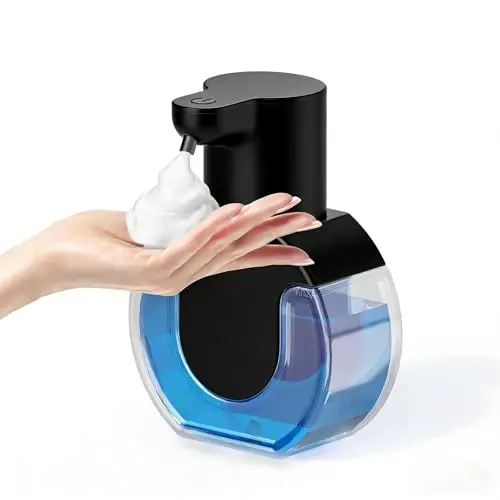
P10 Rechargeable Foaming Dispenser – Big Tank, Long Standby
A wall-mountable foaming dispenser with a 420ml reservoir that keeps refills infrequent and a USB-chargeable battery that skips disposable cells entirely. The sensor fires on approach and four output levels let you dial from a small pump to a generous wash. It handles hand soap, dish soap, and even shampoo once diluted, so one unit can cover a kitchen sink and a bathroom vanity.

ST1023 Sensor Pump – Precision Dosing, No-Drip Valve
The brushed-nickel sensor pump that set the template: a fast touchless trigger, precise volume control, and a flexible silicone valve that snaps shut after every dispense. The compact reservoir suits a bathroom vanity more than a busy kitchen, and a two-year warranty backs the build.

Clearis-L Touchless Dispenser – USB-C Rechargeable, Self-Cleaning
A stainless, USB-C rechargeable dispenser built around a gear pump and duckbill nozzle designed to resist clogs. Three output modes cover everything from a drop of facial cleanser to a full dose of dish soap, and a self-cleaning cycle flushes the line between refills. IPX5 sealing handles splash at the sink.

SY-915B Touchless Dispenser – 15-Level Dial, Thick-Soap Ready
A dial-controlled touchless dispenser with fifteen output levels set by a physical knob on top, so the dose stays identical every pull. The battery bay sits high inside the body, away from countertop splash, and the wide-mouth opening takes thick dish soap straight from the bottle. Ships with wall-mount hardware.
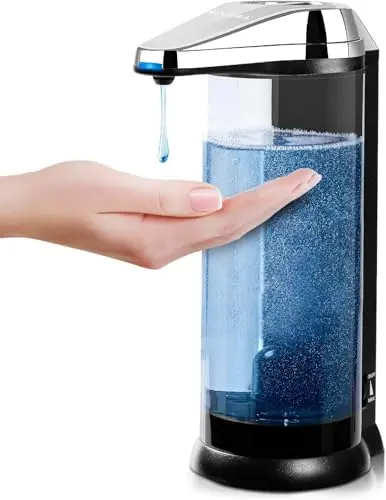
V-470 Automatic Dispenser – Wall-Mount or Countertop
A workhorse with a wide output dial spanning 0.03 to 0.19 oz per activation, so it can serve a bathroom vanity and a utility sink with the same unit. It sits on the counter or hangs on the wall, the clear body shows soap level at a glance, and the sensor reads a hand from just under three inches away.
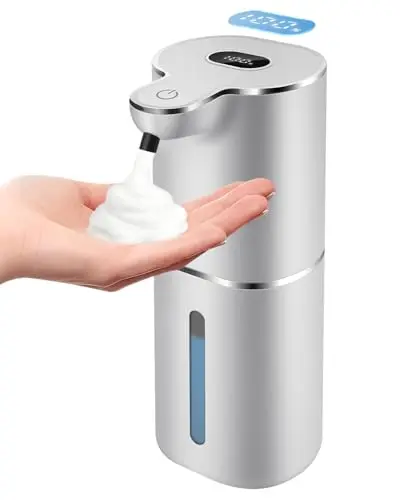
P15 Foaming Dispenser – Digital Display, Six Foam Levels
A foaming dispenser with an HD display showing the current foam level and remaining battery at a glance. Six foam settings plus a ten-second continuous mode handle everything from hand rinses to self-cleaning, and a 1200mAh rechargeable cell with IPX5 sealing covers the power side. Mounts on the wall with traceless stickers or sits on the counter.
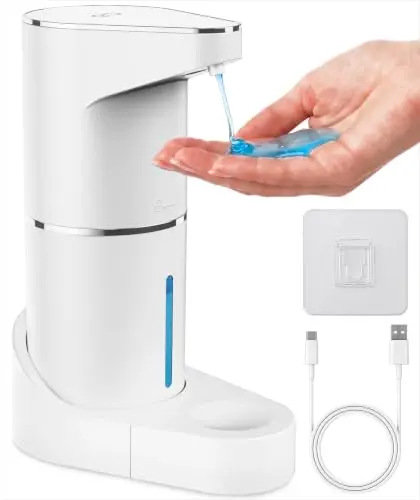
Touchless Soap Dispenser – Quiet Pump, USB-C Rechargeable
A matte-white, USB-C rechargeable dispenser with a 12 oz reservoir and three output levels. The pump runs quietly, the body mounts to a wall or sits on the counter, and IPX4 sealing handles everyday splash. Run time per charge is long at the lowest setting.
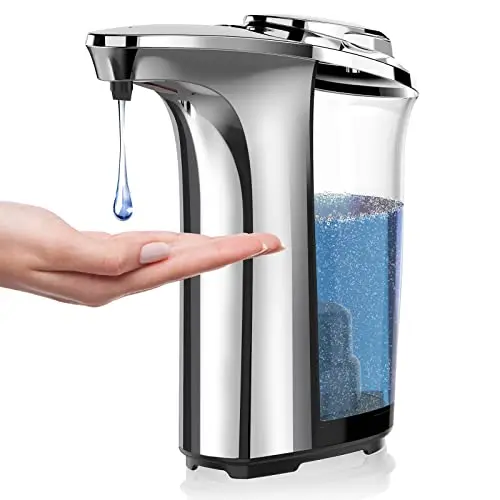
YM-201 Touchless Dispenser – 17oz Tank, Five Volume Levels
A brushed-aluminum touchless dispenser with a 17 oz reservoir, five output levels, and an IPX4 seal. The no-drip spout is shaped to resist clogging, and the non-slip rubber-ring base keeps it planted. Four AA batteries run it, and the wide opening makes refills tidy.
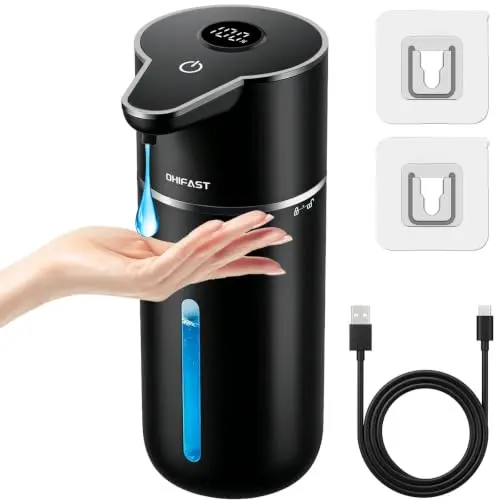
OFSDTBP27G Smart Dispenser – 500ml Tank, No Dilution Needed
A 500ml black dispenser that pushes undiluted liquid soap – thick dish soap included – with no mixing required. Six output levels plus a triple-click cleaning mode, a 1200mAh USB-C cell, and IPX5 sealing. Mounts on the wall or stands on the counter.

TR-01 Dual-Mode Dispenser – IPX7, 200-Day Standby
A dual-mode dispenser that runs touchless by sensor or manual for a heavy pour, with three auto-mode output levels. A phone-grade lithium battery claims roughly 200 days of standby per charge, the pump is tuned to run quietly, and IPX7 sealing covers the charging port too. Backed by an eighteen-month warranty.
How We Evaluated These Automatic Soap Dispensers
We didn’t run these dispensers through a lab-based pump-cycling rig or a multi-month sink trial. What we did: cross-referenced 10 automatic soap dispenser models from 10 distinct brands across six decision axes – sensor speed and trigger zone, output adjustability, reservoir capacity and refill access, soap-type compatibility, power source, and build with water resistance. We triangulated published specifications, audited feature sets, weighed owner feedback where available, and mapped each unit against realistic buyer profiles: a family kitchen sink, a powder-room vanity, a rental where drilling isn’t an option.
The scoring framework weighted real-world fit (70%) – how reliably a dispenser delivers soap at the volume you want without drips or clogs – against feature differentiation (30%) – genuinely useful advantages like rechargeable power, self-cleaning modes, and soap-type flexibility. No brand paid for placement; recommendations track fit and differentiation, not brand preference. If you want the most consistent foaming experience for a busy bathroom, the P10 Rechargeable Foaming Dispenser is where we’d start; if you want the premium feel and precise dosing of a long-established name, the ST1023 Sensor Pump earns the higher spend.
The same failure modes come up again and again – moisture creeping into a battery bay, a nozzle clogging after a switch to a thicker soap, a sensor that stops reading a hand – so we weighted how each design defends against those specifically. The power question matters more than the marketing suggests, too: a sealed USB-C unit you can top up beats a dispenser that quietly dies mid-month with corroded contacts.
How to Choose the Right Automatic Soap Dispenser
1. How Sensor Trigger Zones Shape Everyday Automatic Soap Dispenser Use
Sensor range varies more than you’d expect, from about 2.4 inches to nearly 3, and that difference changes how a dispenser behaves at a real sink. A very wide trigger zone means the unit fires when you reach for the faucet handle. A tight one means you commit to putting your hand directly under the spout. Neither is wrong, but a tight, precise trigger zone is easier to live with once you’re used to it.
Two things make sensing unreliable: dark or reflective surfaces near the sensor, and a sensor window filmed with soap residue. Most units want a hand or a light-colored object under the spout, and nearly all need the window wiped every week or two. If a dispenser suddenly stops reading your hand, clean the window before you assume the pump has failed.
2. Foaming vs. Liquid: Match the Dispenser to the Soap You Actually Use
This is the decision that trips people up most. Foaming dispensers aerate soap as it leaves the pump, so a small amount goes a long way and the foam spreads evenly across both hands. The tradeoff: they can’t push ordinary liquid hand soap as-is. Most need it cut with four to six parts water, or you buy pre-mixed foaming soap refills. Skip that step and you get a sputtering, half-dispensing mess.
Liquid dispensers are more forgiving about what’s in the bottle. Good ones move thick dish soap undiluted and handle hand soap, shower gel, and shampoo. What they don’t tolerate is lotion-based or high-solids soap – that’s the classic clog. If dish soap is the main job, the SY-915B takes it straight from the bottle with no mixing at all.
3. Reservoir Size, Refill Access, and Counter Footprint
Capacity in this category runs from a bathroom-sized reservoir to a 500ml tank, and the difference is measured in how often you’re standing over the sink with a bottle in your hand. As a rough rule, anything under 10 oz belongs in a bathroom; anything over 16 oz can carry a kitchen sink for weeks. A clear window or transparent body matters as much as raw volume – it’s the difference between a planned refill and an empty-pump surprise.
Then there’s refill access. A wide-mouth opening lets you pour from a bulk jug without a funnel. A narrow neck guarantees you’ll spill. And decide early whether you want the unit on the counter or on the wall. Wall-mount kits free up space at a tight sink, but adhesive mounts need a clean, flat surface and a few hours of cure time before you fill the reservoir.
4. AA Batteries or USB-C: Power Choices That Decide Longevity
Disposable AA cells are the default, and they’re fine – four alkalines can run a busy bathroom for months at moderate volume settings. The catch is that every battery change is an opportunity for water to get past a hatch seal, and rechargeable cells can underperform in units designed around 1.5V alkalines.
USB-C rechargeable dispensers sidestep both problems. There’s no hatch to open, no cells to buy, and a sealed port with a rubber plug keeps moisture out. The Clearis-L is the clearest example here – a 1500mAh cell, a sealed charging port, and no battery compartment to corrode at all. The tradeoff is remembering to charge it, though most units in this tier run for weeks to months per charge.
5. Waterproof Ratings and the Battery-Bay Failure Mode
IPX4 covers splashes from any direction. IPX5 handles a low-pressure jet. IPX7 means the housing survives brief immersion. For a bathroom vanity, IPX4 is plenty. For a kitchen sink where you’re rinsing a pot next to the dispenser, IPX5 or better is worth seeking out.
The failure mode that matters is quieter than a rating. Soap and water migrate down the body and pool in the battery compartment, where they corrode the contacts and kill the unit months later. Two design responses show up in this lineup: moving the battery bay higher in the body, and sealing the charging port with a rubber plug. Both work. Neither is universal.
6. What Automatic Soap Dispensers Deliver at Each Price Tier
Entry-level dispensers get you a working sensor, a plastic body, and a few output levels. That’s genuinely enough for a bathroom, and the savings are real. What you give up is usually finish quality and long-term pump reliability – this is the tier where units tend to quit after a year.
Mid-range is where the useful features land: rechargeable batteries, IPX5 sealing, wider output ranges, and better soap compatibility. If you’re buying one dispenser for a main kitchen sink, this is the sweet spot. The V-470 is the capacity play here, with a wide output dial and a wall-mount option.
Premium buys finish and precision – brushed metal, tighter sensing, no-drip valves, longer warranties. You’re paying for the object as much as the function, and capacity often goes down rather than up. Worth it if the dispenser is visible on a nice vanity; harder to justify for a utility sink.
Frequently Asked Questions
1. Are foaming automatic soap dispensers better than liquid ones?
Not better – different. Foaming output aerates the soap, so a smaller dose covers both hands and spreads more evenly. It’s gentler on skin and it’s what most people prefer at a bathroom sink. The catch is that foaming units can’t push ordinary liquid soap straight from the bottle; it needs cutting with four to six parts water first, or you buy pre-mixed foaming refills.
Liquid dispensers are the more flexible choice. They handle thick dish soap undiluted, plus shower gel and shampoo, and they demand no prep at all. If one dispenser has to serve a kitchen and a bathroom, go liquid.
2. What's the difference between the simplehuman ST1023 and the Secura V-470?
They’re aimed at different buyers. The ST1023 is the precision instrument: a tight precise trigger, a silicone no-drip valve that keeps the spout clean, and volume buttons on top. It holds a small reservoir, which suits a bathroom vanity, and it carries a two-year warranty.
The V-470 is the volume play. A 17 oz reservoir and a wide output dial make it the better fit for a household that goes through a lot of soap, and it mounts on a wall or sits on the counter. The tradeoffs are a battery door that needs a screwdriver and a pump that dislikes thick soap. If capacity is what you’re after, the V-470 is the one; if you want the cleanest dispense, it’s the ST1023.
3. How does the SUNLY Clearis-L compare to the Cheftick P15?
One is liquid, one is foam. The Clearis-L uses a gear pump and a duckbill nozzle to push liquid soap without clogging, offers three output modes, and includes a self-cleaning cycle for flushing the line. It’s the more versatile of the two if you switch soap types often.
The P15 is a foaming unit with a digital display showing foam level and battery state, six foam settings, and a ten-second continuous mode. It’s the friendlier choice for handwashing in a family bathroom, provided you’re content diluting ordinary soap. For dish soap at a kitchen sink, the Clearis-L is the more natural fit – liquid output, no dilution, and a nozzle built for thick soap.
4. How long should an automatic soap dispenser last?
Longer than most of them do. The wear items are the pump and nozzle, which see soap residue on every cycle, and the battery bay, which is where moisture does its damage. A dispenser that keeps its electronics dry and gets its nozzle wiped occasionally should run for years.
Warranty coverage is a reasonable proxy for how much confidence a maker has. Terms in this category run from eighteen months to two years, and several units here don’t state one at all. Buy from a brand that will replace a unit that quits in month eight.
5. Can I put thick dish soap in an automatic soap dispenser?
Depends entirely on the pump. Liquid dispensers built for the job move undiluted dish soap without complaint. Foaming units can’t: they need the soap thinned, and thick soap straight from the bottle will clog the aerator.
What to avoid across the board is lotion-based soaps and anything with scrubbing beads or high solids. Those are the recipes that turn a working dispenser into a paperweight. If you must switch between soap types, run a few cycles of warm water through the unit first.
Final Verdict
For most sinks, the P10 Rechargeable Foaming Dispenser is the answer. It pairs a reservoir larger than most foaming units here with foam that stays consistent to the last pump and a battery you recharge instead of replace – and it costs less than most of this lineup. If you want a dispenser that feels like a fixture rather than an appliance, the ST1023 Sensor Pump earns its premium with the tightest sensor and the cleanest spout in the group. Thick dish soap straight from the bottle? The SY-915B takes it undiluted and asks nothing else of you. And if you’d rather never think about batteries again, the Clearis-L charges over USB-C and flushes itself clean.
