
Best Bamboo Charcoal Air Purifier Bags – 2026 Reviews

There’s a specific kind of frustration that comes from a smell you can’t locate. The closet that smells faintly of old rain. The car that still carries last summer. The basement that’s not flooded, not moldy, just… off. Bamboo charcoal bags exist for exactly that problem, and they’re one of the few low-tech options in the air care aisle that actually has a mechanism behind it.
The mechanism is adsorption. Activated bamboo charcoal is riddled with microscopic pores that trap odor molecules and water vapor instead of covering them with fragrance. That means two things shape a good bag versus a mediocre one: how much charcoal is actually inside, and whether the fabric lets air reach it without leaking black dust onto your shelf.
Below we’ve sorted through sets across the market and grouped them by what they’re genuinely good at – whole-room coverage, scattered spot treatment, vehicle duty, and small-space shoe control. None of these are miracle workers, but the right bag in the right place is a quietly effective thing to own.
Best Bamboo Charcoal Air Purifier Bags – 2026 Reviews
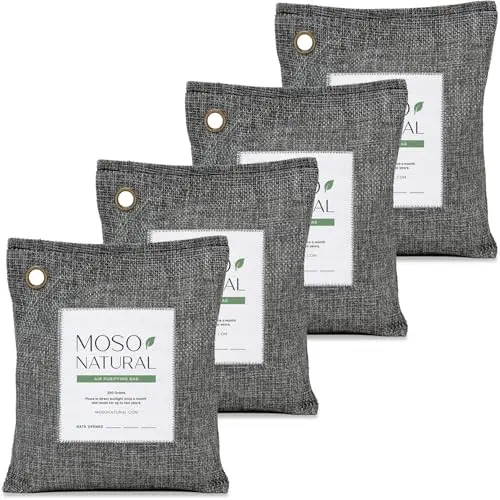
Air Purifying Bag 200g (4-Pack) – Room-by-Room Odor Control
A four-pack of 200g linen bags filled with activated Moso bamboo charcoal. Each bag is rated for spaces up to 90 square feet, so the set covers a small apartment or four separate problem areas without a plug, a refill, or a fragrance cartridge. The reinforced grommet lets you hang one in a closet, hook one in the car, and tuck the rest into cabinets and pet corners.
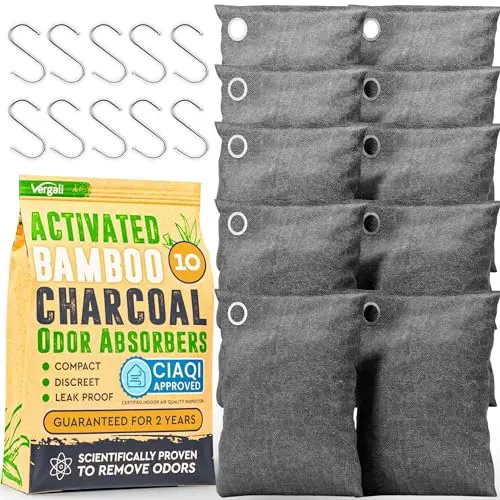
Activated Charcoal Odor Absorber 10-Pack – Scatter-and-Forget Coverage
Ten compact charcoal bags, each around 3.5 oz, with hooks included so you can hang them almost anywhere. Vergali positions this pack for cars, closets, shoes, basements, and pet areas, and the count is the whole point – you spread them thin and cover a lot of small trouble spots at once instead of rationing one bag between rooms.

Air Purifying Bag 600g – Large-Room Coverage
A single 600g linen bag rated for spaces up to 300 square feet – bedrooms, living rooms, basements, kitchens. It stands on its own or hangs from the reinforced grommet, and after two years you cut it open and work the charcoal into garden soil rather than sending it to landfill.
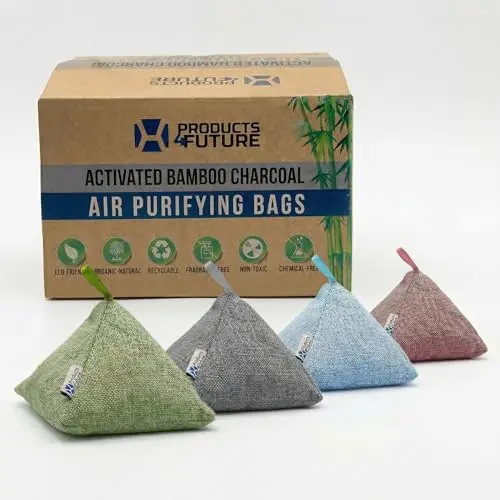
Pyramid Charcoal Bags 200g (4-Pack) – Decorative Odor Control
Four 200g bamboo charcoal bags in a stitched pyramid shape, rated for spaces up to 100 square feet each. The form factor is the hook here: these are meant to sit out in the open as decor rather than hide behind a towel stack, and the pack includes a bonus guide with usage ideas for getting the most out of them.
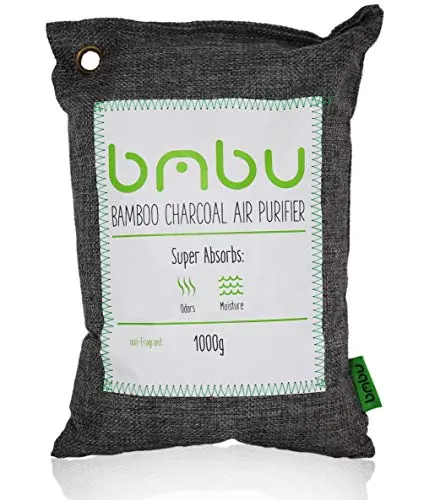
1000g Charcoal Bag – Flat-Profile Vehicle and RV Control
A single 1000g bag in a flat 8 x 6 inch format, sold sealed airtight so the charcoal hasn’t already been breathing warehouse air before it reaches you. bmbu targets vehicles, RVs, campers, and mobile homes with this one, though it works anywhere you’d reasonably put a full kilogram of activated bamboo charcoal.
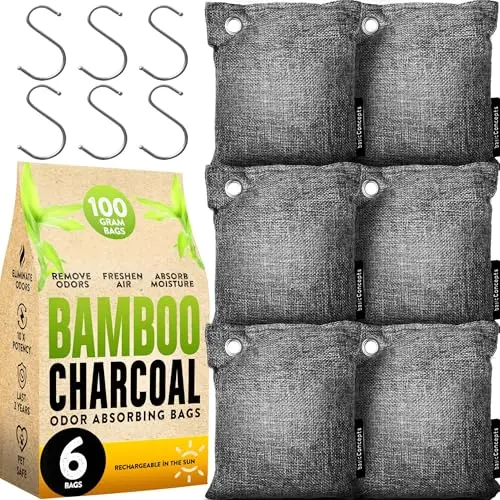
Charcoal Odor Absorber 6-Pack – Lifetime Replacement Support
Six smaller 100g bags aimed at strong, localized odors – shoes, closets, basements, refrigerators, and drawers. Basic Concepts backs the pack with a lifetime replacement policy and US-based support, which is more backup than most listings in this category offer at any price tier.
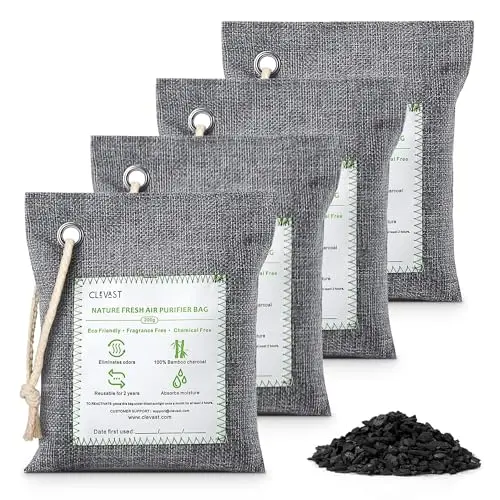
Bamboo Charcoal Bags Large Set – Burlap Shell with Hook
A large multipack of natural bamboo charcoal bags in a durable burlap shell, each fitted with a built-in metal hook. Clevast positions the set for homes, cars, pets, bathrooms, and basements, and the burlap finish reads considerably less synthetic than the nylon and polyester covers on some rivals.
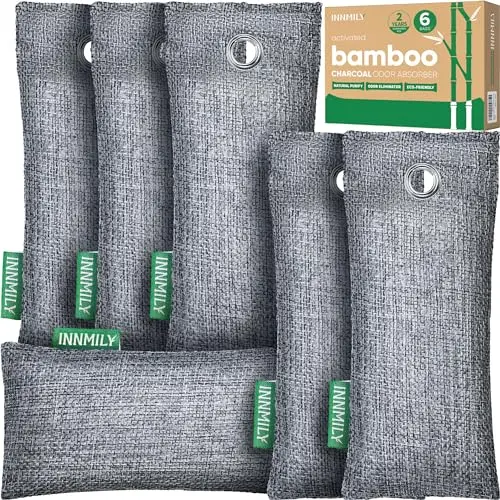
Charcoal Shoe Deodorizer 6-Pack – Small-Space Specialist
Six compact activated charcoal pouches built around shoes, drawers, gym bags, and closets, sold with metal S-hooks for hanging. The three-layer fabric design is meant to keep charcoal dust inside while still letting air move through, and the brand plants a tree for each pack purchased.
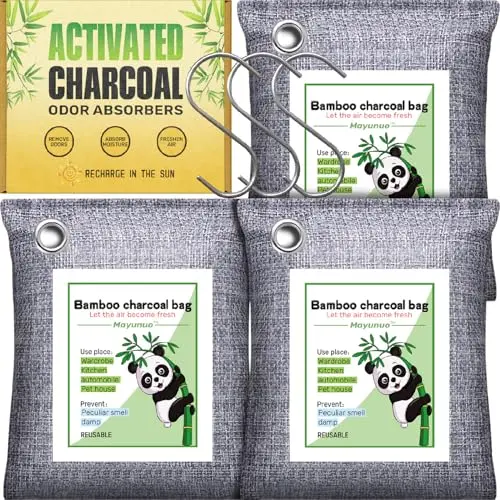
Charcoal Odor Absorber 3-Pack – Entry-Level Room Coverage
A three-bag starter set of activated bamboo charcoal pouches for cars, closets, bathrooms, basements, and pet areas. Mayunuo keeps it simple: a double-layered bag, no fragrance, no additives, and a two-year recharge cycle in sunlight.
How We Evaluated These Bamboo Charcoal Air Purifier Bags
We didn’t run these bags through a sealed-room odor chamber or measure adsorption with lab instrumentation. What we did: cross-referenced 9 bamboo charcoal bag sets from 8 distinct brands across five decision axes – charcoal fill weight and activation, rated coverage area, shell material and construction, hanging or placement hardware, and the recharge and end-of-life routine. We triangulated published specifications, feature sets, and aggregated owner feedback where available, then mapped each set against realistic buyer scenarios, from a single closet to a damp basement to a full-time vehicle.
It’s worth being clear about what this category can and can’t do. Activated bamboo charcoal adsorbs – it traps odor molecules and moisture in its pores rather than covering them with scent. Every bag here relies on the same monthly sunlight recharge to off-gas what it has collected, and differences between products come down to fill weight, pore quality, shell breathability, and hardware rather than any proprietary trick.
The scoring framework weighted real-world fit for the space you’re actually treating (70%) against feature differentiation (30%) – the construction details, hardware, and lifecycle extras that separate one bag from another. We have no commercial relationship with any brand featured here; recommendations track fit and differentiation, not brand preference. If you’re treating several rooms at once, the Moso Natural 200g 4-Pack is the straightforward answer. If you’re chasing a dozen small trouble spots instead, the Vergali 10-Pack stretches much further.
How to Choose the Right Bamboo Charcoal Air Purifier Bags
1. What Bamboo Charcoal Air Purifier Bags Actually Do
These are cloth bags filled with activated charcoal made from bamboo, and they work by adsorption – odor molecules and water vapor cling to the charcoal’s enormous internal surface area instead of being masked by fragrance. Nothing inside is powered, heated, or sprayed. There’s no plug, no refill, and no scent.
That also sets the ceiling on performance. A bag only treats the air that drifts passively past it, so placement near the odor source matters more than which brand’s name is on the seam. A bag sitting across the room from a litter box is mostly decoration.
2. Fill Weight and Square Footage: Sizing Bamboo Charcoal Bags to a Room
The most useful number on any listing is fill weight in grams. Pouches in the 50-100g range are spot treatments for shoes, drawers, and gym bags. Bags around 200g handle a closet or a car. Anything near 600g and up is built for a room. Rated coverage usually tracks fill weight, but brands measure it loosely, so treat the square-footage figure as a rough guide rather than a guarantee.
Buy for the space, not the pack count. Ten small bags won’t do what one large bag does in a damp basement – if that’s your situation, the Moso Natural 600g is the one actually rated for it.
3. Shell Material, Breathability, and the Charcoal Dust Problem
Charcoal only works if air reaches it, so the fabric has to breathe – but it also has to be woven tightly enough that fine black dust doesn’t sift onto your shelf. Linen and burlap shells breathe well and look natural. Multi-layer synthetic weaves tend to contain dust better but read as utilitarian. This is one of the real gaps between cheap bags and good ones, and it’s almost never advertised.
Check the hardware too. A reinforced grommet or an included S-hook sounds trivial until you’re unhooking the bag every month for its recharge.
4. The Monthly Sunlight Recharge Nobody Remembers
Every bag in this category is reusable for roughly two years, and the mechanism is identical: an hour or two of direct sun each month releases the trapped moisture and odor compounds and restores capacity. Skip it and nothing breaks – the bag just quietly stops working.
That’s the argument for visible placement over hidden placement. A bag you can see is a bag you’ll remember to recharge, which is exactly why the decorative options earn their keep.
5. Moso Natural vs Vergali: Which Air Purifier Bag Set Fits Your Space?
These two sit at opposite ends of the same idea. The Moso Natural 200g 4-Pack is built around fewer, larger bags – four 200g units rated at 90 square feet each, with reinforced grommets and a premium per-bag cost. The Vergali 10-Pack inverts it completely: ten compact bags with hooks, cheap per unit, designed to be scattered.
Go Moso if you’re treating actual rooms and want bags that survive a couple of years of monthly handling. Go Vergali if your problems are small and scattered – shoes, a gym bag, a car, a closet – and you’d rather have a bag in each one. For a large damp space, neither is the right shape, and the single 600g format wins by default.
6. What Bamboo Charcoal Bags Won't Fix
Be realistic about the ceiling here. These bags are passive and slow. They won’t clear smoke from a fire-damaged room, remediate mold, or keep pace with an active moisture source like a leak. A genuinely damp basement needs a dehumidifier; the bag handles the residual mustiness afterward.
They don’t sterilize anything either. If the odor is coming from bacteria sitting on a surface – a wet towel, a sponge, a forgotten gym shirt – the charcoal can’t reach it. Clean the source first, then place the bag.
7. Price Tiers and What You're Actually Paying For
Bamboo charcoal bags fall into three rough tiers. Entry-level multipacks get you a lot of small bags for very little. Mid-range sets add better shells, real hardware, and clearer coverage numbers. Premium single-source bags cost more per unit but usually carry tighter quality control and a longer usable life.
What separates them is pore quality and construction, not volume. A cheap bag full of low-grade charcoal that leaks dust is worse than no bag at all. Match the tier to the job: stay at the entry level for scattered spot treatment, and step up when a single bag has to carry a room on its own.
Frequently Asked Questions
1. Do bamboo charcoal air purifier bags actually work, or are they a gimmick?
They work, but modestly and slowly. Activated bamboo charcoal is genuinely porous and does trap odor molecules and moisture – that part isn’t marketing. What it isn’t is a machine. There’s no fan pushing air through it, so a bag only treats the air that drifts past, and the effect builds over days rather than minutes.
Where people get disappointed is scale. One small pouch in a large musty room won’t do much; matching bag size to the space and placing it near the source is what makes the difference. Treat these as a maintenance tool, not a remediation tool.
2. What's the difference between the Moso Natural 200g 4-Pack and the Vergali 10-Pack?
Mostly bag size and count. The Moso set gives you four 200g bags rated for 90 square feet each – fewer, heavier units with reinforced grommets, aimed at rooms and cars. The Vergali 10-Pack gives you ten compact bags with hooks, aimed at scattering across shoes, closets, drawers, and vehicles.
If you want the bags to mostly stay put in three or four rooms, Moso is the better shape. If you want a bag in every small trouble spot and don’t mind checking more of them each month, Vergali covers more ground for less outlay.
3. How many charcoal bags does a bedroom or basement actually need?
For a normal bedroom, one 200g bag is usually enough; for something closer to 300 square feet, you want a 600g bag or two 200g units working together. Basements are the hard case – go by square footage, and add a second bag if the mustiness persists after a few weeks.
The rule that matters more than count: put bags near the odor source, not in a decorative spot across the room. Two bags in the right place beat six in the wrong one.
4. Moso Natural 600g vs bmbu 1000g: which is better for a damp basement?
They’re chasing different things. The Moso 600g is explicitly rated for up to 300 square feet and is designed to sit in a room, with a stitched linen shell and a grommet for hanging. The bmbu 1000g is a flat, higher-capacity bag aimed at vehicles, RVs, and mobile homes, sold sealed airtight so it arrives at full strength.
For a basement, the Moso is the more appropriate shape and carries the clearer coverage rating. The bmbu’s advantage is raw capacity and a flat profile that slides under a seat – better suited to a camper or a truck cab than a living space.
5. How often do these bags really need to be recharged?
Once a month, for about an hour or two of direct sun. That’s the standard across every brand here, and it isn’t brand-specific – sunlight drives off the trapped moisture and odor compounds so the pores open back up. Cloudy days still work, just more slowly.
Expect roughly two years of useful life with that routine. After that, most brands suggest emptying the charcoal into garden soil, where it helps with moisture retention.
Final Verdict
For most people, the Moso Natural 200g 4-Pack is the answer. Four properly weighted bags, grommets that survive monthly handling, and a two-year recharge cycle you can actually keep up with – it handles the ordinary spread of a home without asking you to think about it. If your odor problems are scattered and small rather than room-sized, the Vergali 10-Pack puts a bag in every one of them at far less per unit. When the job is a single large, damp space, skip the scatter approach and go with the Moso Natural 600g, which is rated for the square footage instead of pretending to be. And if the vehicle is the problem, the bmbu 1000g was built for exactly that.
