
Best Barista Espresso Machines – 2026 Reviews

There’s a specific moment that separates people who own an espresso machine from people who use one: the first time you pull a shot that actually works. Not coffee that tastes fine, but a shot that runs slow and even, with crema that holds together and milk that folds into it instead of sitting on top like soap foam. Getting there isn’t really about spending more. It’s about whether the machine hands you the levers – grind, dose, tamp, steam – or quietly makes those decisions on your behalf.
That’s roughly the line between a barista espresso machine and a standard one. A genuine barista machine gives you a real portafilter, a steam wand you control by hand, and enough temperature consistency that your second shot tastes like your first. A basic machine gives you a button and a decent cup, which is a perfectly reasonable thing to want. It just isn’t the same product.
So the two axes worth chewing on before you buy are grind control and milk control. Everything else – pump pressure figures, preset counts, screen size – sits downstream of those. We looked across the category at machines ranging from fully hands-on to heavily automated, and the lineup below is organized around how much of the workflow you actually want to own.
Best Barista Espresso Machines – 2026 Reviews
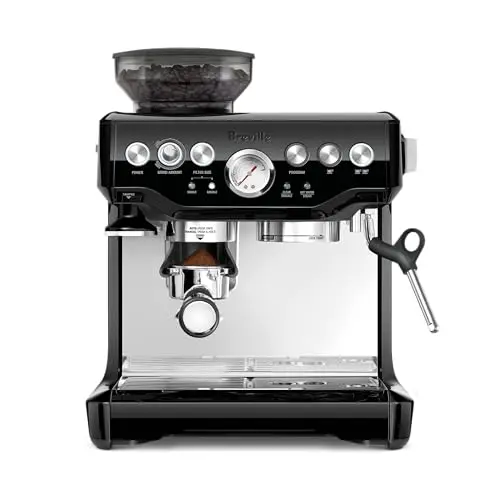
Barista Express – Bean-to-Cup With Manual Steam Control
The Barista Express is the machine most home baristas land on after a few rounds of comparison shopping, and the reason is structural: it puts a conical burr grinder, a 54mm portafilter, and a manual steam wand in one footprint instead of three. Grind goes straight into the basket, so the workflow is genuinely bean-to-cup rather than a relay race across the counter.
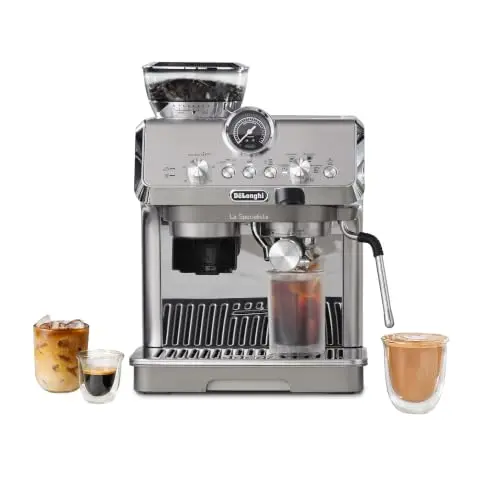
La Specialista Arte Evo – Grinder, Steam Wand, and Cold Brew
De’Longhi’s answer to the all-in-one barista machine leans harder on guidance than the Breville does. There’s a conical burr grinder with eight grind settings, a dosing and tamping guide that takes the guesswork out of puck prep, and a commercial-style steam wand for microfoam. It also does cold extraction, producing cold brew in minutes rather than hours.
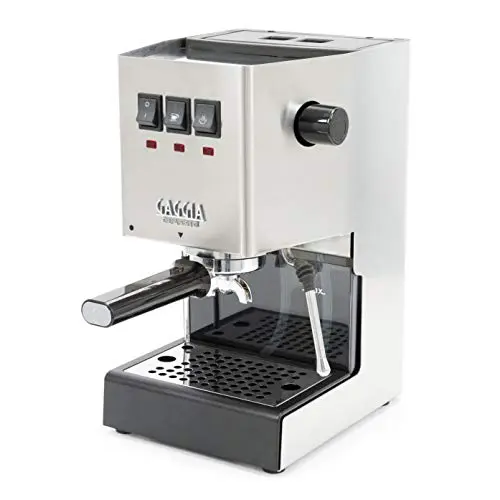
Classic Evo Pro – Commercial Parts, Real Manual Control
The Gaggia Classic Evo Pro is the purist’s machine in this lineup. Solid steel housing, Italian build, a 58mm commercial portafilter, and a commercial three-way solenoid valve – parts you’d normally find on a cafe machine. It ships with no grinder, which is the point: the money goes into hardware you can service and tune for years.
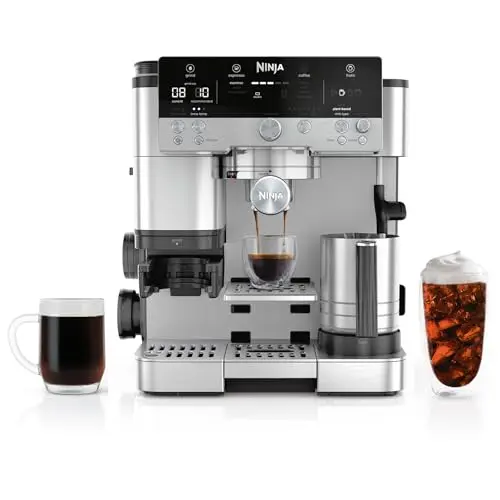
Luxe Cafe Premier ES601 – Guided Barista Assistance
The Luxe Cafe Premier is a three-in-one that treats espresso, drip coffee, and cold brew as equal citizens. Barista Assist technology handles precision grinding, weight-based dosing, assisted tamping, and live temperature and pressure adjustments based on the drink you selected. It’s the most automated path to a decent shot in this lineup.
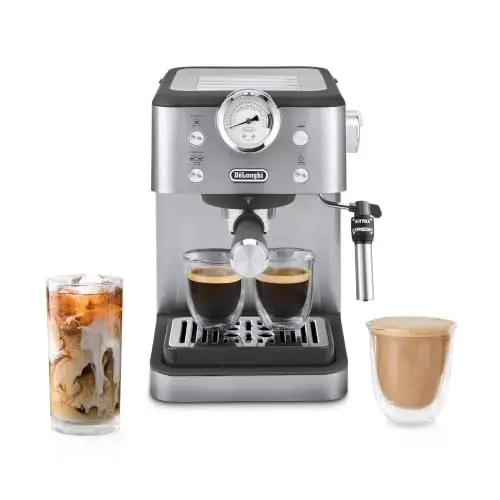
Classic Signature EM450M – Compact Entry Into Real Espresso
A compact, stainless-steel semi-automatic built around a 15-bar Italian pump and Thermoblock heating. Preset single and double shots take the dosing decision off your plate, and a two-setting adjustable steam wand covers both silky steamed milk and richer microfoam. It’s the smallest serious machine De’Longhi makes for home use.
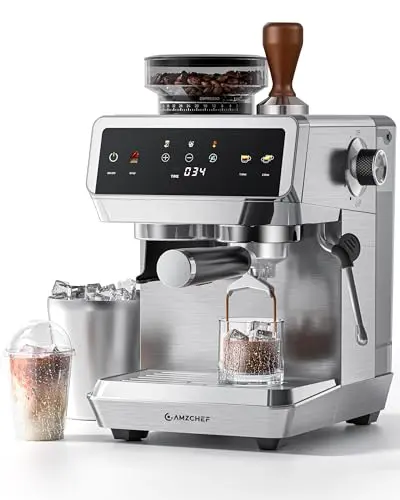
CM1626 – Built-In Grinder With Adjustable Temperature
Rare combination at the entry tier: a built-in grinder with 44 grind settings, adjustable brew temperature, a proper stainless steam wand, and a one-touch cold brew mode. The touch display shows grind time, brew time, and temperature so you can repeat a result instead of guessing at it. It does the things machines two tiers up charge for.
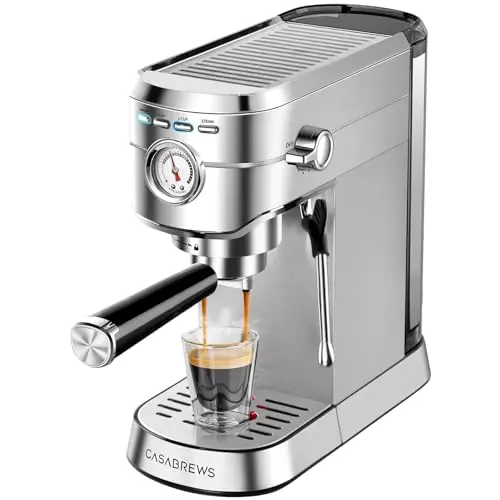
CM5418 – Compact Steam-Wand Espresso
A genuinely small machine – under six inches wide – that still manages a steam wand, a built-in pressure gauge, and a 34oz removable tank. The brushed stainless body looks more expensive than it is, and the narrow footprint is the whole point for apartment kitchens and crowded counters.
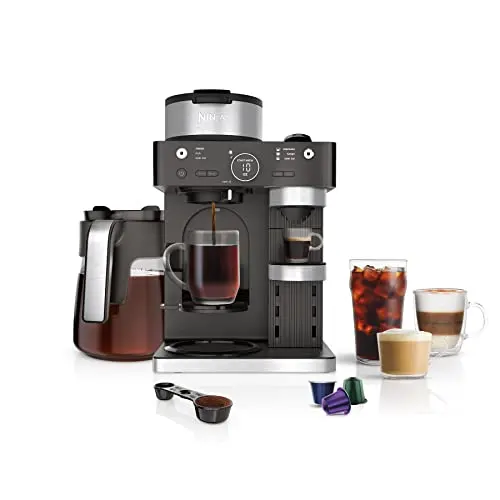
Espresso and Coffee Barista System CFN601 – Capsule and Grounds Flexibility
A hybrid that brews Nespresso Original capsules for espresso and coffee grounds for everything else, including a full 12-cup carafe. Three espresso brew styles, nine coffee sizes, and a fold-away frother cover a lot of ground in one appliance. It’s built for households that want options more than they want dialing-in.
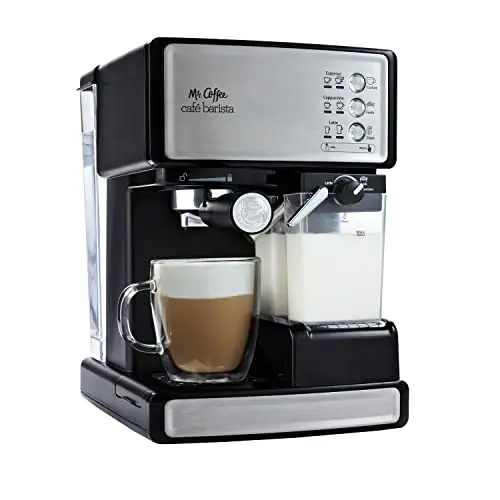
Cafe Barista – Automatic Milk Frother Espresso
A three-in-one semi-automatic that handles espresso, cappuccino, and latte with an automatic milk frother and one-touch drink selection. Choose a single or double shot filter, hit a button, and the machine froths the milk for you. It’s the least intimidating entry point in this lineup.
How We Evaluated These Barista Espresso Machines
We didn’t pull shots back to back for weeks or measure extraction yield with a refractometer. What we did: cross-referenced nine espresso machines from seven distinct brands across six decision axes – grinder integration, steam wand type, temperature control, portafilter size, footprint, and how much manual input each machine genuinely requires. We triangulated published specifications, feature sets, aggregated owner feedback where available, and use-case fit against the two buyer profiles that dominate this category: the person learning the workflow and the person who already knows it and wants better hardware.
The scoring framework weighted real-world performance (70%) – how consistently a machine delivers a well-extracted shot and usable microfoam – against feature differentiation (30%) – unique technical advantages and how specifically each machine serves the barista use case. We have no commercial relationship with any brand featured here; recommendations track fit and differentiation, not brand preference. If you want the grinder and the machine in one box, the Barista Express is our pick. If you’d rather buy hardware you can service and tune yourself, the Classic Evo Pro serves you better.
One pattern worth naming: reliability signals came up repeatedly across this category, so we weighted long-term durability feedback rather than treating it as background noise.
How to Choose the Right Barista Espresso Machine
1. What Makes an Espresso Machine Genuinely Barista-Grade
The word barista gets attached to a lot of machines that haven’t earned it. The practical test is simple: can you change the outcome? A barista-grade machine gives you a non-pressurized filter basket, which means the resistance in the puck comes from your grind and your tamp rather than a valve faking it. That single detail is the difference between a learning curve that’s real and one that’s theater.
The second marker is a steam wand you control by hand. Automatic frothers are convenient, but they produce foam, not microfoam – the wet, glossy milk that integrates into a shot instead of sitting on top of it. If latte art is anywhere on your list, a manual wand is non-negotiable. The third is temperature stability, because a machine that drifts between shots turns brewing into compensation.
2. Built-In Grinder vs. Separate Grinder: The Real Tradeoff
A built-in conical burr grinder is the biggest single convenience upgrade in this category. It eliminates the dose-transfer mess, keeps grounds fresh, and collapses your counter setup into one appliance. Machines like the Breville Barista Express and the De’Longhi La Specialista Arte Evo are designed around this idea, and it’s why they feel like a workflow rather than a gadget. If you want one box and one less purchase, the Barista Express is the pick here.
The counterargument is serviceability. A standalone grinder can be upgraded, repaired, or replaced on its own, and a dedicated burr grinder often grinds more consistently than an integrated unit. Machines built around a 58mm portafilter like the Gaggia Classic Evo Pro assume you’re going this route – no grinder included, and the money goes into the group instead.
3. Steam Wand or Automatic Frother: Choosing Your Milk Route
Manual steam wands give you control over how much air you introduce and when, which is the difference between milk that pours like wet paint and milk that sits in a stiff cap. They also demand practice, and there’s no way around that. Automatic frothers remove the practice entirely and are the right answer for anyone who wants a cappuccino before work without thinking about it.
If you want the wand, the Classic Evo Pro is the pick – its commercial-style wand is the most capable in this lineup. If you’d rather walk away from the milk entirely, the Ninja Luxe Cafe Premier’s dual froth system handles hot and cold foam hands-free, and the Mr. Coffee Cafe Barista’s automatic frother is the least intimidating option of all.
4. Pressure, Temperature, and Portafilter Size Explained
Ignore the pump number. You’ll see machines rated at 15, 19, and 20 bar in this category, and none of that reflects what happens inside the puck – espresso extracts at roughly 9 bar, and the extra headroom is about how the pump is rated, not how the shot tastes. Low-pressure pre-infusion, where the machine wets the puck gently before ramping to full pressure, matters far more than the headline figure.
Portafilter diameter is the spec that actually shapes your long-term experience. A 58mm commercial portafilter opens up the widest range of aftermarket baskets, tampers, and distribution tools. Smaller sizes work fine but narrow your upgrade path. Temperature control splits the same way: PID regulation holds a setpoint shot after shot, while a simpler thermostat drifts and leaves you compensating with your own habits.
5. Where Budget Espresso Machines Cut Corners
Budget machines almost always cut the same three things: the basket, the wand, and the temperature control. A pressurized basket hides bad grind, which is genuinely useful when you’re starting out but caps how good your shots can get. A weak wand makes textured milk difficult to impossible. And no temperature adjustment means you’re stuck with whatever the thermostat happens to give you.
That doesn’t make them bad buys – it makes them starting points. If you want a grinder and adjustable brew temperature without moving up a tier, the CM1626 is the value play, pairing 44 grind settings with a temperature range you can actually dial. If you already own a capable grinder, spend the money on a better pump and wand instead.
6. Kitchen Fit and Daily Upkeep for Barista Espresso Machines
Counter depth is the spec people forget. A full barista setup – machine, grinder, tamping mat, knock box – eats considerably more depth than the machine’s own footprint suggests, and some of these units run deep. Measure the clearance under your cabinets before ordering, particularly if the water tank fills from the top and you need headroom to lift it out.
Daily upkeep matters more than most buyers expect. Backflushing with a blind basket, descaling on a schedule, and emptying the drip tray are non-optional habits, not occasional chores. Machines with removable tanks and dishwasher-safe detachable parts make the routine faster; small tanks make it more frequent. Factor both into your decision.
Frequently Asked Questions
1. Do you need a separate grinder to make barista-quality espresso at home?
Not strictly, but you need a capable grinder somewhere in the chain. Pre-ground coffee loses its aromatics within days and gives you no way to dial in for a new bag of beans, which is the single biggest lever you have over flavor. A built-in conical burr grinder solves that in one box, which is why the all-in-one machines are so popular with people moving up from a basic brewer.
If you already own a good standalone grinder, put the money into the machine instead and treat portafilter size and steam wand quality as your deciding factors. The Barista Express is the simplest path for most people because grinder, dose, and brew all live in one footprint.
2. What's the difference between the Breville Barista Express and the De'Longhi La Specialista Arte Evo?
They’re aimed at slightly different baristas. The Barista Express leans on PID temperature control and low-pressure pre-infusion to make shots forgiving, and its 54mm portafilter accepts a broad range of baskets and accessories. The La Specialista Arte Evo counters with a dosing and tamping guide, three selectable infusion temperatures, and cold extraction that produces cold brew in minutes rather than hours.
The short version: the Breville gives you more room to learn by feel, while the De’Longhi gives you more guardrails and a cold-drink capability nobody else here matches. Both grind on demand into the portafilter.
3. How does the Gaggia Classic Evo Pro compare with the Ninja Luxe Cafe Premier ES601?
They’re close to opposites. The Gaggia is a manual machine built on commercial parts – a 58mm portafilter, a three-way solenoid valve, and a wand you operate by hand. It assumes you want to learn puck prep and temperature management. The Ninja Luxe Cafe Premier goes the other direction with Barista Assist dosing, assisted tamping, and a hands-free dual froth system, plus drip coffee and cold brew modes the Gaggia doesn’t attempt.
Choose the Gaggia if you want to grow into the machine over years and can service it. Choose the Ninja if you want a consistent good cup immediately and don’t care about learning the mechanics.
4. Are barista espresso machines hard to learn?
There’s a real curve, but it’s shorter than the internet makes it sound. The skills are dose consistency, tamping level, and adjusting grind as beans age. Most people get to a drinkable shot within a week and a good one within a month.
The machines that flatten the curve are the ones with guided dosing and preset recipes – the Ninja Luxe Cafe Premier and the De’Longhi La Specialista Arte Evo both shorten the runway considerably. If you’d rather skip the curve entirely and buy hardware built for it, the Classic Evo Pro rewards the effort more than any machine here.
5. How much does a barista espresso machine actually cost to own?
Think in tiers rather than a single number. Entry-level machines give you a pump and a wand but usually skip the grinder, so budget for one separately. Mid-range all-in-ones bundle a burr grinder, temperature control, and a decent wand. Premium manual machines put the money into commercial-grade components that can be serviced rather than replaced.
Ongoing costs are modest but real: descaling solution, water filters if your machine takes one, and eventually a replacement basket or gasket. None of it is expensive relative to what you’d spend on cafe drinks, but ignoring the maintenance schedule is what shortens a machine’s life.
Final Verdict
For most people shopping this category, the Barista Express is the answer – it puts a real grinder, a real steam wand, and temperature control in one box without asking you to buy three separate things. If you’d rather build a setup you can service and tune yourself, the Classic Evo Pro is the purist’s machine, and its commercial portafilter gives you the widest upgrade path in the lineup. And if budget is the hard constraint, the CM1626 gets you a grinder, adjustable brew temperature, and a steam wand together.
The honest summary: buy the machine that matches how much of the workflow you actually want to own. If the answer is none of it, skip the manual wands and non-pressurized baskets until you’ve had a few months of practice.
