
Best Bed Frames For A Tempur-Pedic Adjustable Bed – 2026 Reviews

You already own the expensive half of this decision. A Tempur-Pedic mattress is a real investment, and the base underneath it decides whether that investment gets used the way it was designed to. Get the frame wrong and you end up with a deck that flexes under the foam’s weight, a motor that complains on every lift, or a mattress that creeps toward the foot each time you raise the head.
Two things separate a base that works with dense foam from one that fights it. First, load handling: lifting a heavy memory foam mattress thousands of times puts genuine strain on the motors and the hinge, so weight rating and lift-cycle testing matter more here than they do on a light innerspring setup. Second, deck and retention design – a firm platform and a retainer bar keep a heavy mattress from sliding or bridging over the joints. Presets, quiet motors, and under-bed lighting are the quality-of-life layer stacked on top.
We looked across the market at adjustable bases sold on their own, plus a couple of bundle options for anyone replacing the mattress at the same time. Some are built for a single king, some sync a split king into one continuous surface, and a few are stripped-down budget decks that still nail the two things that matter. Here’s how they compare.
Best Bed Frames for a Tempur-Pedic Adjustable Bed – 2026 Reviews
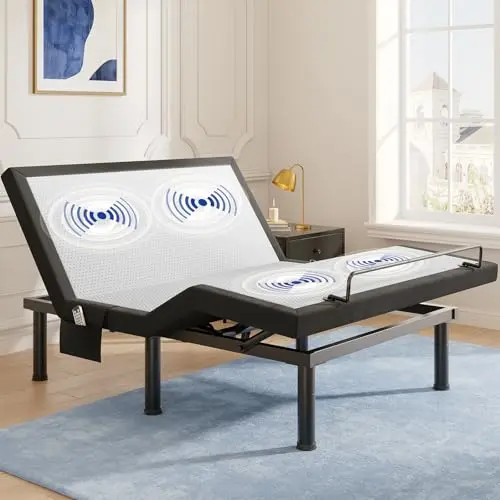
T600 Adjustable Base – 850-lb Capacity, Quiet Dual Motors
A queen-size electric base built on a steel frame with a 12 mm wooden deck plate, rated to 850 pounds. Head and foot sections adjust independently, with zero-gravity and anti-snore presets, massage modes, dual USB ports, under-bed lighting, side pockets, three leg heights, and a retainer bar. Compatible with memory foam, gel foam, latex, and hybrid mattresses under 14 inches.
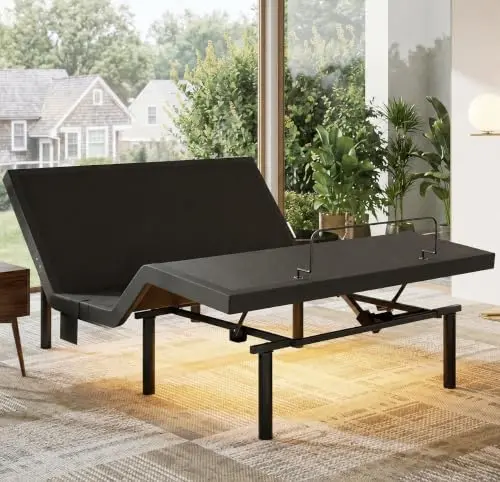
Queen Adjustable Bed Frame – Presets, USB-C, and Night Light
Queen electric base with head lift to 65 degrees and foot lift to 45, TV mode plus two memory presets, dual USB-A and USB-C charging, an LED night light, and adjustable legs spanning roughly 8 to 13 inches. Rated to 750 pounds, tested for 50,000 lift cycles, and fitted with a mattress retainer bar. Tool-free assembly.
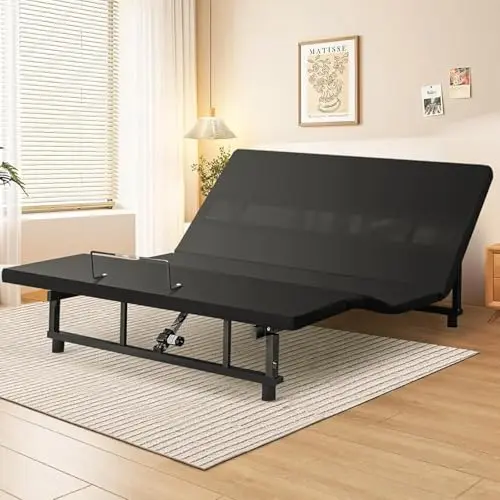
King Adjustable Bed Frame – Extra-Length Heavy-Duty Deck
King-size electric base with a reinforced steel frame rated to 750 pounds and an extra-long deck that keeps feet on the mattress. Head incline runs 0 to 61 degrees, foot 0 to 37, with zero-gravity, anti-snore, and TV modes on a wireless remote. OKIN motors run under 45 dB, and the base fits memory foam, latex, hybrid, and gel foam mattresses.
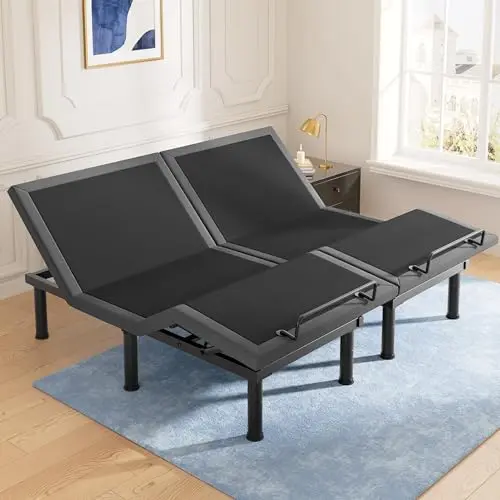
T450 Split King Base – Sync Control as King
Split king base with independent head lift to 65 degrees and foot lift to 45, syncable so a single remote drives both halves as one king. Zero gravity, TV mode, and one-touch flat, whisper-quiet motors under 45 dB, three leg height sections, an under-bed nightlight, a 750-lb rating, and 20,000 lift-cycle testing. Backed by a 5-year warranty.
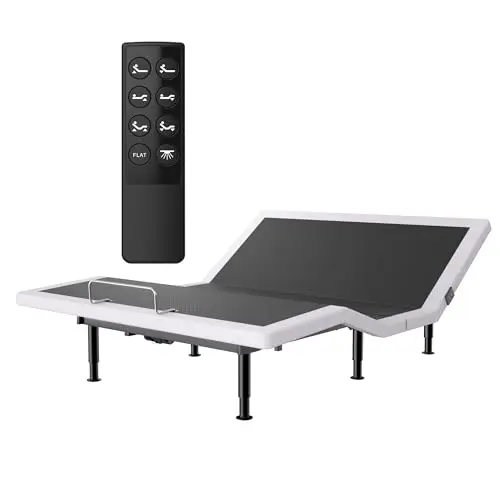
Queen Adjustable Bed Frame – 900-lb Reinforced Steel
Queen base with independent head tilt to 60 degrees and foot tilt to 40 on dual silent motors, built on a reinforced steel frame rated to 900 pounds and tested for 12,000 lift cycles. Under-frame LED lighting, bedside USB ports, and legs adjustable from roughly 10 to nearly 15 inches. Tool-free assembly, compatible with memory foam, latex, and hybrid mattresses.
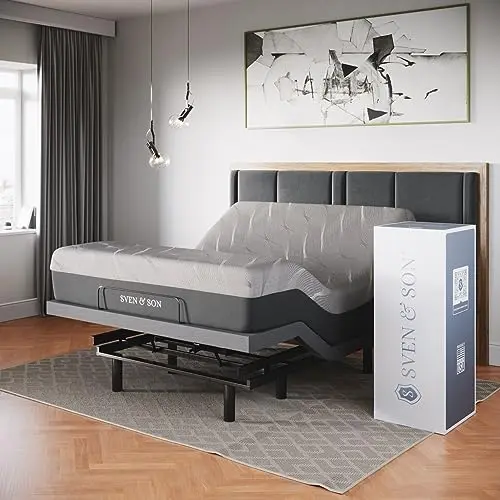
Classic Adjustable Base + 14-Inch Hybrid – 25-Year Warranty
A queen adjustable base bundled with a 14-inch hybrid mattress. Head lift to 75 degrees, foot lift to 45, zero-gravity and anti-snore presets, saved memory positions, multiple massage modes, under-bed lighting, USB ports, adjustable legs, a mattress retention system, and an emergency power-down function. Backed by a 25-year warranty.
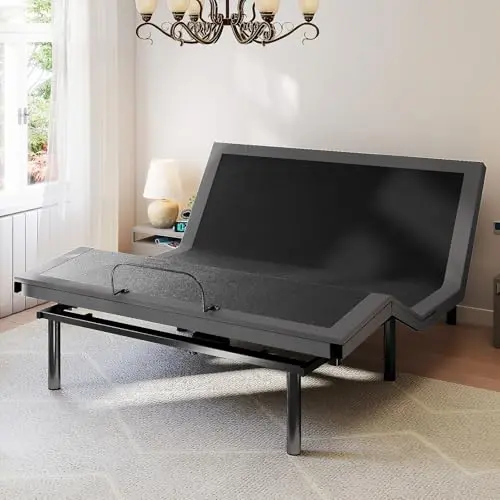
Full Adjustable Bed Frame – Zero-Gravity on a Budget
Full-size electric base with head incline from 0 to 60 degrees and foot from 0 to 40, a wireless remote with one-touch flat, and a zero-gravity position. Rated to 750 pounds, built with an anti-shake structure and a mattress retainer bar, with integrated USB-A and USB-C charging and tool-free assembly.
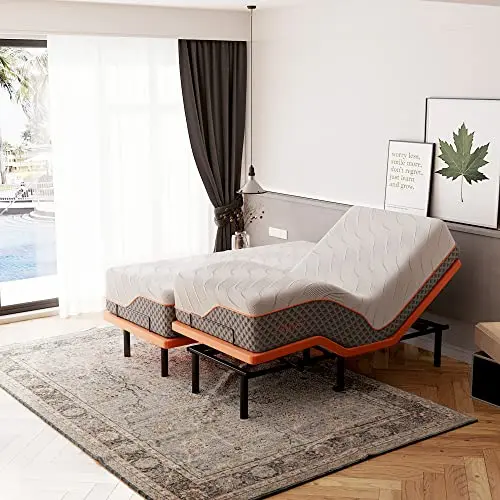
Split King Base + 14-Inch Hybrid – App-Controlled
A split king adjustable base bundled with a 14-inch hybrid mattress. Head lift to 55 degrees, foot lift to 42, zero-gravity and anti-snore modes, three memory presets, app control alongside a wireless remote, massage modes, dual USB ports, under-bed lighting, and legs adjustable from roughly 8 to 11.4 inches. The base carries a 10-year warranty.
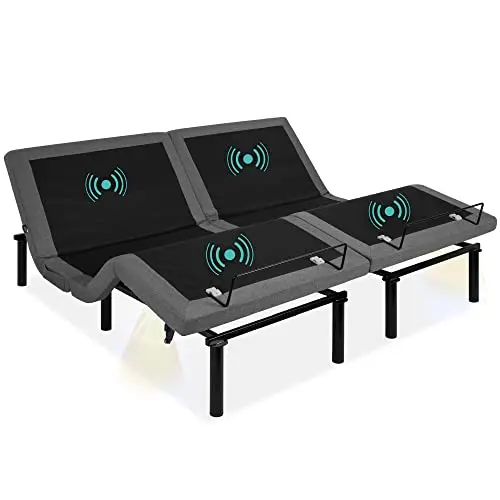
Split King Adjustable Base – Presets and Massage
Split king electric base with TV, head-tilt, and zero-gravity presets plus custom saved positions. Independent head and foot incline, wave, pulse, and constant massage modes, a wireless remote with a flashlight, under-bed night lights, a built-in USB port, a side pocket, and a 750-lb capacity. Compatible with memory foam, latex, and hybrid mattresses.
How We Evaluated These Bed Frames
We didn’t sleep on each of these bases for months on end, and we didn’t run load-cell measurements on the decks. What we did: cross-referenced 9 adjustable bed frames from 8 distinct brands across 6 decision axes – weight capacity and lift-cycle testing, head and foot lift range, deck construction and mattress retention, presets and controls, motor noise and height adjustability, and warranty coverage. We triangulated published specifications, feature sets, and owner feedback where available, then mapped each base against what a heavy foam mattress actually demands: repeated lifting under load, a mattress that stays put when the head rises, and thickness limits the marketing copy never mentions.
The scoring framework weighted real-world fit (70%) – how well each base serves someone keeping an existing memory foam mattress – against feature differentiation (30%) – the extras that separate one frame from the next. There’s no commercial relationship between this review and any brand featured, and recommendations track fit and differentiation rather than brand preference. If load handling and quiet motors are your priority, the T600 is the match; if you’d rather have long lift-cycle durability and presets, the Marsail queen base is the better fit.
One note on the two mattress bundles in this roundup: both are legitimate bases, but they arrive with a mattress attached, which is the opposite of what most Tempur-Pedic owners need. We scored them on the base itself and flagged the bundle lock-in in each write-up.
How to Choose the Right Bed Frame for a Tempur-Pedic Mattress
1. Why Weight Capacity Matters More With a Tempur-Pedic Mattress
A dense memory foam mattress is a different load than an innerspring. It barely compresses, it doesn’t shift around, and it sits on the deck like one heavy slab – so the motors are lifting that full weight plus yours every single time you raise the head. Weight capacity is the first number to check, and it doubles as a proxy for build quality. 750 pounds is the common floor across this market; frames rated above that give you real headroom, which matters most with two adults sharing the bed.
The second number is lift-cycle testing – the manufacturer’s claim for how many raise-and-lower cycles the mechanism survived. It’s the closest thing to a durability signal you can get before purchase, and the spread here runs from roughly 12,000 to 50,000 cycles. A base with a high cycle rating and a modest capacity is usually a better bet than the reverse.
2. Deck Construction and Retention for Heavy Foam Mattresses
Foam grips more than an innerspring does, but a heavy mattress still migrates toward the foot when the head section rises, and it can bridge awkwardly over hinged joints. A retainer bar at the foot is the single most useful design detail in this category, and a solid deck plate distributes load better than an open wire grid.
Look at the hinge and the anti-shake structure too. Two-piece frames – split kings in particular – live or die on how rigidly the halves behave when only one side is raised. That’s where cheap bases reveal themselves, and it’s rarely obvious on a spec sheet.
3. Lift Range, Presets, and the Positions You'll Actually Use
Head sections in this market range from about 55 to 75 degrees, foot sections from 37 to 45. More range is nice, but the useful difference is elsewhere: memory presets, a zero-gravity mode, and an anti-snore setting are what turn a base into something you adjust daily instead of occasionally.
Control style matters as much as the positions. A simple handset is fine; a wireless remote with one-touch flat is better; app control is a genuine convenience if you’re the type who loses remotes. Check whether head and foot adjust independently or together – nearly all frames here do the former, but a split king also needs sync control so one remote can drive both halves.
4. Split King vs Single King: Sizing Your Adjustable Bed Frame
A split king is two twin XL platforms sitting side by side, which is the only option if two people want different positions. The catch is that each half moves independently, so you need sync control or you’ll be juggling two remotes. If you want two independently adjustable halves, the T450 split king is built for exactly that. If you’d rather have one long continuous deck, the Mixcous king frame covers taller sleepers with an extra-length deck.
One practical note: split king bases typically ship as two boxes and can arrive on different days. Don’t schedule a setup afternoon around a single delivery window.
5. Can Your Tempur-Pedic Mattress Sit on Any Base? Thickness and Zero-Clearance
Thickness is the constraint people miss. Some frames explicitly cap compatibility at mattresses under 14 inches, and a thick mattress that sits above the retainer bar can slide or overhang. Measure your mattress before you buy rather than going by the model name.
Zero-clearance setups are the other gotcha. Several bases here require their legs to be installed – they won’t work dropped into an existing platform bed frame with a low rail. Adjustable leg heights (roughly 8 to 15 inches across this market) also decide how easy the bed is to get in and out of and how much storage you gain underneath.
6. Warranty and Motor Life on Adjustable Bed Frames
Coverage in this category swings wildly, from a 60-day window to a 25-year term, and the headline number rarely tells the whole story. Read what’s actually covered: the steel frame is usually the longest-lived component, while motors, control boxes, USB ports, and remotes often fall under shorter tiers.
The question to ask is which part is most likely to fail. It’s the motor and the control box, not the steel. A base with a moderate overall term but strong motor coverage is a better bet than a long warranty that excludes the electronics after year two.
7. What You Get at Each Price Tier
Entry-level bases give you two motors, a remote, a retainer bar, and not much else. They lift fine and they’ll hold a heavy mattress, but expect fewer presets and shorter warranties. Mid-range is where memory presets, USB charging, night lighting, and higher lift-cycle ratings show up – that’s the sweet spot for most Tempur-Pedic owners, since you’re paying for durability and daily usability rather than novelty.
Premium money buys massage modes, app control, the longest warranty terms, and in some cases a bundled mattress you may not need. If you’re keeping your existing mattress, spending up for a bundle is money spent on the wrong half of the purchase. If budget is the deciding factor and full size fits your room, the DUMOS covers the fundamentals without extras.
Frequently Asked Questions
1. Will a third-party adjustable bed frame work with a Tempur-Pedic mattress?
Physically, in most cases yes. The fit questions are deck support, weight capacity, and mattress thickness relative to the frame’s retainer. Memory foam is designed to flex, so it conforms to a raised head section the way an adjustable-friendly mattress does.
Where people get caught out is warranty language. Some mattress makers specify foundation requirements, so read the terms of your own mattress coverage before you commit rather than assuming. The safest version of this purchase is a base with a retainer bar, a solid deck, and a capacity comfortably above your body weight plus the mattress weight combined.
2. Tami Tami T600 vs Marsail: which handles a heavy foam mattress better?
They solve the problem from different angles. The T600 leads on raw capacity at 850 pounds, with high-thrust motors, massage modes, side pockets, and a 5-year warranty – but it caps mattress thickness at under 14 inches.
The Marsail queen base rates to 750 pounds and leans on 50,000 lift cycles, with TV mode, two memory presets, and USB-A and USB-C charging, but no massage. If your mattress is thick and you want maximum load headroom, take the T600. If you want long mechanical life plus preset convenience and a slimmer profile, take the Marsail. Both need their legs installed.
3. Do I need a split king base if my mattress is a split king?
Yes. A split king mattress is two separate pieces, and each half needs its own moving platform – a single-deck king base won’t articulate them separately. The upside is that two sleepers get genuinely independent positions, which is the whole reason people buy split king in the first place.
The feature to look for is sync control, which lets one remote drive both halves together so the bed behaves like a king when you’re not adjusting separately. The Tami Tami T450 is built around exactly that, with independent head and foot positioning when you want it.
4. How much weight capacity do I actually need?
Work it out roughly: your weight, your partner’s weight, and the mattress weight combined, then add margin. 750 pounds is the de facto standard across this market and is usually plenty for a queen or king with a foam mattress.
But capacity is also a build-quality proxy. A frame rated to 850 or 900 pounds typically has beefier motors and a stiffer deck, which translates into less flex and quieter lifting over time – even if you never approach the limit. If two large adults share the bed, buy the headroom.
5. How thick can my Tempur-Pedic mattress be on these bases?
It varies by frame. Some bases explicitly state compatibility for mattresses under 14 inches, and others simply say most memory foam, latex, and hybrid mattresses fit. Many Tempur-Pedic models land somewhere in the 10 to 13 inch range depending on model and size, but measure yours rather than guessing.
The practical issue is the retainer bar: a mattress that sits well above it can slide when the head section rises. If your mattress is on the thick end, favor a base with a taller retention system, like the T600, and check the stated thickness limit before ordering.
Final Verdict
For most people pairing a base with an existing Tempur-Pedic mattress, the T600 is the pick – the highest practical load rating here, quiet dual motors, a retainer bar that keeps heavy foam planted, and massage and USB extras without a premium jump. If presets and long lift-cycle durability matter more to you than massage, the Marsail queen base is the cleaner buy. Taller sleepers on a king should choose the Mixcous for the extra-length deck, and split king owners who want one synchronized surface get it from the T450. The two bundles only make sense if you’re replacing the mattress at the same time. Everyone else should keep the mattress and put the difference into a base with real load headroom.
