
Best Blackout Curtains For Nursery – 2026 Reviews

It’s 3am, the baby is finally down, and a streetlight is throwing a pale stripe across the crib wall. You’ve already tried the blinds. This is the moment most parents start reading curtain listings, and it’s also where the marketing gets slippery – “blackout” isn’t a regulated term, and plenty of panels that claim it will still leave the room glowing around the edges.
Two things separate a nursery curtain that works from one that frustrates you. The first is how the darkening is built – a sewn-in liner or a coated backing behaves very differently from a plain triple-weave panel whose performance shifts with color. The second is coverage: panels wide enough to close the sides, long enough to cover the frame, hung on a rod that reaches past the window.
Fabric that blocks everything in the middle but leaks around the perimeter is the most common disappointment here, and it’s almost entirely a sizing problem. We went through the sets that actually turn up in nursery searches, across brands, and weighed them against what a baby’s room needs: full dark on demand, quiet fabric, and something you can wash without a ritual. Here’s how they stack up.
Best Blackout Curtains for Nursery – 2026 Reviews
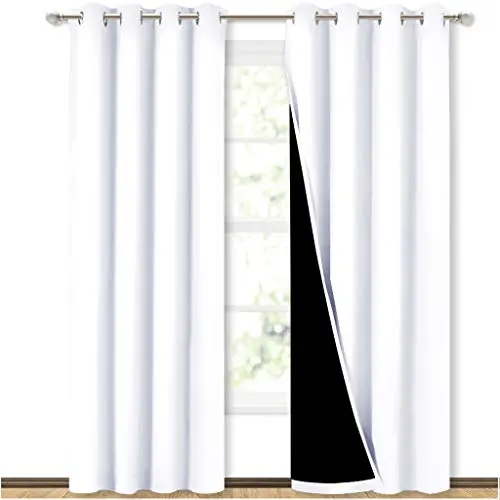
Two-Layer Blackout Drapes – True Dark for Daytime Naps
A white two-panel set at 52 by 84 inches per panel with a sewn-in black liner. The double construction is the reason it goes fully dark rather than just dim, and the heavyweight drape also muffles hallway noise.

Star-Print Kids Drapes – Nursery Decor That Darkens the Room
Two navy panels at 42 by 63 inches with a silver foil star print and a 1.6-inch grommet top. Built for kids’ rooms and nurseries first, with darkening performance that leans heavily on how dark a color you choose.
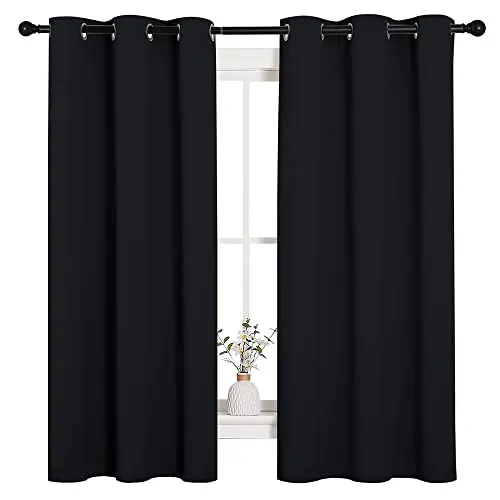
Triple-Weave Blackout Pair – The Affordable Workhorse
Two black panels at 42 by 63 inches, unlined, with triple-weave construction and six grommets per panel. The most affordable route to a genuinely dark nursery corner, and the black color does the heaviest blocking.
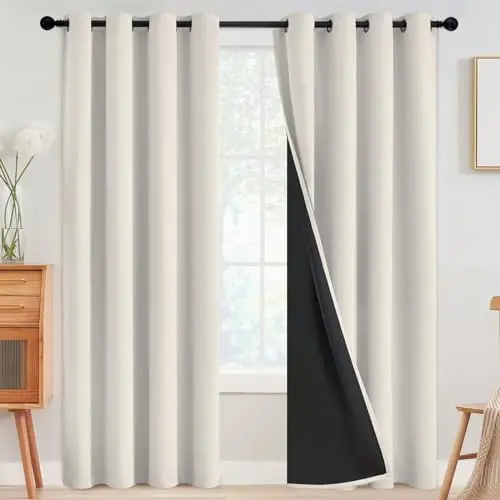
Black-Backed Cream Pair – Dark Room, Soft Neutral Look
Two cream panels at 52 by 84 inches with eight grommets per panel and a black backing that handles the blocking while the face stays a warm neutral. A useful middle ground for nurseries where a wall of dark fabric isn’t the look.
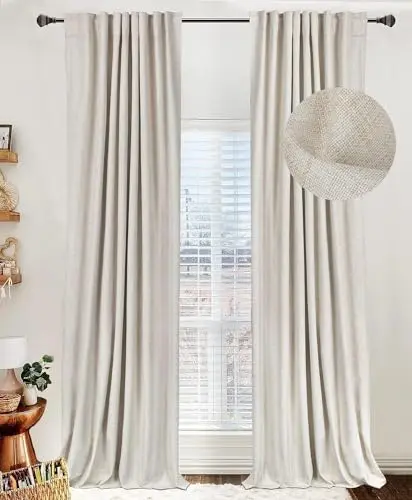
Linen-Look Multi-Hang Drapes – Flexible Mounting, Tighter Edges
Two cream panels at 50 by 84 inches with a linen-textured face and five different hanging methods – back tab, hook belt, rod pocket, clip ring, and track. The flexibility matters most in a nursery, where tight edge coverage cuts the light leaks that wake babies.
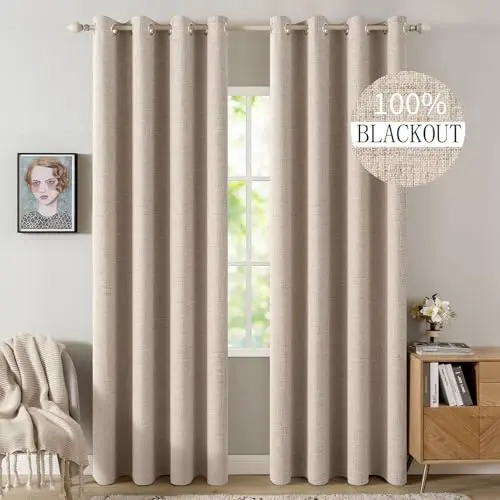
Faux-Linen Blackout Pair – Cool Room, Softer Look
Two beige panels at 52 by 84 inches, eight grommets per panel, and a faux-linen face over a triple-weave blackout build. Aimed at people who want the texture of linen with the function of a blackout drape.

Lined Faux-Linen Pair – Two Hanging Styles, Real Blackout
Two panels at 52 by 84 inches in a linen tone, with a dedicated blackout liner and a top that works as either a rod pocket or back tabs. A sensible all-rounder for a nursery that needs to look like a bedroom.
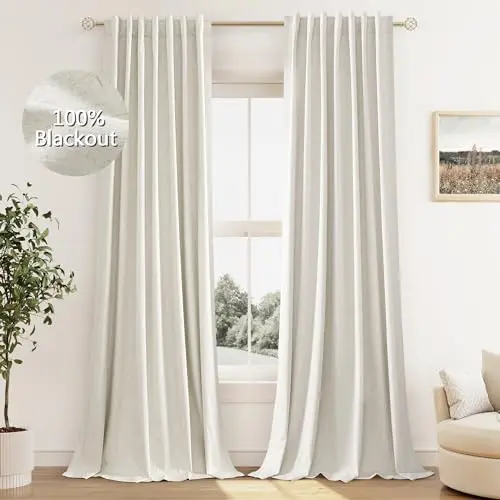
Linen-Blend Blackout Pair – Neutral, Easy to Hang
Two cream panels at 52 by 84 inches in a linen blend with a white blackout coating on the back and three hanging options via back tabs, a rod pocket, or your own clip rings.
How We Evaluated These Blackout Curtains for Nursery
We didn’t stand in a sealed room with a light meter at 6am, and we didn’t run a year of wash cycles to see how the backings held up. What we did: cross-referenced eight blackout curtain models from seven distinct brands across six decision axes – light-blocking construction, panel coverage and sizing, hanging hardware, fabric and lining type, thermal and noise performance, and care requirements. We triangulated published specifications, owner feedback where available, and nursery-specific use-case fit against the realities of a room that needs to go dark at 2pm and again at 7pm.
We weighted the scoring 70% toward real-world performance – how completely a given set blackouts a room with a normal window and a normal rod – and 30% toward feature differentiation, meaning the things that make one panel meaningfully different from the next: a sewn-in liner versus a coating, or a rod pocket that closes edge gaps versus a grommet top that doesn’t. We mapped each set against the two failure modes that actually ruin nursery blackout – fabric that blocks light in the middle but leaks at the edges, and construction that can’t survive being washed. We have no commercial relationship with any brand here; recommendations track fit and differentiation, not brand preference. If you want the most complete set for a nursery, the NICETOWN two-layer drapes are where we’d start; if the budget is the constraint, the triple-weave pair gets you most of the way.
How to Choose the Right Blackout Curtains for Nursery
1. What Actually Makes Blackout Curtains Work in a Nursery
A blackout curtain isn’t a single feature – it’s three working together. Fabric density and weave set the baseline, and three-layer or triple-weave constructions interrupt noticeably more light than a single woven sheet. Color and backing do the rest: dark tones absorb more than pale ones, which is why the same curtain in black and in ivory behaves differently, and any honest 100% blackout claim usually means a coating or a sewn-in liner is in the construction somewhere.
Then there’s coverage, which is where most nurseries lose the battle. The function you’re buying is a room that gets dark on demand – mid-morning nap, a 9pm summer sunset, the early sunrise that convinces a toddler it’s morning. That’s a higher bar than a bedroom blackout, and it’s mostly a sizing question rather than a fabric one.
2. Real Blackout vs Room Darkening: How to Read the Claims
Blackout and room darkening get used interchangeably in listings, and they aren’t the same thing. Room darkening typically means most light is softened but the room still reads as daytime. True blackout should get you close to night. The percentage ranges brands publish are usually color-dependent, and the fine print almost always says darker colors perform better – which is the most useful line in the whole listing.
Here’s the practical read. If a set is described as unlined with a stated range rather than a flat full-block claim, treat it as room darkening and size up accordingly. If it has a sewn-in liner or a coated backing, the full-blackout claim is usually worth taking seriously – the NICETOWN two-layer drapes are the clearest example of that construction in this lineup.
One more caveat: a blackout label describes the fabric, not your window. Fabric that blocks everything still leaks around the perimeter if the panel is narrower than the frame.
3. Sizing Nursery Blackout Curtains: Why Edges Matter More Than the Middle
The single most useful sizing rule is double the window width. Panels that together measure roughly twice the window’s width will close with a slight overlap and fold into real pleats instead of stretching flat. Anything narrower and you get a taut sheet with light pouring down both sides.
On length, longer is almost always better. Hanging the rod well above the frame and letting the panel run to the floor covers the top and bottom leak points that a sill-length curtain leaves wide open. The trade-off is hemming, which is why fixed 84-inch lengths dominate this category. If closing gaps is the entire goal, the 100% Blackout Shield pair is our pick – the rod pocket option pulls the panel flush to the wall in a way a grommet top simply can’t.
4. Grommet, Rod Pocket, or Back Tab: Hanging Style and Light Leaks
Grommet tops are the easiest to slide and the most likely to leak, since the metal rings create a scalloped top edge with visible gaps. Rod pockets hug the rod and the wall, which is the best light-blocking option and the least adjustable. Back tabs sit in between: a soft pleat, tighter than a grommet, and easy to remove for washing.
In a nursery, hanging style is also a safety question. Skip anything that introduces long cords, wands, or loops near the crib, mount the rod into studs or with proper anchors, and keep panels clear of the crib itself so nothing can be pulled down. Sets that give you multiple hanging options are worth a small premium here, because you can adapt when you move rooms or change the rod.
5. Fabric, Lining, and Washing Blackout Curtains in a Baby's Room
Most nursery blackout curtains are polyester, and that’s fine – it holds its shape, resists wrinkling, and washes well. Faux-linen and linen-blend faces add texture and read softer against a neutral nursery, though the actual linen content is usually minimal. Fabric matters less for performance than the backing or liner does; that’s the layer doing the blocking.
Check the care instructions before you buy, not after. Coated backings generally can’t take a hot iron and often prefer hand washing, while plain triple-weave polyester usually goes straight into a cold machine cycle. In a room where curtains will get washed at inconvenient times, that difference is worth more than a nicer texture.
6. What Nursery Blackout Curtains Cost at Each Tier
At the entry tier, expect unlined triple-weave polyester in standard sizes – the blocking is real but color-dependent, and you’ll want to size up. The middle of the market buys you a sewn-in liner or a coated backing, wider panels, and a more considered fabric face; this is where most nurseries land and where the value curve peaks. The premium tier adds multi-hang hardware, heavier construction, and textures that read like real linen – worth it if the room is visible and you’re not rehanging curtains every year.
For a first nursery, the middle of the market is the right answer almost every time. The NICETOWN triple-weave pair sits below that and still darkens a room convincingly; the linen-look sets sit above and buy you looks as much as function.
Frequently Asked Questions
1. Are blackout curtains safe for a nursery?
The curtain itself isn’t the risk – the installation is. Mount the rod into studs or use proper anchors, keep any cords, wands, or long loops out of reach, and make sure the panel can’t be pulled down from the crib. Grommet, rod pocket, and back tab styles are all cord-free at the panel, so the hardware is what you’re vetting.
Two other practical points: keep fabric clear of the crib so nothing drapes within reach, and don’t let long panels hang over a radiator, outlet, or floor vent. Beyond that, blackout fabric is ordinary polyester or a polyester blend and behaves like any other curtain in the room.
2. BGment star curtain vs MIULEE linen pair: which is the better nursery pick?
They solve different problems. The BGment star panels are a 42 by 63-inch room-darkening set with a foil print on a navy ground – decor first, darkening second, with the navy doing real work on light. The MIULEE linen pair is a 52 by 84-inch true blackout with a woven texture and a white backing, so it goes darker and covers more window.
Pick the BGment if the nursery has a theme and a smaller window. Pick the MIULEE linen pair if the priority is a genuinely dark room for daytime sleep and the decor is neutral.
3. Joydeco vs 100% Blackout Shield: which darkens a nursery window better?
Both are built to full blackout, so the difference shows up at the edges. The Joydeco set uses a dedicated liner and offers a rod pocket or back tabs, with 52-inch panels that cover a bit more width. The 100% Blackout Shield pair gives up a little width in exchange for five hanging methods, including a 3-inch rod pocket and track mounting, which lets you pull the panel flush to the wall.
If your window already leaks at the sides and you can’t move the rod, the 100% Blackout Shield pair is the more adaptable choice. If you have a wide window, Joydeco’s extra width does more for you.
4. How wide and long should blackout curtains for a nursery be?
Width matters more than most people expect. Aim for panels totaling roughly twice the window width – a 40-inch window wants about 80 inches of fabric across the pair. That gives you overlap in the middle and enough slack to close the sides.
On length, the standard advice is to hang the rod above the window frame and run the panel to the floor or just below the sill, depending on the look. For a nursery, erring long is safer because it covers the bottom gap that lets in a low sunrise. Check the panel width before you buy – a 42-inch pair and a 52-inch pair behave very differently on the same window.
5. Do I need 100% blackout in a nursery, or is room darkening enough?
Not every baby needs a cave. Some sleep fine in a dim room; others wake the moment a sliver of light hits the wall. The honest answer is that more darkness gives you more control over nap timing and early summer mornings, and it’s much easier to add light back than to remove it.
A practical middle path: buy a true blackout set, then leave a deliberate gap or add a nightlight for overnight feeds so you’re not navigating a pitch-black room at 2am. What you don’t want is room darkening fabric on a window where a 5am sunrise still gets through – that’s the setup that produces a wake-up you can’t fix.
Final Verdict
For most nurseries, the answer is the NICETOWN two-layer drapes. The sewn-in liner is what separates a genuinely dark room from a dim one, and at 52 by 84 inches the coverage actually reaches past the frame. If you’re furnishing a first nursery on a tight budget, the NICETOWN triple-weave pair gets you most of the way there for a fraction of the spend – just buy longer than you think you need. Want the room to look like a kid’s room? The BGment star panels handle a themed nursery better than anything else here, and the navy keeps the darkening honest. And if you’d rather have a curtain that reads like linen, the MIULEE linen pair is the best-looking set that still goes fully dark. Whichever you choose, mount the rod wider and higher than the window and you’ll fix more light leaks than any fabric upgrade will.
