
Best Budget Coffee Grinders – 2026 Reviews

A bag of good beans and a lousy grinder is a lopsided matchup. The grinder decides how evenly water hits the coffee, and no amount of single-origin labeling rescues a brew built on a mix of powder and pebbles. The good news is that the affordable end of this category has gotten genuinely usable – you don’t need to spend much to get fresh grounds that beat pre-ground every morning.
What separates a good budget grinder from a frustrating one comes down to two things. First, whether the machine can produce a consistent particle size for the way you brew – blade grinders chop, burr grinders crush, and that difference shows up in the cup. Second, how much of your morning it consumes: how long it takes, how loud it is, and whether cleanup is a ten-second rinse or wiping grounds out of a fixed bowl with a damp paper towel.
We looked across the major brands in the affordable tier – blade grinders, entry-level burr mills, and a hand grinder for people who brew away from an outlet – and ranked them on what they actually do well rather than on spec-sheet bragging. Below you’ll find the picks worth your money and, just as usefully, the places where cheap grinders still cut corners.
Best Budget Coffee Grinders – 2026 Reviews
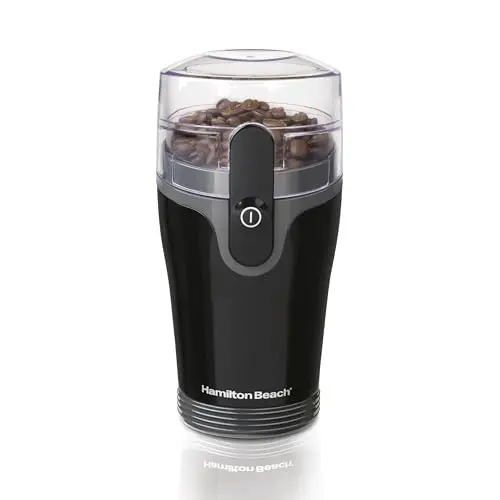
Fresh Grind 80335R – Removable Dishwasher-Safe Bowl
A compact blade grinder that gets the daily job done with less fuss than most of its rivals, thanks to a grinding bowl that lifts out for filling, pouring, and dishwasher cleaning. It handles enough beans for a full twelve-cup pot and stores its own cord underneath.

F20342 Precision Grinder – 200W for Beans and Spices
The most capable all-rounder in the cheap electric tier: a punchy motor, the largest blade-grinder hopper here, and blades that take on peppercorns, nuts, and seeds as readily as coffee beans.
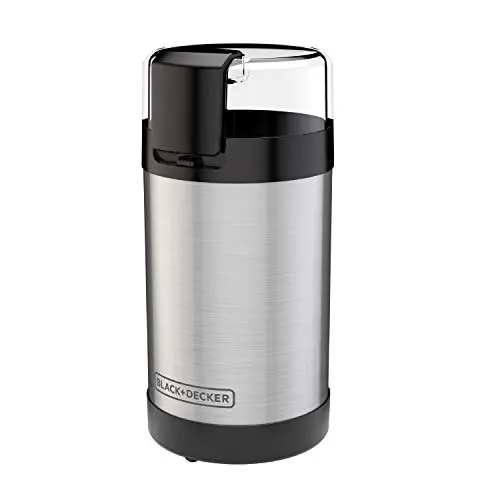
CBG110S One Touch – Stainless Bowl, Two-Year Warranty
A small, quiet, stainless-lined blade grinder backed by the longest warranty in this roundup. It punches above its size on grind speed and feels sturdier than the plastic-bowl competition.
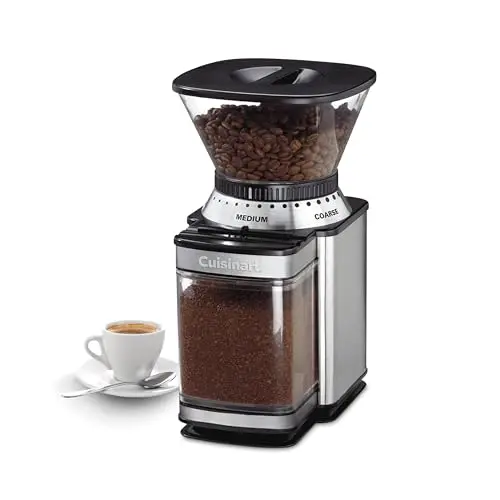
Supreme Grind DBM-8P1 – Entry-Level Burr Precision
The least expensive route into real burr grinding. Flat stainless burrs, eighteen grind settings, and a cup selector with automatic shutoff put noticeably more even grounds in your basket than any blade machine at this tier.
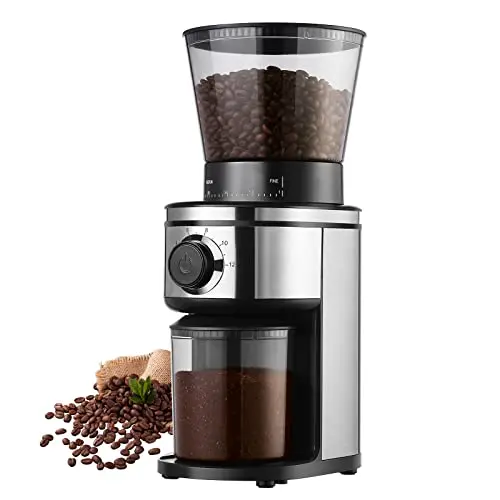
BG702S-PG Conical Burr Grinder – Quiet, Uniform Grinding
An upgrade-tier burr grinder that behaves like a much more expensive machine: slow-turning conical burrs, thirty settings, a spill-resistant hopper, and the quietest operation in this lineup.

FreshGrind 80301PS – Lowest-Cost Fresh Grounds
The cheapest ticket into fresh-ground coffee, and it doesn’t ask much of you: press, hold, release. It also handles seeds, herbs, and spices without complaint, which makes it a solid first grinder or a spare.

Coffee Bar DCG-20BKN – Simple One-Touch Grinding
A tidy, predictable blade grinder with a marked clear lid that lets you portion beans by eye and watch the grind develop. Best suited to drip and French press duty in a one-or-two-pot household.
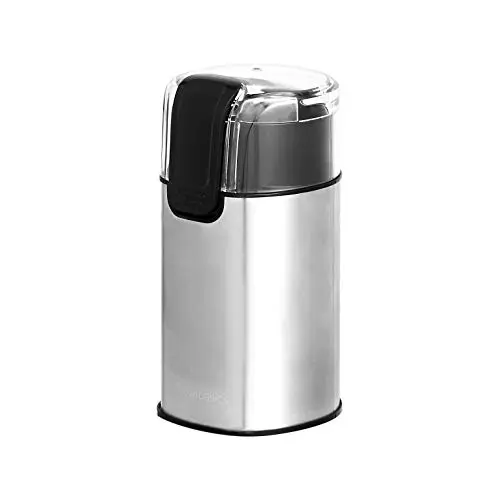
CG9402-UL Fast Grinder – One Ounce in Ten Seconds
Speed and simplicity at a low outlay. Roughly an ounce of beans in ten seconds, a heavy-duty steel blade that also handles spices and nuts, and a clear lid so you can watch the grind instead of guessing.
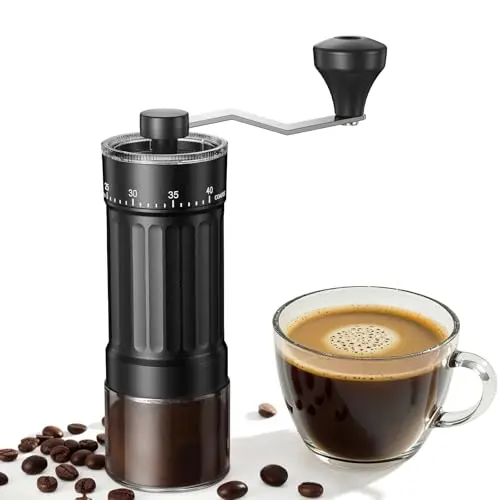
MCG-01 Mini Hand Grinder – Travel-Ready Ceramic Burrs
A hand grinder small enough to live in a duffel bag, with external grind adjustment that’s genuinely rare at this price. No cord, no outlet, no noise – just a couple of minutes of cranking for a fresh cup anywhere.
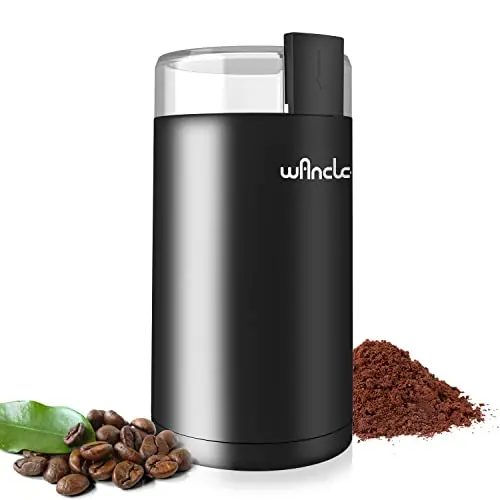
P00273 Electric Grinder – Compact Bean and Spice Mill
A small, quiet, low-cost mill with a copper motor and a stainless bowl. It handles spices and seeds as readily as beans, which makes it a natural second grinder rather than a main workhorse.
How We Evaluated These Budget Coffee Grinders
We didn’t run lab particle-size analysis or grind batch after batch for months on these machines. What we did: cross-referenced 10 coffee grinders from 9 distinct brands across six decision axes – grind consistency, motor and blade-or-burr design, capacity, cleanup, build quality, and how each one behaves in a real morning routine. We triangulated published specifications, mapped feature sets against common brewing methods, and weighed owner feedback where available to see which claims hold up beyond a first impression.
The scoring framework weighted real-world fit for a budget buyer (70%) – how well each grinder delivers on the job it’s sold for without asking you to work around its quirks – against feature differentiation (30%) – lid interlocks, removable bowls, grind selectors, warranty length, and anything else that separates near-identical machines. We have no commercial relationship with any brand here; the ranking tracks fit and differentiation, not brand preference. If you want one grinder that does everything without fuss, the Hamilton Beach Fresh Grind 80335R is the match; if the goal is the smallest outlay that still produces fresh grounds, the Proctor Silex FreshGrind 80301PS covers it.
What we can’t tell you is how any individual motor holds up after two years of daily duty. Grinders in this tier are built to a price, and long-term reliability feedback is genuinely mixed across every brand we looked at. Weigh that against the low cost of replacement, and against the fact that most of these machines are simple and easy to live with while they last.
How to Choose the Right Budget Coffee Grinder
1. What Budget Actually Buys You in a Coffee Grinder
An inexpensive grinder isn’t a worse version of an expensive one – it’s a different set of tradeoffs. At the affordable end, every machine makes roughly the same bargain: a simple universal motor, a plastic housing, and a blade or small burr set, in exchange for a price that makes fresh-ground coffee an everyday habit rather than a hobby.
What you’re really buying at this tier is consistency you can work with. Blade grinders chop unevenly, which is fine for drip and French press where the brew method is forgiving, and less fine for pour-over or espresso where uniform particles matter. The step up to an entry-level burr mill buys uniformity; what it doesn’t buy is quiet operation, tidiness, or commercial-grade durability. Spend accordingly and your expectations will line up with reality.
2. Blade vs. Burr: The Choice That Shapes Every Budget Coffee Grinder
Blade grinders spin a propeller and chop. They’re fast, cheap, and versatile – most will grind spices and nuts too – but the particle size is a bell curve, with dust and chunks in the same batch. Burr grinders crush beans between two abrasive surfaces and produce a far narrower particle range, which is why burr mills dominate for espresso and pour-over.
For drip coffee and French press, a careful blade grinder with pulse-and-check technique gets you most of the way there. If you’ve been chasing sour-then-bitter swings in a pour-over, though, inconsistency is usually the culprit. The Cuisinart Supreme Grind DBM-8P1 is the least expensive route into real burrs in this lineup, and it’s the upgrade we’d make first.
3. Capacity: Matching a Budget Coffee Grinder to Your Daily Cups
Cup-count claims need translating. Most of these grinders are rated in ounces or grams of beans against a cup number, and a generous rating assumes a small cup – figure on roughly 2 to 2.5 ounces of beans for a full drip batch. If you brew a big pot every morning, check the bean capacity, not the cup number on the box.
Smaller chambers are actually an advantage for single-serve brewing, since a partially filled bowl grinds more evenly than a barely covered blade. The tradeoff is that a full-pot household will be grinding twice. Decide which morning you actually have before you buy.
4. Cleanup and Build Quality: Where Cheap Coffee Grinders Cut Corners
The single biggest quality-of-life difference in this category is whether the grinding bowl lifts out. A removable, dishwasher-safe bowl turns a two-minute wipe-down into a five-second rinse; a fixed chamber means reaching around a blade with a damp cloth, and coffee oils go rancid if you don’t.
Build quality follows the same pattern. Stainless steel bowls and blades outlast plastic, lid interlocks stop accidental starts, and cord storage keeps the counter sane. What you won’t find at this price is a sealed gearbox or a serviceable motor – these are simple machines meant to be replaced rather than repaired, which is worth factoring into how much you spend.
5. Manual Hand Grinders: The Other Budget Route
A hand grinder sidesteps motors, cords, and noise entirely, and in the affordable tier it can deliver more uniform grounds than an electric blade grinder. The cost is your forearm and a couple of minutes per dose, which is a fair trade for camping, travel, or a shared apartment where early-morning grinding isn’t welcome.
Look for external grind adjustment and ceramic or steel conical burrs. If portability is the entire point, the CEVING MCG-01 is the pick here – forty external settings in a body that weighs less than a paperback.
6. How to Avoid the Two Most Common Budget Grinder Regrets
Regret one: buying too small. A grinder that holds enough for two mugs becomes a daily irritant in a four-cup household, and cup-count ratings routinely oversell real capacity. Regret two: expecting espresso from a blade grinder. That isn’t a technique problem you can fix with more pulsing – the particle spread is simply too wide, and no budget blade grinder solves it.
If you brew a full pot most mornings and want the least fuss, the Hamilton Beach Fresh Grind 80335R is the one to get – a removable dishwasher-safe bowl and twelve-cup batch capacity cover the daily job. If espresso or pour-over is the goal, budget for burrs instead and accept a smaller batch.
Frequently Asked Questions
1. What's the difference between the Hamilton Beach Fresh Grind and the KRUPS F203?
Mostly the bowl and the batch size. The Hamilton Beach Fresh Grind 80335R uses a removable, dishwasher-safe grinding bowl, which makes cleanup a rinse instead of a wipe-down, and it’s the quieter of the two. The KRUPS F20342 counters with a 200-watt motor and a 3 oz capacity – the larger hopper of the pair – plus a real talent for spices and nuts.
If you’ll only ever grind coffee and hate cleaning, take the Hamilton Beach. If you want one inexpensive machine for peppercorns, flax, and coffee, the KRUPS F20342 is the more versatile pick.
2. Cuisinart Supreme Grind vs. Ollygrin BG702S-PG: which budget burr grinder should you buy?
The Cuisinart Supreme Grind DBM-8P1 is the established budget burr: eighteen grind settings, an 8 oz hopper, a cup selector with automatic shutoff, and a grind chamber that holds enough for a crowd. It’s also loud, prone to scattering grounds, and its long-term reliability record is uneven.
The Ollygrin BG702S-PG costs more but brings 40 mm conical burrs, a slower gear-reduction motor, thirty settings, a spill-resistant auto-locking hopper, and overheat and clutch protection. It’s quieter and tidier, and feedback on grind uniformity is stronger. If the grinder lives on your counter and you grind daily, the Ollygrin BG702S-PG is worth the stretch; on a strict budget, the Cuisinart does the core job.
3. Are budget coffee grinders consistent enough for pour-over and French press?
French press is forgiving – a coarse, slightly uneven grind still steeps into something drinkable, so a blade grinder used with short pulses works fine. Pour-over is stricter: water flows through the bed at a rate set by particle size, so fines slow the drawdown and over-extract while boulders under-extract and leave the cup thin.
That’s the point where a burr grinder earns its place, even an inexpensive one. If pour-over is your daily brew, prioritize uniformity over capacity and accept a smaller hopper.
4. How long should a budget coffee grinder last?
Honestly? Plan on a couple of years of regular use and be pleasantly surprised beyond that. These are simple motors in plastic housings, and durability feedback across this tier is genuinely mixed – some units run for years, others quit within months.
Warranty length is the clearest signal of how much confidence a brand has in its own build: coverage here ranges from a single year up to two years. Given the low cost of entry, most people treat these as replaceable tools rather than lifelong appliances, which is a reasonable way to shop the category.
5. Can you use a budget coffee grinder for spices, nuts, and seeds?
Yes – most electric blade grinders in this tier are explicitly built for it, and several list peppercorns, fennel, flax, chia, and nuts as intended uses. Stainless steel blades handle hard seeds better than you’d expect from a machine this size.
Two caveats. Coffee oils and spice oils linger, so either clean thoroughly between uses or keep a second inexpensive grinder for spices. And don’t chase nut butter in a small blade bowl – you’ll end up with a gunky chamber that’s genuinely annoying to clean.
Final Verdict
For most buyers, the Hamilton Beach Fresh Grind 80335R is the answer – it grinds a full pot in seconds, runs quieter than most rivals, and the removable dishwasher-safe bowl makes it the least annoying grinder here to live with. If you’re spending as little as possible, the Proctor Silex FreshGrind 80301PS does the same basic job for less and still handles spices and seeds on the side. And if uneven particle size is what’s been disappointing you, step up to the Cuisinart Supreme Grind DBM-8P1, which trades a little convenience for a genuinely more uniform grind and eighteen settings to brew with. Brewing away from a kitchen counter? The CEVING MCG-01 is the travel pick. Whatever you choose, buy beans whole and grind just before you brew – that habit matters more than any upgrade in this lineup.
