
Best Budget Comforters – 2026 Reviews

A comforter shouldn’t be one of those purchases you regret every time you make the bed. Budget bedding has gotten genuinely good: brushed microfiber covers, down-alternative fills, and box stitching that used to show up only on pricier sets are now common at approachable tiers. But budget is not shorthand for good enough. The difference between a cheap comforter and a smart budget comforter usually comes down to fill weight, cover feel, and how the stitching holds up after washing.
The best budget comforters balance warmth with breathability and avoid the two classic traps: a cover that feels plasticky and a fill that clumps into one corner. You’ll also run into three broad formats-standalone comforters, duvet inserts, and bed-in-a-bag bundles-and each asks a different question of your wallet and your bed setup.
This guide looks across brands to help you pick from the budget comforter market, not from one company’s catalog. We’ll focus on the details that actually change how a comforter feels at night: fill, fabric, construction, included pieces, and care. The goal is simple-find a comforter that feels like an upgrade without turning into a long-term regret.
Best Budget Comforters – 2026 Reviews
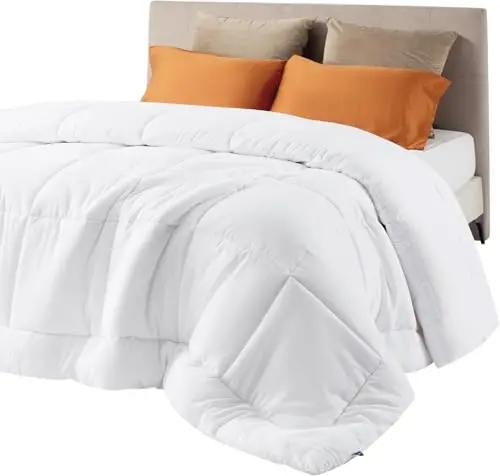
Comforter Duvet Insert – All-Season Box-Stitch Essential
A white down-alternative comforter that works as a standalone blanket or a duvet insert. Box stitching, corner tabs, and a machine-washable build make it the most flexible pick in this budget lineup.
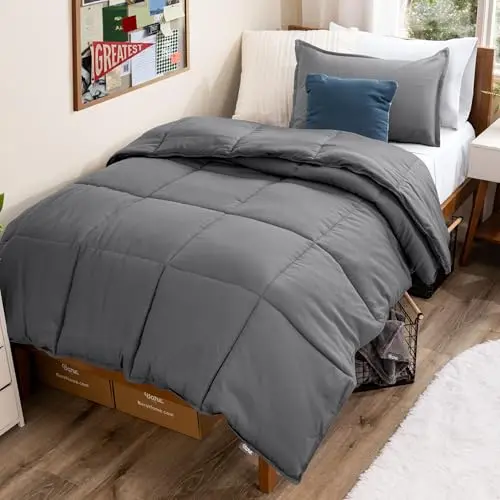
Ultra-Soft Down Alternative Comforter Set – Soft All-Season Starter
A brushed microfiber comforter set with a 300 GSM down-alternative fill, box stitching, and a matching sham. The twin/twin XL set is a simple, low-risk starter for guest rooms, dorms, and budget primary bedrooms.

All-Season Down Alternative Comforter – Duvet Insert With Corner Tabs
A lightweight down-alternative comforter that doubles as a duvet insert. Box stitching, corner tabs, and a soft polyester cover make it a practical year-round layer.
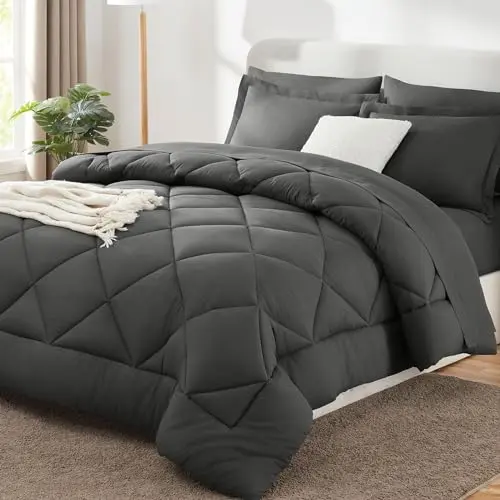
7-Piece Bed in a Bag – Complete Queen Setup
A complete queen bedding bundle with comforter, sheets, pillowcases, and shams. The 240 GSM down-alternative fill and brushed microfiber cover are designed for year-round use, and the deep-pocket fitted sheet fits mattresses up to 14 inches.
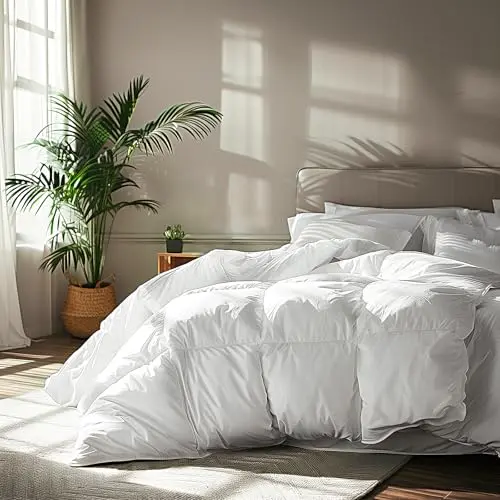
Goose Feather Down Fiber Comforter – Hotel-Style Cotton Cover
A hotel-inspired duvet insert with a 100% cotton cover and a feather-and-down-fiber fill. Sewn-through box construction and corner loops help it work with a duvet cover, while the medium-warmth build targets year-round use.
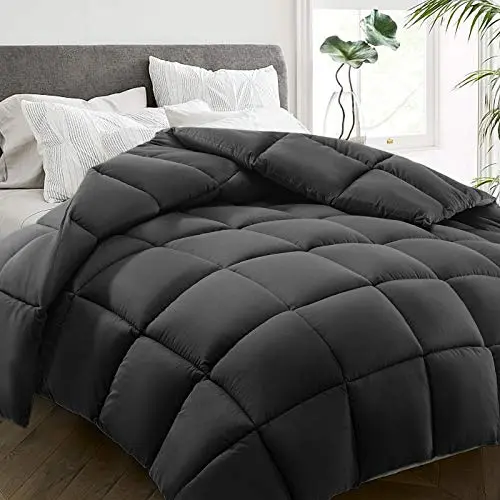
All-Season Down Alternative Comforter – Peach-Skin Softness
A soft, lightweight down-alternative comforter with a peach-skin brushed cover and box-stitch quilting. It’s designed as a year-round duvet insert or standalone comforter.
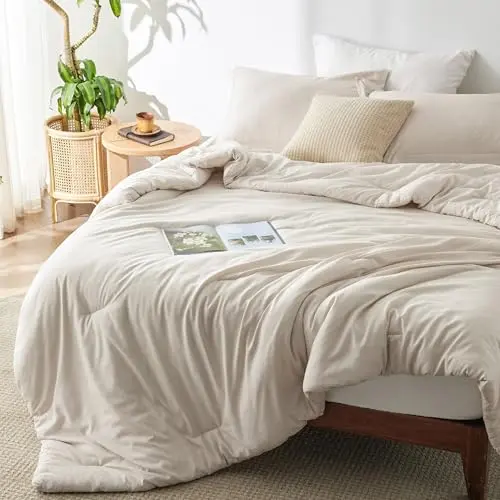
Cationic Dyed Comforter Set – Heathered 3-Piece Look
A three-piece comforter set with a heathered, cationic-dyed finish. The brushed microfiber cover, corner loops, and matching shams make it a low-key upgrade for a bedroom.
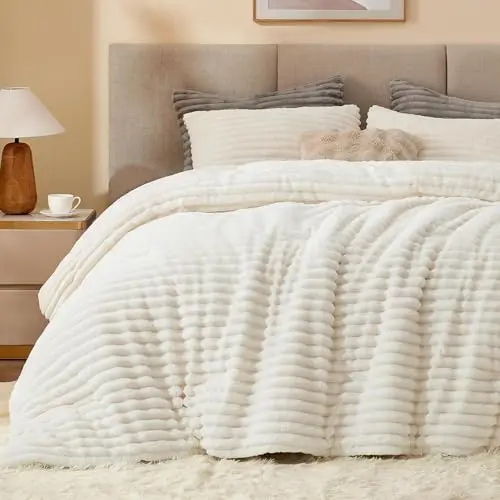
Fleece Faux Fur Comforter Set – Heavy Plush Warmth
A plush fleece comforter set with a faux-fur texture on one side and a micro-mink reverse. The down-alternative fill and cream white finish make it a winter-focused budget option.
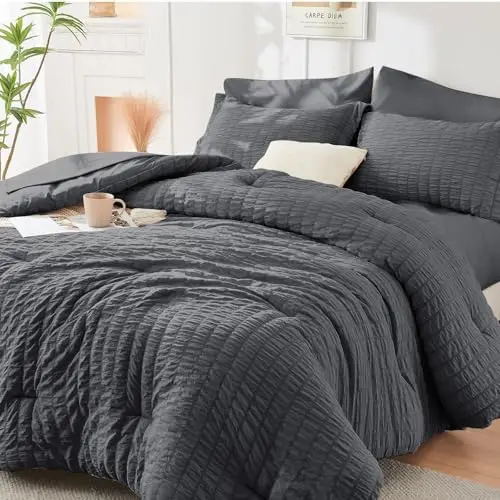
Seersucker 7-Piece Bed in a Bag – Textured Complete Set
A seven-piece queen bedding set with a seersucker texture, deep-pocket fitted sheet, and 240 GSM down-alternative comforter. It’s a complete setup with a bit more visual interest than a plain solid.
How We Evaluated These Budget Comforters
We didn’t put these comforters through months of nightly sleep or repeated wash-cycle testing. What we did: cross-referenced 9 budget comforter models from 8 distinct brands across 6 decision axes – fill weight and type, cover fabric, warmth versus breathability, stitching and fill control, included pieces, and care requirements. We triangulated published specifications, feature sets, owner feedback where available, and use-case fit for different bedrooms and sleep temperatures. We also weighed how each option behaves as a standalone comforter versus a duvet insert, because that flexibility matters more in this category than marketing language. We audited care instructions, size options, and included components to separate true budget value from a low sticker that cuts corners. We did not measure thermal performance in a lab or track loft loss over a season.
The scoring framework weighted real-world fit (70%) – how well each comforter delivers on warmth, softness, and practical care – against feature differentiation (30%) – unique construction, included pieces, size range, and buyer-specific advantages. We mapped budget tiers, but we did not treat the lowest price as automatically better; a cheap comforter that sleeps hot or sheds seams is not a value. We benchmarked each pick against the common budget-comforter failure points: thin fill, plasticky covers, weak seams, and misleading size photos. We have no commercial relationship with any of the brands featured; recommendations track fit and differentiation, not brand preference. If you want one flexible all-season insert, the Bedsure Comforter Duvet Insert is the pick; if you want a soft twin-room set with a sham included, the Bare Home Ultra-Soft Down Alternative Comforter Set is the stronger match.
How to Choose the Right Budget Comforters
1. What Makes a Budget Comforter Worth Buying?
A budget comforter should earn its place on fill weight, cover feel, and box stitching rather than price alone. Look for down-alternative fill that is evenly distributed, a brushed microfiber or cotton cover, and corner tabs if you plan to use a duvet cover. The best budget picks avoid the two common failure points: a plasticky cover and a fill that clumps after washing.
2. Fill Weight and Warmth: Finding the Right Budget Comforter for Your Bedroom
Fill weight is the clearest shortcut to warmth, and breathability matters as much as loft. A 240 GSM or 300 GSM down-alternative fill is a common budget range. If you sleep hot, prioritize airflow over thickness; if you sleep cold, plan to add a blanket rather than expecting a summer-weight insert to do winter work. If you want a lightweight insert for year-round use, the COHOME All-Season Down Alternative Comforter is a sensible match.
3. Cover Fabric and Softness: Microfiber, Cotton, and Fleece
Brushed microfiber is the budget standard because it’s affordable, soft, and machine-washable. Cotton covers breathe better and feel more traditional, but they usually push you toward the top of the budget range and may require dry cleaning. Fleece and faux fur are warm-weather mismatches for hot sleepers but great for winter coziness.
4. Stitching, Tabs, and Fill Control
Box stitching keeps fill from migrating, and sewn-through construction is a common upgrade. Corner tabs or loops matter if you’ll use a duvet cover; they anchor the insert and prevent midnight bunching. Check the number of tabs if you toss and turn. For a complete bundle with sheets and shams, the CozyLux 7-Piece Bed in a Bag is the practical route.
5. Comforter vs Duvet Insert vs Bed in a Bag
A standalone comforter is the simplest buy; a duvet insert gives you styling flexibility but needs a cover; a bed in a bag covers the whole bed in one order. Budget bundles can be a great value, but check sheet depth, pillowcase count, and whether the comforter is lightweight by design. If you want a hotel-style cotton cover and don’t mind dry-clean care, the Serta Goose Feather Down Fiber Comforter is the step-up pick.
6. Care and Durability: What Budget Comforters Can Handle
Machine-washable care is a baseline for budget bedding. Wash cold on gentle, tumble dry low, and avoid overloading the machine. Seam durability is the most common weak point in this tier; reinforce with gentle cycles and inspect after the first wash. Vacuum-packed comforters need 24-48 hours to fluff, so don’t judge loft straight out of the box.
7. How to Spot a False Bargain
A low price isn’t a value if the comforter is too thin, undersized, or sheds seams after a wash. Compare dimensions against your mattress, read care instructions, and check whether the fill is whole-piece or loose. OEKO-TEX certification is a useful safety signal, but it doesn’t guarantee durability. The strongest budget picks balance softness, warmth, and realistic care.
Frequently Asked Questions
1. What separates a good budget comforter from a cheap one?
A good budget comforter earns its price with fill weight, cover feel, and corner tabs rather than a flashy label. Look for even fill distribution, a soft shell, and a machine-washable build. A cheap comforter usually reveals itself through thin loft, a plasticky shell, or seams that start to pull after the first wash.
2. Are budget comforters warm enough for winter?
Yes, but it depends on fill weight and how you sleep. A lightweight all-season comforter can work in winter for average bedrooms, especially if you add a blanket. If you sleep cold, prioritize a higher-loft or medium-warmth option rather than expecting a summer-weight insert to do all the work.
3. Bedsure Comforter Duvet Insert vs COHOME All-Season Comforter: Which budget duvet insert should you choose?
Choose the Bedsure Comforter Duvet Insert if you want the most flexible all-season insert. Its box-stitch construction, 8 corner tabs, and broad size range make it easy to use alone or inside a duvet cover. The COHOME All-Season Comforter is a lighter, simpler alternative with whole-piece polyfill; it’s a good fit if you want a basic duvet insert and don’t need the same size spread.
4. Bare Home Comforter Set vs CozyLux 7-Piece Bed in a Bag: Which budget set is the better buy?
Go with the Bare Home Ultra-Soft Down Alternative Comforter Set if you want a soft twin-room set with a matching sham and a 30-night trial. Choose the CozyLux 7-Piece Bed in a Bag if you need a 7-piece bundle with deep-pocket sheets and shams in one order. Bare Home is the softer, simpler set; CozyLux is the more complete furnishing package, though its lightweight fill won’t suit cold sleepers.
5. Do budget comforters hold up after washing?
Most budget comforters are machine washable, but care still matters. Wash cold on a gentle cycle, tumble dry low, and avoid overloading the machine. Seam durability is the weak point in this tier, and vacuum-packed comforters need 24-48 hours to fluff before you judge the loft.
Final Verdict
For most budget shoppers, the Bedsure Comforter Duvet Insert is the answer. It nails the basics-box-stitch fill control, corner tabs, and all-season warmth-without forcing you into a duvet cover or a dry-clean routine. If you want a soft, complete twin-room setup, the Bare Home Ultra-Soft Down Alternative Comforter Set includes a matching sham and a 30-night trial, which is rare at this tier. For a one-box queen setup, the CozyLux 7-Piece Bed in a Bag covers the comforter, sheets, and shams in a single order; just go in understanding it’s a lightweight all-season build. And if a cotton cover and hotel-style feel matter more than the lowest budget tier, the Serta Goose Feather Down Fiber Comforter is the splurge. Start with the Bedsure insert unless your bed setup points clearly to a bundle or a cotton upgrade.
