
Best Budget Manual Coffee Grinders – 2026 Reviews

A hand grinder is the quiet upgrade that makes a modest coffee setup taste fresher. The catch is that the budget end of the market is crowded with lookalike mills that promise espresso-range adjustment and deliver uneven, powdery grinds. Budget shouldn’t mean sacrificing the two things that matter most: burr alignment and a repeatable adjustment mechanism.
That’s why the best budget manual coffee grinders aren’t simply the cheapest models on the shelf. A useful budget pick has a stable axle, a burr set that suits your usual brew method, and a body that won’t flex under daily cranking. Ceramic burrs can work well for drip and French press, while stainless burrs tend to handle finer settings with more consistency – but the surrounding build matters just as much.
We compared the budget-friendly options across brands and focused on where each one makes sense: travel, beginner brewing, espresso-leaning experiments, or simple daily drip. The goal is to help you choose a grinder that fits your counter, your bag, and your brew method without paying for features you won’t use.
Best Budget Manual Coffee Grinders – 2026 Reviews
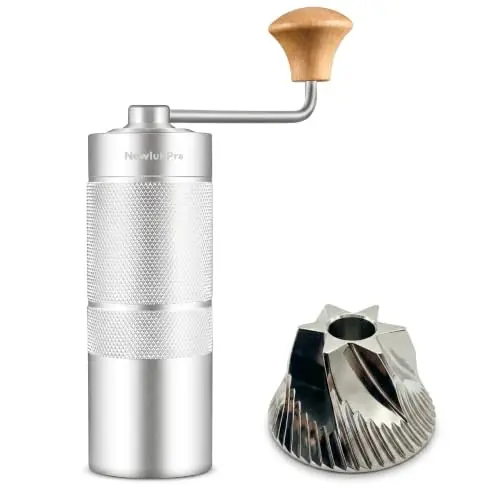
M6 – All-Metal Espresso-Ready Value
The M6 is a budget hand grinder with an all-metal aluminum body, a 38mm SUS420 hexagonal conical burr, and a double-bearing axle. It offers 40 grind settings, a 25g capacity, and a comfortable ergonomic handle. It’s aimed at espresso, pour-over, cold brew, and French press without plastic parts.
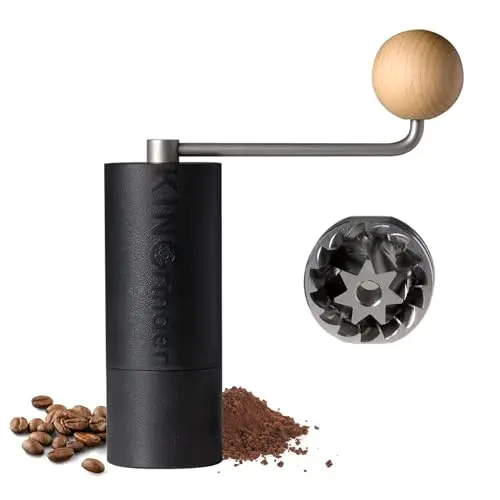
P2 – Lightweight Travel Grinder
The P2 is a lightweight hand grinder built around a SUS420 conical burr and an ABS body. It weighs about 330g, holds 20g of beans, and uses 30 clicks per rotation for fine adjustment. It’s aimed at pour-over, French press, and AeroPress, and it comes with a cleaning brush and handle.
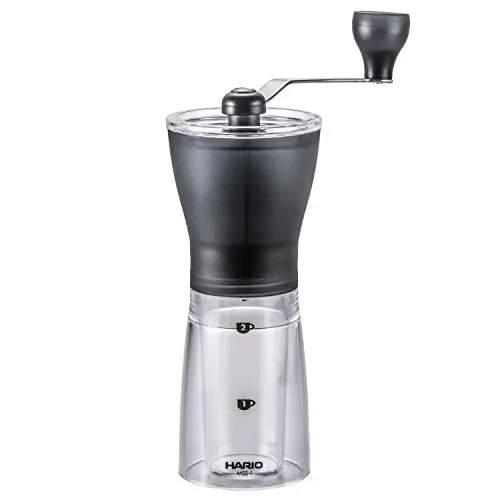
Ceramic Coffee Mill Original – Classic Entry-Level Hand Mill
The Hario Ceramic Coffee Mill Original is the classic entry-level hand grinder. It uses a ceramic burr, holds about 24g of coffee, and stores compactly with the handle removed. The slim design is simple to use and clean, and the ceramic burr won’t rust.
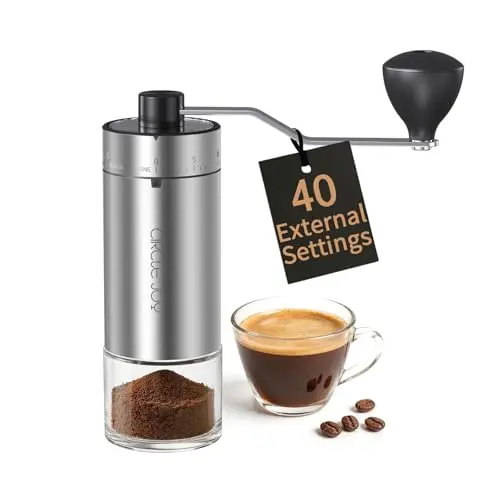
Mini Manual Coffee Grinder – Long-Handle Comfort
The CIRCLE JOY mini grinder pairs a ceramic conical burr with a stainless steel body and an extra-long handle. It has 40 external grind settings, a 30g capacity, and a clear glass grounds hopper. It’s built for home, travel, camping, and office use.
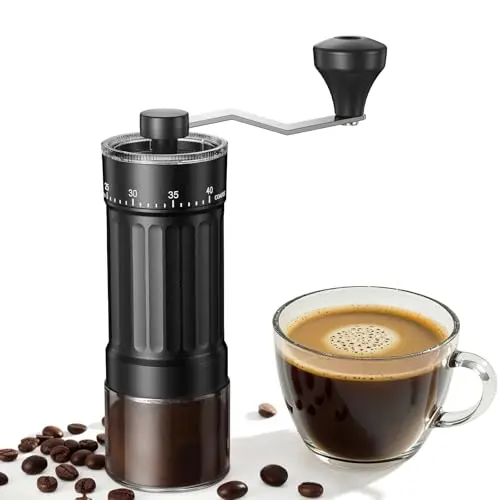
MCG-01 Mini Manual Coffee Grinder – External-Adjustment Value
The CEVING MCG-01 is a compact manual grinder with 40 external grind settings and a ceramic conical burr. It holds 30g of beans, weighs about 325g, and breaks down into three main parts for cleaning. It’s aimed at espresso, pour-over, French press, and travel.
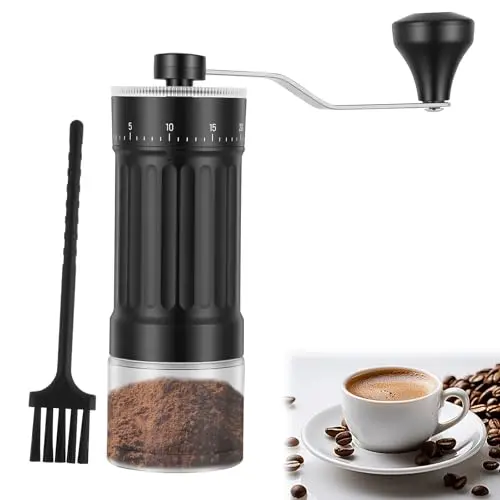
KFXMJ-001 Mini Manual Coffee Grinder – Glass-Jar Budget Pick
The HZBSGZR mini grinder uses a ceramic conical burr and a glass jar with 40 grind settings. It holds 30g of beans, weighs about 11.5 oz, and is built from ABS with a hand crank. It’s aimed at travel, camping, French press, and pour-over.
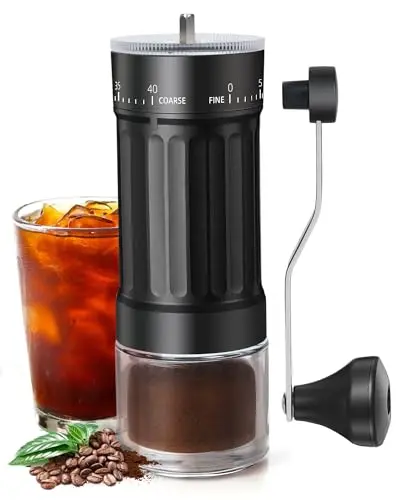
HS-011 Manual Coffee Grinder – Lightweight Glass-Jar Option
The Rsoilch HS-011 is a lightweight manual grinder with a ceramic conical burr and 40 grind settings. It uses an ABS body and a transparent glass jar, holds about 25g of beans, and weighs roughly 11.3 oz. It’s aimed at espresso, pour-over, French press, and travel.
How We Evaluated These Budget Manual Coffee Grinders
We didn’t run controlled particle-size tests or long-term durability trials. What we did: cross-referenced seven budget manual coffee grinders from seven brands across five decision axes – burr material and grind consistency, adjustment range, capacity, build materials, and portability with cleaning. We triangulated published specifications, feature sets, and owner feedback where available, then weighed each grinder against representative buyer profiles for budget manual coffee grinders.
The scoring framework weighted real-world fit (70%) – how well each budget manual coffee grinder delivers on its stated brewing use and daily ownership – against feature differentiation (30%) – unique technical advantages and use-case specificity. We have no commercial relationship with any of the brands featured; recommendations track fit and differentiation, not brand preference. If you want the most balanced all-metal option, the M6 is the pick; if travel is the priority, the P2 is the better match.
We audited construction details such as burr material, axle support, hopper capacity, and handle design, because those are the parts that separate a budget grinder that lasts from one that frustrates. We also mapped grind-setting range to common brew methods and flagged where a budget burr set is realistically limited. The result is a lineup built for shoppers who want fresh-ground coffee without paying premium prices. That matters more than spec-sheet bravado when you’re grinding every morning.
How to Choose the Right Budget Manual Coffee Grinder
1. What Makes a Manual Coffee Grinder Genuinely Budget-Friendly
A budget manual coffee grinder should save you money without wrecking the parts that matter. Prioritize burr alignment and metal axle support over cosmetic extras; a wobbly burr turns a cheap grinder into a frustrating one. The best budget models also keep a usable adjustment range instead of offering settings that all taste the same. If you want the most balanced all-metal option, the M6 is the pick.
2. Burr Material and Grind Consistency in Budget Manual Coffee Grinders
Ceramic burrs are common at the low end because they resist rust and handle drip and French press well. Stainless steel burrs usually cost more, but they tend to hold a finer setting with fewer stalls. Neither material fixes a weak axle, so look for stable construction before assuming a burr will perform like a premium set.
3. How Many Grind Settings Do You Really Need?
An external adjustment ring is easier to use than an internal dial, especially when you switch brew methods often. Stepped settings are fine for most drinkers; the key is repeatability, not an enormous click count. If you want to dial in espresso on a budget, expect a narrower usable range and more trial and error than a premium grinder provides.
4. Capacity and Portability for Daily Manual Coffee Grinder Use
Most budget hand grinders hold between 20g to 30g capacity, which covers one or two mugs. If you brew for a household, err toward the larger hopper. For a travel-friendly pick, look at weight and handle design; a foldable or long handle can make a compact grinder easier to use on the road. The P2 is the lighter travel-first option in this lineup.
5. Build Materials, Cleaning, and Long-Term Ownership
An ABS body keeps weight and cost down, while an aluminum alloy frame feels sturdier and resists flex. Glass hoppers are nice for visibility but less forgiving in a camping bag. Whichever material you choose, tool-free disassembly makes cleaning much easier, and a brush included in the box is a small but useful bonus.
6. Budget Manual Coffee Grinder Pitfalls to Avoid
The biggest trap is buying a budget manual coffee grinder that claims espresso-grade performance without the burr stability to deliver it. Skip models with plastic burr mounts, vague adjustment, or no support path for replacement parts. A simple, proven design like the Hario Ceramic Coffee Mill Original is often a safer bet than a feature list that looks impressive on paper.
Frequently Asked Questions
1. Are budget manual coffee grinders good enough for espresso?
Sometimes, but not always. A budget manual coffee grinder can pull decent espresso if it has a stable axle, a stainless steel burr, and fine adjustment that stays put. Many low-cost models use a ceramic burr that works better for drip and French press than for true espresso range. If espresso is your main goal, the M6 is the safer budget-leaning pick.
2. What's the difference between the NewlukPro M6 and the KINGrinder P2?
The M6 leans toward all-metal body construction, a 40 grind settings range, and a larger hopper for home brewing. The P2 is a lightweight ABS build with a smaller 20g capacity, which makes it easier to pack but less suited to brewing for two. Choose the M6 for a sturdier daily driver; choose the P2 for travel.
3. How does the Hario Ceramic Coffee Mill Original compare with the CEVING MCG-01?
The Hario is the simpler classic: a ceramic burr, a 2-cup capacity, and a compact body that stores easily. The CEVING adds external adjustment and a larger 30g capacity, so it offers more range on paper, though its handle durability is less certain. For low-fuss drip and French press, the Hario is the easier recommendation; for more settings, the CEVING makes sense.
4. Do budget manual coffee grinders work for travel and camping?
Yes, as long as you match the grinder to the trip. A lightweight body and a protected handle matter more than a huge hopper when space is tight. Avoid a glass hopper if your bag gets knocked around, and favor a grinder that breaks down without tools. Budget manual coffee grinders can be excellent camp companions when the build suits the environment.
Final Verdict
For most budget-minded shoppers, the M6 is the answer – it pairs an all-metal body and a stainless conical burr with enough adjustment range for espresso, pour-over, and French press. If you mainly grind on the road, the P2 is lighter and easier to pack, though it holds less. The Hario Ceramic Coffee Mill Original remains the simplest first grinder for drip and French press, and the CEVING MCG-01 is the better fit if external adjustment and a larger bean capacity matter more than metal-body polish. None of these are espresso-lab tools, but each gets you fresh-ground coffee without a premium spend.
