
Best Built-In Espresso Machines – 2026 Reviews

A built-in grinder changes the whole espresso routine. Instead of juggling a separate burr grinder, a scale, and a dosing cup before your first shot, you load beans into the hopper and work from one machine – usually in less counter space than the two appliances would have needed separately.
That convenience comes with a catch: not every machine with a hopper is worth the counter real estate. The differences that actually matter show up in grind adjustment range, how the machine handles dose and tamping, and whether the steam wand or milk system can produce the microfoam you want for a latte. Brew temperature stability matters just as much – a good built-in grinder paired with sloppy temperature control produces fresh-tasting bad espresso.
We compared all-in-one machines across brands, from budget-friendly semi-automatics to fully automatic models with integrated milk carafes, so you can choose based on how much hands-on work you actually want. Some drinkers want to dial in a shot by feel and taste. Others want one button press before a 7 a.m. meeting. Both are legitimate, and the right answer depends entirely on which one you are.
Best Built-In Espresso Machines – 2026 Reviews
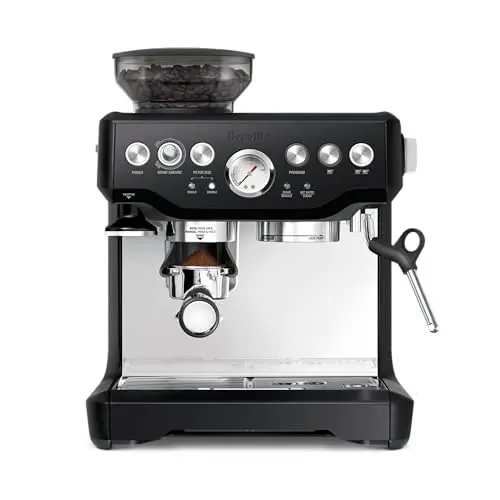
Barista Express BES870BTR – Built-In Grinder with Manual Steam Wand
A bean-to-cup semi-automatic with an integrated conical burr grinder that doses straight into a 54mm portafilter. PID temperature regulation and low-pressure pre-infusion do the precision work, while the manual steam wand gives you real microfoam for latte art.
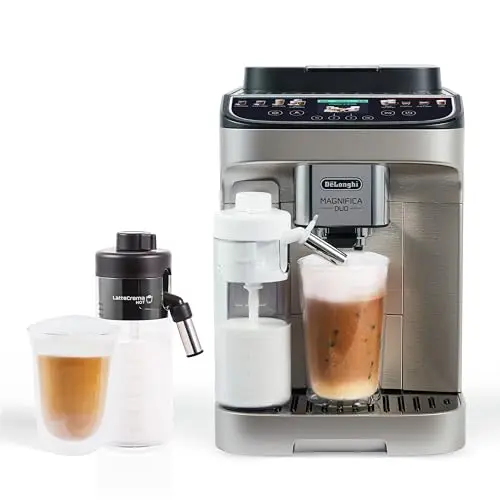
Magnifica Duo ECAM33080SXB – Fully Automatic with Hot and Cold Frothing
A fully automatic machine covering espresso, drip coffee, cold brew, and iced drinks through 20 preset recipes. The integrated conical burr grinder feeds a one-touch system, and the LatteCrema hot and cool carafes handle dairy or plant milk at either temperature.
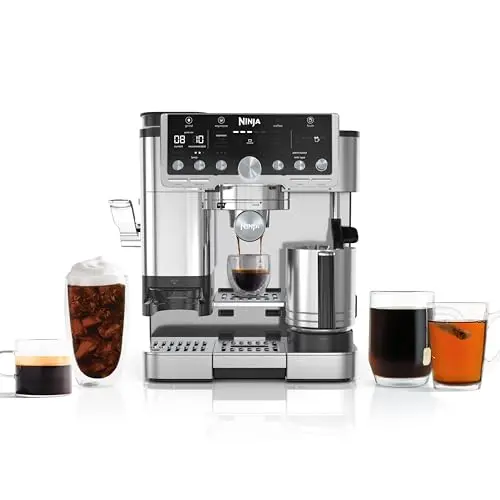
Luxe Cafe Pro ES701 – Four-in-One Espresso, Drip, and Cold Brew
A four-in-one that brews espresso, drip coffee, cold brew, and cold press espresso from a 25-setting built-in grinder. Barista Assist handles dosing, tamping, and real-time pressure adjustments, and the Dual Froth Pro system foams milk without supervision.
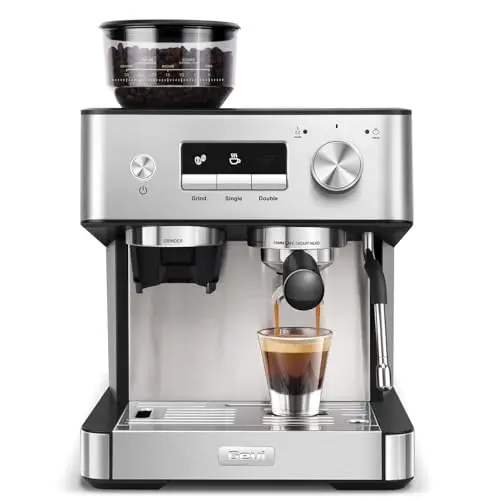
ECMI0-SS0A1 – 30 Grind Settings with 58mm Portafilter
A semi-automatic all-in-one built around a 30-setting conical burr grinder and a 58mm portafilter. NTC and PID temperature control keep extraction stable, and the dual-function wand switches between steam and hot water.
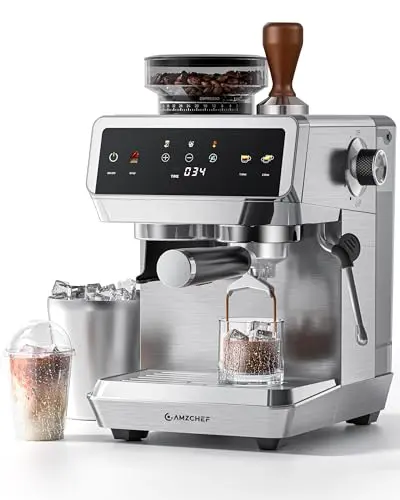
CM1626 – 44 Grind Settings with Cold Brew Mode
A compact built-in grinder machine with 44 grind settings and adjustable brew temperature from 190F to 201F. A one-touch cold brew mode and an 8mm steam wand cover iced drinks and milk foam alike.
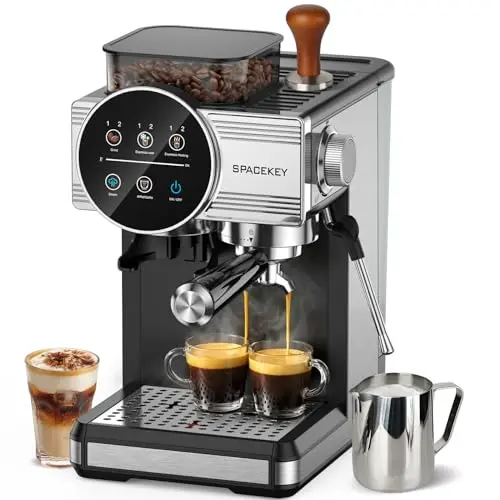
CM5510 – Anti-Clog Grinder with Pre-Infusion
A compact semi-automatic pairing a 20-bar pump with a 30-setting conical burr grinder and PID temperature control. An anti-clog grinding system, smart pre-infusion, and a dedicated cold brew function round out the feature set.
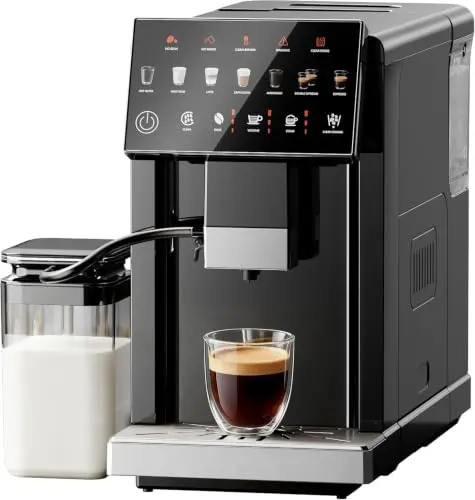
CM004-02 – Fully Automatic with Self-Cleaning
A fully automatic option with a 15-setting built-in grinder and a touchscreen for drink selection and volume. The automatic milk system foams for cappuccinos and lattes, while self-cleaning and bean purge routines simplify upkeep.
How We Evaluated These Built-In Espresso Machines
We didn’t pull hundreds of shots with a refractometer in a test kitchen. What we did: cross-referenced 7 built-in espresso machines from 7 distinct brands across 6 decision axes – grinder range and adjustability, brew temperature stability, milk frothing capability, capacity and footprint, included accessories, and how much hands-on work each machine actually demands. We triangulated published specifications against feature sets and owner feedback where available, then mapped every model to a realistic buyer profile: the tinkerer, the one-button commuter, the iced-coffee drinker, and the small-kitchen shopper.
The scoring framework weighted real-world fit (70%) – whether a machine delivers the drink quality and workflow its buyer expects – against feature differentiation (30%), meaning grind settings, portafilter size, frothing systems, and anything genuinely unusual. Seven brands in one lineup means real contrast: a premium semi-automatic that rewards practice, a super-automatic that removes the practice entirely, and several mid-tier machines borrowing features from both ends. No brand gets a pass for its name, and we have no commercial relationship with any manufacturer.
A few things we can’t tell you: long-term reliability past the first year, or how each grinder holds calibration after months of daily use. What we can: how the feature sets compare, what each workflow actually demands, and which machine suits which kind of drinker. If you want the reference point for controllable espresso, the Barista Express is it; if you’d rather press a button and walk away, the Magnifica Duo is the answer.
How to Choose the Right Built-In Espresso Machines
1. What the Built-In Grinder Actually Buys You
A built-in grinder is mostly a convenience argument, but it’s a good one. You skip the separate appliance, the transfer step, and the counter space – and because the grinder doses directly into the portafilter or brew unit, the coffee is fresher at the moment of extraction.
The catch is that integrated hardware varies enormously. A conical burr grinder with 30 or more settings behaves very differently from a modest unit with a narrow adjustment window. If you plan to move between espresso, drip, and cold brew, grind range matters more than pump pressure.
2. Grind Settings and Burr Quality: The Spec That Matters Most
Two machines can both claim a built-in grinder and feel nothing alike. Look at the number of steps and whether the burrs are conical, the common choice in this category. A wide range with fine steps lets you correct a shot that runs too fast or too slow.
Dosing method is the other half of the equation. Weight-based dosing removes a variable that time-based dosing leaves in place, and an integrated tamper or dosing funnel cuts down on mess. Neither is essential, but both shorten the path from a sour shot to a repeatable one.
3. Semi-Automatic vs Super-Automatic Built-In Espresso Machines
The biggest decision isn’t brand, it’s how much work you want. Semi-automatic machines give you the grinder but leave dosing, tamping, and steaming to you. Fully automatic models take all of that and hand you a finished drink.
Semi-automatic wins on ceiling: with practice and a good bean, you can pull a shot a super-automatic can’t match. Super-automatic wins on Tuesday morning, when nobody wants to weigh beans. If you drink milk drinks daily, the hands-off argument gets stronger. If you drink straight espresso and enjoy adjusting variables, take the manual route – the Barista Express is the obvious starting point.
4. Milk Systems: Steam Wands, Carafes, and What You'll Actually Use
Manual steam wands take a few weeks to learn and produce the best microfoam once you do. Automatic carafes and frothing systems get you most of the way with zero skill, which is usually the right trade for milk-heavy drinkers.
Two details get overlooked. First, hot and cold frothing is now a genuine differentiator – cold foam for iced drinks is a separate capability, not a given. Second, check whether milk parts are removable and dishwasher-safe, because a carafe you dread cleaning stops getting used.
5. Sizing a Built-In Espresso Machine for a Real Kitchen
These are not small appliances. Several models here run 12 inches wide or more, and depth matters more than the spec sheet suggests once you account for cup clearance and a portafilter handle sticking out front. Measure the counter, then measure the space under the cabinets.
Water tank capacity is the other practical number. A small tank means refilling every few drinks. Front-access and removable tanks are worth prioritizing if the machine will sit beneath upper cabinetry.
6. Where the Price Tiers Land, and What You Get at Each
Entry-level all-in-ones get you a built-in grinder, a steam wand, and basic temperature control. Mid-range machines add wider grind adjustment, PID temperature control, and better portafilters. The premium tier buys hands-off automation – automatic milk systems, recipe menus, cold brew programs – rather than dramatically better espresso.
That last point is worth sitting with. Spending more in this category mostly buys convenience and consistency, not a different class of shot. A carefully dialed affordable machine with fresh beans will outperform a neglected premium one. The AMZCHEF CM1626 is a good reminder that the budget tier isn’t a compromise tier anymore.
7. Descaling, Backflushing, and Everyday Care
Every machine here needs descaling, and most tell you when. Use filtered water and the interval stretches; skip it and the grinder isn’t the part that fails. Machines with self-cleaning programs make this a button press rather than an afternoon.
Beyond that: empty and rinse the milk system after every use, purge the steam wand, and knock out the drip tray before it overflows. Bean hoppers should be emptied periodically, since oils go stale and gum up the feed.
Frequently Asked Questions
1. Do you really need a built-in grinder in an espresso machine?
Not strictly, but the case is strong if counter space is tight or you drink espresso daily. A built-in burr grinder eliminates a transfer step and keeps grounds fresher, and it means one fewer appliance to buy. The trade-off is upgrade ceiling: a standalone grinder can be replaced or improved, while built-in grinders are fixed for the life of the machine.
If you mostly drink milk drinks or use capsules, the grinder matters less. If you’re chasing a better straight shot, it matters a lot.
2. What's the difference between the Breville Barista Express and the De'Longhi Magnifica Duo?
They answer different questions. The Barista Express is semi-automatic: built-in conical burr grinder, PID temperature control, manual steam wand, 54mm portafilter. You dose, tamp, and steam, and you’re rewarded with real control. The Magnifica Duo is fully automatic: 20 recipes, hot and cold frothing carafes, cold brew in minutes, and almost no input from you.
Choose the Breville if you want to learn and improve. Choose the De’Longhi if you want a consistent latte before a morning call and never want to think about grind size again.
3. Is the Ninja Luxe Cafe Pro worth it over the Gevi ECMI0-SS0A1?
The Luxe Cafe Pro sits well above the Gevi in price tier and adds automation the Gevi doesn’t attempt: hands-free frothing, an integrated tamper, weight-based dosing, and a 12-cup drip carafe alongside espresso. The ECMI0-SS0A1 counters with a 58mm portafilter – the standard size for aftermarket baskets and tampers – and a wider 30-setting grind range for manual dialing.
If you want one button and a walk-away workflow, the Ninja earns the extra spend. If you want the most control for the least money, the Gevi is the better buy.
4. Can a built-in grinder machine handle iced coffee and cold brew?
Increasingly, yes. Cold brew programs appear on the De’Longhi Magnifica Duo, which uses cold extraction to brew in under three minutes, and one-touch cold modes show up on the AMZCHEF and Spacekey as well. The Ninja Luxe Cafe Pro goes further with a cold press espresso function that brews at lower temperature and pressure for iced drinks.
What you won’t get from most of these is a true overnight-steep concentrate. If cold brew is your daily drink, prioritize a machine that names the function explicitly.
5. How much counter space does a built-in espresso machine need?
More than the dimensions imply. Machines in this category run from compact footprints around 10 inches wide up to roughly 15, and you need counter clearance above for filling the bean hopper plus room in front for the portafilter and a cup. Depth of 12 to 17 inches is typical.
Measure the height under the cabinets before anything else – several of these are 14 to 17 inches tall.
Final Verdict
For most buyers, the Breville Barista Express is the answer. It’s the rare machine that pairs a genuinely useful built-in grinder with the control to make each shot better than the last, and it doesn’t hide behind automation.
If you’d rather press one button, the Ninja Luxe Cafe Pro gets you there with hands-free frothing and a coffee carafe in the same box. On a tighter budget, the AMZCHEF CM1626 covers grind range and temperature control for far less. And if you want the fully automatic endgame – hot and cold foam, 20 recipes, cold brew on demand – the De’Longhi Magnifica Duo is purpose-built for it.
