
Best Chairs And A Half With Ottoman – 2026 Reviews

There’s a specific moment that sends people shopping for a chair and a half: you’re curled up with a book, or halfway through a movie, and the armchair you’ve had for years is suddenly two inches too narrow in every direction. A loveseat would swallow the room. A regular accent chair won’t fix anything. The chair and a half sits in that gap – wide enough to tuck your legs up, small enough to fit a bedroom corner.
What separates a good one from a disappointing one comes down to two things. First, build: framed and upholstered pieces give you an upright back and a seat height you can push out of, while boneless foam loungers arrive compressed in a box, sit low and soft, and ask you to wait a few days before they look like the product photos. Second, the ottoman. A movable one extends the chair into a chaise and disappears when you need floor space; a fixed or storage version commits your layout in exchange for convenience.
We mapped the market across brands rather than crowning a favorite label, because the right answer here depends on whether you want to read sitting up or disappear into a chair for three hours. What follows is a lineup built around those two jobs – plus honest notes on the ones to think twice about if your knees, your doorway, or your square footage have opinions.
Best Chairs and a Half with Ottoman – 2026 Reviews
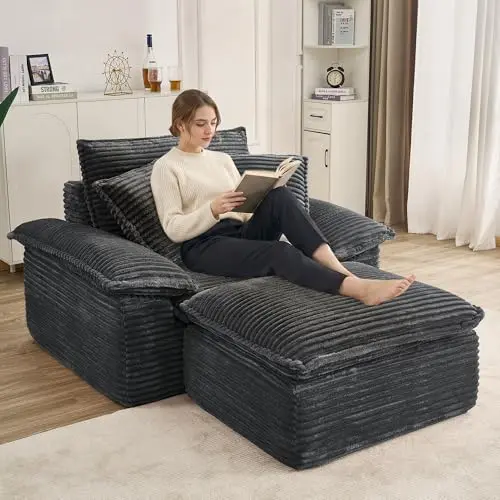
63-Inch Cloud Chair and a Half – No-Assembly Deep Seat Lounger
A 63-inch deep-seat lounger in warm grey corduroy, with a separate ottoman that pushes out into a chaise or slides aside for floor space. Dual-layer cushions combine foam, cotton, and pocket springs for a soft-but-supported sit, and the whole thing arrives compressed in one box with no assembly required.
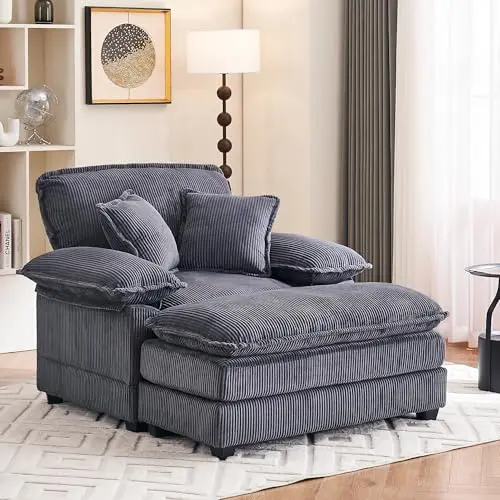
GF-1 Corduroy Chaise – Oversized Reading Chair with Ottoman
A 46.9-inch corduroy chair with a 24.8-inch seat depth and a load-tested 300-pound base. The squared frame and shaped back are built for sitting upright with a book rather than sinking backward, and the ottoman extends the footprint into a low chaise. Ships in two boxes with hardware included.

82-Inch Boneless Sleeper – Chair, Chaise, and Bed in One
A frameless foam lounger that works three ways: a 60-inch chair, a chaise with the front cushion pushed out, or an 82-inch sleeper for guests. Corduroy upholstery over foam with internal spring support, a 52-inch-wide seat, and a 450-pound capacity – all arriving compressed in one box with nothing to assemble.
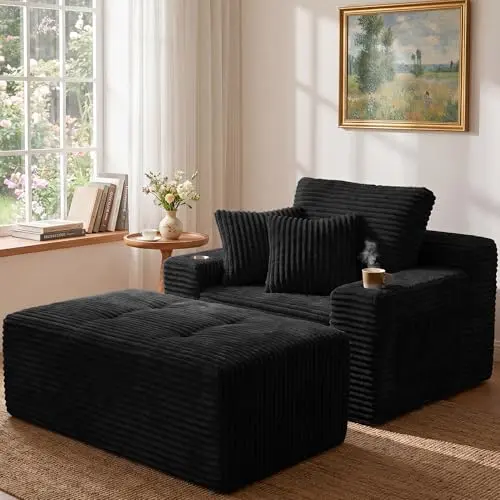
66-Inch Boneless Chaise – Cup Holders and Deep Seat
A 66-inch boneless corduroy chaise with a wide deep seat, a separate ottoman, and three matching pillows. Built-in cup holders and side pockets sit on both armrests, the one-piece foam core is rated to 600 pounds, and it arrives vacuum-packed with no assembly.

42-Inch Corduroy Chair – Nailhead Trim and Rolled Arms
A 42-inch corduroy chair with rolled arms, nailhead trim, and a matching ottoman – a traditional silhouette in a footprint that still fits a bedroom corner. Wood frame rated to 350 pounds, high-resilience foam cushions, and tool-free assembly that takes minutes rather than an afternoon.
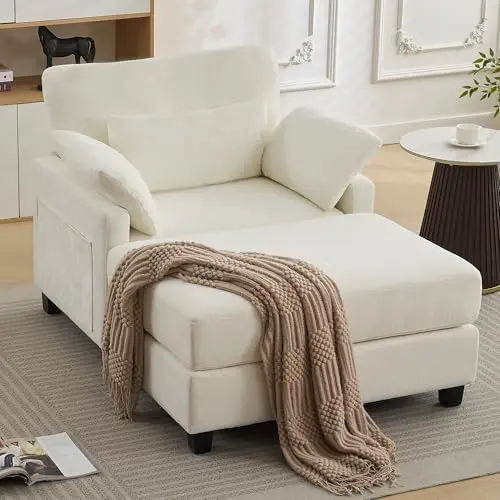
57.5-Inch Chenille Chaise – Removable Covers, Plush Sit
A 57.5-inch chenille chaise in white, with an ottoman, a contoured backrest, and removable armrest covers and back pillows for easier cleaning. Solid wood frame and high-resilience sponge cushions carry a 300-350 pound rating, and assembly is quoted at around half an hour.
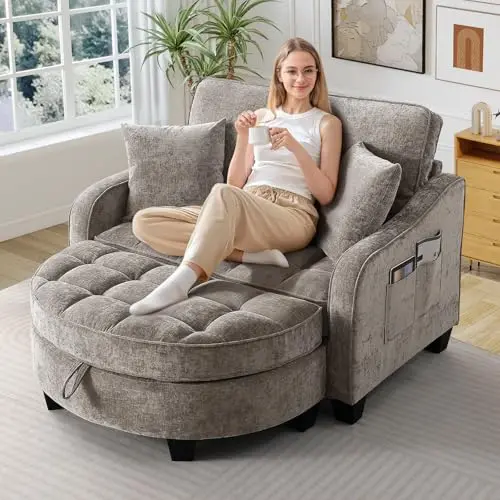
51-Inch Tufted Chair and a Half – Storage Ottoman Included
A 51-inch tufted chenille chair with an adjustable backrest, two throw pillows, a side pocket, and – the differentiator – a semi-circular ottoman with a lift-off lid for storing blankets and remotes. Solid wood frame rated to 350 pounds, in a warm brown that suits a study or sunroom.
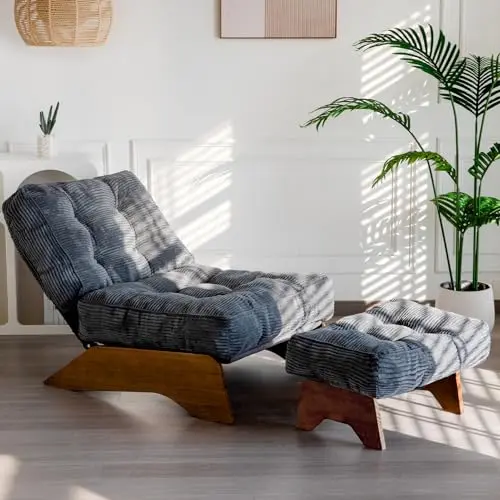
A85 Accent Chair and Ottoman – Adjustable Backrest Set
A compact tufted accent chair with a two-position adjustable backrest and a matching ottoman, built on an FSC-certified wood base. Corded fabric, foam cushioning, and spot-clean care make this the smallest and most affordable route into the chair-and-ottoman format.
How We Evaluated These Chairs and a Half with Ottoman
We didn’t put these chairs through a load-testing rig or live with them for months on end. What we did: cross-referenced 8 chair-and-a-half models from 8 distinct brands, mapped them across six decision axes – seat width and depth, frame and fill construction, ottoman function, delivery and assembly, weight capacity, and upholstery care – then weighed published specifications against owner feedback where available and against how people actually use this furniture: reading, TV, naps, and the occasional overnight guest.
The scoring put real-world fit (70%) ahead of feature differentiation (30%). That means a chair earned credit for being genuinely wide and deep enough to curl up in, for a back you can sit upright against, and for an ottoman that does something useful – not for spec-sheet bragging. The remaining weight went to the things that change daily ownership: movable versus fixed ottomans, hidden storage, tool-free setup, and fabric that wipes clean. We have no commercial relationship with any of these brands; recommendations track fit, not brand preference. If you want the widest, most lounger-like seat, the KEIKI 63-inch is your match. If you’d rather have a structured back for upright reading, the ZX Design GF-1 fits better.
Two caveats applied throughout. Capacity ratings are manufacturer figures, not something we verified, so we treated them as guidance rather than gospel. And compressed-foam deliveries get a grace period: a chair that looks thin on day one may be a different piece of furniture after 96 hours of expansion, so we discounted first-impression reactions accordingly.
How to Choose the Right Chair and a Half with Ottoman
1. How Wide Is a Chair and a Half, Really?
The name is loose. In practice this category runs from roughly 40 to 52 inches across the arms, which sits between a generous armchair and a small loveseat. The number that matters more is the seat width between the arms – a 46-inch chair with thick rolled arms can give you less usable room than a 41-inch chair with slim track arms.
Seat depth is the other half of the equation. Anything under about 22 inches keeps you upright with your feet reaching the floor; 24 to 26 inches lets you tuck a leg up. Pair a deep seat with an ottoman and you effectively get a chaise; pair a shallow seat with one and you get a footrest that’s further away than you want.
2. Framed Upholstered Chairs vs Boneless Foam Loungers
Most of this market splits into two builds. Framed construction – wood or metal rails, legs, foam cushions – gives you a seat height around 16 to 20 inches, a back you can push against, and a piece that stays put when you stand up. It also means assembly, often from two boxes, and real weight to shift.
Boneless foam chairs arrive vacuum-compressed, expand over two to four days, and sit low and soft with no frame to press against. They’re easier to move, cheaper to ship, and far more forgiving in an apartment stairwell. If upright back support is a priority – knees, hips, or just working on a laptop – the framed route is the safer bet, and the ZX Design GF-1 is the clearest example of it here.
3. Ottoman Styles: Footrest, Chaise Extension, or Hidden Storage
An ottoman can be three different products depending on how it attaches. A movable ottoman that isn’t bolted down gives you the most flexibility – chaise when you want it, side table or spare seat when you don’t. A fixed extension is more stable under your calves but locks the footprint in place.
The storage ottoman is the sleeper feature of this category. A semi-circular ottoman with a lift-off lid swallows blankets, remotes, and the book you’re halfway through, which matters in a room where the chair is already the biggest thing in it. The KINFFICT 51-inch is the pick if that’s the priority.
4. Corduroy, Chenille, and What's Under the Cover
Nearly every chair in this roundup is corduroy or chenille, and the difference is mostly texture and maintenance. Corduroy has a ribbed nap that hides crumbs and pet hair well and takes spot cleaning without water rings. Chenille is softer and flatter, with a slight sheen, and shows crushing where you sit most.
Underneath, look for layered fill rather than a single foam block. Pocket springs or a spring unit under foam gives a chair more rebound and less of a bottoming-out feel after an hour. Foam-and-cotton blends feel plusher but settle faster. Whatever the cover, assume spot clean only – none of these are meant for a washing machine.
5. Weight Capacity, Frame Materials, and Floor Contact
Published weight capacity in this category ranges widely, from 300 pounds up to figures that sound aspirational. Treat those as design targets rather than guarantees, and pay more attention to what’s carrying the load: solid wood and metal rails hold up differently than engineered wood legs.
Floor contact is the quiet dealbreaker. Legged chairs on hardwood need felt pads; frameless foam chairs benefit from an anti-slip base, especially on smooth floors. On carpet, a low foam lounger sinks and becomes harder to rise from than a framed chair with a firm seat.
6. Delivery, Assembly, and Getting It Through the Door
Two things trip people up after checkout. First, vacuum-compressed chairs look alarming on arrival – thin, creased, and nowhere near the photos – until they finish expanding, which can take anywhere from 48 to 96 hours. Judge them after that window, not before.
Second, two-package delivery is common with framed chairs, and the boxes don’t always land on the same day. Measure your door and stair turn before ordering; a few of these pieces need a surprisingly tight minimum door width. If you’d rather skip the whole business, the Gericco 82-inch arrives in a single box with no tools required.
Frequently Asked Questions
1. How wide is a chair and a half compared to a loveseat?
A loveseat typically runs 52 to 60 inches across the arms; a chair and a half mostly lives between 40 and 52 inches. The practical difference is who fits. Most of these seats are comfortable for one adult plus a child, a dog, or a laptop tray, but they’re not a substitute for a two-person sofa.
Pay more attention to seat width between the arms than to the headline dimension – chunky rolled arms eat a surprising amount of it. And check seat depth: anything past 24 inches starts to feel like a chaise once you add the ottoman.
2. What's the difference between the KEIKI 63-inch and the ZX Design GF-1?
They represent the two builds in this category. The KEIKI is boneless compressed foam: it ships in one box, needs no assembly, sits low and soft, and its ottoman moves freely. The ZX Design GF-1 is framed and upholstered, with a 24.8-inch seat depth, a load-tested base, and a back you can sit upright against – but it arrives in two packages and takes assembly.
Choose the ZX Design GF-1 if you want posture support for reading or working; choose the KEIKI if you want the widest, most lounger-like seat and zero setup.
3. Do boneless corduroy chairs flatten out over time?
They settle rather than collapse. A high-density foam core without springs will soften where you sit most, and the seat can hold a shallow impression. Rotating the ottoman cushion, fluffing the back, and giving the foam its full 72 to 96 hours to expand on arrival makes a meaningful difference.
What you give up compared with a framed chair is rebound – there’s no spring unit pushing back, so rising from a low seat takes more effort. If anyone in the house has knee or hip trouble, a framed chair with a seat height above 16 inches is easier to live with.
4. Which chair and a half works best in a small apartment?
Look at footprint before seat width. A 42-inch chair with a movable ottoman can be tucked into a corner with the ottoman stashed elsewhere; a 60-inch lounger with a fixed extension can’t. The LUXSeatful 42-inch is the tidiest of the group – corduroy, rolled arms, and it goes together without tools.
Also favor dual-purpose pieces: an ottoman that doubles as a side table or storage saves you buying one. And lean toward spot-clean covers if the chair sits near a kitchen or entry.
5. Is the ottoman actually useful, or is it just extra floor space?
It earns its keep if it moves. As a chaise extension, an ottoman turns a 42-inch chair into something you can fully stretch out on; as a footrest, it changes your seated posture enough to matter over a two-hour movie. As a fixed block, it mostly just adds depth.
Plan the layout before you buy: a chair plus ottoman needs roughly six feet of depth once extended. If that’s tight, a boneless lounger is easier to rearrange, since you can move the seat and the ottoman independently.
Final Verdict
For most people, the KEIKI 63-inch is the answer – it pairs the widest usable seat in the roundup with a movable ottoman, pocket-spring cushioning, and a delivery that requires nothing but patience. If you’d rather sit upright with real back support, the ZX Design GF-1 is the better-built chair, and its 24.8-inch seat depth is the most thoughtfully proportioned here. On a tighter budget, or in a room that doubles as a guest space, the Gericco 82-inch converts from chair to sleeper without a single tool. And if the chair is going where people will see it, the LUXSeatful 42-inch brings rolled arms and nailhead trim that the foam loungers can’t match.
