
Best Coffee Grinders For Commercial Espresso – 2026 Reviews

The gap between a shot that sings and one that tastes like burnt lemon peel usually isn’t the machine. It’s the grind. On a commercial espresso counter that margin gets thin fast, because you’re pulling shot after shot and every wobble in particle size shows up in the cup – then again ten minutes later, when the grinder has warmed up and drifted.
Three things separate a grinder that survives espresso duty from one that looks the part on a spec sheet: how fine it can actually go without wandering, how repeatable the dose is when you’re working quickly, and how much coffee it leaves sitting in the chute between shots. Retention and static are the unglamorous specs nobody prints on the box, and they’re the ones that ruin a morning service.
We cross-shopped the espresso-capable end of the coffee grinder market rather than the drip-first end, and we’ve been straight about where each option’s ceiling sits. A true production café grinder is a different class of machine – bigger flat burrs, continuous-duty motors, serviceable parts. What’s here is the practical tier for a small café, a food truck, a market stall, or a home bar pulling several shots a day. Here’s what we’d actually put on the counter.
Best Coffee Grinders for Commercial Espresso – 2026 Reviews
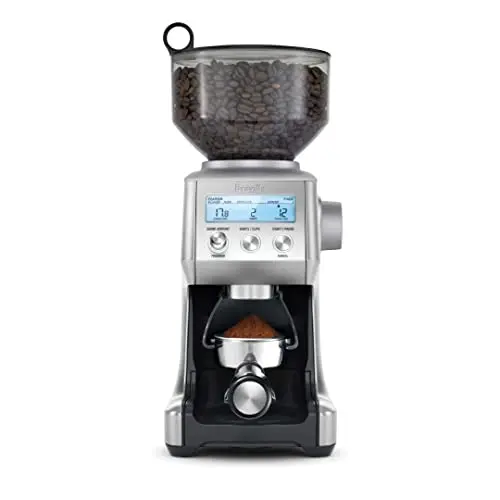
Smart Grinder Pro – Espresso-Focused Dosing Control
The Smart Grinder Pro is the most espresso-literate machine in this lineup. Sixty stepped settings, a programmable dose timer that adjusts in 0.2-second increments, and included portafilter cradles in both 50-54mm and 58mm sizes mean you can grind straight into the basket instead of a cup. The 18-ounce hopper is the largest here, and the LCD keeps grind setting, dose time, and shot count visible while you work.
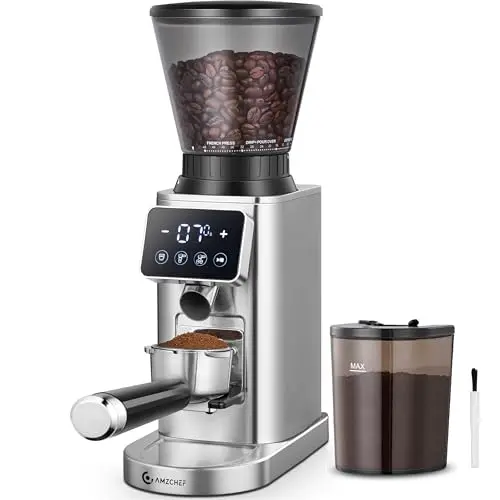
CG209 Burr Grinder – 48-Setting Espresso Control
A 40mm stainless conical burr set, 48 grind settings, and a touchscreen that runs doses up to 40 seconds in half-second steps. The anti-static design and stainless catch container cut down the cling that plagues cheaper grinders, and the included cradle fits 51-54mm and 58mm portafilters. The 10.6-ounce hopper has a UV-blocking tint and a trap door so you can pull it off mid-session without spilling beans.
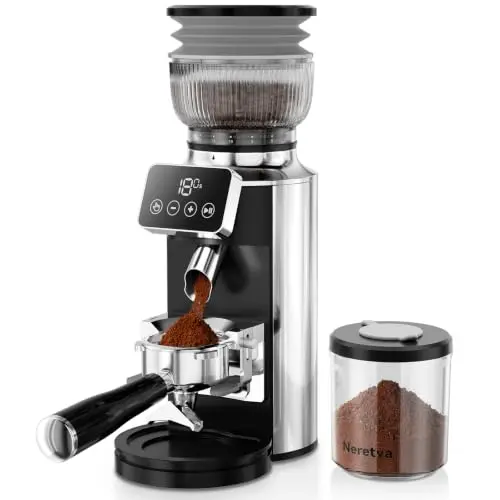
PE3766SU – Low-Retention Espresso Grinder
Built espresso-first: a 30-step stainless conical burr set, a plasma generator to knock down static, and an angled outlet that keeps retention low. The portafilter cradle handles 51mm to 58mm baskets with two or three ears, and the electronic timer runs in 0.1-second increments up to 25 seconds before switching to one-second steps. A ground coffee jar, brush, and silicone air blower come in the box.
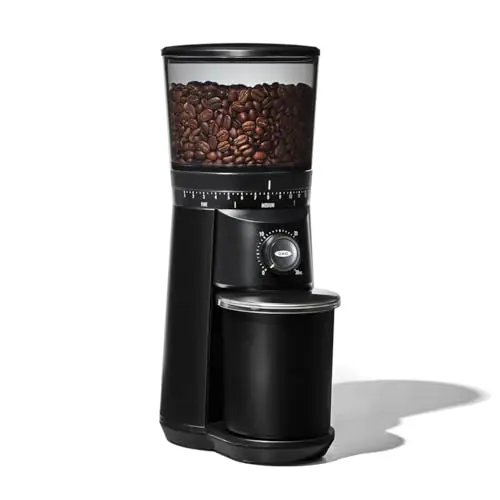
Brew Conical Burr Grinder – Quiet Daily Grinding
A 40mm conical burr grinder with 15 stepped settings plus 43 micro-adjustments, a 12-ounce UV-blocking hopper, and a one-touch start that remembers your last setting. It’s the quietest of the group and the simplest to live with day to day, though its espresso range is narrower than the dedicated espresso grinders here.
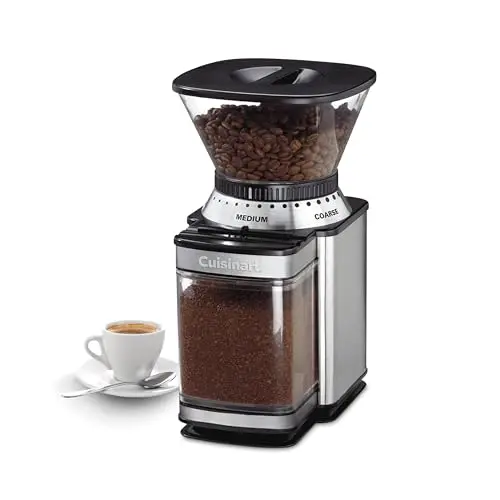
Supreme Grind DBM-8P1 – Simple Batch Brewing
A stainless flat burr mill with 18 grind positions, an 8-ounce hopper, and a cup-count selector that grinds for 4 to 18 cups with automatic shutoff. It’s the most affordable way off a blade grinder and fine for drip and French press, but the espresso end of its range is coarse and inconsistent next to the dedicated espresso grinders here.
How We Evaluated These Coffee Grinders for Commercial Espresso
We didn’t run controlled kitchen lab tests or long-term reliability trials – no particle-size analysis, no timed duty-cycle stress runs. What we did: cross-referenced five coffee grinder models from five distinct brands across six decision axes – burr type and diameter, fine-end grind range, dose control, retention and static behavior, hopper capacity, and build quality under repeated use. We triangulated published specifications, feature sets, and owner feedback where available, then mapped every option against the workflow of someone pulling shots back to back rather than one drink on a quiet Sunday. Two things separated the lineup more than any spec sheet line: how fine a grinder can actually go without drifting, and how much coffee it leaves behind between doses.
Scoring weighted real-world fit for espresso workflows (70%) – how reliably a grinder delivers a repeatable fine grind and a controllable dose – against feature differentiation (30%), which covers timed dosing, portafilter support, anti-static design, and adjustment granularity. We have no commercial relationship with any brand featured here, and recommendations track fit and differentiation rather than brand preference. If you’re dialing in a small café or a serious home bar, the Smart Grinder Pro is the safest place to start; if espresso-first hardware with a direct portafilter cradle and less counter mess is the priority, the CG209 makes a strong case.
How to Choose the Right Coffee Grinder for Commercial Espresso
1. What Actually Matters for Commercial Espresso Grinding
Espresso compresses everything. A double basket extracts in roughly half a minute, so small swings in particle size show up immediately as sour, bitter, or gushing shots. The variables that matter most are burr type and diameter, how fine the grinder can actually go, and whether you can repeat that exact setting tomorrow morning. Bigger burrs run cooler and turn out more uniform grounds; smaller burrs work fine, but they ask more of the motor at fine settings.
Stepped versus stepless adjustment is the other fork in the road. Stepped grinders click into fixed positions – easier to return to a known setting, less able to land exactly where a stubborn bean wants. Stepless gives infinite resolution but no reference points. Most of this lineup is stepped with micro-adjustments layered on top, which is the practical middle ground for espresso.
2. Why Grind Range and Micro-Adjustments Decide Espresso Quality
Advertised setting counts are marketing until you look at the fine end. A grinder with sixty settings spread across a coarse range can still be useless for espresso, while fifteen well-spaced steps with micro-adjustments may be plenty. What you want to know is how much the burr gap moves per click in the espresso zone.
Conical burrs dominate this part of the market because they’re cheaper to make well and more forgiving of imperfect alignment. Flat burrs tend to produce a flatter particle distribution and a more defined flavor profile, which is why serious espresso setups gravitate toward them – but a cheap flat burr is worse than a good conical one. If you’re pulling espresso and want the widest usable adjustment range in this lineup, the Smart Grinder Pro is the pick.
3. Dosing, Retention, and Static Control in Real Workflows
The spec sheet rarely mentions the two things that annoy espresso people most: retention and static cling. Retention is the coffee that stays inside the chute after you finish grinding. At home, a couple of grams is tolerable. On a busy counter it means the first shot of the morning is stale and every dial-in is partly guesswork.
Anti-static designs – plasma generators, grounded chutes, stainless catch cups – reduce the cling that sends fines across the counter and into the grinder’s seams. Direct-to-portafilter dosing solves the other half of the mess. If you want the tidiest workflow and the lowest retention here, the PE3766SU is built around exactly that.
4. How Commercial Espresso Volume Changes Your Coffee Grinder Priorities
Here’s the honest framing: a true café grinder is a different animal. It runs large flat burrs, a motor rated for continuous duty, serviceable parts, and a dosing mechanism designed for hundreds of shots between cleanings. Nothing in this lineup is that machine, and pretending otherwise would be a disservice to your morning rush.
What these grinders are is the light-commercial tier: a small café with a short rush, a food truck, a market stall, an office with a serious espresso habit, or a home bar pulling multiple shots a day. At that volume, duty cycle and heat matter more than features. A grinder that pulls beautifully for ten shots and gets hot on the eleventh will drift on you. For that kind of small-volume service, the CG209 is the more sensible ceiling – plenty of adjustment, anti-static handling, and a hopper that holds a real session’s worth of beans.
5. Budget, Mid-Range, and Premium Coffee Grinders for Espresso
The entry tier is where most people start and where most frustration lives. Budget grinders can produce decent drip and press coffee, but the espresso end of their range tends to be coarse or inconsistent, and the build is usually the first thing to fail. If espresso is the actual goal, that’s money spent twice.
The mid-range is the sweet spot for espresso at home or in a small commercial setting: proper conical burrs, timed dosing, anti-static handling, and a hopper you don’t have to refill mid-service. The premium end buys finer adjustment, better burrs, and more consistent output – but past a point you’re paying for café-grade hardware that needs café-grade volume to justify itself.
Frequently Asked Questions
1. What's the difference between the Breville Smart Grinder Pro and the AMZCHEF CG209?
The Breville leans on dose-by-time precision, programmable in 0.2-second increments, plus 60 settings across a range that comfortably covers brew methods beyond espresso. The CG209 counters with 48 settings, a touchscreen interface, anti-static handling, and a UV-blocking 10.6-ounce hopper.
In practice: the Breville is the more precise instrument for dialing espresso, while the AMZCHEF is the friendlier daily machine with less mess on the counter. If you’re chasing repeatable shots, the Smart Grinder Pro is the pick.
2. Can a home-style coffee grinder handle commercial espresso volume?
Up to a point. Light commercial use – a small café’s morning rush, a cart, a market stall – is realistic for machines in this class, provided you accept a duty cycle ceiling. The tell-tale sign you’ve outgrown one is drift: shots that pull differently after twenty minutes of steady grinding as the burrs and motor heat up.
True production cafés need large flat burrs, continuous-duty motors, and serviceable parts, which is a different purchase entirely. Be honest about your daily shot count before you spend.
3. What's the difference between the Neretva PE3766SU and the OXO Brew Conical Burr Grinder?
They’re built for opposite ends of the workflow. The PE3766SU is espresso-first: portafilter cradle, low retention, plasma anti-static, 30 settings, and a fine-grained timer. The OXO is brew-first: 15 settings plus 43 micro-adjustments, one-touch memory start, a quiet motor, and a 12-ounce UV-blocking hopper.
If you make drip most mornings and espresso occasionally, the OXO is easier to live with. If every drink starts at a portafilter, the PE3766SU is built for it.
4. How often should I clean an espresso coffee grinder?
Weekly for the chute and catch area, monthly for a fuller brush-out. Retained grounds go stale quickly, and stale grounds sitting in the path of fresh ones will flatten your shots no matter how good the beans are.
Use the cleaning brush that ships with most grinders to clear the chute and burr chamber, and never wash burrs with water. Grinder cleaning tablets are worth the effort a few times a year if you’re grinding daily – they pull out the oils that brushing leaves behind.
Final Verdict
For most people grinding espresso at any kind of real volume, the Smart Grinder Pro is the answer – timed dosing, a 60-step range, and cradles for both basket sizes make it the least fussy way to chase a repeatable shot. If you’d rather spend less and want espresso-first hardware, the CG209 covers the same workflow with cleaner anti-static handling and a longer feature list than its tier suggests. And if low retention and a tidy portafilter dose matter more than settings count, the PE3766SU is built around exactly that.
Skip all three if you’re opening a café with a full espresso bar. That’s a different class of machine with bigger burrs and serviceable parts. For a small counter, a food truck, or a home setup pulling several shots a day, these are the practical picks.
