
Best Coffee Makers With Stainless Carafe – 2026 Reviews

A coffee maker with a stainless carafe solves a very specific problem: you want a hot second cup without a warming plate slowly cooking the flavor out of the pot. The carafe is the difference between coffee that tastes fresh an hour later and coffee that tastes like it has been sitting in a diner carafe since dawn. But not every stainless carafe performs the same way.
The two axes that matter most are heat retention and pour control. A carafe can look sleek and still dribble onto the counter, or hold heat beautifully and be a pain to fill. The better models get both right, then add useful extras like programmable brewing, brew-strength control, or a removable water tank. We surveyed the market across brands to find the coffee makers that actually make the stainless carafe worth having.
Best Coffee Makers with Stainless Carafe – 2026 Reviews
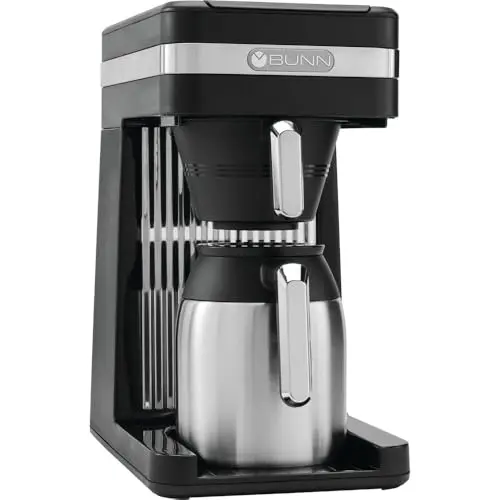
CSB3T Speed Brew Platinum Thermal – Fast, Simple Thermal Brewing
A speed-focused thermal brewer with an internal hot-water tank and a vacuum-insulated carafe. It is built for fast pots and simple operation.

EC-YTC100XB – Vacuum-Insulated Heat Retention
A vacuum-insulated stainless carafe brewer with a removable water tank and a 200-degree brewing target. It is designed around heat retention and easy serving.
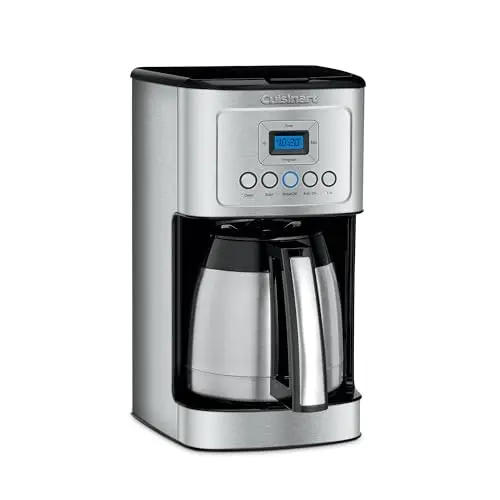
DCC-3400NAS – Programmable 12-Cup Thermal Brewer
A programmable 12-cup thermal brewer with brew-strength control and a 1-4 cup setting. It is feature-rich, though the carafe pour needs a steady hand.
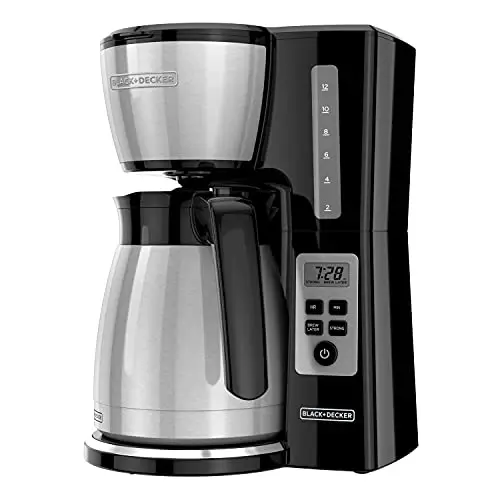
CM2046S – Budget 12-Cup Thermal Brewer
A budget-friendly 12-cup thermal brewer with a four-layer carafe and 24-hour auto brew. It covers the basics without a warming plate.

2150023 – 10-Cup Thermal with Brew Later
A 10-cup programmable thermal brewer with a double-walled stainless carafe and a Strong Brew option. It is a mid-range choice with a freshness timer.
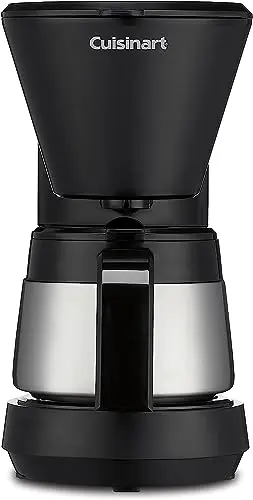
DCC-5570NAS – Compact 5-Cup Stainless Carafe
A compact 5-cup brewer with a stainless steel carafe and removable water reservoir. It is sized for small households and tight counters.
How We Evaluated These Coffee Makers with Stainless Carafe
We did not run controlled thermal-loss tests or measure carafe temperatures over several hours. What we did: cross-referenced six coffee makers from five distinct brands across six decision axes – heat retention, pour control, brew speed, programming flexibility, capacity and footprint, and cleaning routine. We audited published specifications, mapped feature sets to common morning routines, and weighed owner feedback where available. We compared stated capacities against typical household sizes and checked whether the controls and carafe lids were straightforward to live with. We also paid close attention to carafe geometry, because a thermal pot that dribbles or takes forever to empty undercuts the whole point of a stainless carafe.
The scoring framework weighted real-world fit (70%) – how well each machine delivers hot coffee with minimal fuss – against feature differentiation (30%) – programmable brewing, brew-strength control, batch size, and carafe design. A stainless carafe should earn its place by solving heat and pouring, not by adding complexity. We have no commercial relationship with any brand here, and recommendations track fit rather than brand preference. If speed is your priority, the Bunn CSB3T Speed Brew Platinum Thermal is the match; if heat retention matters more, the Zojirushi EC-YTC100XB serves you better. Neither choice is a knock on the other; they solve different parts of the same problem.
How to Choose the Right Coffee Makers with Stainless Carafe
1. Why a Stainless Carafe Changes the Coffee Maker Equation
A stainless steel carafe is not just a material upgrade; it changes how the machine manages heat. Most stainless models use a thermal carafe instead of a glass pot and warming plate, so coffee stops cooking the moment the brew ends. That usually means better flavor stability for the second and third cup. The trade-off is that heat retention depends on insulation quality, not on continuous heat, so a weak carafe shows up quickly.
2. Heat Retention: What a Thermal Carafe Actually Delivers
Vacuum insulation is the feature that separates a true thermal carafe from a simple stainless shell. Double-walled construction traps a layer of air or vacuum between walls, slowing heat loss without a heating element. Preheating the carafe with hot water before brewing is a small step that makes a noticeable difference, especially with larger pots. If you drink coffee over several hours, prioritize insulation over extra brew modes.
3. Pour Control and Carafe Design: The Daily-Use Difference
A thermal carafe lives or dies by pour control. Look for a drip-free spout and a lid that opens cleanly; thumb-activated pouring is convenient but only works if the carafe balance feels natural. Carafe geometry matters too: a tapered body pours more predictably than a wide, straight-sided pot. This is the detail that turns a good brewer into a daily-use machine.
4. Brew Speed, Programming, and Capacity: Matching the Machine to Your Morning
Brew speed matters most in households that make coffee in a hurry. A fast cycle helps, but it should not come at the expense of saturation or temperature. A programmable timer is useful if you want coffee ready at a set time, while batch size should match your actual consumption; oversized pots waste coffee and undersized pots create extra cycles. If speed is the priority, the Bunn CSB3T is the pick.
5. Cleaning, Descaling, and Long-Term Care for Stainless Carafe Coffee Makers
Stainless carafe coffee makers need a little more routine care than glass pots because you cannot see the buildup. A self-clean cycle simplifies descaling, and a charcoal filter helps with water taste if your tap water is hard or chlorinated. A decalcify indicator is a helpful reminder, but the carafe itself still needs hand washing and thorough drying. Skip this routine and even a good thermal pot will pick up stale oils.
6. Budget, Mid-Range, and Premium: What to Expect at Each Tier
Budget-friendly stainless carafe models usually cover the basics: a thermal carafe, a simple timer, and a keep-warm or auto-shutoff feature. Mid-range machines add stronger brew options, better carafe lids, and more flexible batch sizes. Premium models focus on heat retention, pour ergonomics, and build details rather than gadget count. For a budget-conscious kitchen, the BLACK+DECKER CM2046S is the value anchor; for a small household, the Cuisinart DCC-5570NAS keeps the footprint tight.
Frequently Asked Questions
1. What's the difference between the Bunn CSB3T and the Zojirushi EC-YTC100XB?
The Bunn CSB3T is built around speed: an internal hot-water tank and a vacuum-insulated carafe let it brew a full pot in about four minutes. The Zojirushi EC-YTC100XB is built around heat retention and pour ergonomics, with a removable water tank and a tapered carafe that is easy to serve from. Choose the Bunn for fast repeat brewing; choose the Zojirushi for all-day heat retention. Bunn CSB3T is the speed pick, while Zojirushi EC-YTC100XB is the heat-retention pick.
2. Is a stainless steel carafe better than a glass carafe?
A stainless steel carafe is better if you value heat retention and flavor stability over seeing the coffee level. It usually pairs with a thermal design that does not need a warming plate, so the coffee stops cooking after the brew. A glass carafe is easier to monitor and often simpler to clean, but it relies on a warming plate that can gradually stale the flavor. Neither is universally better; the right choice depends on whether you sip slowly or finish the pot quickly.
3. Do stainless carafe coffee makers keep coffee hot all day?
Not all of them, and the label alone does not guarantee it. Vacuum-insulated models hold heat longest, while simpler double-walled carafes may only stay hot for a couple of hours. Preheating the carafe with hot water before brewing extends that window, and a tight-fitting lid matters as much as wall thickness. If all-day heat is the goal, prioritize insulation quality over extra brew settings.
4. How does the Cuisinart DCC-3400NAS compare with the BLACK+DECKER CM2046S?
The Cuisinart DCC-3400NAS is the more feature-rich machine, with 24-hour programmability, brew-strength control, a 1-4 cup setting, and a self-clean cycle. The BLACK+DECKER CM2046S keeps things simpler: a 4-layer thermal carafe, 24-hour auto brew, and a Vortex showerhead at a budget-friendly tier. The Cuisinart gives you more control; the BLACK+DECKER gives you the core thermal-carafe experience with fewer extras. If you want flexibility, go Cuisinart; if you want value, go BLACK+DECKER.
5. How often should I clean a thermal carafe coffee maker?
Rinse the carafe after every use, and plan a deeper clean weekly if you brew daily. Thermal carafes trap oils and odors more than glass because you cannot see the interior easily. Use the machine’s self-clean cycle or a descaling solution when the decalcify indicator prompts you, and do not forget the lid and spout. A charcoal filter helps with water taste, but it does not replace routine cleaning.
Final Verdict
For most buyers, the Bunn CSB3T Speed Brew Platinum Thermal is the answer. It brews fast, keeps coffee hot in a vacuum-insulated carafe, and skips the warming plate without asking you to learn a complicated routine. If you want a more programmable thermal brewer, the Cuisinart DCC-3400NAS gives you brew-strength control and a 1-4 cup setting. Budget-conscious kitchens should look at the BLACK+DECKER CM2046S, which covers the essentials at a lower tier. And if heat retention is the whole point, the Zojirushi EC-YTC100XB is the premium pick for slow sippers. Match the machine to your morning, and the stainless carafe becomes a genuine upgrade rather than a spec-sheet detail.
