
Best Coffee Makers – 2026 Reviews

Walk the small-appliance aisle at a big-box store and you’ll see the same wall of near-identical 12-cup coffee makers: black plastic, glass carafe, the same promise printed on every box. The differences that actually matter don’t show up there. They show up in the third cup, when the coffee has been sitting on a warming plate for an hour and tastes like it. Or in month eight, when the brew basket starts leaking onto the counter.
Two things separate the machines worth owning from the ones you’ll replace. The first is brew temperature and even saturation – whether water hits the whole bed of grounds at a consistent, hot temperature or dribbles down the middle of it. The second is brew-style fit. A household that drains a full pot every morning and a household that wants one good cup at 6 a.m. need different machines, and buying the wrong one is the most common mistake in this category.
We looked across brands rather than down a single product line – entry-level drip pots, programmable carafe machines, pod brewers, a specialty machine with a frother, and one manual press – and sorted each by what it’s genuinely good at. Below you’ll find picks for full-pot households, single-cup drinkers, cramped counters, latte people, and anyone who wants good coffee without adding another appliance. Start with how you actually drink coffee and the shortlist gets short fast.
Best Coffee Makers – 2026 Reviews
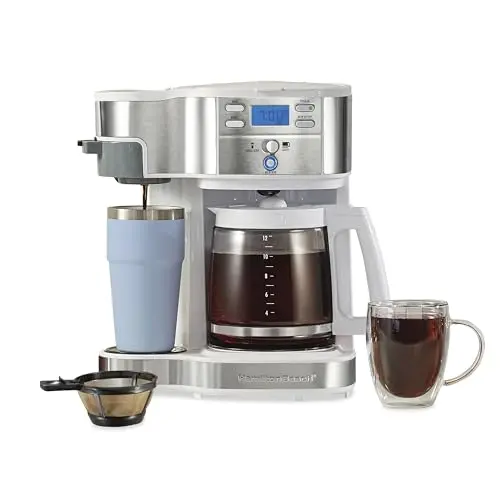
2-Way Programmable 49933 – Full Pot or Single Cup in One
A genuine two-in-one: the carafe side brews up to 12 cups on a programmable timer, while the single-serve side fills a mug or travel cup with up to 14 ounces. Each side has its own easy-fill reservoir with a water window. Both run on ground coffee, so there are no pods to buy or toss.
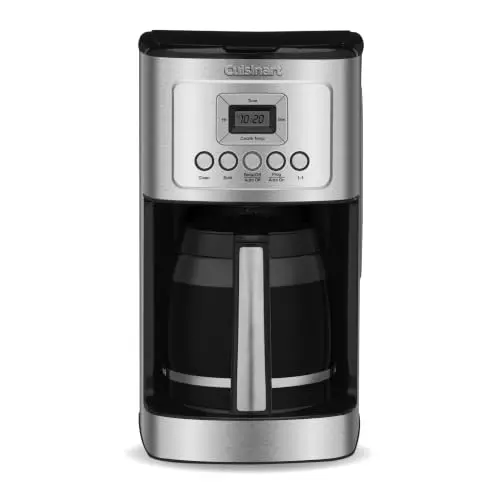
PerfecTemp DCC-3200 – Hot, Consistent Drip for a Crowd
A 14-cup programmable drip machine built around one idea: coffee that’s actually hot. PerfecTemp brewing runs at a higher temperature, and an adjustable warming plate lets you pick low, medium, or high after the brew finishes. Brew Strength gives you regular or bold, the 1-4 cup setting protects small batches, and a gold-tone permanent filter plus charcoal water filter are both included.
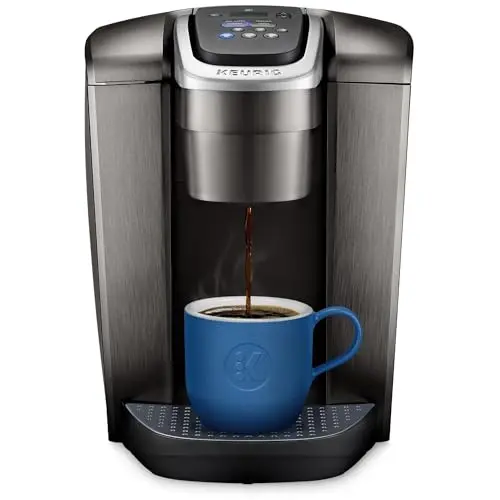
K-Elite – Single-Serve With Strength and Temperature Control
A single-serve pod brewer with more control than most. Five cup sizes from 4 to 12 ounces, a Strong Brew button, an iced setting that brews hot over ice, and a hot water on demand button for tea or oatmeal. The 75-ounce removable reservoir means fewer refills, a descale reminder handles maintenance, and quiet brew technology keeps early mornings civil.
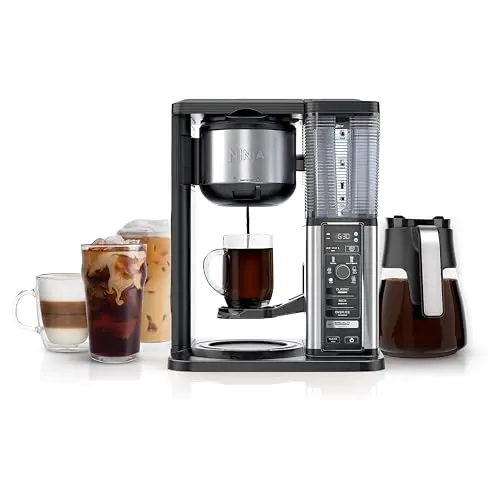
Specialty CM401 – Coffeehouse Drinks Without the Pods
A specialty brewer for people who drink lattes and iced coffee, not just plain drip. Four brew styles – Classic, Rich, Over Ice, and Specialty – plus a fold-away frother for hot or cold milk. Six brew sizes run from a single cup to a full 10-cup carafe, and the carafe, filter, reservoir, and frother whisk are all top-rack dishwasher safe.
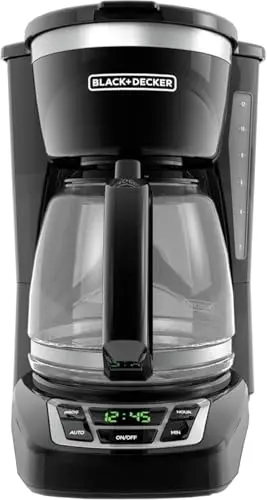
Vortex CM1160B-1 – Programmable Drip at Entry Price
A 12-cup programmable drip machine at about the least you can spend on a pot with a clock. Vortex showerhead brewing spreads water evenly across the grounds, the front water window shows exactly how much you’ve poured, and large rubberized buttons with an easy-read screen run the 24-hour timer. Sneak-A-Cup pauses the brew for an early pour, and it shuts itself off after two hours.
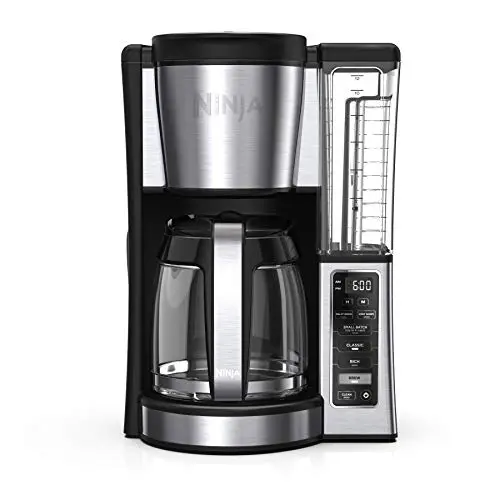
Fresh Brew CE251 – Programmable 12-Cup With Small-Batch Control
A straightforward 12-cup programmable brewer with two strengths – Classic and Rich – and hotter brewing technology aimed at even saturation. The small-batch setting keeps 1-4 cup brews from tasting diluted, delay brew runs 24 hours out, and the warming plate holds coffee for up to four hours. Mid-brew pause and a one-button clean cycle round it out.
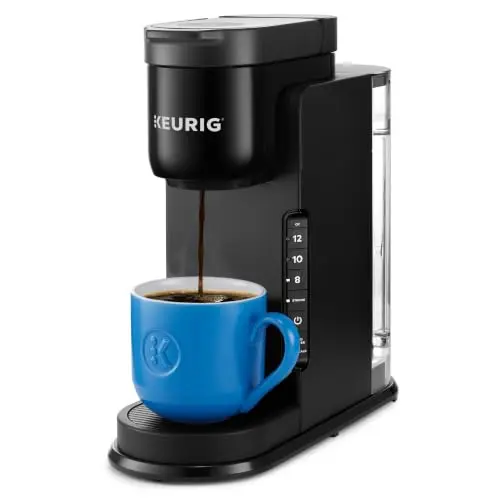
K-Express – Compact Single Serve for Small Counters
The compact end of the pod-brewer lineup. Three brew sizes at 8, 10, and 12 ounces, a Strong Brew button, and a 42-ounce removable reservoir covering roughly four cups before a refill. The drip tray pulls out to clear travel mugs up to 7.4 inches, and the machine powers down five minutes after the last brew.
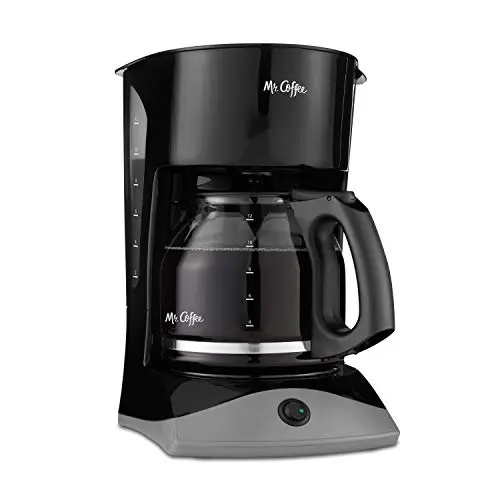
SK13 12-Cup – One Button, No Fuss
The classic 12-cup drip machine stripped to essentials: an on/off indicator light, Grab-A-Cup auto pause for a mid-brew pour, cord storage to keep the counter tidy, and a removable basket filter that lifts out for filling and rinsing. No clock, no timer, no screen.
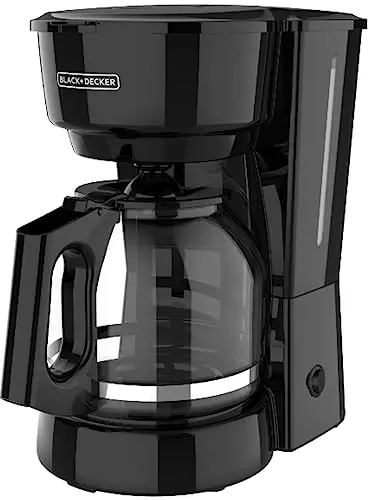
Vortex CM0915BKD – Switch-On, No-Frills 12-Cup
The simplest brewer in the lineup: a switch, a hot plate, and Vortex technology that spreads water over the grounds for fuller extraction. Sneak-A-Cup pauses the flow mid-brew, the carafe spout is shaped to pour without drips, and the brew basket is dishwasher safe.
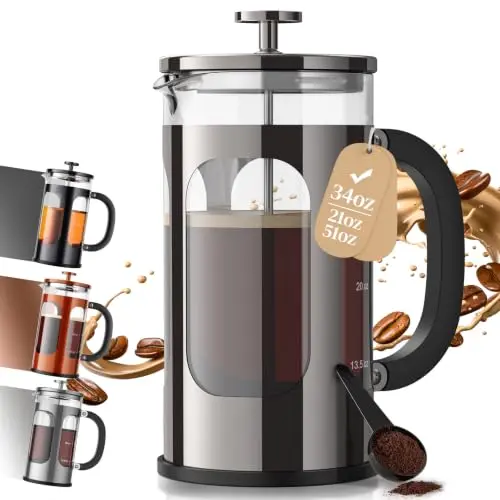
34oz French Press – Full-Immersion Brewing, No Electricity
A one-liter full-immersion brewer with a borosilicate glass carafe rated from -40F to 302F, so it handles hot coffee, cold brew, and loose-leaf tea. The brewing path is 304 stainless steel and food-grade silicone with no plastic touching your coffee, and a four-layer filter keeps grit out of the cup. Ounce markings and a scoop are included.
How We Evaluated These Coffee Makers
A few things we can’t tell you: how each of these machines holds up after two years of daily brewing, or how the carafe pours at 6 a.m. when you’re not watching it. What we can tell you is how the feature sets stack up. We cross-referenced 10 coffee makers from 7 distinct brands across six decision axes – brewing temperature and control, capacity and brew-size flexibility, programmable convenience features, cleaning and descaling upkeep, counter footprint and build, and warranty coverage.
We triangulated published specifications, feature documentation, and owner feedback where available, then mapped each machine against realistic buyer profiles: the single-cup commuter, the two-person household that finishes a pot, the household that wants coffeehouse drinks without the café run. We also weighed how each one handles the awkward middle – a small batch, a half carafe, a second cup an hour later. The scoring framework put real-world fit for the intended job (70%) against feature differentiation (30%) – what one machine offers that the others genuinely don’t. Specs were audited against manufacturers’ published details rather than marketing language.
We have no commercial relationship with any of the brands here; recommendations track fit and differentiation, not brand preference. If you want one machine for both a fast cup and a full pot, the Hamilton Beach 2-Way Programmable 49933 is your match; if hot, consistent drip coffee for a crowd matters more, the Cuisinart PerfecTemp DCC-3200 serves you better.
How to Choose the Right Coffee Makers
1. Drip, pod, or press: which coffee maker type fits your morning
Almost every machine on a store shelf falls into one of three families, and that choice matters more than brand. A drip machine with a carafe brews a pot at once, runs on inexpensive ground coffee, and is the only type that reliably serves more than two people at the same time. A single-serve pod brewer wins on speed and cleanup but locks you into pods and one cup at a time. A French press is manual, unplugged, and produces the fullest body of the three – at the cost of four minutes of attention.
Most households are one primary type plus a secondary machine for the exception: a drip pot for weekdays, a press for weekends, a pod brewer in a home office. Decide which job is primary before you compare features, because a great pod machine and a great drip machine aren’t solving the same problem.
2. Capacity and brew-size flexibility: how many cups do you actually drink?
Capacity is the easiest spec to overbuy. A 12-cup carafe holds roughly 60 ounces, which is more than most two-person households finish before the coffee goes stale on the warming plate. If you routinely pour half a pot down the sink, a small-batch setting or a single-serve side will do more for your coffee quality than any upgrade.
The other direction matters too. If one person leaves at 6 a.m. and another works from home, a machine that only brews a full pot is a daily compromise. That’s the case for brew-size flexibility – and it’s why the Hamilton Beach 2-Way Programmable 49933, with a full carafe side and a single-serve side on the same body, covers more households than any single-purpose machine here.
3. Brew temperature and consistency: the spec most shoppers ignore
Two machines with identical capacity can produce very different coffee, and temperature is usually why. Brew temperature control and an even saturation pattern – a showerhead that spreads water across the whole bed of grounds rather than dumping it in the center – do more for flavor than a fancy carafe. Cheap machines also lose heat on the warming plate, which is why coffee tastes thin and burnt an hour after brewing.
If hot, consistent coffee is the whole point for you, look for a machine that advertises a brewing temperature feature and an adjustable warming plate. The Cuisinart PerfecTemp DCC-3200 is built around exactly that combination, and it’s the pick to beat if your last pot always tasted lukewarm.
4. Programmable features worth paying for, and the ones you can skip
A 24-hour programmable timer is the feature most people actually use – set it once and coffee is waiting. Auto shutoff is the one that saves you from turning the car around in the driveway. Both are worth paying a little more for. Brew strength settings earn their keep if you like a bolder cup; iced modes and milk frothers are worth it only if you’ll use them weekly.
What you can usually skip: adjustable warming-plate temperatures if the pot is gone within the hour, second reservoirs, and app connectivity. If all you want is a timer plus auto shutoff, the BLACK+DECKER Vortex CM1160B-1 delivers both for close to the floor on programmable pricing.
5. Cleaning, descaling, and upkeep: what keeps a coffee maker tasting good
Every drip and pod machine here will eventually taste bad if you skip descaling. A self-clean cycle or a descale indicator turns a vague chore into a button press. A removable water reservoir and a dishwasher-safe brew basket make the weekly rinse far less annoying, and a charcoal water filter helps if your tap water is hard or heavily chlorinated.
Consumables are the hidden variable: basket-style paper filters, cone filters, and pods all carry ongoing costs, while a permanent gold-tone filter removes one of them. Check which filter your shortlist takes before you buy, especially if you’re restocking a kitchen from scratch and don’t want a surprise midweek filter run.
6. What to check when you buy a coffee maker at a big-box retailer
Retail shelves and online listings rarely carry identical model numbers, and that’s by design. A machine sold at a big-box store like Target may share a nameplate with one sold elsewhere but differ in carafe size, filter type, or warranty length. Note the model number on the box and match it against the listing or spec sheet before you commit.
Three things are worth checking in the aisle: the filter type the machine takes and whether that size is easy to find locally, whether a replacement carafe is available for that specific model, and the warranty terms printed on the box rather than the marketing card. Return windows at large retailers are generous, but a machine that leaks in month fourteen is a warranty question, not a return question.
Frequently Asked Questions
1. Hamilton Beach 2-Way vs. Keurig K-Elite: which suits a two-person household?
They solve different problems. The Hamilton Beach 2-Way Programmable 49933 runs on ground coffee and gives you two machines in one body: a programmable 12-cup carafe side and a single-serve side that fills a travel mug. Two people who drink coffee at the same time get a full pot without waiting.
The Keurig K-Elite is faster for one cup and offers strength control, an iced setting, and hot water on demand – but you’re buying pods indefinitely and brewing one cup at a time. Pick the Hamilton Beach if grounds and volume rule your mornings; pick the K-Elite if pod convenience does.
2. What's the difference between the Cuisinart PerfecTemp DCC-3200 and the Ninja Fresh Brew CE251?
Both are programmable drip machines with a glass carafe, but they’re aimed at different kitchens. The Cuisinart is the larger of the two at 14 cups, and it adds PerfecTemp higher-temperature brewing, an adjustable warming plate, a charcoal water filter, and a three-year warranty.
The Ninja Fresh Brew CE251 is the more affordable machine, and it counters with Classic and Rich brew styles, a genuine small-batch setting, a removable water reservoir, and a warming plate that holds up to four hours. Choose the Cuisinart for capacity, heat, and coverage; choose the Ninja if you brew small batches often and want a bolder cup without paying for capacity you won’t use.
3. Is a pod coffee maker more expensive to run than a drip machine?
Per cup, almost always yes. A K-Cup pod costs several times what the equivalent dose of ground coffee does, and that gap compounds over a year of daily brewing. A drip machine or a French press trades convenience for a much lower cost per cup.
The tradeoff isn’t irrational, though. Pod machines win on cleanup, speed, and consistency, and if you drink one cup a day the difference is smaller than it looks. If you drink three, it adds up quickly.
4. How long should a coffee maker last before it needs replacing?
Expect a few years of daily use from a well-cared-for drip or pod machine, and treat every additional year past that as a bonus. Descaling on schedule is the single biggest factor – mineral buildup kills machines that would otherwise keep going.
Coverage varies widely across this lineup: three-year warranties, two-year warranties, and one-year coverage all appear. Check replacement carafe availability too, since a cracked pot is the most common reason a working machine gets retired.
5. Is a French press worth owning alongside a drip coffee maker?
Yes, if you want a fuller-bodied cup or you brew cold coffee. A French press is full immersion – grounds steep, then you plunge – so the cup carries more oils and body than a paper-filtered drip brew. It also needs no electricity, which makes it the obvious choice for camping or a power outage.
The tradeoff is manual control: you boil water separately, time the steep, and hand-wash the carafe. The Veken 34oz French Press handles hot coffee and cold brew in the same vessel, and its four-layer filter keeps the grit out of the cup.
Final Verdict
For most people, the Hamilton Beach 2-Way Programmable 49933 is the answer. It covers a rushed weekday cup and a weekend pot in one footprint, runs on ground coffee, and shuts itself off – the three things that actually matter at 6 a.m. If you want a programmable pot for close to the floor on price, the BLACK+DECKER Vortex CM1160B-1 gets you the timer and auto shutoff without the extras. Pod drinkers who want strength and temperature control should go with the Keurig K-Elite, and if your ritual includes foam and iced drinks, the Ninja Specialty CM401 is purpose-built for it. Start with how you actually drink coffee, and the right machine falls out of that answer fast.
