
Best Commercial Air Purifiers – 2026 Reviews

Commercial air quality problems rarely look like a dusty bedroom. They look like a restoration crew pulling wet drywall, a print shop running adhesives all day, or a small office where the front desk smells last night’s cleaning chemicals. That’s why shopping for a commercial air purifier is less about style and more about airflow, filter stages, and whether the machine can run hard without falling apart.
Two specs separate the serious tools from the pretenders: CFM and filtration stack. CFM tells you how much air the unit moves; the filter stack tells you what it can actually remove. Noise, footprint, and duty cycle decide whether the thing is practical on a real job. We looked across commercial scrubbers, specialty odor machines, and light-duty HEPA towers to sort out which buyer each one fits.
Best Commercial Air Purifiers – 2026 Reviews

Air Shield 550 – Commercial HEPA Air Scrubber
A restoration-grade HEPA air scrubber built for jobs where dust, smoke, and debris are constant. The 550 CFM airflow and daisy-chain support make it a practical choice for water damage, fire cleanup, and construction sites.
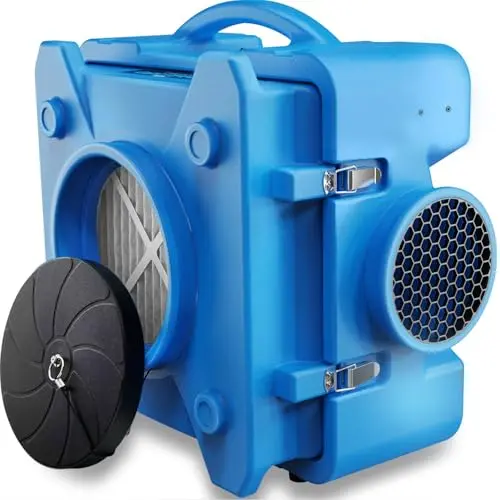
Shield-550 – 3-Stage Commercial Air Scrubber
A 550 CFM commercial air scrubber with a three-stage filter stack that includes activated carbon. It’s aimed at restoration crews and contractors who want odor and VOC control without adding a separate carbon stage.
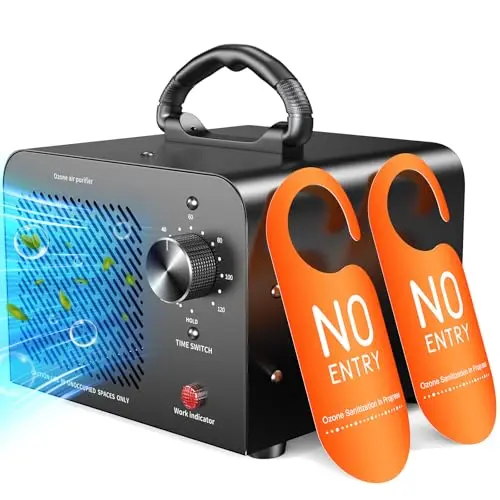
CQ-48g – High-Output Ozone Deodorizer
A compact ozone generator for unoccupied commercial spaces. It’s a specialty odor-shock tool for smoke, pets, and mildew, not a continuous HEPA purifier for occupied rooms.
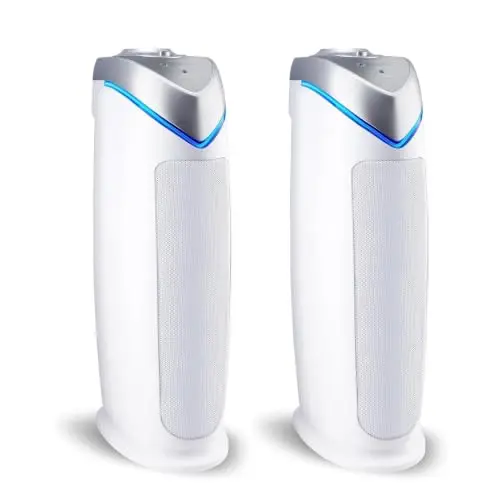
AC4825W2PK – Light-Duty HEPA Tower 2-Pack
A two-pack of slim HEPA towers for small offices, reception areas, and home workspaces. It’s a light-duty option for everyday dust and pollen, not a restoration-grade air scrubber.
How We Evaluated These Commercial Air Purifiers
We did not run controlled CADR tests or particle-count measurements in a sealed commercial space. What we did: cross-referenced four commercial air purifier models from four distinct brands across five decision axes – airflow and coverage, filtration stages, build and duty cycle, noise and placement, and safety or maintenance needs. We triangulated published specifications, feature sets, owner feedback where available, and use-case fit for restoration crews, contractors, small offices, and odor-treatment jobs. We also mapped each model to the buyer it actually serves rather than treating every air-treatment machine as interchangeable. We benchmarked published CFM and coverage claims against the filter type each unit uses, because a high airflow number means little if the filter stack cannot match the job. We audited safety notes and maintenance requirements separately, since some air-treatment tools are not meant for occupied rooms.
The scoring framework weighted real-world performance (70%) – how well each option handles its stated commercial job – against feature differentiation (30%) – unique filtration, warranty, portability, and safety advantages. We have no commercial relationship with any featured brand; recommendations track fit and differentiation, not brand preference. The goal is a shortlist that matches the work, not a spec-sheet parade. If you need a restoration-grade scrubber, the Air Shield 550 is the first one to shortlist; if you want carbon filtration and a longer warranty, the Shield-550 is the stronger fit.
How to Choose the Right Commercial Air Purifiers
1. What Makes a Commercial Air Purifier Different From a Home Unit?
A commercial air purifier is built for workload first. That means continuous duty operation, larger filter surface area, and a serviceable filter stack that can handle drywall dust, smoke, or construction debris without choking in a day. Home units are tuned for quiet comfort in a bedroom or office; commercial scrubbers are tuned for air turnover and uptime.
2. CFM, Coverage, and Filtration: The Specs That Matter
CFM tells you how much air the machine moves, but coverage claims only make sense when you pair airflow with the filter load. For commercial work, look at air exchanges per hour in the actual room, not just the biggest square-footage number on the box. A HEPA and carbon stages setup covers particles and odors; a pre-filter protects the expensive filters and keeps performance steadier. If odor control is part of the job, the Shield-550 is a clear example of a scrubber with carbon built into its stack.
3. Commercial Air Purifier vs. Ozone Generator: Different Tools, Different Risks
An ozone generator is not a HEPA purifier. It is a shock-treatment tool for unoccupied spaces, useful for smoke, mildew, and tough odors, but it must be used with strict ventilation and no people, pets, or plants present. A HEPA scrubber is the safer choice for continuous filtration in occupied commercial areas. For odor-only jobs in empty rooms, the CQ-48g is the specialty tool; for ongoing particle removal, stay with a scrubber.
4. BlueDri Air Shield 550 vs. CADPXS Shield-550: Which Commercial Air Scrubber Fits?
These two are the closest head-to-head in the lineup. The BlueDri Air Shield 550 is the restoration-workflow pick, especially if you need daisy-chain support to run multiple units on a larger job. The CADPXS Shield-550 is the odor-control pick because it includes carbon filtration and backs the unit with a longer warranty. Both are 550 CFM-class scrubbers; the decision comes down to whether your priority is multi-unit coordination or a more complete filter stack out of the box. If you’re setting up a large loss with several machines, the Air Shield 550 is the easier anchor.
5. Budget, Mid-Range, and Premium Commercial Air Purifiers: What Changes?
Budget-friendly commercial air purifiers often trade filter capacity, warranty length, or build refinement for a lower entry point. Mid-range models are where most buyers land: enough airflow for real jobs, a serviceable filter stack, and support that doesn’t disappear after the sale. Premium units add longer warranties, more robust housings, or specialized filtration, but the jump only pays off if the machine’s duty cycle matches your work. In every tier, price out replacement filters before you commit; consumables are the long-term cost that separates a bargain from a money pit.
Frequently Asked Questions
1. What makes an air purifier truly commercial-grade?
Commercial-grade usually means the unit can run long duty cycles, move enough CFM to turn over the air in a real workspace, and use a serviceable filter stack that won’t clog after a few days of job-site dust. A home purifier can help in a small office, but it isn’t built for restoration debris or around-the-clock drying work.
2. What's the difference between the BlueDri Air Shield 550 and the CADPXS Shield-550?
The BlueDri Air Shield 550 leans toward restoration workflow, with daisy-chain support for running multiple units and a simple pre-filter-plus-HEPA path. The CADPXS Shield-550 adds carbon filtration in its three-stage stack and backs the unit with a longer warranty, so it’s the better fit when odors and VOCs are part of the job. For a large loss where you’re coordinating several scrubbers, the Air Shield 550 is the more practical anchor.
3. Can a home air purifier like the GermGuardian AC4825W2PK handle commercial use?
The GermGuardian AC4825W2PK is a light-duty HEPA tower, not a restoration-grade scrubber. It can make sense in a small office or reception area where the goal is everyday dust, pollen, and odor reduction, but it lacks the airflow and filter capacity for construction dust, water damage, or fire cleanup. If that’s your use case, the AC4825W2PK is a reasonable quiet option; if not, step up to a commercial scrubber.
4. How does the hadlook CQ-48g compare with HEPA air scrubbers for odor removal?
The CQ-48g is an ozone shock treatment, while a HEPA scrubber is a continuous particle-removal machine. Ozone can knock down smoke and mildew odors in unoccupied spaces, but it must not run around people, pets, or plants, and it does not replace filtration for occupied commercial areas. Use it as a targeted odor step, then ventilate before anyone returns.
5. Do commercial air purifiers need carbon filtration?
Not always. HEPA filtration handles particles, while activated carbon is what addresses VOCs and odors from paint, adhesives, smoke, and cleaning chemicals. If your commercial air purifier will run in a print shop, salon, or post-fire space, carbon is worth prioritizing; for plain dust and debris, a good pre-filter and HEPA combination is the core requirement.
Final Verdict
For most commercial buyers, the Air Shield 550 is the answer: it has the airflow, HEPA filtration, and daisy-chain flexibility to handle restoration dust and smoke without turning into a niche machine. If you want carbon filtration and a longer warranty, the Shield-550 is the value-minded commercial scrubber. For odor-only jobs in empty rooms, the CQ-48g is a powerful specialty tool, provided you follow the unoccupied-space rules. And if your version of commercial is a small office or reception area, the AC4825W2PK is the quiet light-duty pair that makes more sense than a job-site scrubber. Match the machine to the job, not the marketing label.
