
Best Commercial Bulk Coffee Grinders – 2026 Reviews

A commercial bulk coffee grinder has a different job than the shiny home grinder on a kitchen counter. It has to keep up when the line is long, the hopper is full, and the next batch is already waiting. That changes the priorities: raw capacity matters, but so do duty cycle, burr stability, and how much coffee stays trapped in the chute.
The tricky part is that commercial bulk is not a single spec. Some machines are built for big dry batches and grind by blade at high speed; others are commercial-style flat burr grinders with smaller hoppers but far better particle consistency. We looked at both approaches because the right pick depends on whether you are feeding a bulk bin, a coffee bar, or a high-volume kitchen.
Below, we break down the tradeoffs that actually separate these grinders: capacity versus consistency, speed versus heat, and convenience versus cleanout. The goal is to help you choose from the category, not to push one badge-friendly favorite.
Best Commercial Bulk Coffee Grinders – 2026 Reviews
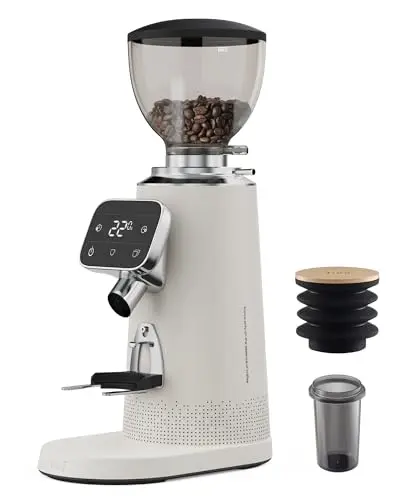
G3 – Commercial 64mm Flat Burr for Bulk Coffee
The Tuni G3 is a commercial-labeled 64mm flat burr grinder built for espresso and batch brewing. It pairs a stainless steel body with 100 grind settings, anti-static grounds handling, and two hoppers: a 250g main hopper and a 50g single-dose hopper. The portafilter holder fits 51-58mm baskets, and the LED touchscreen handles single, double, and continuous dosing.

Titanium 64mm Flat Burr – Large-Hopper Espresso Grinding
The MOKKOM BD-CG308 uses titanium-coated 64mm flat burrs and a 100-setting adjustment ring to cover espresso through cold brew. It includes a 350g main hopper plus a silicone single-dose hopper, an anti-static system, and an LED timer for repeatable dosing. The full metal body is built to reduce vibration during longer grinding sessions.

CG301 – 64mm Flat Burr with Precision Timer
The SHARDOR CG301 is a 64mm flat burr grinder with a 100-setting adjustment range, an all-metal grinding chamber, and a precision timer with 0.1-second control. It includes a portafilter holder, a stainless steel cup, and an anti-static system to manage mess. The 250g hopper and 260W motor are aimed at espresso, drip, and French press duty.

1000g High-Speed Grain Mill – Large-Batch Grinding
The LEJIEYIN 1000g high-speed mill is a commercial-style powder machine for large dry batches. It uses a 2400W motor and three-layer stainless steel blades to grind grains, spices, herbs, corn, and coffee beans to a 50-300 mesh fineness. The 1000g capacity and 0-5 minute timer make it suited to bulk dry grinding, with overload protection and a safety lid.

HC-800Y – Commercial Grain Mill for Bulk Batches
The VEVOR HC-800Y is a 2100W commercial-style grain and spice mill with an 800g grinding cup and a 28,000 RPM motor. It offers 5-, 15-, and 30-second timer presets, 30-300 mesh fineness, and a swing-type body for easier pouring. It is designed for dry grains, spices, corn, pepper, and coffee beans, with a 5-10 minute rest recommended between runs.
How We Evaluated These Commercial Bulk Coffee Grinders
We didn’t run these machines through a full commercial kitchen shift or measure particle distribution in a lab. What we did: cross-referenced 5 commercial bulk coffee grinders from 5 distinct brands across 5 decision axes – grinding capacity, burr or blade design, duty cycle and heat management, grind adjustment range, and cleanout or retention behavior. We triangulated published specifications, feature sets, and owner feedback where available, then mapped each grinder against realistic high-volume coffee scenarios: filling bulk bins, grinding through back-to-back batches, and dialing in espresso without emptying a hopper.
The scoring framework weighted real-world fit for bulk coffee work (70%) – capacity, consistency, speed, and how well each machine handles repeated use – against feature differentiation (30%) – unique design choices like dual hoppers, anti-static systems, and extended warranties. We audited the lineup for overlap and weighed claims against the input specifications rather than marketing language. We have no commercial relationship with any brand here; recommendations track fit and differentiation, not brand preference. If you want the most balanced commercial-style coffee grinder, the Tuni G3 is the one we would start with. If you need more hopper capacity in a burr grinder, the MOKKOM Titanium 64mm Flat Burr is the better match.
How to Choose the Right Commercial Bulk Coffee Grinders
1. What Makes a Coffee Grinder Commercial Bulk Ready?
Commercial and bulk are two separate promises. Commercial usually points to duty cycle, build stability, and serviceability; bulk points to hopper size, grinding capacity, and how fast the machine can move through a batch. A grinder can be one without the other. A 64mm flat burr espresso grinder may be commercial-style in burr quality but still hold only 250g of beans. A high-wattage grain mill may hold 1000g but produce a less uniform coffee grind. Decide which promise matters more for your workflow before you compare models.
For coffee-specific bulk work, the minimum question is whether the grinder can handle back-to-back batches without overheating or forcing long cooldowns. For retail bulk bins or a small coffee bar, that may matter more than an espresso-fine adjustment range. For a kitchen that grinds a lot of dry goods, a high-capacity blade mill can be the more practical tool as long as you accept the consistency tradeoff. If you are shopping coffee-first, the Tuni G3 is the safer starting point; if dry-goods capacity leads, the LEJIEYIN 1000g mill makes more sense.
2. Burr vs. Blade: The Biggest Fork for Bulk Coffee Grinding
Burr grinders crush beans between two hard surfaces, which generally gives you a more uniform particle size and better control for espresso, drip, and pour-over. Flat burrs are common in commercial-style coffee grinders; conical burrs are another option. Blade mills spin a blade at high speed and chop until the coffee looks fine, which is fast and roomy but less predictable. If you need to dial in espresso or serve consistent brew batches, burr design should be non-negotiable. If you are grinding large volumes of dry coffee for bulk packaging and can tolerate a wider particle spread, a blade mill can still get the job done.
3. Capacity, Duty Cycle, and Hopper Size in a Bulk Coffee Grinder
Capacity comes in two forms: hopper size and grinding chamber size. A large hopper reduces refills during service; a large grinding chamber lets you process a bigger single batch. The burr grinders here typically hold 250-350g, which is generous for a home or small coffee bar but not a true bulk bin. The grain-mill style machines hold 800-1000g and are built for larger dry batches. Do not ignore duty cycle: some high-speed mills need a rest after a few minutes, and that cooldown can bottleneck a busy shift. Check the manufacturer’s run-time guidance before you assume a big capacity number means nonstop output.
4. Grind Consistency and Adjustment Range for Commercial Bulk Coffee
Grind consistency is what separates coffee-first grinders from general-purpose mills. Uniform particles extract at a similar rate, which makes espresso shots and brew batches easier to repeat. Look for a wide adjustment range if you switch between espresso, drip, and French press, and a stepless or fine-step ring if you need to dial in small changes. A large step count is useful only if the mechanism is repeatable and easy to return to a known setting. For bulk coffee, consistency matters more than raw speed once you are past the minimum capacity you need.
5. Cleaning, Retention, and Maintenance in a High-Volume Grinder
Retention is the coffee left inside the chute, burr chamber, or discharge path after grinding. In a high-volume setup, small retention numbers add up, and stale grounds can affect the next batch. Removable magnetic discharge pipes, bellows, and easy-access burr chambers make cleanout faster. Anti-static systems help keep grounds from clinging to surfaces and flying around the counter. Blade mills are usually simpler to brush out but can be harder to clean around the blades safely. Whatever you choose, plan a daily cleanout routine rather than treating maintenance as an occasional deep clean.
6. What to Expect at Each Price Tier
Entry-level bulk mills prioritize capacity and power, often with blade-based grinding and simpler controls. Mid-range commercial-style burr grinders add flat burrs, anti-static features, timed dosing, and portafilter holders. Premium picks bring larger burrs, more refined adjustment, dual hoppers, and sturdier build quality. The higher tier is not automatically better for bulk work: a premium espresso grinder with a small hopper may be less useful than a simpler high-capacity mill if your goal is filling large bins. Match the tier to the job, not to the badge on the box.
Frequently Asked Questions
1. What should I look for in a commercial bulk coffee grinder?
Start with the job the grinder has to do. For coffee-first work, prioritize burr type, grind consistency, and adjustment range before hopper size. For bulk dry goods, prioritize capacity, duty cycle, and motor power. Then check retention and cleanout, because a grinder that holds stale grounds will undermine even a good burr set. A true commercial bulk machine should also have a realistic cooldown schedule and a build that stays stable during repeated batches.
2. Are all commercial bulk coffee grinders actually built for high-volume use?
No. Commercial-style often describes the burr set or build quality, not a certified duty rating. Some grinders with 64mm flat burrs and metal bodies still have small hoppers and are better suited to a small coffee bar or serious home setup than a full production line. Others have large grinding capacity but need frequent cooldowns. Check the run-time guidance and hopper size separately, then match those limits to your busiest shift rather than the average day.
3. Tuni G3 vs. SHARDOR CG301: Which commercial-style grinder is better for bulk coffee?
The Tuni G3 is the more flexible pick for a small coffee bar because its dual hoppers, anti-static system, and portafilter holder support both batch and espresso workflows. The SHARDOR CG301 is the stronger value if you want 64mm flat burrs, a precision timer, and a longer 2-year warranty without moving to the top tier. Both have modest hoppers for true bulk work, so choose the Tuni for workflow flexibility and the SHARDOR for price-to-feature balance. If espresso is the priority, the Tuni G3 is the safer route.
4. MOKKOM vs. LEJIEYIN: Which handles larger coffee batches better?
For coffee quality, the MOKKOM is the better batch tool because its 64mm flat burrs and 100 grind settings give you more control over particle size, and its 350g hopper reduces refills. For raw capacity, the LEJIEYIN wins with a 1000g grinding chamber and a 2400W motor that can process large dry batches quickly. The tradeoff is consistency: the LEJIEYIN is a blade mill, so it is better for bulk dry grinding than espresso dial-in. Choose MOKKOM for coffee-first batches and LEJIEYIN for volume-first dry goods.
5. Can a grain mill work as a commercial bulk coffee grinder?
Yes, with caveats. A grain mill like the VEVOR or LEJIEYIN can grind dry coffee beans in large batches, and its high-speed blades are fast. But it will not match a flat burr grinder for particle uniformity, which matters for espresso and consistent brew extraction. Use a grain mill for bulk dry grinding, coarse-to-medium coffee, or non-coffee dry goods, and plan for cooldown breaks between runs. If your customers expect espresso-grade consistency, a burr grinder is the better fit.
Final Verdict
For most commercial bulk coffee setups, the Tuni G3 is the best overall starting point. It combines 64mm flat burrs, a dual hopper system, and anti-static dosing in a package that can handle both espresso and batch brewing without turning into a full café grinder. If you need more hopper capacity in a burr grinder, the MOKKOM Titanium 64mm Flat Burr is the better fit. For true large-batch dry grinding, the LEJIEYIN 1000g mill offers the most capacity, while the VEVOR HC-800Y is the budget-conscious way to get started. Buy for the work you actually do: coffee consistency first, or bulk capacity first. The Tuni is the safer default when you need both.
