
Best Commercial Garment Steamers – 2026 Reviews

Steam a rack of forty dresses with a handheld unit and you’ll learn the difference between a garment steamer and a commercial garment steamer in about eleven minutes – roughly how long it takes before the reservoir runs dry and your wrist starts filing complaints. The machines that survive a working day aren’t the ones with the flashiest demo. They’re the ones that hold enough water to keep pace, recover quickly between garments, and don’t need a siesta halfway through a fitting appointment.
Two things separate the real workhorses from consumer units wearing a commercial badge. The first is tank capacity measured against honest continuous steam time – a big reservoir that delivers thin steam for twenty minutes is worse than a smaller one with a genuine hour of output. The second is heat-up and recovery. Two minutes is a coffee break you can absorb. Fifteen minutes is a customer standing in front of you in a half-steamed jacket.
This guide maps the market across brands and across those two axes, then adds the stuff buyers only notice after a month: housing materials, hose and steam-head handling, low-water alerts, automatic shut-offs, and how long the warranty actually runs. Wattage is the headline number on every box. It’s rarely the one that decides whether a steamer holds up in a shop.
Best Commercial Garment Steamers – 2026 Reviews

J-2000 – Two-Minute Heat-Up Workhorse
The J-2000 is the machine most people picture when they hear ‘commercial garment steamer’ – a floor-standing unit with a 1300-watt solid brass heating element, a 3/4-gallon tank good for about 1.5 hours of steam per fill, and a two-minute heat-up that means it’s working almost as soon as you plug it in. The 6-inch plastic steam head rides on a large-diameter hose, and a fusible link with automatic shut-off cuts power if things run dry. Assembled it stands 64 inches tall on a high-impact plastic housing, and Jiffy backs it with a three-year warranty.
X3A Commercial – Water Alerts and Big Runtime
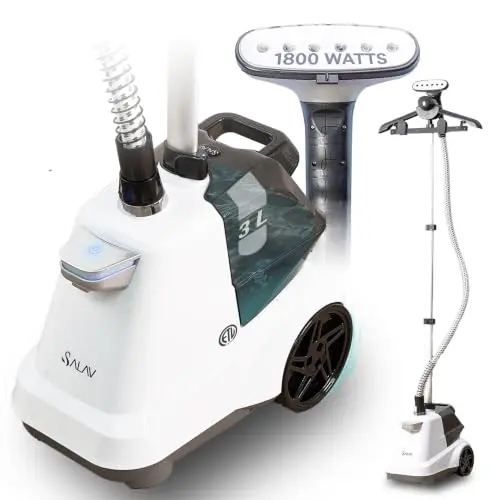
The X3A pairs an 1800-watt heating element with a 3-liter tank rated for 90-plus minutes of steam and a 45-second heat-up. What sets it apart is the water-management logic: a blue indicator starts blinking and a 90-second beep sounds when the level drops, then the unit powers down with a final beep and a red light. A telescopic aluminum pole collapses for storage, 360-degree wheels move it between rooms, and a fabric brush and pants press ship in the box. One-year warranty.

H-23 – Long Runtime, Low Buy-In
The H-23 is the value argument in standing form: 1500 watts, a 2.8-liter tank rated for about 80 minutes of continuous steam, and a 35-second heat-up. Height adjusts on the pole, an electronic pump system is designed to keep water off your fabrics, and a dual safety system cuts power when the unit overheats or runs low, then resets automatically. A pants clip and a children’s clothing hanger come in the box, and the warranty runs three years.

J-4000 Pro-Line – Gallon-Tank Capacity
The J-4000 is Jiffy’s pro-line machine: a 1500-watt incoloy heating element inside a solid die-cast aluminum housing, a full 1-gallon tank, and a 6-inch plastic steam head on a 5.5-foot flexible rubber hose. Separate standby and steam settings let you hold temperature without running full output. Four 360-degree swivel casters move it around a stockroom, and it carries the same three-year limited warranty as the rest of the Jiffy line.
SX3 – Foot Control and Three Settings
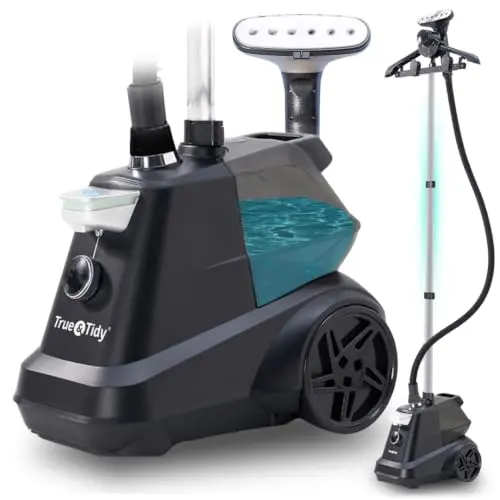
A 1800-watt standing steamer built for both retail and home use, with a removable 3-liter reservoir rated for more than 90 minutes of steam. Three steam settings and a step-on/off foot control let you adjust output and power without bending down mid-garment. A telescopic aluminum support bar retracts for storage, wheels handle movement, and a multifunction hanger holds awkward pieces. It’s ETL certified and ships with a pants press and fabric brush attachment.
H-508X – Anti-Drip Standing Steamer
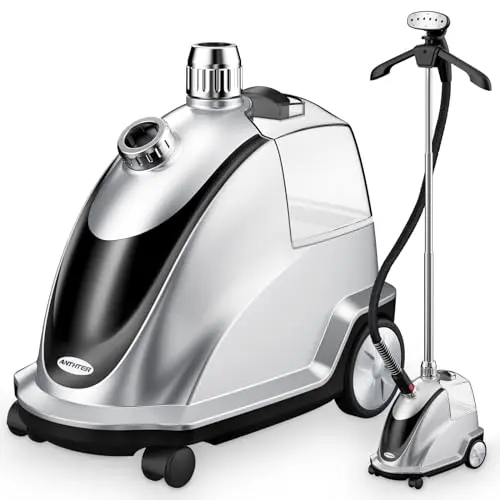
A 1500-watt upright with a 2.4-liter tank, a listed 35-second heat-up, and about 90 minutes of continuous steam per fill. The emphasis is on water control: an electronic pump system is designed to stop the spitting and dripping that can stain fabric. An adjustable pole sets working height, wheels roll it between rooms, and a dual protection system cuts power on overheating or low water, then resets automatically. Three-year warranty.
How We Evaluated These Commercial Garment Steamers
We didn’t run instrumented steam-output or water-consumption measurements, and we didn’t park a steamer in a boutique for six months of daily use. What we did: cross-referenced six commercial garment steamer models from five distinct brands against six decision axes – tank capacity and honest continuous runtime, heat-up and recovery speed, heating element and housing build, steam-head and hose design, safety behavior around low water and overheating, and how each unit actually fits a workflow. We triangulated published specifications, feature sets, and owner feedback where available, then pressure-tested the claims against what a shop or a home user is really asking the machine to do.
The scoring framework weighted real-world fit at 70% – how well a steamer delivers on its stated duty cycle, not how impressive its wattage looks on a box – against feature differentiation at 30%, meaning the capabilities that actually separate one unit from another. We have no commercial relationship with any brand featured here, and recommendations track fit and differentiation rather than brand preference. If throughput is your bottleneck, the Jiffy J-4000 is the capacity answer. If you’d rather not wait around before the first garment, the Jiffy J-2000 heats in about the time it takes to hang something up.
Warranty length, safety cutoff behavior, and included attachments were weighed as part of the purchase decision, not as footnotes. A machine with a short warranty and no low-water protection has to earn its place on performance alone.
How to Choose the Right Commercial Garment Steamer
1. What Actually Makes a Garment Steamer Commercial-Grade
The label is applied loosely. A true commercial garment steamer is built around a duty cycle, not a single steaming session – it’s expected to run for an hour or more at a stretch, repeatedly, without the element overheating or the output tapering off. That shows up in element construction (solid brass and incoloy units rather than consumer-grade coils), housing materials, hose diameter, and the presence of real safety cutoffs.
The tell is usually the warranty and the parts story. A three-year warranty on a steam appliance implies the manufacturer expects the heating element and housing to survive commercial hours. A one-year warranty isn’t automatically a bad machine, but it tells you what the maker is willing to stand behind.
2. Tank Capacity, Continuous Steam, and Real Duty Cycle
Tank capacity ranges from roughly 2.4 liters up to a full gallon in this category, and the honest way to read it is against continuous steam time. Anything claiming an hour or more per fill can generally handle a rack; anything under that will interrupt you mid-garment, which is exactly when an interruption is most expensive.
Bigger tanks aren’t automatically better. A gallon reservoir is heavier to move and slower to come up to temperature, so if you steam a handful of garments a day rather than a rack, you’re paying for capacity you’ll never use. If you do run a full rack before opening, capacity is the spec that decides your morning – the J-4000 Pro-Line pairs its gallon tank with casters so the extra weight isn’t a problem.
3. Heat-Up Time Is the Spec Commercial Buyers Underrate
Thirty-five seconds versus two minutes versus fifteen minutes is not a rounding error when a customer is standing there. Fast heat-up is what lets a steamer function as a touch-up tool rather than a scheduled task you plan your morning around.
The tradeoff is that very quick units often carry smaller tanks, while high-capacity machines take longer to reach temperature. If you steam in short bursts throughout the day, favor speed – the Jiffy J-2000 reaches working temperature in about two minutes and holds roughly an hour and a half of steam, which covers most boutique days comfortably.
4. Build Quality, Safety Cutoffs, and Warranty Coverage
Look for automatic shut-off tied to water level and temperature, not just a thermal fuse. The better implementations warn you – a blinking indicator, an audible beep – before powering down, so you refill instead of discovering a dead machine mid-hem. ETL certification is a useful baseline signal that the electrical design has been independently checked.
Hose diameter matters more than most buyers expect: a narrow hose chokes output and kinks at the worst possible moment. On the build side, die-cast aluminum housings survive knocks in a stockroom far better than plastic, though plastic units are lighter to move between rooms.
5. Commercial Garment Steamer Pricing, Explained in Tiers
Think in three bands. Entry-tier uprights get you 1500 watts, a 2.4-to-2.8-liter tank, and a standing frame at the lowest spend – the compromise is usually a lighter build and a shorter track record. Mid-tier commercial units add wattage, larger removable tanks, water alerts, and attachments, and this is where most shops land. Premium pro-line machines buy you heavier housings, gallon tanks, and long warranties from manufacturers with a parts pipeline.
Skip any band that forces you to give up low-water protection or a warranty longer than a year. Those two features are what separate a tool from a disposable appliance.
6. Matching a Commercial Garment Steamer to Your Workflow
Boutiques and retail floors need fast turnaround and a small footprint; a two-minute heat-up and a moderate tank beat raw capacity. Hotels and housekeeping teams steam volume continuously, so runtime per fill and casters outweigh heat-up speed. Bridal and tailoring work rewards attachments and gentle water control – a pants press, a fabric brush, and a pump system that doesn’t spit.
Home users should optimize for storage instead: a collapsible telescopic pole and a removable reservoir matter more than a gallon tank. If you want foot-controlled output and multiple heat settings for mixed fabrics, the True & Tidy SX3 splits the difference well.
Frequently Asked Questions
1. What's the difference between the Jiffy J-2000 and the Jiffy J-4000?
Both are USA-made Jiffy machines with three-year warranties, but they’re built for different rhythms. The J-2000 runs a 1300-watt solid brass element and a 3/4-gallon tank with a two-minute heat-up, and ships with a plastic outer shell and no wheels. The J-4000 steps up to a 1500-watt incoloy element, a full gallon of water, a die-cast aluminum housing, and 360-degree casters – at the cost of a much slower listed heat-up and a higher price tier.
Choose the J-2000 if you steam in bursts and want to be working within minutes. Choose the J-4000 if the machine runs continuously and refills are your real bottleneck.
2. How does the SALAV X3A compare to the Jiffy J-2000?
The X3A is the more modern spec sheet: 1800 watts, a 3-liter tank, a 45-second heat-up, and a low-water alert that beeps and blinks before the unit automatically shuts off. It also rolls on 360-degree wheels and includes a fabric brush and pants press. The J-2000 counters with a longer warranty, a brass heating element, and a much deeper track record across retail and tailoring shops.
If you want maximum steam volume and safety alerts for mid-tier money, the SALAV X3A is the pick. If you want the machine least likely to need service in year three, the Jiffy is the safer call.
3. How does the Jenaely H-23 stack up against the True & Tidy SX3?
They’re close on paper and split on workflow. The H-23 heats in a listed 35 seconds and runs about 80 minutes on 2.8 liters, with a three-year warranty and a friendlier price tier. The SX3 brings 1800 watts, a removable 3-liter reservoir, three steam settings, ETL certification, and a step-on foot control – more control, less warranty coverage.
If you steam mixed fabrics all day and want to switch intensity without reaching for a dial, the True & Tidy SX3 is the better fit. If speed, runtime, and warranty length matter more than settings, the H-23 wins on value.
4. Do I need a commercial garment steamer instead of a handheld?
Run the numbers on interruptions. A commercial upright carries 2.4 to 3.8 liters, which translates to 80 minutes to an hour and a half of continuous steam, and it stands on its own so both hands stay free for the garment. A handheld typically needs refilling every few pieces and forces you to hold the unit at shoulder height.
You also get automatic shut-off, low-water alerts, and warranties measured in years rather than months. If you steam more than a handful of garments a week, the standing machine is the more honest tool for the job.
5. Can you leave a commercial garment steamer running all day?
Not unattended, and the manuals generally don’t bless it. What these machines do offer is low-water alerts and automatic shut-off so a dry tank doesn’t become a hazard, plus standby settings on some models that hold temperature without full output. That’s protection, not permission.
The practical routine is to power down between clients when the machine will sit idle, rinse the reservoir regularly, and unplug it at close. Treat the safety features as a backstop for the one time you forget, not as a substitute for switching it off.
Final Verdict
For most buyers, the Jiffy J-2000 is still the answer. A two-minute heat-up, roughly an hour and a half of steam per fill, and a three-year warranty on a USA-built machine make it the least risky way to spend commercial-steamer money. If the budget is tighter, the Jenaely H-23 gets you 80 minutes of runtime and the same warranty length for a good deal less. And if your morning starts with a full rack and a queue, the Jiffy J-4000 and its gallon tank are purpose-built for that pace – just switch it on early.
Buy for your busiest hour, not your average one. That single question sorts the rest of this lineup for you.
