
Best Commercial Humidifiers – 2026 Reviews

Dry air in a commercial space is not just a comfort problem. It shows up in static shocks at the front desk, cracking wood fixtures, and that stale feeling in a warehouse office by mid-afternoon. A bedroom humidifier usually cannot keep up.
The commercial label is doing real work here. You need to look at output at scale – gallons or liters per day, coverage claims, and how often you will be refilling – plus whether the unit is freestanding or tied into ducted HVAC. Control and maintenance matter just as much, because a humidifier that is annoying to service stops getting serviced.
We compared the major approaches across brands: furnace-mounted evaporative systems, wick-based console units, and high-capacity ultrasonic models. The goal is to match the space, not to crown one brand. If you know the square footage, ceiling height, and whether ductwork is available, the right pick gets much clearer.
Best Commercial Humidifiers – 2026 Reviews

HQ-JS905-4H – High-Output Commercial Coverage
A freestanding ultrasonic commercial humidifier with a 30L tank, up to 4,200 sq ft coverage claim, 3000 mL/h max output, remote control, and a wheeled base. It is built for warehouses, large rooms, and other spaces where refills need to be infrequent.
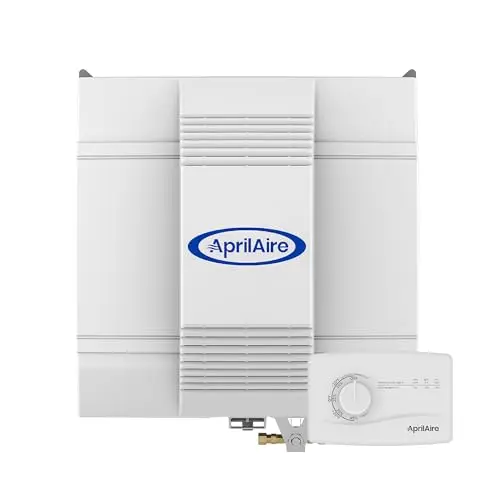
700M – HVAC-Integrated Whole-House Humidification
A furnace-mounted evaporative humidifier for whole-building coverage up to 5,300 sq ft, with 18 gallons per day capacity, a built-in fan, and manual humidistat control. It integrates with ducted HVAC rather than sitting on the floor.
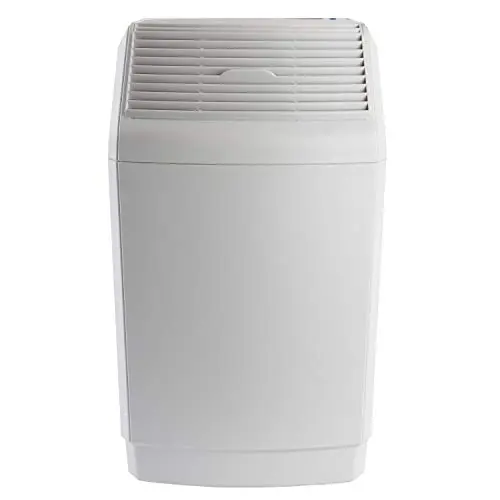
Space Saver 831000 – Digital Control for Large Spaces
A freestanding evaporative humidifier with a 6-gallon tank, up to 2,700 sq ft coverage, digital controls, auto humidistat, automatic shut-off, and casters. It uses a wick filter and front-fill design for large rooms.
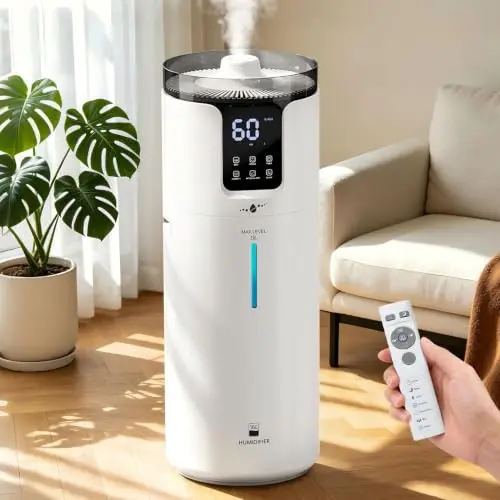
LCDJSQ-J19 – Quiet Commercial Cool Mist
A 16L ultrasonic cool-mist humidifier with up to 1,500 sq ft coverage, 48-hour runtime, top-fill tank, remote control, 12-hour timer, night light, and aroma tray. It is aimed at large rooms, offices, and light commercial spaces.
How We Evaluated These Commercial Humidifiers
We didn’t run controlled output tests or long-term reliability trials in commercial spaces. What we did: cross-referenced 4 commercial humidifier models from 4 brands across 5 decision axes – coverage and output, installation type, control and automation, maintenance burden, and safety features. We triangulated published specifications, feature sets, owner feedback where available, and use-case fit for offices, workshops, warehouses, and HVAC-equipped buildings. We also weighed how each unit would behave in daily service: refill frequency, filter or wick replacement, water quality needs, and whether the controls are simple enough for staff to use without a manual. We mapped each model to representative buyer profiles: a facility manager replacing a failed console unit, an office manager adding humidity to a shared floor, and a homeowner with a large ducted system that behaves like a light commercial space. That exercise matters because a unit that shines in a 500 sq ft office can be the wrong tool for a 4,000 sq ft warehouse, and vice versa.
The scoring framework weighted real-world fit (70%) – how well each option delivers on its stated commercial use case – against feature differentiation (30%) – unique technical advantages and use-case specificity. We have no commercial relationship with any of the brands featured; recommendations track fit and differentiation, not brand preference. If you need a freestanding unit for a large room or warehouse floor, the LRAZU HQ-JS905-4H is the pick; if the building has ducted HVAC, the AprilAire 700M is the better route.
How to Choose the Right Commercial Humidifiers
1. What Separates Commercial Humidifiers From Consumer Models
Commercial humidifiers are judged on coverage ratings, daily output, and refill interval first. A consumer unit might be fine for a bedroom, but it will struggle in an open office, shop, or warehouse where air changes constantly. Look for capacity measured in gallons or liters per day, not just tank size, and check whether the unit is designed for continuous duty.
Serviceable parts matter too. Wicks, filters, atomizers, and pumps all wear out, so replacement cost and availability should be part of the decision. Controls are the other divider: commercial spaces usually need an auto humidistat, clear error alerts, and a unit that shuts off safely when the tank runs dry.
2. Matching Commercial Humidifier Coverage to the Space
Square-footage claims are a starting point, not a guarantee. Ceiling height, air changes, open floor plans, and nearby heat sources all change how much moisture a room actually needs. A unit rated for a large open room may underperform in a warehouse with high ceilings and constant door traffic. Use the coverage rating as a ceiling, then size down if the space is unusually leaky or tall.
If your space is around 2,700 sq ft and you want a freestanding evaporative console, the AIRCARE Space Saver is the pick. For bigger rooms, plan on either a high-output ultrasonic unit or a ducted system that distributes moisture through the building.
3. Installation and Control Options for Commercial Humidifiers
The biggest fork is ducted HVAC versus freestanding units. A furnace-mounted humidifier blends into the building and can cover a large footprint, but it needs ductwork and installation work. Freestanding units are easier to deploy, move, and replace, which makes them the practical choice for rental spaces and shops.
For controls, an auto humidistat is the minimum for commercial use. Remote control, timers, and app support are nice when staff need to adjust settings without crawling behind a unit. For a quiet office or studio where you want a top-fill tank and remote control, the Lacidoll 16L is the pick.
4. Water Type and Maintenance for Commercial Humidifiers
Ultrasonic humidifiers generally want distilled or purified water to avoid white mineral dust on desks, equipment, and floors. Evaporative wick models are more forgiving with tap water, but mineral buildup still shortens wick life. Check whether the manufacturer recommends a demineralization cartridge or a specific water type before you commit.
Wick replacement and regular cleaning are the recurring chores. In a commercial setting, choose a unit that is easy to drain, open, and scrub; otherwise maintenance gets postponed. A low-water shutoff and a visible water-level window are small features that prevent bigger problems.
5. Budget Tiers in the Commercial Humidifier Market
Entry-level commercial humidifiers are usually smaller freestanding units with basic controls and coverage in the hundreds of square feet. They suit a single office, studio, or small shop. Mid-range models add larger tanks, digital humidistats, casters, and better output for a few thousand square feet. Premium options include high-capacity ultrasonic units and HVAC-integrated systems, where installation cost becomes part of the budget.
Spend where the space demands it: output, coverage, and serviceability first; app control and lighting last. A cheaper unit that needs constant refills or frequent filter changes is not a bargain in a commercial setting.
Frequently Asked Questions
1. What makes a humidifier genuinely commercial-grade?
Commercial-grade comes down to sustained output, duty cycle, and serviceability. A unit should be able to run through a workday without constant refills, hold a set humidity level with an auto humidistat, and use parts you can actually replace. Tank size helps, but daily output and coverage are the better indicators of whether it can handle a commercial room.
2. How does the AprilAire 700M compare with the LRAZU HQ-JS905-4H?
The AprilAire 700M is a ducted HVAC humidifier with coverage up to 5,300 sq ft and 18 gallons per day, while the LRAZU HQ-JS905-4H is a freestanding ultrasonic unit with a 30L tank and 4,200 sq ft coverage claim. Choose the AprilAire 700M if the building has ductwork and you want moisture distributed through the system. Choose the LRAZU for a warehouse floor, shop, or large room where wheeled mobility and high mist output matter more than whole-building integration.
3. Is the AIRCARE Space Saver a better fit than the Lacidoll 16L for a large office?
The AIRCARE Space Saver is the better fit for a larger office because it is rated to 2,700 sq ft and uses a 6-gallon tank with digital auto control. The Lacidoll 16L tops out around 1,500 sq ft, but it is quieter and easier to refill from the top. Go with AIRCARE if coverage and evaporative operation lead; go with Lacidoll if the room is smaller and low noise is the priority.
4. Do commercial humidifiers need distilled water?
For ultrasonic commercial humidifiers, distilled or purified water is the safer default because it reduces mineral dust settling on surfaces. Evaporative wick models can usually handle tap water, but mineral buildup will shorten wick life and increase cleaning. Follow the manufacturer’s water recommendation, and use a demineralization cartridge if the unit supports one.
Final Verdict
For most commercial spaces, the LRAZU HQ-JS905-4H is the answer – it pairs a 30L tank and 3000 mL/h output with wheeled mobility, which is exactly what a large room or warehouse floor needs. If the budget is tighter and your space is closer to 2,700 sq ft, the AIRCARE Space Saver gets you credible evaporative coverage with digital controls and casters. And if the building already has ducted HVAC, the AprilAire 700M is the more elegant route: it distributes moisture through the system and covers a much larger footprint. The Lacidoll 16L remains a good quiet-space option for offices and studios, but it is not the first pick for warehouse-scale humidity. Match the unit to the space, and the decision gets simple.
