
Best Commercial Ice Makers – 2026 Reviews

The ice runs out at the worst possible moment. Always has. You’ve filled the cooler, the crowd shows up, and somewhere around the second hour someone is driving to the store for bagged ice that’s already melting in the trunk. A commercial ice maker solves that permanently – but the category is a mess of overlapping specs, and the machine that looks strongest on a listing page is often the wrong size for the actual job.
Two things separate a good machine from an expensive mistake. The first is the relationship between daily output and bin capacity – a unit that makes plenty of ice but stores very little will still leave you short at peak. The second is drainage. Almost everything in this class drains by gravity, which is a footnote right up until you realize there’s no floor drain where you planned to put it.
We looked across brands at machines built for home bars, cafes, and full commercial counters, from compact under-counter units to freestanding workhorses that produce by the bag. Below you’ll find the ones worth your money and, just as usefully, who each one is genuinely for.
Best Commercial Ice Makers – 2026 Reviews
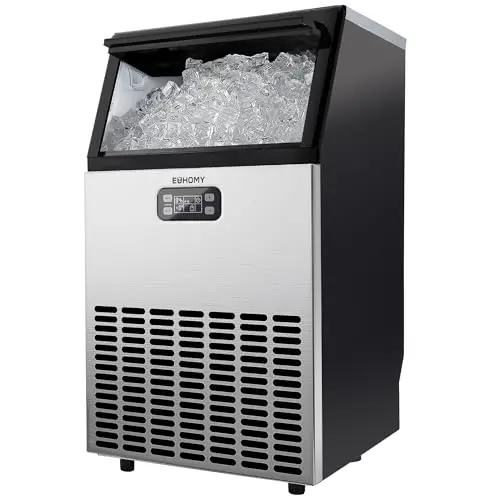
IM-02 – 100 lbs Daily in an Under-Counter Footprint
A 100-lb-per-day machine with a 33-lb built-in bin, ETL certification for both household and commercial use, and a body that slides under standard counters. It’s the most widely adopted shape in this class, and the controls are the reason why.
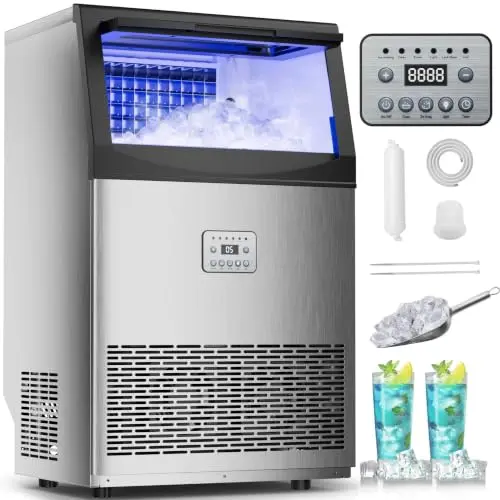
MM-ZB972H – 240 lbs Daily with a 55 lb Bin
A 240-lb-per-day machine with a 55-lb bin and a removable water filter – the capacity jump most home bars and busy kitchens actually notice, in a body that still fits under a counter.
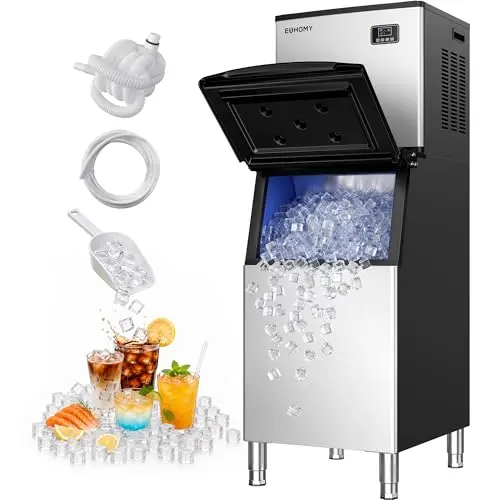
CIM-01 – 400 lbs Daily with a 250 lb Bin
A freestanding commercial unit built for real volume: 400 lbs of ice a day into a 250-lb insulated bin, with a programmable timer and automatic drainage. This is the step up when ice becomes an operational line item.

CIM-500T-3 – 170 lbs Daily with Water Filtration
A middle-weight commercial machine: 170 lbs per day into a 55-lb bin, with an automatic water filter, a 24-hour timer, and 20mm foam insulation that holds ice longer between cycles.
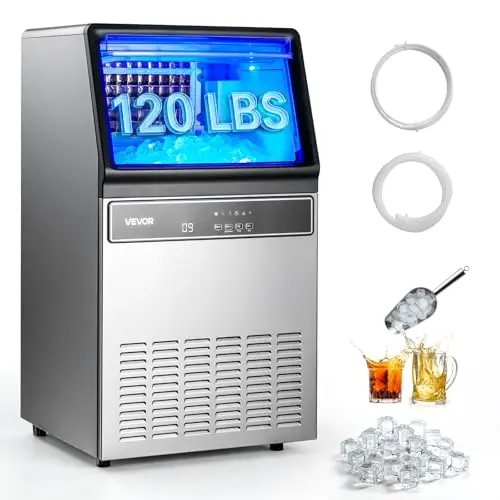
IMC9000F – 120 lbs Daily with a 48-Hour Timer
120 lbs per day into a 33-lb bin, with a 48-hour programmable timer, quiet operation, and a detachable water tank for cleaning. The most scheduling-friendly machine in this lineup.
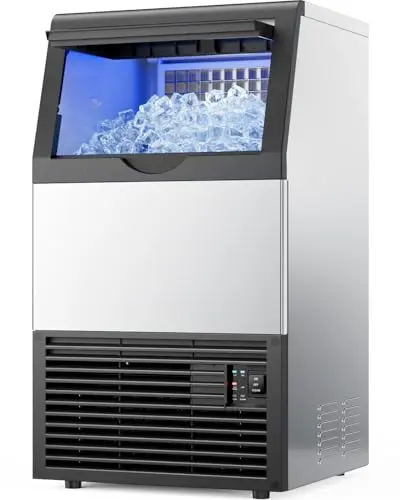
CIM-360F – 100 lbs Daily in a Compact Cabinet
A compact 100-lb-per-day machine that fits flush under standard cabinets, with front venting, adjustable thickness, and a warranty that runs longer than most of the field.

0987-001-C1 – 110 lbs Daily with a Built-In Water Filter
A 110-lb-per-day under-counter machine with a built-in water filtration system, ten thickness settings, and a full accessory kit in the box.
How We Evaluated These Commercial Ice Makers
A few things we can’t tell you: we didn’t run a multi-month reliability trial or measure melt rates in a temperature-controlled room. What we can tell you is how these machines compare where it counts – daily output, usable bin capacity, drainage requirements, and the footprint each one claims. We cross-referenced 7 commercial ice makers from 6 distinct brands across five decision axes: production rate, storage capacity, installation and drainage, controls and cleaning, and build quality. We triangulated published specifications, manufacturer documentation, and owner feedback where available, then mapped each machine against realistic buyer profiles – a home bar that fills a cooler on weekends, a cafe running through ice from open to close, and a small kitchen working around a fixed counter opening.
We also weighed each machine’s stated certifications, since commercial approval isn’t cosmetic. Our scoring weighted real-world fit (70%) – whether a machine actually delivers the volume and footprint its buyer needs – against feature differentiation (30%), which covers water filtration, timers, insulation, and thickness control. We audited each listing’s claims against its own specification table and flagged the gaps; a machine that overstates usable bin capacity loses ground even when the compressor is solid. We have no commercial relationship with any brand here, and recommendations track fit rather than brand preference. If you want the safest all-around choice, the EUHOMY IM-02 is the machine we’d hand most people. If you’re feeding a high-volume bar, the Mountman MM-ZB972H covers more ground per cycle.
How to Choose the Right Commercial Ice Maker
1. Daily Output and Bin Capacity: Sizing a Commercial Ice Maker to Your Rush
Two numbers matter and they measure different things. Daily output tells you how much ice the machine can make over 24 hours; bin capacity tells you how much it can hold at once. A unit that makes 120 lbs a day but stores 33 lbs is fine for a steady trickle of customers and terrible for a Friday night, because the bin empties faster than the evaporator can refill it. Match the bin to your peak hour, not your average day.
As a rough guide, a home bar or office pantry lives comfortably in the 100 to 120 lb class, a cafe or small restaurant wants 150 to 240 lbs, and anything above that is a machine that earns its keep by the bag. If you’re near the top of that range, the CIM-01 is the pick here – its 250-lb insulated bin is what makes a 400-lb day useful rather than theoretical.
2. Drainage and Placement: The Hidden Requirements of an Under-Counter Ice Maker
Almost every machine in this class drains by gravity, which means the drain hose has to sit lower than the unit and route to a floor drain or gravity outlet. No pump, no lifting water uphill. Buyers who skip this detail end up with a machine that ices over and a return label. Measure your counter height, confirm front venting if the unit will be built in, and check the depth against your cabinet run before ordering.
Two more setup notes worth taking seriously: let the unit stand upright for 24 hours before first use so the refrigerant settles, and run the self-clean cycle a couple of times before you consume the first batch. Both are in the manuals and both get skipped.
3. Insulation and Bin Design: How Long Ice Actually Lasts
A commercial ice maker is not a freezer, and the distinction matters. Most bins melt and refill on a loop, draining meltwater and replacing it with fresh cubes. That’s fine for steady demand and bad for hoarding. Foam insulation thickness – the better units here use cyclopentane foam – determines how much of your bin survives a slow afternoon, and a well-insulated bin beats a bigger bin with thin walls every time.
Also look at whether the bin has a sliding or transparent door. You’ll open it constantly, and being able to read the level without lifting a lid is a small thing that stops being small in week three.
4. Ice Thickness, Water Filtration, and Self-Cleaning
Adjustable thickness control is the most underrated feature in the category. Thin, fast-freezing cubes suit smoothies, seafood displays, and rapid cooling; thick, slow-frozen cubes last longer in a whiskey glass and dilute more slowly. A machine with a wide thickness range does more work than a machine with a bigger compressor and no control.
Water filtration is the other one. Hard water produces cloudy cubes, scale in the evaporator, and service calls. Built-in filtration – found on the Mountman, Nanori, and Uthfy units here – pays for itself in cube clarity and reduced descaling. Pair it with a one-touch self-clean cycle and you’ve handled most of what goes wrong with these machines.
5. EUHOMY IM-02 vs. VEVOR IMC9000F: Two Takes on the 100-lb Class
These two sit at similar output and similar footprints, and they’re aimed at different people. The IM-02 leans commercial: ETL certification for business use, a simpler control scheme, and a build that reads like equipment rather than an appliance. The IMC9000F leans convenience: a 48-hour timer, a detachable tank for cleaning, and quieter operation that suits an open kitchen.
If the machine is going into a licensed space or a busy back counter, take the certification. If it’s going into your home and you want to schedule ice around a party, take the timer.
6. What Separates Budget and Premium Commercial Ice Makers
The price ladder in this category tracks three things: production capacity, insulation and bin size, and compressor duty rating. Budget-friendly units still make good ice – the Mojgar proves that – but they run a lighter-duty compressor and expect you to accept a smaller buffer between cycles. Premium units add heavier compressors, thicker walls, and the certifications and timers that commercial operators need to sleep at night.
Spend up for one reason: if the machine stopping costs you money. Otherwise, a well-chosen budget unit with a good warranty will serve a home bar for years.
Frequently Asked Questions
1. Is a 100-lb commercial ice maker enough for a small bar or cafe?
Usually yes, with a caveat about the bin. A 100 lb per day machine keeps up with a small bar’s steady demand, but the 33 lb storage bin is the real limit – during a rush the bin drains faster than the evaporator refills it. If your peak hour runs more than a few dozen drinks, step up to a machine with a 55 lb bin or better. For a home bar, an office pantry, or a low-volume coffee counter, the 100-lb class is more than enough.
2. What's the difference between the Mojgar CIM-360F and the VEVOR IMC9000F?
Both land in the 100-to-120 lb class, but they solve different problems. The Mojgar CIM-360F is the compact built-in – 15-inch width, front venting, a 24-month machine and compressor warranty, and a bin that’s explicitly not a freezer. The VEVOR IMC9000F adds a 48-hour timer, quieter operation under 50 dB, and a detachable water tank for cleaning. Choose Mojgar for tight cabinetry and longer coverage; choose VEVOR if scheduling and noise matter more to you than warranty length.
3. Do commercial ice makers need a floor drain, or can they run on a pump?
Nearly all under-counter units in this lineup are gravity drain only – no pump included and no pump option. That means the drain hose must sit lower than the machine and lead to a floor drain or gravity outlet. Check this before you buy, not after: a machine that can’t drain will ice over and shut down. If you have no floor drain, you either need a condensate pump plumbed separately or a different installation location entirely.
4. Mountman MM-ZB972H vs. Uthfy CIM-500T: which suits a busy kitchen better?
The Mountman wins on raw capacity – 240 lbs per day with a 55 lb bin and a removable water filter. The Uthfy CIM-500T runs 170 lbs per day into the same bin size, with 20mm foam insulation and a 24-hour timer, and it asks for less floor space. Where ice is the bottleneck, take the Mountman. Where the footprint is the constraint, the Uthfy covers it.
5. Can a commercial ice maker be built into cabinetry?
Only if it’s designed for it. Look for front venting and a stated under-counter or built-in configuration – the Mojgar CIM-360F and the EUHOMY IM-02 both qualify. A freestanding machine shoved into a cabinet with no airflow will overheat and underperform. Leave the clearances the manual specifies, and remember that drain access matters as much as the opening dimensions.
Final Verdict
For most buyers, the EUHOMY IM-02 is the answer. It hits the balance this category keeps missing: enough output for a real crowd, a bin that doesn’t need constant attention, and commercial certification without the commercial price tier. It’s the one we’d recommend to a friend opening a small cafe, and the one we’d buy for a garage bar that hosts often.
If budget is the constraint, the Mojgar CIM-360F gets you most of the way there with longer coverage and a genuinely compact cabinet. If ice is a business input rather than a convenience, the EUHOMY CIM-01 is the step up that ends the mid-service run. And if you want serious capacity without a floor-standing tower, the Mountman MM-ZB972H is the machine that fits both worlds.
