
Best Commercial Patio Umbrellas – 2026 Reviews

Walk past any cafe at two in the afternoon and you can usually spot the umbrella that was bought on price. It’s the one tied shut on a sunny day, or the one whose canopy has gone chalky while the tables underneath sit empty. Shade is revenue on a commercial patio – the seats in the sun simply don’t turn over.
The gap between an umbrella that survives a season and one that survives a few years comes down to two things: canopy fabric weight and frame material. Fabric measured in grams per square meter decides how the color holds and how much radiant heat it blocks. The frame decides whether you spend your summers fighting rust. Wind is the third variable, and it’s the one that ends most commercial umbrellas early.
This guide covers the options worth cross-shopping across the market, from entry-level crank-and-tilt umbrellas to a genuinely commercial-grade frame, and explains which one fits a restaurant patio, which suits a rental or poolside deck, and which is simply the right shape for a long communal table.
Best Commercial Patio Umbrellas – 2026 Reviews
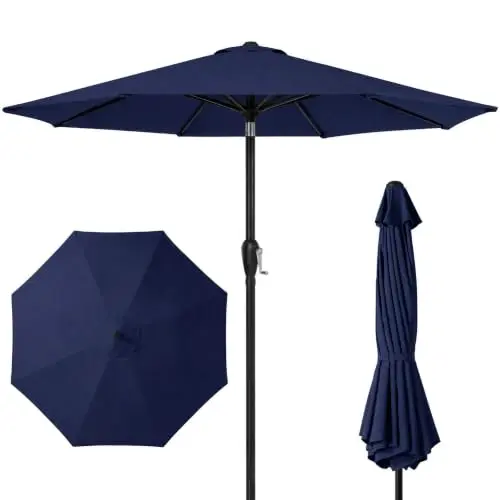
NPO1005 Commercial Grade – Five-Year No-Fade Aluminum Frame
An octagonal nine-foot canopy in dense 260 GSM polyester on a rustproof aluminum frame, with a five-year no-fade claim and a smooth crank-and-tilt lift. Built and marketed for restaurant and cafe patios rather than backyard use.
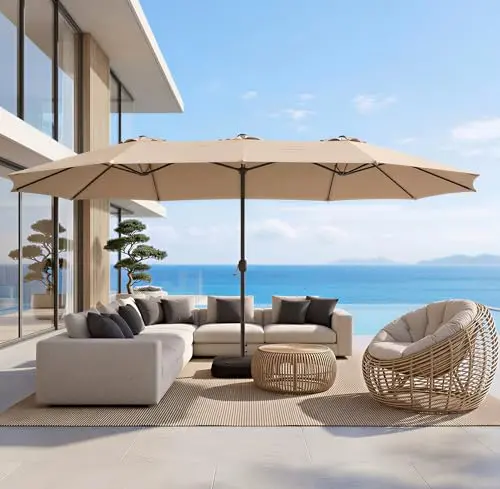
15ft Double-Sided with Base – Park-Sized Shade out of the Box
A 15 by 9 foot double-sided canopy that opens to roughly 135 square feet of shade, sold with a cross base, two fillable sandbags, and a cover. Three roof vents and a 1.9-inch powder-coated steel pole anchor the frame.
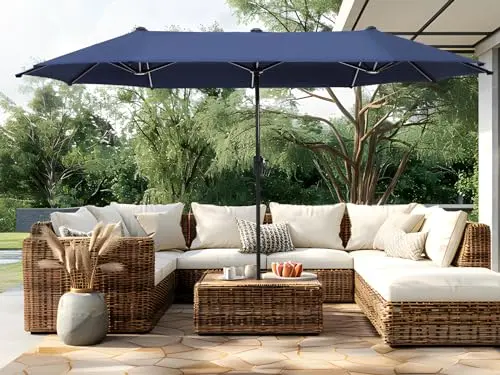
PVGM010-Z 13ft Double-Sided – Rectangle Shade for Long Tables
A 13 by 6.5 foot rectangular double-sided canopy on a single 1.5-inch steel pole with 12 ribs and a crank lift. The narrow footprint suits long tables where a round canopy would leave the ends exposed.
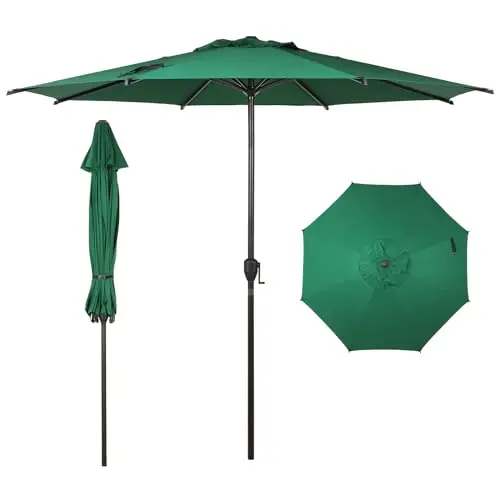
Lyon 9ft – Tool-Free Setup with UPF 50+ Canopy
A nine-foot market umbrella with a threaded, tool-free pole, eight aluminum ribs reinforced with end screws, and a UPF 50+ polyester canopy. The canopy closes with a clip instead of velcro or snaps.
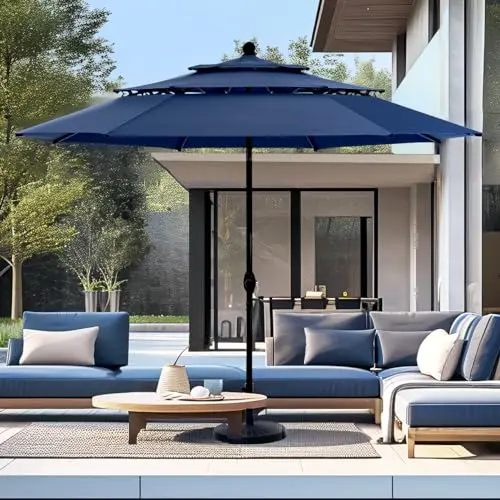
10ft 3-Tier Auto-Tilt – Triple Vent for Exposed Sites
A ten-foot canopy with a three-tier vented top, a 1.5-inch powder-coated steel pole, eight ribs, and an auto-tilt crank. The stacked vents are designed to let air pass through instead of letting the canopy act as a sail.
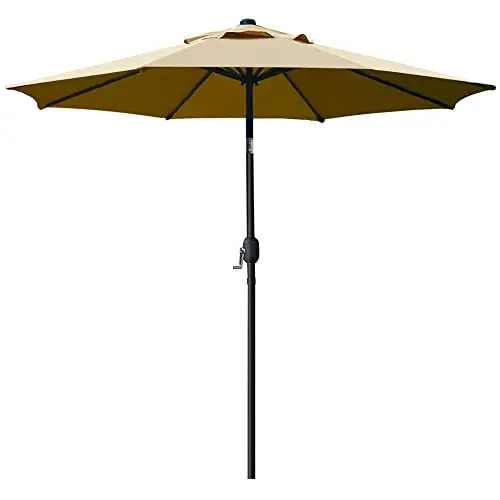
UM-TN-9 9ft – Lightweight Aluminum Crank Tilt
A nine-foot umbrella on a 40mm aluminum pole with eight ribs, a single wind vent, and a crank with push-button tilt. Light enough for one person to move between tables, and sized for 42 to 54 inch tables with four to six chairs.
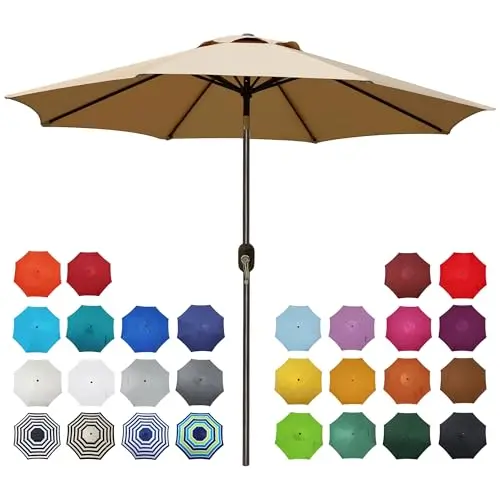
9ft Market – Simple Crank-and-Tilt Shade
A nine-foot market umbrella with a 100 percent polyester canopy, powder-coated aluminum and iron pole, eight iron ribs, and a crank with push-button tilt. The manufacturer positions it for both residential and commercial locations.
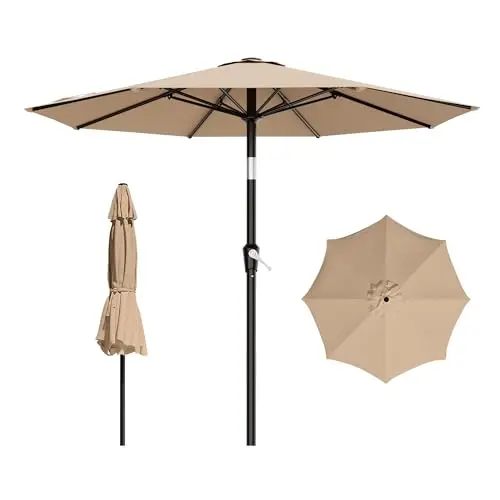
9ft Iron-Frame – Vented Value Shade
A nine-foot canopy on a powder-coated iron pole with eight ribs, a double-layer vent, and a crank with push-button tilt. Sized for four to six chairs around a standard patio table, with the base sold separately.
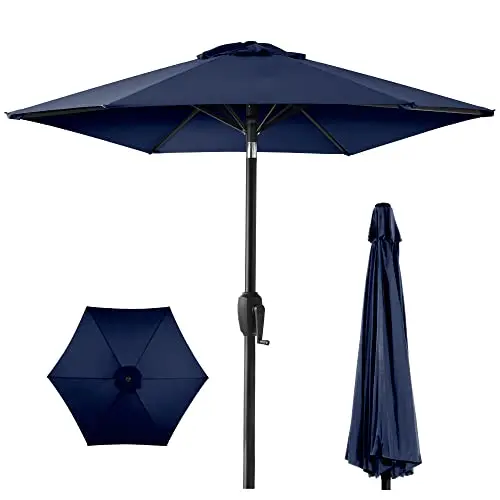
SKY5703 7.5ft – Compact Six-Rib Market Umbrella
A 7.5-foot six-rib umbrella in 180g polyester with a powder coating, on a powder-coated steel frame with a hand crank and push-button tilt. Compact scale for bistro tables and tight decks.
How We Evaluated These Commercial Patio Umbrellas
We didn’t put these umbrellas through a full season of daily commercial service. There’s no wind-tunnel data here and no multi-month fade measurement. What we did: cross-referenced 9 patio umbrella models from 8 distinct brands across five decision axes – canopy fabric weight and UV claims, frame and rib material, wind management and venting, tilt and crank mechanism design, and mounting and base requirements. Two of those axes carried most of the weight: fabric density, because it’s the clearest published proxy for fade and heat performance, and frame material, because rust is what quietly ends an umbrella’s working life.
We triangulated published specifications, manufacturer feature claims, owner feedback where available, and use-case fit against three buyer profiles: restaurant and cafe patios that leave umbrellas up through the season, rental and poolside decks where gear gets moved often, and large residential shade setups. The scoring framework weighted real-world fit for daily outdoor use (70%) – how well each canopy, frame, and mechanism holds up to repeated opening, sun exposure, and wind – against feature differentiation (30%) – venting design, fabric density claims, tilt hardware, and included bases. We have no commercial relationship with any brand featured; recommendations track fit and differentiation rather than brand preference. If you’re outfitting a business patio, the Newport Outdoor NPO1005 is the spec-for-spec match; if covering a dozen seats at once is the goal, the Bigroof 15ft solves that problem better than anything else in the lineup.
How to Choose the Right Commercial Patio Umbrella
1. What Actually Makes a Patio Umbrella Commercial Grade
Commercial grade isn’t a certification – no standards body polices the label, so treat it as shorthand for a set of material choices. The first is fabric weight in grams per square meter. A 260 GSM polyester canopy is a different product from the 180g material on entry-level umbrellas, and the difference shows up as better heat blocking and slower color fade. The second is frame material and finish: rustproof aluminum over steel or iron, with a powder coating that survives chips and cleaning.
The third is mechanism duty cycle. A commercial umbrella gets opened, closed, tilted, and furled far more often than a backyard one, so crank gears, tilt joints, and rib attachment points matter more than any single spec-line number. If you’re kitting out a restaurant patio, the Newport Outdoor NPO1005 is the one here whose fabric and frame claims actually line up with that workload.
2. Canopy Fabric Weight and Fade Resistance
Grams per square meter is the number to look for, and the one most listings bury in a bullet point. Below roughly 200 GSM you’re buying a canopy that will look tired after a single season of direct sun. Above 240 GSM the fabric holds color longer and blocks more radiant heat, which is what fade resistance claims are really about. Look for UPF ratings when the umbrella shades a seating area people sit under for hours rather than a walkway.
Water behavior matters too. Water-repellent fabric beads rain and sheds it; waterproof usually means a coating that can wear through at the folds. Neither survives being furled wet, so dry the canopy before storing it. Vented canopies dry faster and breathe better, which also helps on humid afternoons.
3. Frame Material and Rib Count: Aluminum vs Steel and Iron
Aluminum won’t rust, full stop, and that single property decides how long an umbrella looks presentable on a wet patio. Steel and iron are stronger per millimeter and cheaper, which is why most entry-level umbrellas use them – but they need intact powder coating to survive, and chips turn into rust fast. For a patio that stays outdoors year-round, aluminum is the safer bet.
Rib count runs from six on compact umbrellas to twelve on wide double-sided frames, and more ribs mean a canopy that flexes less in wind. Pole diameter matters just as much for stability – 1.5 inches is common on single-pole frames, and closer to 1.9 inches is what you want on anything wider than ten feet.
4. Wind Management: Vents, Tilt, and Knowing the Limits
Every umbrella in this category eventually meets a gust, and wind vents are the main defense. A single vent at the crown relieves pressure; triple and double-layer vents move more air and are worth having on exposed decks. Tilt mechanisms are a convenience for tracking the sun, not a wind feature – in fact, tilt joints are one of the more commonly reported failure points across this category.
The honest answer is that no crank-and-tilt umbrella is a permanent fixture in high wind. Close and tie it before storms roll through, and if your patio is genuinely windy, plan for a heavy base and treat the umbrella as removable equipment rather than architecture.
5. Sizing a Commercial Patio Umbrella to Tables and Seating
Canopy diameter maps roughly to seating: 7.5 feet for a bistro table, nine feet for a four- to six-top, ten feet and up for larger setups or loungers. Double-sided canopies are measured as a rectangle – a 13 by 6.5 foot frame reaches the ends of a long table that a round canopy simply can’t. If covering a dozen seats at once is the goal, the Bigroof 15ft and its included cross base is the practical route.
Check your table before ordering. Pole diameter has to clear the umbrella hole, and base poles on large double-sided frames can run over two inches. A weighted base is not optional on a commercial patio – sandbag-style bases need real fill weight to hold, and a light stand is how umbrellas end up on their side.
6. Where the Price Tiers Actually Diverge
The entry tier gets you a polyester canopy in the 180-200g range, a steel or iron frame, and a crank with push-button tilt. These work, and they’re the right call for a seasonal setup or a patio that gets stored each winter. Expect to replace them sooner, and budget for a decent base since most don’t include one.
Mid-range buys an aluminum frame, better fabric, and stronger hardware. The premium tier is where commercial claims get specific: dense 260 GSM fabric, multi-year fade warranties, rustproof aluminum throughout, and sometimes a base in the box. The jump in cost is usually smaller than the jump in service life, especially if the umbrella never comes down.
Frequently Asked Questions
1. Are 'commercial grade' patio umbrellas actually built differently?
Usually yes, but the label itself means nothing. No certification governs it, so the difference lives in details you can verify: canopy fabric weight (260 GSM versus 180g), frame material (aluminum versus steel or iron), and how the ribs attach to the hub. Commercial umbrellas also tend to publish longer fade claims and higher UV ratings, because those are the specs a business buyer asks about.
If that distinction matters for your patio, the Newport Outdoor NPO1005 is the clearest example here of a spec sheet written for daily business use rather than weekend backyard use.
2. Newport Outdoor NPO1005 vs Abba Patio Lyon: which is the better commercial buy?
They answer different questions. The Newport Outdoor NPO1005 is the heavier-duty canopy: 260 GSM fabric, a rustproof aluminum frame, and a five-year no-fade claim, which is what you want if the umbrella lives outdoors through the season on a restaurant patio.
The Abba Patio Lyon wins on handling. Its threaded pole assembles without tools, and the clip closure makes daily furling faster than velcro. It’s also UPF 50+ rated. If your staff breaks the umbrella down every night and stores it, the Lyon is easier to live with; if it stays up, go with the denser fabric.
3. PHI VILLA 13ft double-sided vs Bigroof 15ft: which covers more seats?
The Bigroof 15ft covers more area – roughly 135 square feet from a 15 by 9 foot canopy – and it ships with a cross base and two sandbags, so it’s ready to anchor once you fill them. That’s the pick for a pool deck or a large open patio where one umbrella has to do the work of three.
The PHI VILLA 13ft trades some total area for a narrower 13 by 6.5 foot rectangle and 12 ribs, which suits a long table or a counter run where a wide footprint would block circulation. Both are freestanding frames rather than through-table umbrellas, so plan on a weighted stand either way.
4. Can a residential patio umbrella survive on a cafe patio?
For a season, usually. The failure points are fabric fade, rust at the rib joints, and the tilt mechanism, roughly in that order. Entry-tier umbrellas use 180-200g polyester and steel or iron frames, which is fine for a backyard that sees weekend use and less fine for a patio that opens and closes daily.
If you go the value route, plan on replacing it more often and buy a heavy weighted base – flimsy stands cause more damage than cheap canopies do.
5. What size commercial patio umbrella fits a four-top table?
A nine-foot canopy is the standard answer for a 42 to 54 inch table with four to six chairs, which is why most of the picks here land at that size. Push to ten feet if the table is larger or you want shade to extend past the chairs instead of stopping over them.
Measure the umbrella hole before ordering and check the pole diameter against it – 1.5 inches is common, but some large frames run closer to two, and a pole that doesn’t clear the table is a return waiting to happen.
Final Verdict
For most commercial patios, the Newport Outdoor NPO1005 is the answer – a 260 GSM canopy, rustproof aluminum frame, and a five-year no-fade claim that reads like it was written for a business rather than a backyard. It’s the one we’d specify for a cafe that leaves umbrellas up through the season.
If setup speed matters more than fabric density, the Abba Patio Lyon gets you tool-free assembly and a UPF 50+ canopy at the entry end of the market. If your problem is covering a dozen seats rather than one table, the Bigroof 15ft arrives with a base and enough span to do it, while the PHI VILLA 13ft is the better shape for a long communal table.
Match the umbrella to your table size, your wind exposure, and how often it gets taken down – that decides more than any single spec.
