
Best Countertop Espresso Machines – 2026 Reviews

Walk into any home with a serious coffee habit and you’ll spot the same thing: the espresso machine has quietly claimed a corner of the counter, and everything else has been rearranged around it. That’s the first real decision in this category – how much counter real estate you’re willing to hand over, and whether the machine earns it back in the cup.
Two things separate a machine you’ll still be using in two years from one that ends up on a shelf. The first is extraction control: a pump that holds steady pressure, temperature that doesn’t wander mid-shot, and a portafilter that doesn’t fight you. The second is milk. If your order is a flat white rather than a straight espresso, the steam wand matters as much as anything on the spec sheet – and it’s the part budget machines cut first.
We looked across the major brands in this category, from entry-level pump machines to bean-to-cup all-in-ones and capsule systems, and the honest answer is that they don’t compete on a single ladder. A capsule machine judged like a semi-automatic will always lose, and the reverse is just as true. What follows is a guide to picking the one that fits how you actually make coffee, not the one with the biggest number on the box.
Best Countertop Espresso Machines – 2026 Reviews
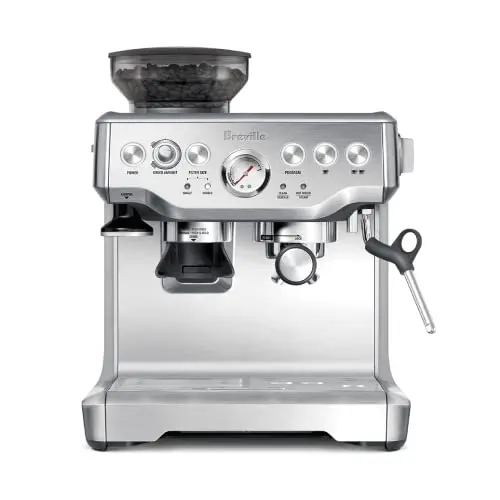
Barista Express – Built-In Grinder, Beans to Cup
The Barista Express is the closest thing to a complete espresso setup in one box. A conical burr grinder sits on top and drops freshly ground coffee straight into the portafilter, so you go from whole beans to a finished shot without a second appliance on the counter. PID-controlled temperature regulation and low-pressure pre-infusion do the invisible work behind a balanced cup, and the steam wand is built for hand-textured microfoam rather than push-button foam.
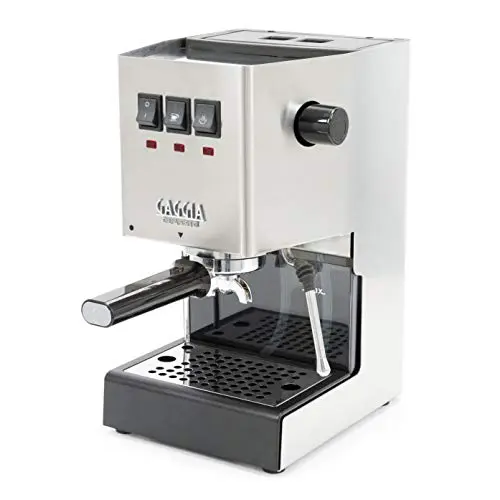
Classic Evo Pro – Commercial Parts, Made in Italy
The Classic Evo Pro is built around commercial-style parts rather than convenience features. A 58mm stainless portafilter, a three-way solenoid valve, and a commercial steam wand put it closer to a café setup than to a beginner appliance, and the steel housing is designed to be opened and serviced rather than replaced. There’s no grinder in the box – this one assumes you’re building a setup around it.
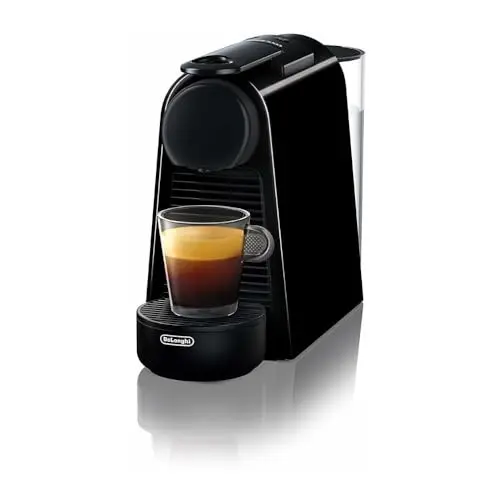
Essenza Mini – Capsule Espresso for Tiny Counters
The Essenza Mini strips espresso down to the essentials: capsule in, shot out, in a footprint barely wider than a paperback. It’s a 19-bar machine that runs Nespresso Original capsules, and the removable 0.6 liter tank slides out for refills without moving the unit. If your priority is a consistent espresso with almost no cleanup, this is the shortest path.
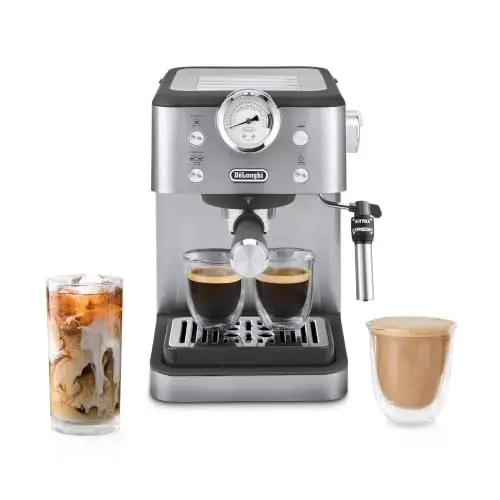
Classic Signature EM450M – Adjustable Frother, Fast Heat-Up
The Classic Signature is the middle of De’Longhi’s manual range and the most thoughtfully featured machine in its tier. Thermoblock heating gets it to temperature quickly, a 15-bar Italian pump handles extraction, and the adjustable two-setting steam wand switches between easy steaming and proper microfoam for latte art. Preset single and double recipes take the guesswork out of dosing.

Stilosa EC260BK – Budget Manual Espresso
The Stilosa is De’Longhi’s entry point into manual espresso, and it keeps the essentials: a stainless steel boiler, a 15-bar pump, and a real manual steam wand instead of a plastic frothing attachment. The 1000ml tank and compact body make it an easy first machine, and it ships with a portafilter, scoop-tamper, and both filter baskets.

ECMG0 – 20-Bar with Pressure Gauge
The Gevi packs an unusual amount of hardware into an entry-level body: a 20-bar pump, NTC temperature control, pre-infusion, and a built-in pressure gauge on the front panel. The full stainless housing looks more expensive than it is, and a hot water function means americanos and tea don’t require a detour to the kettle.
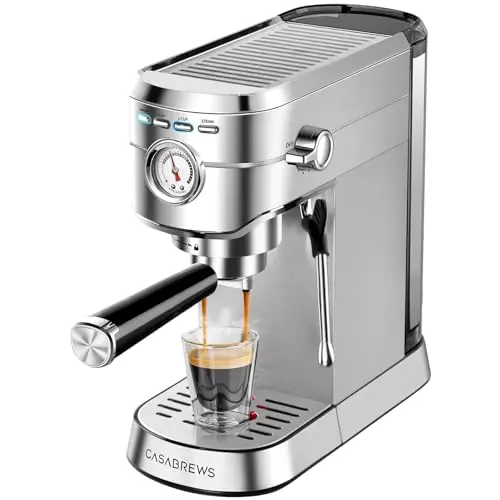
CM5418 – Compact with Pressure Gauge
The CM5418 is a narrow, semi-automatic pump machine with a 20-bar Italian pump, a front-mounted pressure gauge, and a steam wand for microfoam. The 34oz tank is detachable, the brushed stainless body is compact enough for tight counters, and the package includes single and double 51mm baskets plus a tamper.

3700 Essential – Big Tank, Entry Tier
The 3700 Essential drops the pressure gauge and keeps the parts that matter: a 20-bar Italian pump, a steam wand for milk, and a 43.9oz removable tank that’s the largest in the compact class here. It’s a straightforward semi-automatic built for people who want to learn manual espresso on a very small budget.
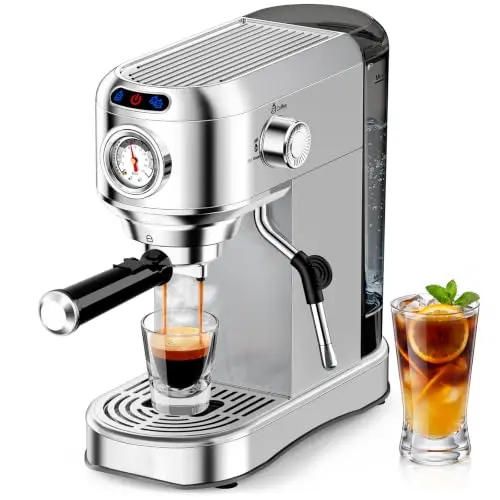
ST-699B – 20-Second Heat-Up, Narrow Body
The AERCANA ST-699B is a narrow semi-automatic with a 20-bar pump, a front pressure gauge, and a 1450W heating system that reaches brewing temperature in about 20 seconds. The 34oz tank detaches for refilling, and the hot water dispenser and cup warmer add a little versatility beyond espresso. It’s among the smallest machines here at roughly 5.3 inches wide.
How We Evaluated These Countertop Espresso Machines
We didn’t pull hundreds of measured shots with a refractometer or run timed temperature-stability tests. What we did: cross-referenced 9 countertop espresso machines from 7 distinct brands across 5 decision axes – extraction hardware, milk-frothing capability, counter footprint and tank capacity, daily workflow, and ease of cleaning. We triangulated published specifications, mapped each machine’s feature set against the buyer profile it actually suits, and weighed owner feedback where available to flag the points where expectations and reality tend to diverge.
The category splits into three rough camps: manual and semi-automatic pump machines where you grind, dose, and tamp yourself; bean-to-cup all-in-ones with an integrated grinder; and capsule systems that trade control for speed. Each camp was benchmarked on its own terms rather than against a single idealized workflow, because a capsule machine judged like a semi-automatic will always lose.
The scoring framework weighted real-world fit (70%) – how well a machine delivers on the way people actually make espresso at home – against feature differentiation (30%) – the hardware and workflow advantages that separate one model from the next. We have no commercial relationship with any of the brands featured; recommendations track fit and differentiation, not brand preference. If you want beans-to-cup in a single box, the Barista Express is your match; if you’d rather build a traditional setup and choose your own grinder, the Classic Evo Pro serves you better.
How to Choose the Right Countertop Espresso Machine
1. Pump Pressure, Portafilter Size, and What Actually Changes the Shot
Pump pressure is the most oversold number in this category. A 20-bar pump sounds twice as capable as a 15-bar unit, but the coffee puck only ever sees roughly 9 bar of extraction pressure – the extra headroom is about stability under load, not intensity. What separates a good shot from a mediocre one is how consistently the machine delivers that pressure, and whether the temperature holds through the whole extraction.
Portafilter diameter is the spec that rarely makes the marketing copy but shapes your upgrade path. A 58mm commercial portafilter accepts standard baskets, tampers, and distribution tools, which means cheaper accessories and easier technique transfer. The 51mm portafilters common on compact machines work fine but leave you in a smaller ecosystem.
Temperature control matters more than the pressure figure. PID temperature regulation is the most precise approach, holding brew water within a tight band. Thermoblock heating and NTC control are quicker to warm up and easier to package in a small body, which is why they show up on most mid-range machines. Low-pressure pre-infusion, meanwhile, wets the puck before full pressure arrives – it’s the feature most responsible for a smooth, even extraction on a dark roast.
2. Measuring Countertop Footprint Before You Commit
Counter space ends more espresso dreams than budget does. Machines here run from roughly 4.3 inches wide at the compact end to 12.5 inches on a full bean-to-cup unit, and depth is usually the bigger surprise – most need 12 to 14 inches front to back.
Height is the spec people forget. Check the clearance under your upper cabinets before you fall for a machine with a grinder on top, because loading a hopper in a narrow gap is miserable. Also think about tank access: a removable tank that lifts off the back is far easier to refill than one you fill in place. If lattes are the goal, measure your tallest glass – a cappuccino cup needs more clearance under the spout than an espresso demitasse.
If space is genuinely tight, the Essenza Mini at roughly 4.3 inches wide is the obvious route, and its removable tank means you can refill without pulling it forward.
3. Manual, Semi-Automatic, or Capsule: Choosing Your Espresso Workflow
There are three real workflows here, and picking one matters more than any spec. Manual and semi-automatic machines ask you to grind, dose, and tamp yourself. They reward attention and teach you a lot, but they’re a morning routine, not a convenience. Bean-to-cup machines with an integrated grinder collapse the process into one box – fill a hopper, set a grind, and the machine handles dosing. Capsule systems trade control for speed and cleanup; the coffee is consistent and the process is nearly hands-free, but you’re buying capsules indefinitely.
Most first-time buyers underestimate how much of the result comes from the grinder rather than the machine. If you go manual, budget for a capable burr grinder alongside it. If that’s not a step you want to take, the Barista Express bundles a conical burr grinder and dosing directly into the portafilter, which removes the biggest variable in one move.
4. Milk Frothing: Steam Wands, Adjustable Frothers, and What They Deliver
Milk is where cheap machines visibly separate from good ones. A panarello sleeve – the plastic attachment that froths by churning air into milk – produces stiff, bubbly foam that’s fine for a cappuccino and useless for latte art. A manual steam wand produces the fine, wet microfoam you need to pour.
Wand quality varies more than you’d expect. A commercial-style wand gives you dry steam and control; a two-setting adjustable frother splits the difference by offering a forgiving mode and a textured mode. And a removable froth nozzle is a small convenience that pays off daily, because milk residue in a fixed wand is one of the fastest ways to make a machine smell wrong.
If milk drinks are your main drink, weight the wand heavily. If you drink espresso straight, put that money into grind quality and temperature stability instead.
5. What Budget, Mid-Range, and Premium Tiers Actually Buy You
Entry-level machines get you a working pump, a steam wand, and a basic portafilter. What they don’t get you is temperature precision or build quality – expect a plastic housing, minimal thermal control, and a shorter service life.
The mid-range tier is where the value sits. You gain real temperature control, better steam, larger tanks, and sturdier housings. The De’Longhi Classic Signature and the Gaggia Classic Evo Pro both live here, and both hold up better to daily use.
At the premium end, you’re paying for integrated grinding or commercial-grade parts. The Barista Express sells the first; the Classic Evo Pro sells the second with a 58mm portafilter and a three-way solenoid. Neither is automatically better – they’re different answers to the same question. If your ceiling is genuinely low, the 3700 Essential covers the fundamentals at the entry tier without asking you to give up a 20-bar pump or a steam wand.
6. Cleaning, Descaling, and the Ownership Costs Nobody Budgets For
Espresso machines are wet, hot appliances that push water through fine coffee under pressure, which means they need attention. Backflushing clears coffee oils from the group head and is routine on machines with a three-way solenoid valve. Descaling removes mineral buildup from the boiler and is the maintenance task most likely to be skipped – and the one most likely to shorten a machine’s life.
Filtered water is the cheapest insurance you can buy. Beyond water, the ongoing costs are baskets, gaskets, and – on capsule systems – the pods themselves. A machine you can open and service will outlast one that’s sealed, which is worth factoring in if you plan to keep it for years rather than months.
Frequently Asked Questions
1. Breville Barista Express vs. Gaggia Classic Evo Pro: which should you buy?
They solve the same problem from opposite directions. The Barista Express bundles a conical burr grinder and dosing into one box, so you get a complete workflow and a shorter path to a decent shot. The Classic Evo Pro gives you commercial-grade hardware – a 58mm portafilter, a three-way solenoid, a repairable steel housing – but assumes you’ll buy a grinder separately.
Choose the Barista Express if you want one purchase and one footprint. Choose the Classic Evo Pro if you already own a good grinder or plan to invest in one, and if you value serviceability and standard 58mm accessories over integration.
2. How much counter space does a countertop espresso machine really need?
Plan on roughly 12 inches of depth as a floor, plus clearance in front for the portafilter and a cup. Width varies enormously – compact models run around 5 inches wide, while bean-to-cup machines with an integrated grinder can hit 12.5 inches. Height is the spec that catches people out; a machine with a hopper on top needs 16 inches of vertical clearance or you’ll be filling it sideways.
Also factor in the wand. You need clear space to the side of the machine to swing a milk jug, and that’s usually another half-foot nobody measures.
3. Nespresso Essenza Mini vs. De'Longhi Stilosa: capsule or ground coffee?
This is really a question about how much control you want. The Essenza Mini is a capsule system: one button, a shot in under a minute, almost no cleanup, and no variables to adjust. The Stilosa is a manual machine – you grind, dose, tamp, and steam yourself, and the results track your technique.
Go capsule if consistency and speed matter more than ceiling. Go manual if you want to learn, if you drink milk drinks regularly, and if you’re willing to add a grinder. The Stilosa’s stainless steel boiler and manual steam wand make it a more capable machine; the Essenza’s 4.33-inch footprint makes it the one you’ll actually keep on the counter.
4. Do 20-bar pumps make better espresso than 15-bar pumps?
Not on their own. The puck sees around 9 bar regardless of whether the pump is rated at 15, 19, or 20 bar – the higher rating describes the pump’s capability, not the pressure at the coffee. What matters is pressure stability during the shot and whether the machine holds temperature while it does it.
A well-built 15-bar machine with good thermal control will outperform a cheap 20-bar machine every time. Use the number as a rough indicator of hardware quality, not as a ranking.
5. Can an entry-level espresso machine pull café-quality shots?
It can get close, and the limiting factor is usually the grinder rather than the machine. A budget machine paired with a capable burr grinder, fresh beans, and consistent tamping will produce shots that embarrass a more expensive machine fed stale pre-ground coffee.
What entry-level machines do compromise on is temperature stability, steam quality, and longevity. If you want to pour latte art and keep the machine for years, the mid-range tier is where that becomes realistic.
Final Verdict
For most people, the Barista Express is the answer. It handles grinding, dosing, and steaming in one footprint, and its temperature control and pre-infusion mean the machine isn’t the thing holding your shots back. If you’d rather build a traditional setup and upgrade the grinder on your own schedule, the Classic Evo Pro gives you commercial hardware and a machine you can actually service.
On a tight budget, the 3700 Essential covers the essential workflow – a 20-bar pump, a steam wand, and a large tank – for the least money here. And if counter space is the real constraint, the Essenza Mini makes a genuinely good espresso in a footprint you’ll forget is there.
