
Best Dish Drying Racks For Small Spaces – 2026 Reviews

A dish rack in a small kitchen has a harder job than a dish rack in a big one. It has to hold a real meal’s worth of plates, bowls, and glasses without eating the only stretch of counter you have left. It also has to send water somewhere useful instead of letting it pool under the plates.
The two make-or-break issues are footprint and drainage. A rack can look compact in a product photo and still crowd your sink, or drain so poorly that you trade counter clutter for a puddle. We compared the market with those constraints in mind: how much usable drying space each rack creates, where the water goes, and whether the setup still works when your sink edge sits a little high.
This guide is built for renters, apartment cooks, RV owners, and anyone whose kitchen has more gadgets than square footage. The right pick isn’t the one with the most slots; it’s the one that fits your sink, your cabinet clearance, and your daily dish volume.
Best Dish Drying Racks for Small Spaces – 2026 Reviews
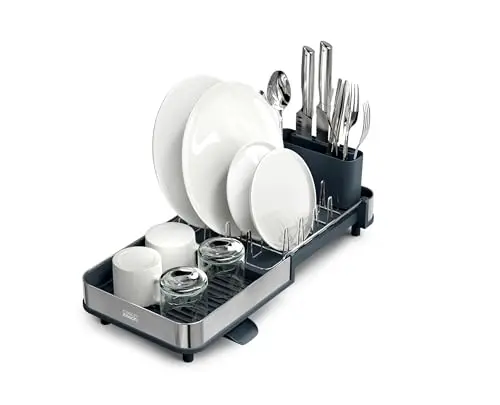
Extend Steel Slim – Expandable Drying for Tight Counters
A slim expandable rack with a two-part sliding tray, steel prongs, a removable cutlery pot with a knife slot, and a swivel draining spout that can be set in three positions. It is designed for smaller kitchens and extends when you need more room.
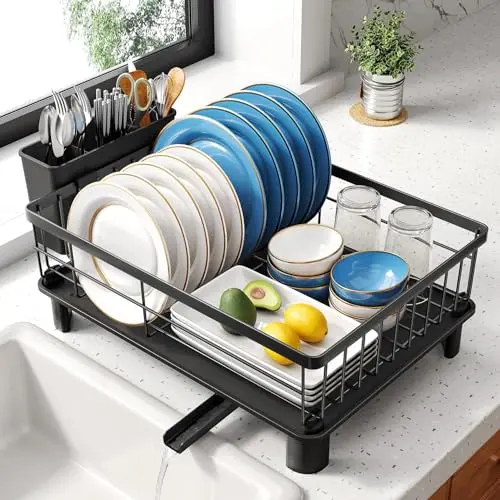
11-Inch Compact Dish Rack – Quick-Drain Counter Saver
A compact countertop rack with an angled drainboard, rotating spout, stainless steel rack, plastic drainboard, removable three-compartment utensil holder, and non-slip silicone caps. It is sized for tight counters and small sinks.
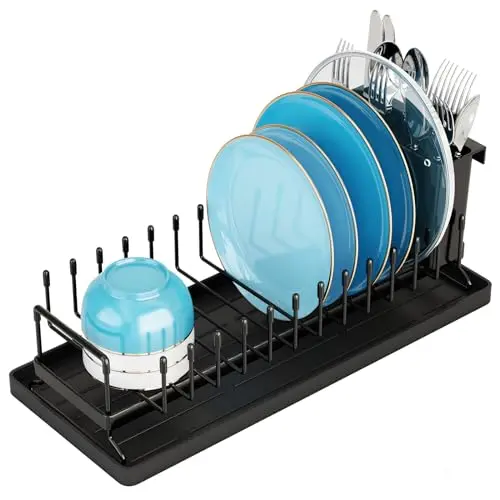
BP-214 – Narrow Cabinet-Friendly Drainer
A narrow dish rack with 12 slots for plates, pot lids, cups, bowls, and cutting boards. It includes a detachable three-slot cutlery holder and a silicone drying mat, and it separates for storage when counter space is tight.
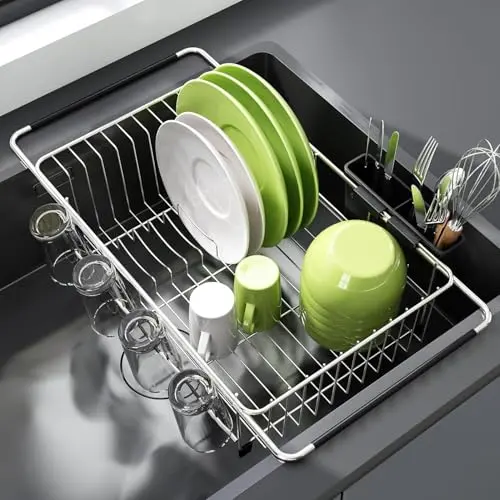
701BBBB – Expandable In-Sink Drainer
An expandable stainless steel rack that can sit over the sink or inside it. Adjustable support bars extend to fit different sink widths, and the open-grid design lets water drip straight into the basin. It includes a utensil holder and silicone sleeve grips.

USKI494 – Compact Countertop Drainer
A compact countertop dish rack with a 12-inch-wide base, drainboard, rust-proof metal frame, detachable cutlery holder, and rotatable water outlet. It holds plates, bowls, glasses, and utensils in a small footprint.
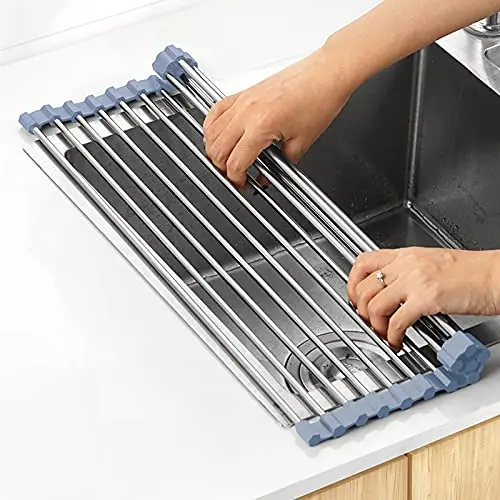
Roll-Up Over-Sink Rack – Foldable Space Saver
A roll-up over-sink rack made with stainless steel pipes and a silicone frame. It supports dishes, cups, bottles, and produce, resists heat up to 400F, and rolls up for cabinet storage when not in use.
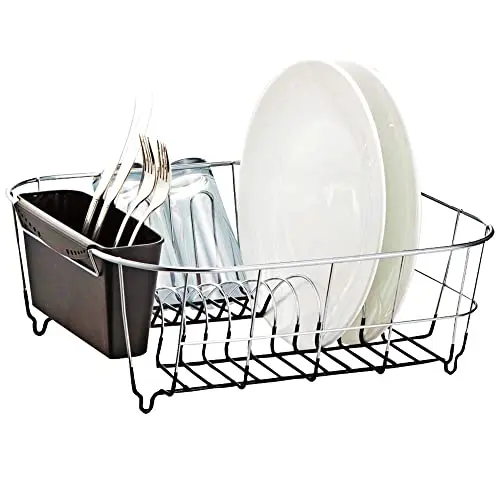
KC-DD-006-2 – Small In-Sink Drainer
A small chrome-plated steel dish drainer with slots for more than eight dishes, a detachable plastic cutlery cup, and a color-coated wire base. It can sit in the sink or on the counter in a compact kitchen.
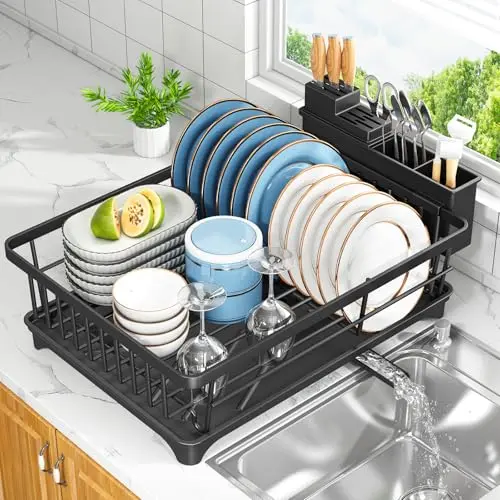
Compact Quick-Drain Rack – Small-Kitchen Organizer
A compact countertop dish rack with an angled drip tray, draining spout, rust-resistant metal frame, and a removable utensil holder with three compartments. It assembles without tools and is sized for small kitchens.
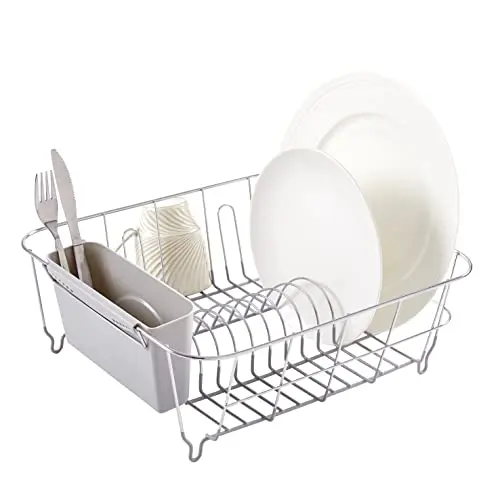
2-Piece In-Sink Set – Colorful Compact Drainer
A two-piece in-sink dish drainer with a removable utensil holder, chrome-plated steel construction, and a rubberized undercoating. It is designed to fit inside most standard sinks and comes in multiple colors.
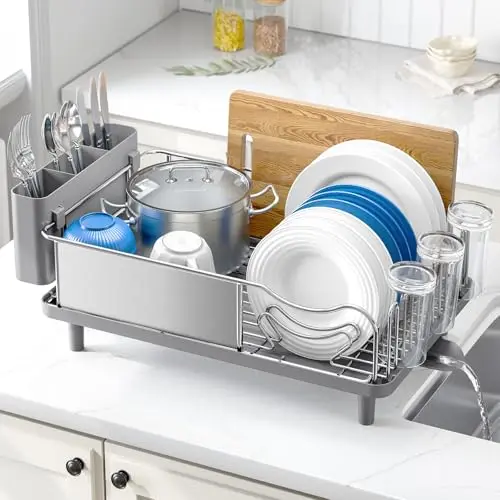
Ur-dr304 – Large-Capacity Stainless Drainer
A stainless steel dish rack with a 16.9-inch by 12.4-inch footprint, a removable drip tray, a three-slot utensil holder, a detachable cup shelf, and a sloped drainage design. It is built for larger dish loads but still keeps a relatively contained footprint.
How We Evaluated These Dish Drying Racks for Small Spaces
We didn’t run controlled kitchen lab tests or long-term reliability trials. What we did: cross-referenced 10 dish drying rack models from 10 distinct brands across six decision axes – footprint dimensions, sink compatibility, drainage design, usable dish capacity, materials and rust resistance, and assembly or cleaning effort. We mapped each rack against small-space scenarios: narrow counters, in-sink setups, adjustable sink widths, and kitchens where the sink lip sits above the counter. We triangulated published specifications, feature sets, and owner feedback where available, then weighed those signals against the realities of a cramped kitchen.
Small-space racks live or die on millimeters, so we treated listed dimensions as the starting point rather than a formality. A rack that is a fraction too wide for the counter beside the sink, or too tall for the cabinet above it, creates a daily annoyance that no extra slot can fix.
The scoring framework weighted real-world fit (70%) – how well each rack saves space while still drying a normal load – against feature differentiation (30%) – expandability, spout placement, cutlery organization, and material quality. We have no commercial relationship with any brand here; recommendations track fit and differentiation, not brand preference. If you want the most flexible premium option, the Joseph Joseph Extend Steel Slim is the one to beat; if you want a compact countertop rack with strong drainage for the money, the SNTD 11-Inch Compact Dish Rack is the better fit.
How to Choose the Right Dish Drying Rack for Small Spaces
1. Measure Your Small Space Before You Buy a Dish Drying Rack
Before comparing racks, measure the patch of counter where the rack will live. The useful numbers are counter depth, cabinet clearance, and sink lip height. A rack that fits the counter but blocks the upper cabinet will feel wrong every morning. If your counter is the bottleneck, the ANTOPY BP-214 is the narrowest pick here.
2. Countertop vs. In-Sink Dish Drying Racks for Small Spaces
Countertop racks are the easiest to live with because they can move, but they eat visible workspace. In-sink racks free the counter and catch drips close to the drain, while over-sink roll-up racks are the most temporary-feeling option. For a sink-based setup that stays put, the Neat-O KC-DD-006-2 is a practical choice.
3. Drainage Design: Where the Water Actually Goes
Drainage matters more in a small kitchen because there is less room to move a puddle out of the way. Look for an angled drainboard, a swiveling spout, or an open-grid design that lets water fall straight into the basin. If drainage is the deciding factor, the SNTD 11-Inch Compact Dish Rack is the pick.
4. How Much Dish Capacity Fits in a Small Footprint?
Do not judge capacity by the number of slots alone. Usable plate spacing and bowl or cup stacking decide whether a compact rack handles a real dinner or only a snack plate. A rack that holds ten thin plates may struggle with deep bowls.
5. Materials, Rust Resistance, and Daily Maintenance
Damp dishes expose every material weakness. 304 stainless steel and well-coated chrome-plated steel are the safer bets, while plastic drainboards are common and easy to clean but can crack or discolor. Dry the frame after washing if you want the finish to last.
6. Expandable and Roll-Up Dish Racks: Flexibility for Tight Kitchens
Expandable trays and roll-up racks are useful when your dish volume changes from day to day. They give you a small collapsed footprint most of the time and extra drying space when a big pot shows up. The tradeoff is usually a little more fiddling at setup.
Frequently Asked Questions
1. What's the difference between the Joseph Joseph Extend Steel Slim and the JASIWAY 701BBBB?
Both are expandable, but they solve different small-space problems. The Joseph Joseph uses a premium compact format with a sliding tray and a swivel spout, so it is best for a countertop strip that occasionally needs more room. The JASIWAY relies on adjustable sink bars and an over-sink or in-sink setup, which suits kitchens where the sink is the only available drying zone. For countertop-only small kitchens, the Joseph Joseph Extend Steel Slim is the cleaner fit.
2. Are in-sink dish drying racks better for small spaces than countertop racks?
They can be, but only if the sink fit works. In-sink racks save counter space and send drips toward the drain, yet they depend on sink dimensions, a clear drainage path, and enough cabinet clearance above. Countertop racks are more forgiving to move, but they take visible workspace. Measure both zones before deciding.
3. How do the SNTD 11-Inch Compact and Kitsure USKI494 compare for tiny kitchens?
Both have compact footprints and removable utensil holders, so the real difference is drainage and fit. The SNTD has an angled drainboard and a rotating spout, while the Kitsure uses an integrated drainboard and a rotatable outlet. If you want the tighter footprint, the SNTD 11-Inch Compact Dish Rack is the pick.
4. Will a dish drying rack fit under my upper cabinets?
Check the rack’s overall height plus the tallest item you plan to dry. Cabinet clearance is the limiting number, not just the rack footprint. If you have low cabinets, a low-profile roll-up rack or a shallow in-sink model is safer than a tall countertop rack.
5. What should I check if my sink edge sits above the counter?
That setup can block a drain spout and send water onto the counter. Look at sink edge height, spout clearance, and whether the rack has elevated legs or a roll-up design. A roll-up rack often works better because it drains directly into the basin.
Final Verdict
For most small kitchens, the Joseph Joseph Extend Steel Slim is the answer: it stays narrow when the counter is crowded, expands when a big load lands, and sends water toward the sink instead of under the plates. If you want a compact countertop rack with strong drainage for less, the SNTD 11-Inch Compact Dish Rack is the value pick. For the tightest counters, the ANTOPY BP-214 is the one that disappears into a narrow strip beside the sink. And if you want to keep the counter completely clear, the MECHEER Roll-Up Over-Sink Rack rolls away when the dishes are done. Pick by your limiting constraint – counter width, sink fit, or storage – and you’ll end up with the rack you actually use.
