
Best Door Jammers – 2026 Reviews

The deadbolt clicks home, the chain goes on, and you still lie there wondering whether the door is actually going to hold. That’s usually the moment people start shopping for a door jammer – after a hotel stay with a loose lock, a new apartment with a hollow-core front door, or a first night alone in a place that doesn’t quite feel secure.
Here’s the thing about this category: nearly every option claims a force rating in the hundreds of pounds, and almost none of those numbers tell you what happens when someone actually leans on the door. What separates a real door jammer from a decorative one comes down to two things – bracing geometry and floor grip. A bar wedged between the floor and the doorknob fails the moment the rubber foot slides on tile or the length doesn’t quite match your door.
We looked across the market at adjustable security bars, floor-mounted steel braces, and pocket-sized travel locks to sort out which designs hold up under the geometry that actually matters. Some are built for a front door you’ll never move. Others fold into a carry-on. The right pick depends entirely on which of those you are.
Best Door Jammers – 2026 Reviews
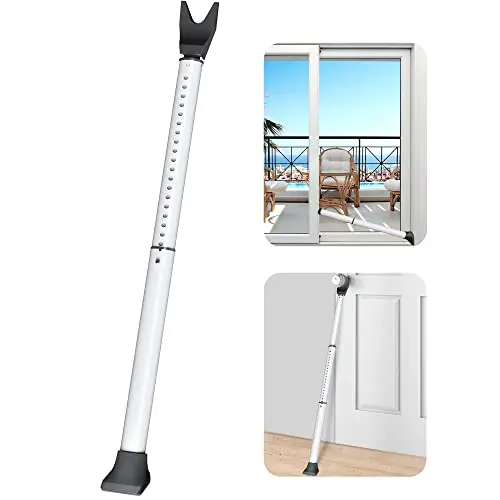
2-in-1 Door Security Bar – Heavy-Duty Coverage for Home and Travel
AceMining’s bar is the one most buyers should start with: a 2.2-pound adjustable brace that props under a doorknob for hinged doors or swaps caps for sliding glass doors and windows. The 1.57-inch tube and reinforced alloy connections give it a substantial feel without making it a hassle to move between rooms.
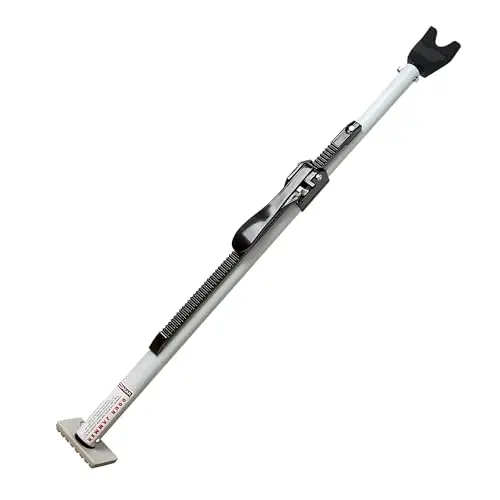
Door Jammer Home Security Bar – Steel Floor Brace That Won't Budge
The Buddybar takes a different approach entirely: a powder-coated steel bar that braces from the floor to the door at a fixed angle and stays put. No plastic, no adjustment gimmicks – just mass and geometry working together.
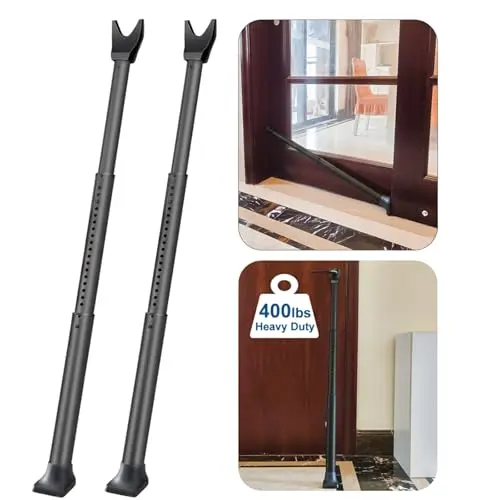
2-Pack Door Security Bar – Twin Bars for Two Entry Points
Rerishom ships two bars in one box, which is the practical answer for anyone securing a front door and a patio slider at the same time. Each bar runs on a 1.57-inch stainless steel tube with a 400-pound force rating.
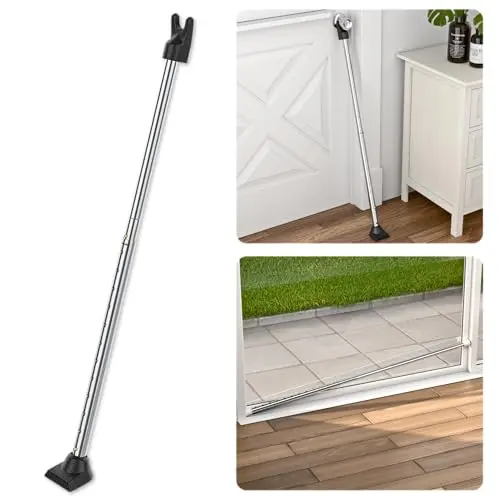
3-in-1 Door Security Bar – One Bar for Hinged and Sliding Doors
A three-in-one design that covers hinged doors, sliding doors, and windows with interchangeable caps, all on a high-grade iron bar that adjusts from 18.25 to 47.5 inches. One of the widest adjustment ranges in the category.
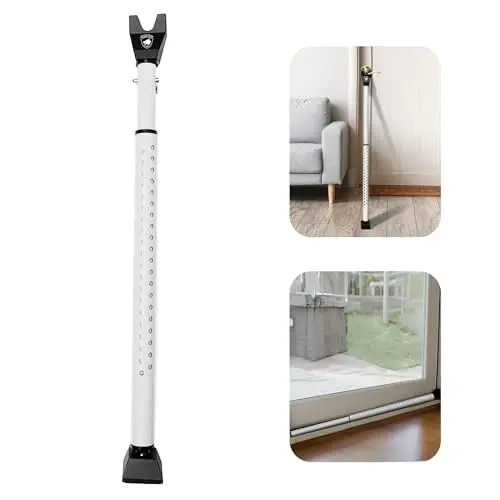
2-in-1 Sliding Door Security Bar – 40-Position Fit with Lifetime Warranty
A 2-in-1 bar with 40 distinct locking positions between 25 and 41.5 inches, plus a removable top piece that converts it into a sliding-door brace. Backed by a lifetime warranty.
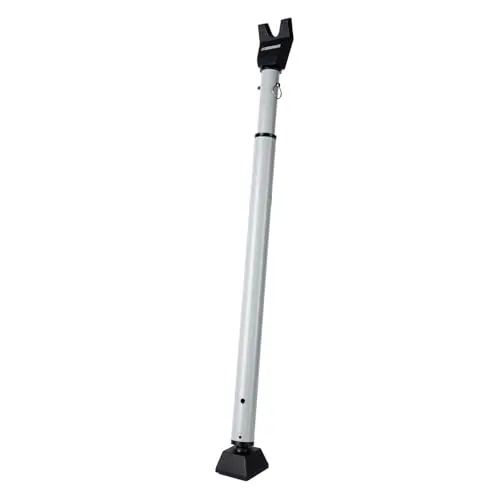
Door Security Bar – Non-Marring Floor Protection for Rentals
A 20-gauge steel bar that adjusts between 25 and 43 inches, with a non-marring top yoke and a pivoting padded foot designed to protect hardwood and tile. Compact enough to travel with.

2-in-1 Door Jammer – Wide Floor Contact on Hard Surfaces
A 2-in-1 bar with an extra-large high-friction rubber base and more than 18 adjustment stops across a 16.5-to-46-inch span, built around a thickened one-inch iron tube rated for 350+ pounds.
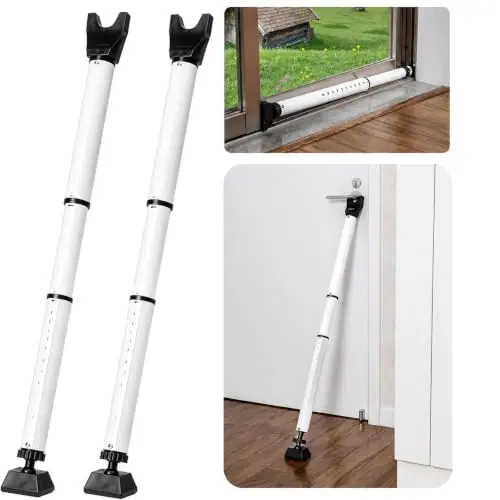
2-Pack Door Security Bar – Budget Twin Pack for Sliding Doors
A two-pack of adjustable bars with interchangeable heads for hinged and sliding doors, spanning 28 to 45 inches and rated for 400 pounds of force. Two doors covered in one purchase.
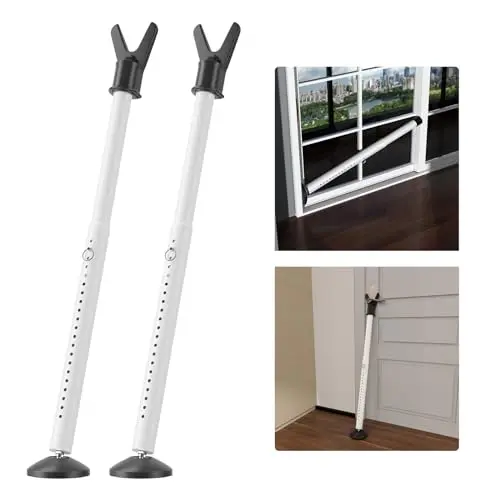
2-Pack Door Stopper Security Bar – Long Reach for Tall Doors
A two-pack of long-reach bars that extend from 18 to 51 inches with a three-inch rubber base and eighteen-plus adjustment positions, rated to 350+ pounds of force. The longest reach in this roundup.
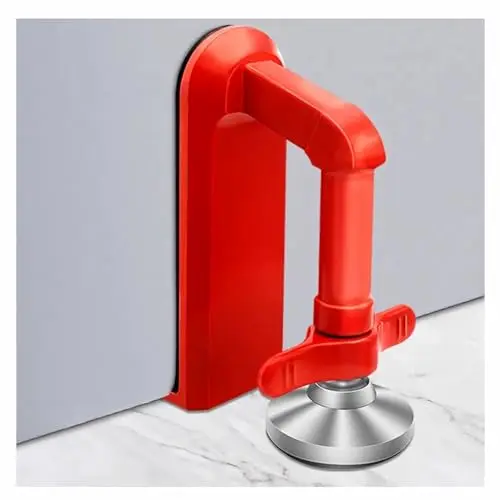
Portable Door Lock – Pocket-Sized Hotel Room Security
A pocket-sized door lock that wedges under the handle of an inward-opening door and tightens with a screw, folding away into a sub-one-pound package for travel. The only genuinely packable option here.
How We Evaluated These Door Jammers
We didn’t attempt forced-entry testing on these bars in a shop or lab. What we did: cross-referenced 10 door jammer models from 10 distinct brands across six decision axes – bracing geometry, rated force, adjustment range, floor grip, footprint and portability, and included extras. We triangulated published specifications, feature sets, and owner feedback where available against representative buyer profiles: renters who can’t modify a door, travelers who need something packable, and homeowners securing a slider alongside a front door.
The scoring framework weighted real-world fit and performance (70%) – whether the geometry actually braces a door and stays put – against feature differentiation (30%) – adjustment granularity, multi-door capability, and hardware quality. We mapped each bar against the two failure modes that matter most: a foot that slides on smooth flooring, and a length range that doesn’t match real doors. We have no commercial relationship with any of these brands, and recommendations track fit and differentiation rather than brand preference. If you want one bar that covers the most situations, the AceMining bar is the straightforward answer; if your front door is the whole point, the Buddybar is built for it.
One thing we weighed heavily: a bar is only as good as the floor under it. An angled rubber foot with a wide footprint outperforms a higher force rating on slick tile, and a bar that’s too short for the door does nothing at all. That’s why adjustment range and floor-contact design carry as much weight in our scoring as the headline number stamped on the box.
How to Choose the Right Door Jammer
1. What Actually Stops a Door: Bracing Geometry Beats Force Ratings
Every door jammer works on the same principle: transfer force from the door into the floor at an angle the door can’t rotate through. What varies is the geometry. A bar that wedges between the floor and the underside of the knob sits at roughly 45 degrees, a good angle for resisting a kick. A floor-mounted steel brace uses a longer, flatter stance that resists the door sliding rather than rotating.
The number printed on the box – 400 pounds, or something several times higher – describes the bar’s own breaking point under ideal conditions, not what it will do on your floor. Treat it as a ceiling, not a promise. Pipe diameter and connection hardware tell you more about real durability than the force claim, because the joints are what fail first.
2. How to Match a Door Jammer to Your Door's Height and Handle
Measure twice. Most adjustable door jammers span somewhere between 16 and 51 inches, but the useful number is the minimum, not the maximum. If your doorknob sits low – common on older interior doors – a bar with a 21-inch minimum simply won’t seat, no matter how strong it is. At the other end, tall exterior doors and wide sliders need reach; anything short of 46 inches leaves the top of the range tight.
Check the handle type too. Lever handles and French door handles give the yoke less material to catch than a round knob, so a non-marring top yoke with a wide cup does better than a narrow hook.
3. Floor Grip: The Failure Mode Nobody Advertises
This is where most of these products succeed or fail in practice. An angled rubber foot with a large contact patch holds on tile and hardwood; a small hard foot skates. The bigger the base, the more forgiving the bar is – a three-inch rubber base tolerates more floor variation than a one-inch nub.
Two floors deserve special caution. Glossy tile and polished concrete give rubber very little to bite, and thick pile carpet lets the foot sink and shift. If that’s your entryway, look for an oversized non-slip base and expect to re-seat the bar occasionally.
4. Hinged Doors vs. Sliding Doors: Do You Need Two Door Jammers?
A 2-in-1 bar covers both, but not equally well. The interchangeable caps that convert a hinged-door jammer into a sliding-door brace usually cost you an inch or two of length, and the sliding configuration relies on the bar sitting in the track channel rather than under a knob. For a patio slider that’s the whole reason you’re buying, a bar designed around that job – the Guard Dog Security bar with its 40 locking positions – fits more precisely than a generalist.
5. Portable Door Jammers for Travel vs. Fixed Home Braces
Travel changes the calculus completely. A two-pound bar fits in a suitcase but still needs a door with a floor gap and a knob to brace against; a nine-ounce under-handle lock fits in a laptop bag and works on any inward-opening door with a suitable gap. Neither replaces a deadbolt – they buy time.
For a permanent home setup, weight stops being a drawback. Something like the Buddybar, at 8.2 pounds of steel, is a nuisance to move and a genuinely different class of brace once it’s in place.
6. Price Tiers: What You Get as You Move Up the Range
At the entry tier you get a workable adjustable bar with a friction foot and a limited adjustment range; expect to trade some rigidity for the price. The mid-range is where better hardware, wider adjustment ranges, and two-bar packs appear – this is the sweet spot for most households. The premium tier buys mass, all-steel construction, and force ratings measured in the thousands of pounds rather than hundreds.
Our honest read: the jump from entry to mid-range buys more real security than the jump from mid-range to premium. Premium is for a specific door you care about disproportionately.
Frequently Asked Questions
1. Do door jammers actually stop a determined intruder?
They don’t stop a determined intruder – they delay one, and that’s the honest way to read the category. A properly seated bar with a 400-pound rated tube and a clean floor seal makes forcing a door dramatically harder and louder, which is usually enough. What it can’t do is compensate for a door frame that fails first.
Several of these brands say a version of the same thing in their own documentation: the bar buys time. Treat a door jammer as one layer, not the whole system, and pair it with a deadbolt and a solid strike plate.
2. What's the difference between the AceMining bar and the SECURITYMAN 3-in-1?
Both are adjustable under-door bars with multi-door caps, but they’re built to different priorities. The AceMining bar is the beefier of the two – a 1.57-inch tube, reinforced alloy connections, and a 400-pound rating – and it carries a little more weight as a result. The SECURITYMAN 3-in-1 wins on adjustment range, stretching from 18.25 to 47.5 inches, and on price tier.
Pick AceMining if hardware quality and durability matter more to you. Pick SECURITYMAN if you need one bar to cover an unusually short or unusually tall door.
3. How does the Buddybar compare to an adjustable bar like the Rerishom?
They solve the same problem from opposite ends. The Buddybar is a fixed-geometry steel brace you set once and leave – 8.2 pounds, no plastic, and a rated force several times higher than anything adjustable. The Rerishom two-pack gives you two lighter bars with 400-pound ratings and a 17.5-to-46-inch range, which is more useful if you have two doors to cover.
If the door never moves, mass wins. If you split time between a front door and a slider, the adjustable pair wins.
4. Which door jammer works best on sliding glass doors?
Look for a dedicated sliding-door cap and fine-grained adjustment. The Guard Dog Security bar has 40 locking positions, which lets it sit snugly in the track channel instead of hanging loose, and the removable top piece converts it in seconds.
Avoid coarse adjustment here – that much slack in a slider track is exactly where a bar loses its bite. Check the maximum length against your slider’s width before you buy.
5. Can I fly with a door jammer?
Yes, if you pick the right type. Bar-style jammers are bulky and heavy enough that most people check them or leave them home; the sub-one-pound under-handle lock style folds flat and slips into a carry-on. Either way, put a bar in a checked bag if you’re unsure, since screeners treat solid metal inconsistently.
For hotel rooms specifically, a pocket-sized lock is the more practical pick, because it works with the door you’re given rather than the door you measured.
Final Verdict
For most people, the AceMining bar is the right first buy – it braces a hinged door or a slider, goes up in seconds, and its 1.57-inch tube and reinforced joints put it a step above the entry tier without the commitment of a permanent installation. If your front door is the one you actually lose sleep over, the Buddybar is in a different class of strength and worth the premium. And if you’re covering two entry points on a budget, the Rerishom two-pack handles both doors for less than a single premium brace.
Traveling instead of securing? Skip all of them and take the MIMIRACLE portable lock: under a pound, fits in a pouch, and it’s the only option here that goes in a carry-on without a second thought. Match the tool to the door you’re actually standing behind.
