
Best Double Boiler Espresso Machines – 2026 Reviews

A double boiler espresso machine is supposed to solve one very specific morning problem: you want espresso and steamed milk ready at the same time, without waiting for the machine to switch modes. That simultaneous workflow is the whole reason to shop in this category, but it is also where the marketing gets slippery.
Some machines use separate brew and steam boilers; others rely on heat exchangers or fast thermoblocks and still promise dual boiler convenience in spirit. For a home barista, the difference shows up in recovery time, milk texture, and how much fiddling you tolerate before your first shot. The other dividing line is the grinder. Built-in grinders make a double boiler machine a true all-in-one, but they add cost, counter space, and another component that can fail.
We looked across the market for machines that actually deliver simultaneous brewing and frothing, then weighed how each one fits different buyers: the all-in-one tinkerer, the budget-focused frother, and the larger-household brewer. The goal is not to crown the most complicated machine. It is to match you with the double boiler espresso machine that fits your counter, your patience, and your milk-drink habit.
Best Double Boiler Espresso Machines – 2026 Reviews
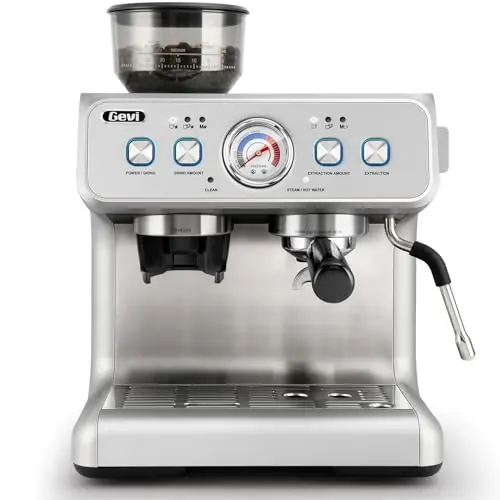
Dual Boiler Espresso Machine – Built-In Grinder and 58mm Portafilter
A semi-automatic double boiler machine with a built-in burr grinder, 31 grind levels, and a 58mm portafilter. It is aimed at home baristas who want an all-in-one setup with PID temperature control and a manual steam wand.
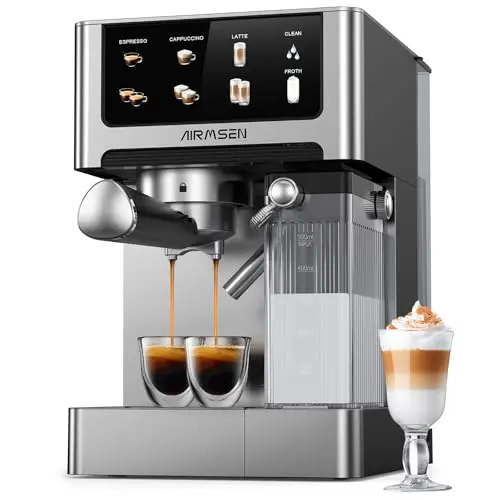
20 Bar Espresso Machine – Automatic Frothing on a Budget
A compact dual boiler espresso machine with a 20-bar pump, automatic milk frother, touchscreen controls, and a 60oz removable water tank. It is the budget-friendly route to one-touch cappuccinos and lattes.
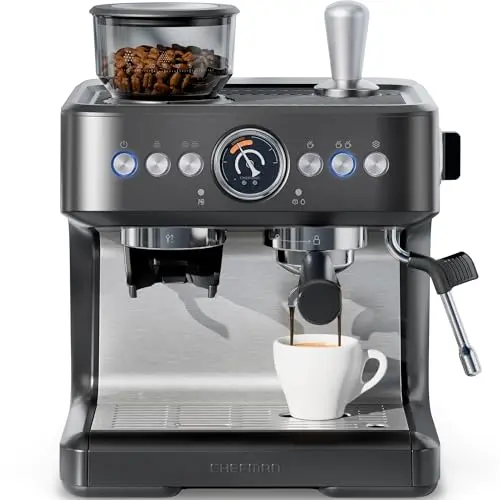
Crema Deluxe – Double Boiler with Built-In Grinder
A semi-automatic double boiler machine with a 30-setting conical burr grinder, 58mm portafilter, 15-bar pump, and 3-liter reservoir. It is built for shoppers who want to brew and froth at the same time with a larger water supply.
How We Evaluated These Double Boiler Espresso Machines
We didn’t spend a month pulling shots in a test kitchen or run lab-grade pressure and temperature measurements. What we did: cross-referenced 3 double boiler espresso machine models from 3 distinct brands across five decision axes – boiler architecture, grind and portafilter setup, milk-frothing control, water capacity and footprint, and owner-feedback signal where available. We triangulated published specifications, feature sets, and the practical workflow each machine creates for a home barista. We also audited the details that separate a true dual boiler from a machine that only markets the idea: separate brew and steam boilers, recovery time, and how much manual control the frother demands. We compared how each machine handles the second drink, not just the first, because that is where boiler design shows up. We also weighed how much counter space each machine really consumes once the portafilter and milk pitcher are in play.
The scoring framework weighted real-world fit (70%) – how well each machine supports simultaneous brewing and frothing for its intended buyer – against feature differentiation (30%) – grinder quality, portafilter size, temperature control, and reservoir capacity. We have no commercial relationship with these brands; recommendations track fit and differentiation, not brand preference. If you want the most complete all-in-one, the Gevi Dual Boiler Espresso Machine is the top pick. If automatic frothing and a lower entry point matter more, the AIRMSEN 20 Bar Espresso Machine is the value route.
How to Choose the Right Double Boiler Espresso Machines
1. What Actually Makes a Double Boiler Espresso Machine Worth It
The phrase double boiler espresso machine gets used loosely. In the strictest sense, it means separate brew and steam boilers, so you can pull a shot while steaming milk without waiting for one boiler to recover. That is the feature that changes your morning rhythm, not just the spec badge.
The practical benefit is simultaneous workflow: espresso keeps extracting while the steam wand textures milk. If you mostly drink straight espresso, a single boiler can be perfectly fine. The upgrade makes the most sense for latte and cappuccino drinkers who make two or more milk drinks back-to-back.
2. Boiler Architecture: True Dual Boiler vs. Marketing Shortcuts
Before you buy, verify whether the machine lists separate brew and steam boilers or only a fast-heating single boiler with a steam mode. Heat-exchanger and thermoblock designs can be quick, but they are not the same as a true dual boiler. In this lineup, the AIRMSEN 20 Bar Espresso Machine and Chefman Crema Deluxe both make the dual boiler claim explicitly, while the Gevi pairs its dual boiler setup with a built-in grinder.
Boiler architecture also affects temperature recovery and how much you can multitask. If the machine cannot maintain brew temperature while steaming, the second drink may taste flatter than the first.
3. Grinder and Portafilter: The Quality Gate for Double Boiler Espresso Machines
A built-in burr grinder is the difference between an all-in-one machine and a machine that needs another appliance beside it. The Gevi and Chefman both include conical burr grinders and 58mm portafilters, which is a more commercial-style size than the smaller baskets on budget machines. More grind settings help you dial in fresh beans, but only if the grinder is consistent enough to repeat the setting.
If you already own a good espresso grinder, a machine without one can be the smarter buy. The AIRMSEN 20 Bar Espresso Machine relies on your grinder and a 51mm portafilter, so budget for that extra gear. If you want the grinder built in, the Gevi Dual Boiler Espresso Machine is the better integrated pick.
4. Milk Frothing: Manual Steam Wand vs. Automatic Frother
Milk is where double boiler machines earn their keep. A manual steam wand gives you control over texture and temperature, which is why the Gevi and Chefman use one. An automatic milk frother like the AIRMSEN’s is faster and more forgiving, especially for beginners, but it leaves less room for fine-tuning latte art.
Think about the milk drinks you actually make. If you want silky microfoam and are willing to practice, a steam wand is the better long-term tool. If you want one-touch cappuccinos on a rushed morning, automatic frothing wins.
5. Water Capacity, Footprint, and Reliability Checks
Counter space is a real constraint with double boiler espresso machines. The 60oz tank on the AIRMSEN and the 3-liter reservoir on the Chefman reduce refill stops, but the Chefman is the heaviest of the three and the Gevi takes up more counter depth. The Gevi’s detachable tank and drip tray make routine cleaning easier, which matters more than a slightly larger reservoir.
Reliability should be part of the math. Mixed durability reports on the AIRMSEN and Chefman make a warranty and easy support more important than a long feature list. If you want the largest reservoir and a built-in grinder, the Chefman Crema Deluxe is the fit; just go in with clear eyes about the tradeoff.
Frequently Asked Questions
1. What's the difference between the Gevi Dual Boiler Espresso Machine and the Chefman Crema Deluxe?
Both are dual boiler machines with built-in grinders, but they optimize for different priorities. The Gevi pairs a 58mm portafilter with 31 grind settings and NTC/PID temperature control in a more compact body. The Chefman counters with a 3-liter water reservoir, a 30-setting grinder, and a 15-bar pump, but it is heavier and has more mixed reliability feedback. Choose the Gevi for the more complete single-unit workflow; choose the Chefman only if the larger tank is a must.
2. How does the AIRMSEN 20 Bar Espresso Machine compare with the Gevi Dual Boiler for small kitchens?
The AIRMSEN is the more space-conscious automatic option: it has a smaller footprint, a 60oz water tank, and a one-touch milk frother, so it suits tight counters and rushed mornings. The Gevi is larger and more involved, but it adds a built-in grinder and a 58mm portafilter for more control. For a small kitchen where automatic frothing is the priority, the AIRMSEN 20 Bar Espresso Machine is the practical match.
3. Are all double boiler espresso machines actually dual boiler?
No. Some machines use heat exchangers, thermoblocks, or fast-recovery single boilers and still promise easy espresso-to-steam transitions. A true dual boiler has separate brew and steam boilers, which is what allows simultaneous brewing and frothing. Check the spec sheet for explicit separate boiler language, and do not assume a double label means the same architecture across brands.
4. Do I need a built-in grinder on a double boiler espresso machine?
Not necessarily. A built-in grinder saves counter space and streamlines the workflow, which is why the Gevi and Chefman include one. But it also adds another component that can fail, and a separate espresso grinder often gives you more upgrade room. If you already own a capable grinder, the AIRMSEN keeps costs lower; if you want an all-in-one setup, the Gevi Dual Boiler Espresso Machine is the more cohesive choice.
Final Verdict
For most people shopping a double boiler espresso machine, the Gevi Dual Boiler Espresso Machine is the answer. It gives you the key dual boiler benefit – brewing and steaming without waiting – and backs it with a built-in grinder, 31 grind settings, and a 58mm portafilter. That is the most complete all-in-one package here.
If automatic milk frothing and a tighter budget matter more, the AIRMSEN 20 Bar Espresso Machine gets you dual boiler heating and one-touch frothing for a more accessible entry point. And if a 3-liter reservoir and a built-in grinder are higher priorities than long-term polish, the Chefman Crema Deluxe is the larger-capacity alternative, provided you accept the reliability tradeoff. Buy for the workflow you actually use, not the boiler badge alone.
