
Best Double-Sided Pillow Top Mattresses – 2026 Reviews

Shopping for a ‘double-sided’ mattress is an oddly confusing experience. The phrase used to mean a bed you could flip every few months to double its usable life. Today it turns up on listings for pillow top hybrids that aren’t flippable at all, where it usually signals a dual-layer comfort build: a plush pillow-top surface sitting on top of deeper support foam and a coil unit. Knowing which version you’re actually being sold is half the decision.
The other half is construction. A pillow top’s cushioned panel can be a quilted fiber wrap, a gel memory foam stack, or a zoned foam layer, and each behaves differently once the honeymoon week is over. Underneath that, coil count, gauge, and zoning determine whether the bed holds your hips and shoulders or lets them sink. Then there’s cooling, where gel foams and phase-change materials do real work while a breathable cover mostly just helps airflow. Get those three layers right and the mattress disappears from your thinking, which is the entire point.
We surveyed this category across the brands that actually sell pillow top hybrids, from entry-level bed-in-a-box options to premium cooling builds. What follows is sorted by who each mattress suits, whether you overheat at night, sleep on your side, carry more weight, or just want the cushioned surface without paying premium prices. Every pick here has construction that backs up its description.
Best Double-Sided Pillow Top Mattresses – 2026 Reviews
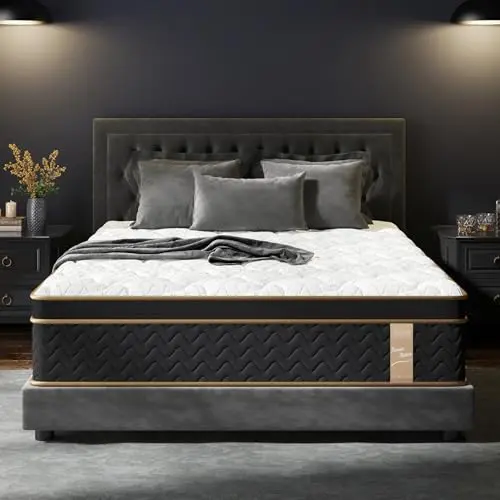
Zoned Pocket Spring Euro Top – Extra Hip, Shoulder and Lumbar Support
A 14-inch hybrid with a Euro top and zoned pocket springs, built to give shoulders and hips a softer landing while the center third stays firm under the lower back. Eight layers in total, 768 coils, and a heavier-gauge perimeter coil that resists roll-off. The cover is a polyester blend, the foam is gel-infused, and the whole build is fiberglass-free with CertiPUR-US and OEKO-TEX certification.
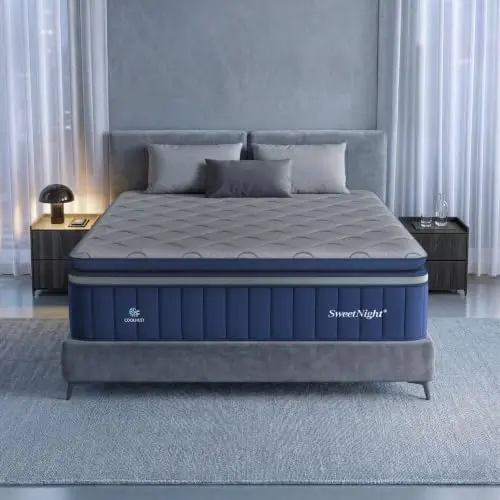
CoolNest 14-Inch Pillow Top Hybrid – Four-Stage Cooling for Hot Sleepers
A 14-inch pillow top hybrid built around temperature control. The cover is ice silk, the pillow top pairs gel memory foam with a resilient 3D comfort foam, and a PCMflux layer is designed to adapt to body temperature through the night. 600 individually wrapped dynamic coils handle support, with a high-density foam encasement around the perimeter to firm up the edges.

Mist 14-Inch Euro Top Hybrid – Support for Back and Side Sleepers
A 14-inch Euro top hybrid with seven layers, 965 pocketed coils, and a cotton cover. The build pairs gel memory foam and high-density foam over a pocketed coil base, with reinforced edges and a stated weight capacity well above most beds in this category. CertiPUR-US and OEKO-TEX certified, fiberglass-free, and sold with a 365-night trial.

Quilted Hybrid 12-Inch – Medium-Plush Pillow Top Feel
A 12-inch quilted hybrid with a stretch-knit cover, a one-inch gel memory foam layer sandwiched between two open-cell comfort foams, and 700 individually wrapped coils underneath. Medium-plush by design, CertiPUR-US certified, fiberglass-free, and compatible with both platform and adjustable bed bases.

Bliss 12-Inch Gel Memory Foam – Cooling All-Foam Value Pick
A 12-inch all-foam bed with a NanoGel memory foam comfort layer, a breathable knit cover, and a reinforced edge. There’s no coil unit here, so read it as the foam alternative in this lineup rather than a true pillow top. Support comes from a triple-layer foam stack tuned for pressure relief and motion isolation, and it’s CertiPUR-US and ISPA certified with a 100-day trial and a 10-year warranty.
How We Evaluated These Double-Sided Pillow Top Mattresses
We didn’t sleep on these mattresses for months or run compression and sag testing in a lab. What we did: cross-referenced 5 pillow top mattress models from 5 distinct brands across 6 comparison dimensions – comfort-layer construction, coil count and gauge, cooling materials, edge support, firmness rating, and certification and trial terms. We triangulated published specifications, feature sets, and owner feedback where available, then mapped each option against the sleepers most likely to end up in this category.
Because ‘double-sided’ means different things depending on the listing, we weighted construction transparency heavily. A mattress that names its layer stack, coil count, and foam certifications is easier to shop than one that leans on adjectives. Firmness labels are especially loose here, since one brand’s medium is another’s plush, so we treated stated firmness as a starting point and checked it against the actual build. We also audited the practical details: whether the brand publishes a real trial period, what the warranty covers, and whether the foams and cover are fiberglass-free.
The scoring framework weighted real-world fit (70%) – how well each mattress delivers the feel and support it claims for the sleepers it targets – against feature differentiation (30%) – cooling systems, zoning, edge reinforcement, and certification depth. We have no commercial relationship with any brand here, and recommendations track fit and differentiation, not brand preference. If you want the most balanced hybrid on the list, the Flexpedic zoned pocket spring hybrid is the pick; if you overheat at night, the Sweetnight CoolNest earns its premium.
How to Choose the Right Double-Sided Pillow Top Mattress
1. What Double-Sided Actually Means on a Modern Pillow Top Mattress
Here’s the part that trips people up. A genuinely double-sided mattress is built symmetrically, with the same comfort layers on both faces, so you can flip it. That construction is now rare, largely because two-sided beds are expensive to build and brands shifted to one-sided designs with longer warranties instead. What most listings mean by ‘double-sided’ today is a dual-layer comfort build: a plush pillow-top surface over a denser support foam, sometimes marketed as two-sided because the feel changes depending on which layer you focus on.
None of that makes the mattress bad. It just changes what to check. If flippability is the actual requirement, ask the seller directly and confirm the base is symmetrical. If what you want is a cushioned surface you can still rotate for even wear, a one-sided pillow top hybrid does the job as long as you rotate it 180 degrees every few months. Rotation, not flipping, is the maintenance routine for every mattress in this lineup, and the ones with reinforced edges and zoned centers handle it better than cheap foam slabs.
2. Pillow Top vs. Euro Top: Picking the Cushioned Surface
The two terms get used interchangeably and they shouldn’t. A pillow top is a separate cushioned panel sewn onto the mattress surface, so it looks and feels like a pillow lying on top of the bed with a visible seam. A Euro top is attached flush, giving you similar softness without the ridge. Pillow tops generally feel plusher at first contact; Euro tops tend to hold their shape longer and won’t roll you toward the middle.
Which you want depends on how you sleep. Side sleepers usually prefer the softer first contact a pillow top gives, because it lets the shoulder sink. Back sleepers and heavier sleepers often do better on a flatter surface over a zoned core, where the support layer is doing more of the work. If you’re between the two, lean toward the flatter build, since you can always add a topper but you can’t add support back into a mattress that’s too soft.
For that flatter, more supportive surface, the Flexpedic zoned hybrid is the clearest example in this lineup.
3. Coil Count, Gauge, and Zoning in a Pillow Top Mattress
Coil count gets quoted like horsepower, but it’s only part of the picture. What matters more is coil gauge, coil height, and whether the springs are individually wrapped or laced into a continuous unit. Pocketed coils let each spring compress on its own, which is what delivers both conformity and motion isolation. A continuous coil system is cheaper and transfers movement across the whole bed.
Zoning is the other spec worth hunting for. A zoned core uses firmer coils or denser foam in the middle third to hold up the lower back and hips while softer zones under shoulders and legs let those areas settle. It’s the single most useful upgrade for anyone who wakes up with lumbar stiffness, and it’s why a 700-coil zoned bed can outperform a 1,000-coil unzoned one. Edge support follows the same logic, using a heavier-gauge perimeter coil or a dense foam encasement to keep the border from collapsing. If you want the most coils in this lineup, the Sleepmax Mist runs 965 pocketed springs.
4. Cooling Features That Earn Their Place
Almost every mattress ships with a cooling claim, and they are not all equal. Gel-infused memory foam does move heat better than plain memory foam, though it still traps some. Phase-change materials, sometimes labeled PCM, are more interesting because they absorb and release heat as temperature shifts, which helps with the 3 a.m. wake-up. A breathable cover helps airflow at the surface, and an ice silk or knit cover feels cooler to the touch on contact.
The feature that doesn’t get marketed enough is open-cell foam, which lets air move through the layer instead of sitting in it. Hybrids with a coil unit also breathe better than all-foam builds by design, because the springs create an air channel beneath the comfort layers. If you sleep hot, prioritize a hybrid with gel or phase-change foam plus a genuinely breathable cover, and don’t expect any mattress to feel cold. Neutral is the realistic goal. The Sweetnight CoolNest stacks the most cooling mechanisms here.
5. Firmness, Body Weight, and Sleep Position
Firmness labels in this category are loose. One brand’s medium is another’s plush, which is why stated firmness should be a starting point rather than a decision. Read it against construction instead: how thick the comfort layer is, how firm the support foam is, and how the coils are zoned.
As a rough guide, side sleepers and lighter sleepers generally do better with more cushioning, because they need pressure relief at the shoulder and hip. Back and stomach sleepers need a flatter surface so the spine stays neutral. Heavier sleepers should look at higher weight capacity ratings and denser support layers, since soft comfort foam compresses further under more load. If you’re a couple with different preferences, a medium-firm hybrid with a distinct comfort layer is usually the compromise that works in practice.
6. Trials, Warranties, and the Fiberglass Question
Buying a mattress you can’t lie on first means return terms carry real weight. A 100-night trial is now table stakes; 365-night trials are the generous end of the market and let you judge a bed across seasons rather than a single week. Read the fine print on return shipping and whether the trial requires a minimum break-in period before you can send it back.
Fiberglass is the other thing to check. Some budget mattresses use a fiberglass sock as a fire barrier, and it can escape through the cover over time, which is a genuine problem for households with kids, pets, or allergies. Look for explicitly fiberglass-free construction along with CertiPUR-US foam certification and, where available, OEKO-TEX cover certification. Those labels together are a reasonable proxy for a mattress that won’t off-gas heavily for weeks. The Vibe Quilted Hybrid and every other pick here clear that bar.
Frequently Asked Questions
1. Are any of these mattresses actually double-sided and flippable?
No, and that’s true of most of the modern category rather than just this lineup. Every mattress here is a one-sided hybrid with a pillow top comfort layer on top and a coil or foam support core below. Flipping one would put you on the support base, which isn’t designed as a sleep surface.
If flippability is a hard requirement, shop specifically for a symmetrical two-sided mattress from a brand that states it explicitly, and expect fewer options. For everyone else, what ‘double-sided’ usually delivers is a dual-layer comfort build, soft foam over firm foam, and that’s what this lineup actually offers. Rotating 180 degrees every few months is the maintenance routine that replaces flipping.
2. How does the Flexpedic zoned hybrid compare to the Sleepmax Mist?
They’re the two most closely matched picks here, and the split comes down to feel. The Flexpedic is the firmer of the two: a medium-firm Euro top with 768 pocketed coils and a pronounced zoned core that stiffens under the lower back. The Sleepmax Mist runs softer, with 965 pocketed coils, a more generous medium-plush surface, and a far higher stated weight capacity.
Choose the Flexpedic zoned hybrid if you want a support-forward landing and the longest warranty arrangement in the group. Choose the Sleepmax Mist if you want more surface cushioning, share the bed with a restless sleeper, or need the higher load rating. Both are fiberglass-free and OEKO-TEX certified, so the safety ground is level.
3. What's the difference between the Sweetnight CoolNest and the Vibe Quilted Hybrid?
They sit at opposite ends of this lineup. The CoolNest is the premium cooling pick, with an ice silk cover, a phase-change foam layer, 600 dynamic coils, and a DuoSense pillow top that pairs cool gel foam over resilient support foam. The Vibe Quilted Hybrid is the entry-level route into the same basic idea: a quilted cover, a medium-plush top, and 700 individually wrapped coils, at a fraction of the commitment.
Go with the Sweetnight CoolNest if you overheat at night and want the most convincing cool-sleep construction here. Go with the Vibe Quilted Hybrid if you want that cushioned, quilted feel on a tighter budget and can live with a medium rather than plush surface.
4. Do I need a box spring for a 14-inch pillow top mattress?
Usually not. Every mattress in this lineup is designed for a platform bed, an adjustable base, or a slatted frame with reasonably tight spacing. A traditional box spring adds height and flex, and on a hybrid with a pocketed coil unit it can actually shorten the bed’s life by letting the base flex unevenly.
Check the weight rating of whatever frame you’re using, especially with a 14-inch queen or king, since these run heavy. If you’re pairing one with an adjustable base, confirm the mattress is listed as adjustable bed compatible, which the Vibe Quilted Hybrid explicitly is.
5. How long does a mattress in a box take to fully expand?
Longer than the box suggests. Most of these beds are usable within a few hours, but full expansion typically takes 24 to 72 hours, and the feel keeps settling for a week afterward. Brands quoting three days are being realistic rather than cautious.
Two practical notes. Walking on the mattress or sleeping on it early can speed the process, and if a bed lands noticeably short of its stated height after the full window, that’s a return conversation rather than something to wait out. The Vibe Quilted Hybrid draws the most mixed notes on this front.
Final Verdict
For most buyers, the Flexpedic zoned pocket spring hybrid is the answer. It pairs a genuinely cushioned Euro top with a zoned coil core, keeps the edges from collapsing, and backs it with the longest trial and warranty arrangement in the group. That combination is hard to beat at the mid-range tier.
If cooling is the priority, the Sweetnight CoolNest is the one to stretch for, since its four-stage cooling build is the most convincing here and the DuoSense pillow top means you aren’t trading comfort for it. On a tighter budget, the Vibe Quilted Hybrid gets you a real quilted top and 700 coils for far less, as long as a medium feel works for you. And if you’d rather skip coils entirely, the Novilla Bliss is the plush, motion-isolating foam alternative.
