
Best Electric Kettles With Temperature Control – 2026 Reviews

You fill the kettle, hit the button, walk away for two minutes, and come back to a rolling boil – which is exactly wrong for the green tea you were about to brew. That small daily friction is what pushed variable-temperature kettles out of coffee-gear territory and into ordinary kitchens.
The gap between a mediocre temperature-control kettle and a good one comes down to two things: how closely it holds a target temperature, and whether the interface makes that target easy to hit without digging out a manual. A kettle that advertises six presets but overshoots by fifteen degrees is worse than one with three accurate ones. Keep-warm duration matters just as much – a hold that only lasts twenty minutes is barely a hold at all.
We cross-shopped the market across brands and body styles – stainless carafes, borosilicate glass, narrow gooseneck spouts, app-connected models – to sort out which kettles actually deliver on their temperature claims and which ones are coasting on a preset label. Whether you’re steeping delicate white tea, pulling a slow pour-over, or filling a teapot for four, the right pick depends on a handful of specific tradeoffs.
Best Electric Kettles with Temperature Control – 2026 Reviews
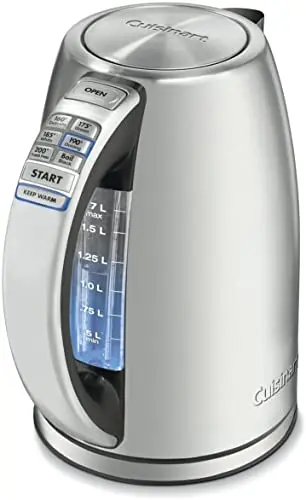
CPK-17P1 PerfecTemp – Six Presets for Everyday Brewing
The classic stainless variable-temperature kettle: a 1.7-liter body, 1500 watts, and six presets mapped to specific tea and coffee styles. One-touch controls with blue LED indicators, a blue backlit water window, and a 360-degree swivel base round out the package.
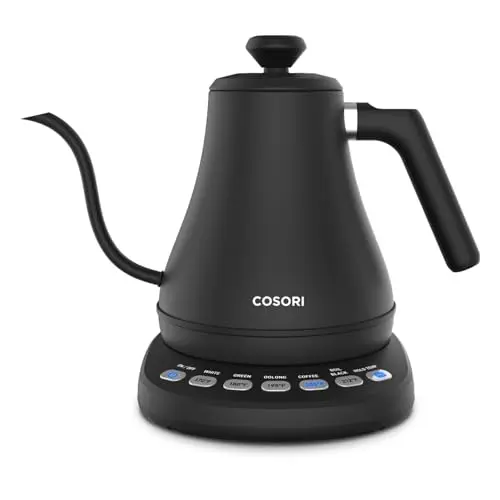
CO108-NK Gooseneck – Precise Pour-Over Control
A 0.8-liter gooseneck built around pour-over. Five one-touch presets, a Hold Temp function that keeps water within a few degrees of target for up to an hour, and 304 stainless in the interior, lid, and spout – no plastic in the water path. The counterbalanced handle and narrow spout are shaped for a slow, controlled pour.
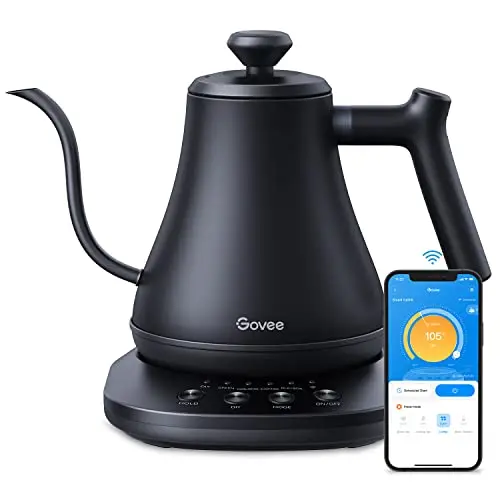
H7170 Smart Kettle – App and Voice Temperature Control
The most connected kettle here. A 0.8-liter gooseneck with WiFi and Bluetooth control through the Govee app, Alexa voice commands, scheduling, and to-the-degree temperature selection from 104F to 212F. All-stainless construction, 1200 watts, and a two-hour keep-warm.
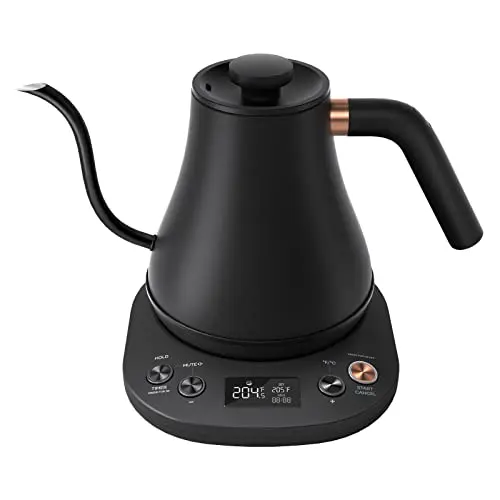
HB-3166M Gooseneck – Real-Time LCD Precision
A 0.8-liter gooseneck with continuous temperature selection from 100F to 212F rather than fixed presets, driven through a 2-inch LCD that shows both set and real-time temperature. 1200 watts, 304 stainless, and a cord-wrap base.

EKT3001 Digital Gooseneck – Thirteen Presets, Two-Hour Hold
A 1-liter digital gooseneck with 13 pre-programmed temperatures plus three custom slots, a 90-degree spout for controlled pouring, and a two-hour keep warm. The LED readout shows both selected and real-time temperature, and the interior is 304 stainless.

CO117-DK Glass Kettle – Six Presets in a 1.7L Carafe
A 1.7-liter borosilicate glass kettle with six one-touch presets powered by a Strix thermostat, a 60-minute keep-warm, and two LED indicators – blue while boiling, white in hold mode. The wide mouth and hinged lid make filling and descaling straightforward, and the filter is stainless.
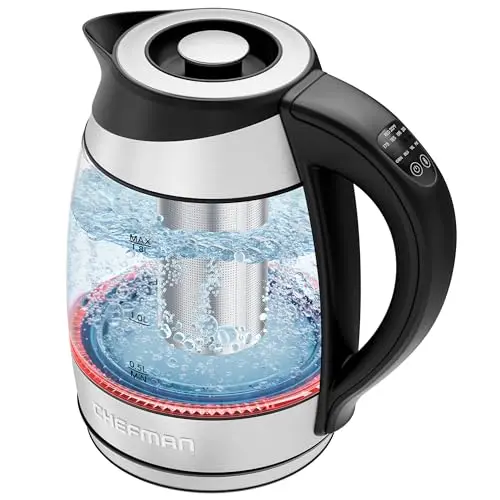
RJ11-17-CTI Glass Kettle – Built-In Tea Infuser
A 1.8-liter borosilicate glass kettle with variable temperature presets from 160F to 212F, a removable stainless tea infuser, and tri-color LED rings that shift from white on standby to red while heating to green in steep mode. 1100 watts, 360-degree swivel base, lift-out lid.
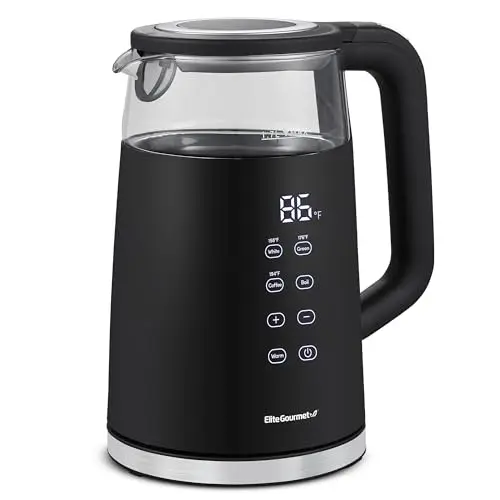
EKT8717 Touchscreen Kettle – Double-Wall Family Capacity
A 1.7-liter double-wall kettle with touchscreen controls, four preset temperatures covering white tea, green tea, oolong and coffee, plus small-increment adjustment on either side of them. A real-time display, two-hour keep warm, and a 304 stainless interior behind a cool-touch exterior. 1100 watts.
How We Evaluated These Electric Kettles with Temperature Control
We didn’t boil hundreds of liters on a bench or log temperature curves with a calibrated probe. What we did: cross-referenced 8 electric kettles with temperature control from 6 distinct brands across 6 decision axes – temperature range and preset granularity, hold accuracy and keep-warm duration, materials in the water path, capacity and boil speed, pour control, and interface clarity. We triangulated published specifications against feature sets and owner feedback where available, then mapped each model to a representative buyer profile: the daily tea drinker, the pour-over regular, the large household, and the app-first user.
The scoring framework weighted real-world fit for the stated use case (70%) – how closely a kettle holds a target temperature, how usable the controls are in daily routine – against feature differentiation (30%) – unique technical advantages like smart connectivity, double-wall construction, or a built-in infuser. We have no commercial relationship with any brand here; recommendations track fit and differentiation, not brand preference. If you want one kettle that covers every tea in the cupboard, the Cuisinart CPK-17P1 is your match; if you’re brewing pour-over, the Cosori CO108-NK is the better tool.
How to Choose the Right Electric Kettle with Temperature Control
1. Temperature Range and Preset Granularity Matter More Than Preset Count
The number on the box – six presets, thirteen presets – tells you less than you’d think. What matters is where those presets land and whether you can adjust between them. A kettle locked to five fixed points forces you to pick the nearest one; a kettle with continuous adjustment lets you dial in exactly the temperature a specific tea wants.
Delicate white and green teas want water well below boiling. Oolong sits in the middle. Black tea and French press coffee want something close to a full boil. A good temperature range covers that spread without gaps at either end. If you mostly drink one style, presets are plenty. If you keep five kinds in the cupboard, fine adjustment in small increments earns its keep.
2. Hold Accuracy: What Keep Warm Actually Means
Keep-warm is the feature most often oversold. Two kettles can both claim a hold function and behave completely differently – one keeps water within a few degrees of target for an hour, the other drifts down steadily and calls it warm.
Look for a stated hold window and a stated accuracy tolerance. A kettle that promises one hour within a narrow band is more useful than one promising two hours of vaguely warm water. For a second cup poured twenty minutes after the first, almost any hold works. For a slow morning with a gaiwan, the difference shows.
3. Pour-Over Kettles vs. Everyday Kettles
Gooseneck kettles exist for one reason: flow control. A narrow, curved spout lets you pour a thin, steady stream over coffee grounds, which is the entire premise of pour-over brewing. A standard wide-spout kettle dumps water in bursts and makes a mess of a coffee bed.
The tradeoff is capacity. Most goosenecks land around 0.8 to 1 liter, which is two large mugs. If coffee is the priority, that’s fine; if you’re also making tea for four, it isn’t. For dedicated pour-over duty, the Cosori CO108-NK is built around the spout and the balance of the handle rather than around volume. If you split the difference between coffee and tea service, a 1-liter gooseneck like the Elite Gourmet EKT3001 is the more versatile shape.
4. Materials in the Water Path: Glass, Stainless, and Plastic
Where the water touches matters for taste and for longevity. 304 food-grade stainless interiors are the safest default – no plastic contact, no lingering flavor, and they survive descaling with vinegar. Glass carafes are visually satisfying and easy to monitor, but borosilicate still carries breakage risk and usually means hand washing.
The detail worth checking is the lid and spout. Plenty of kettles advertise a stainless body and then fit a plastic lid that sits right in the steam path. A model that specifies stainless through the interior, lid, and spout is doing it properly.
5. Capacity and Boil Speed: Matching the Kettle to Your Household
Capacity is easy to get wrong. A 1.7-liter kettle is right for a family that fills a teapot twice at breakfast and wrong for one person making a single mug, where it just means waiting longer for water you won’t use. Wattage works alongside capacity: 1500 watts in a 1.7-liter body heats faster than 1100 watts in the same volume.
If you’re pouring one cup at a time, a 0.8 to 1 liter body with 1200 watts is faster to a boil and easier to handle. If you’re filling a French press and a teapot back to back, the Cuisinart CPK-17P1 and its 1.7-liter capacity save you a second cycle.
6. What Temperature Control Costs Across Tiers
Budget kettles with variable temperature exist, and some do the job. What you give up at the entry level is usually preset granularity, hold duration, and warranty length. Glass bodies with a few presets and short coverage sit at the bottom; stainless variable-temperature kettles with longer holds and multi-year coverage sit at the top.
If price is the constraint, the Chefman RJ11-17-CTI delivers variable temperature and an infuser at the entry tier, with glass durability as the honest tradeoff. The middle of the market is where most buyers land, and it’s where hold accuracy and build quality start improving noticeably. The premium end buys longer warranties, finer control, and in some cases app connectivity.
Frequently Asked Questions
1. What's the difference between the Cuisinart CPK-17P1 and the Cosori CO117-DK?
Both are 1.7-liter kettles with six presets and a keep-warm, so the choice comes down to body material and hold duration. The Cuisinart CPK-17P1 uses a brushed stainless body, offers a 30-minute keep warm, and backs it with a three-year limited warranty. The Cosori CO117-DK uses a borosilicate glass carafe, holds temperature for 60 minutes, and runs 1500 watts with dual LED indicators.
If you want to watch the water and hold temperature longer, go glass. If you want the longer warranty and a body that won’t shatter, go stainless.
2. How does the Cosori CO108-NK compare to the Mecity HB-3166M?
Both are 0.8-liter gooseneck kettles built for pour-over, and both use 304 stainless in the water path. The difference is the interface. The Cosori CO108-NK works from five one-touch presets plus a one-hour hold and stays within a few degrees of target. The Mecity HB-3166M gives you continuous selection from 100F to 212F and a real-time LCD showing both actual and target temperature.
Presets are faster in a morning rush; continuous control is more precise if you’re chasing a specific number.
3. Are temperature presets accurate enough for green tea?
It depends on the kettle, not the concept. Green tea wants water well below a rolling boil, and a preset labeled for green tea is only useful if the kettle actually holds that temperature rather than overshooting it. Strix thermostat control is a reasonable marker of accuracy, and kettles that publish a tolerance band – within a few degrees of target – are more trustworthy than ones that only list preset temperatures.
If green tea is most of what you drink, the Cuisinart CPK-17P1 labels its presets by drink style, which removes most of the guesswork.
4. Do smart kettles work without WiFi?
The Govee H7170 pairs over Bluetooth as well as WiFi, so it works without a network as long as your phone is nearby. WiFi adds range and enables Alexa voice control and scheduling, which is where the smart features actually pay off.
Note that the WiFi setup requires a 2.4GHz network – 5GHz won’t work. If you’d rather not involve a phone at all, the on-kettle controls on the Mecity HB-3166M or Elite Gourmet EKT3001 cover the same temperature selection without an app.
5. Is a glass electric kettle a durability risk?
Borosilicate glass handles thermal shock better than ordinary glass, and the glass kettles here are built for it. That said, glass is glass – a drop or a hard knock ends the story in a way stainless doesn’t. Hand washing is required on the glass models, and repeated descaling is gentler on stainless.
If the kettle lives in a busy kitchen or gets knocked around, stainless is the lower-risk choice. If you want to watch the water heat and don’t mind the care, glass is perfectly workable.
Final Verdict
For most kitchens, the Cuisinart CPK-17P1 is the answer. Six presets labeled by drink style, a 30-minute hold, a 1.7-liter body that handles a full teapot, and a three-year warranty make it the least fussy way to get accurate water temperature every morning.
If coffee is the priority, the Cosori CO108-NK is the better tool – the gooseneck spout and counterbalanced handle are built for pour-over in a way no standard kettle is. On a tighter budget, the Chefman RJ11-17-CTI still gives you variable temperature and a built-in infuser for loose leaf, with glass durability as the honest tradeoff. And if you want to schedule a boil from your phone before you get out of bed, the Govee H7170 is the only kettle here that does it.
