
Best Espresso Machine Accessories – 2026 Reviews

You can pull a decent shot with a stock espresso machine and still feel like your coffee bar is fighting you. Grounds scatter across the counter, the puck comes out muddy, milk splashes over the rim, and the drip tray turns into a graveyard of spent coffee. The right accessories don’t make espresso complicated; they remove the small frictions that turn a morning ritual into cleanup duty.
The most useful espresso machine accessories fall into two lanes: puck prep and daily maintenance. Puck prep tools-tampers, WDT stirrers, dosing funnels, and levelers-shape how evenly water moves through the coffee. Maintenance gear-knock boxes, cleaning tablets, and washable pitchers and cups-keeps the machine and your counter from accumulating residue. A good accessory should solve one of those jobs without creating a new one.
This guide surveys the category across brands and price tiers, from official Breville add-ons to independent barista tools. We’ll focus on fit, build, cleaning, and whether each piece actually earns counter space in a home setup.
Best Espresso Machine Accessories – 2026 Reviews

Knock Box 10 – Mess-Free Puck Disposal
A compact stainless-steel knock box with a removable bar and room for a full day of pucks. It’s designed to sit neatly beside Breville machines and keep spent grounds out of the drip tray.

54mm Espresso Tamper – Self-Leveling Precision for Breville
A walnut-handled, spring-loaded tamper sized for 54mm Breville portafilters. It adds self-leveling pressure and swappable springs to a routine that’s easy to get inconsistent.

Luxe Cafe Knock Box – Double-Shot Capacity with Non-Slip Base
A stainless-accented knock box with a non-slip base and room for double-shot pucks. The removable bar makes routine emptying simple.

Flick WDT – Retractable Needle Distribution
A retractable WDT tool with magnetic mounting, replacement needles, and a fidget-friendly design. It breaks up clumps before tamping without leaving exposed needles on the counter.

51mm Espresso Kit – Four-in-One Puck Prep
A 51mm puck-prep kit that bundles a distributor-tamper, WDT tool, and magnetic dosing funnel. It’s aimed at Delonghi, CASABREWS, and other 51mm machines.

BEC250 Cleaning Tablets – Routine Espresso Maintenance
Official Breville cleaning tablets designed to remove coffee oils and residue from shower screens and filter baskets. A routine maintenance staple for Breville machines.
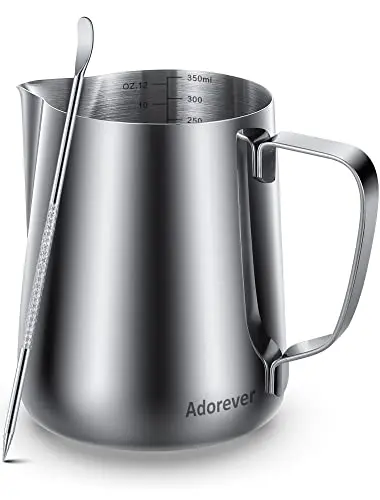
Milk Frothing Pitcher – 12oz Steaming and Latte Art
A 12oz stainless-steel milk frothing pitcher with a point mouth and latte art pen. It’s built for steaming, pouring, and small-batch milk drinks.

Espresso Cups Set of 2 – Double-Spout Shot Glasses
A set of two 4oz borosilicate glass cups with double spouts and handles. They’re useful for splitting shots, serving milk, or pulling two espressos at once.

Espresso Measuring Cup – V-Spout and Scale
A 6oz borosilicate glass measuring cup with a V-shaped spout and visible markings. It works as an espresso shot glass, milk pitcher, or small measuring cup.

Coffee Spoons – Long-Handle Stirring Set
A four-piece set of long-handle stainless-steel coffee spoons with a gold finish. They’re sized for stirring tall glasses, mugs, and iced drinks.
How We Evaluated These Espresso Machine Accessories
We didn’t run a commercial espresso bar trial or measure extraction yield with a refractometer. What we did: cross-referenced 10 espresso machine accessories from 9 distinct brands across 6 decision axes-build material, capacity, workflow fit, machine compatibility, cleaning routine, and included accessories. We triangulated published specifications, feature sets, owner feedback where available, and use-case fit against the daily routines of home espresso drinkers. We mapped each accessory to the job it claims to solve, then weighed whether it creates a new chore in the process. We also audited whether each item’s cleaning instructions match how often a typical home bar will actually clean it, since maintenance accessories fail when they’re fussy.
The scoring framework weighted real-world performance (70%)-how well each tool handles puck prep, cleanup, steaming, or maintenance-against feature differentiation (30%)-unique design choices and use-case specificity. Our scope stayed on accessories that support espresso extraction, puck prep, milk work, and machine care rather than decorative coffee-bar extras. We have no commercial relationship with any brand in this guide; recommendations track fit and differentiation, not brand preference. If you want the simplest cleanup upgrade, the Breville Knock Box 10 is the obvious starting point; if you’re chasing more consistent Breville pucks, the KNODOS 54mm Tamper is the precision pick. Where feedback was uneven, we treated it as a signal to verify, not a verdict.
How to Choose the Right Espresso Machine Accessories
1. Fix Your Weakest Workflow Step First
Start by watching your current routine and finding the step that costs you time or consistency. If spent pucks end up in the sink, a knock box is the upgrade that pays off every single day. If your shots run fast or uneven, a WDT tool or leveling tamper matters more than another cup. If milk splashes over the pitcher rim, a point-mouth pitcher will do more for you than a decorative spoon set. The best espresso machine accessories are the ones that remove a specific friction, not the ones that complete a matching collection.
2. Compatibility Comes Before Features
Portafilter size is the first spec to check. A tamper or distributor sized for 54mm Breville baskets won’t fit a 51mm Delonghi basket, and a dosing funnel that sits loose will spill more grounds than it saves. Check the machine model, basket diameter, and whether the accessory relies on magnets or a friction fit. If you own a 51mm machine, the Reoszeank 51mm Espresso Kit is a direct fit for Delonghi and CASABREWS-style portafilters. For 54mm Breville owners, the KNODOS 54mm Tamper is sized specifically for that basket. Fit is the difference between a tool that disappears into your routine and one that rattles around in a drawer.
3. Cleaning Espresso Machine Accessories: Materials and Routine Matter
Espresso accessories live in a wet, staining environment, so stainless steel, borosilicate glass, and dishwasher-safe finishes are worth prioritizing. A knock box with a removable bar is easier to empty than a sealed bin, and a pitcher with a smooth interior is easier to rinse before milk residue sets. Glass cups should be checked for heat resistance, especially if you pull shots directly into them. If you use cleaning tablets, follow the machine maker’s cycle rather than guessing; the Breville Cleaning Tablets are formulated for Breville shower screens and filter baskets. Good materials don’t just look better-they make the weekly cleanup shorter.
4. Match Espresso Machine Accessory Capacity to Your Daily Shot Count
A 10-puck knock box is convenient for back-to-back drinks but overkill if you pull one shot a day. A 4oz espresso cup is perfect for splitting a double shot, while a 6oz measuring cup gives you more room for milk or a longer drink. Think in terms of your busiest morning, not your average one. Counter footprint matters too: a compact knock box can sit on the drip tray, while a larger bin needs permanent real estate. The right capacity is the one that keeps you from emptying or refilling mid-routine.
5. Breville Knock Box 10 vs Ninja Luxe Cafe Knock Box
These two knock boxes solve the same problem with different priorities. The Breville Knock Box 10 leans on a brushed stainless finish, a removable knock bar, and a compact shape that pairs neatly with Breville machines. The Ninja Luxe Cafe Knock Box emphasizes a non-slip base, a 10 double-shot capacity, and a slightly more utilitarian plastic-and-metal build. If counter space and brand matching matter, the Breville is the cleaner fit. If you pull doubles all morning and want a stable, high-capacity bin, the Ninja makes more sense. Neither is a precision tool; both are about keeping spent grounds out of your workflow.
6. How Much Should You Spend on Espresso Machine Accessories?
Budget-friendly accessories can absolutely improve your routine: a simple WDT tool, a dosing funnel, or a glass shot cup doesn’t need to cost much. Mid-range tools make sense when they solve a repeatable problem, like a self-leveling tamper or a knock box you’ll use daily. The premium tier is for refinement-walnut handles, retractable needles, calibrated springs, or brand-matched finishes. The trap is buying a premium tool before you’ve identified the weak step. Spend first on the accessory that fixes consistency or cleanup; upgrade later for feel and looks.
Frequently Asked Questions
1. Do I really need a knock box if my espresso machine has a drip tray?
A drip tray catches drips; it isn’t a good place to store wet pucks. A dedicated knock box gives you a sturdy striking surface, a contained vessel, and a removable bar that makes emptying less messy. If you pull one shot occasionally, a small bin may be enough. If espresso is a daily habit, a knock box is one of the highest-use accessories on the counter. The Breville Knock Box 10 is a strong default for Breville owners, but any stable bin with a removable bar will do the job.
2. What's the difference between the Breville Knock Box 10 and the Ninja Luxe Cafe Knock Box?
They target similar routines with different footprints. The Breville Knock Box 10 has a brushed stainless finish, a removable bar, and a compact shape that pairs with Breville machines. The Ninja Luxe Cafe Knock Box emphasizes a non-slip base and a 10 double-shot capacity in a plastic-and-metal build. Choose the Breville for a tidier counter match; choose the Ninja if you want a larger, stable bin for double-shot days.
3. KNODOS 54mm Tamper vs Reoszeank 51mm Kit: Which should I choose?
Start with your basket size. The KNODOS 54mm Tamper is a precision tamper for 54mm Breville portafilters, with a self-leveling base and interchangeable springs. The Reoszeank 51mm Kit is a broader puck-prep bundle for 51mm Delonghi and CASABREWS machines, adding a distributor, WDT tool, and dosing funnel. If you already have good prep tools and want better tamping, choose KNODOS. If you’re starting from scratch on a 51mm machine, the kit covers more steps.
4. How often should I use espresso machine cleaning tablets?
Follow your machine maker’s maintenance schedule rather than a generic rule. For many home setups, a regular backflush routine with cleaning tablets matters more than the exact interval. Use them when the schedule calls for it, and don’t rely on tablets to fix a machine that needs descaling or a deeper service. The Breville Cleaning Tablets are formulated for Breville shower screens and filter baskets, and the food-grade ingredients keep the process straightforward. Consistency is the goal, not intensity.
5. Are glass espresso cups and stainless pitchers dishwasher-safe?
Usually, but check the specific product. Borosilicate glass cups like the Qipecedm and TIWPAJS options are generally dishwasher-safe, though hand washing preserves markings and reduces thermal shock. A 304 stainless pitcher is typically dishwasher-safe, but milk residue can bake onto the interior if it sits. Rinse immediately, use a soft brush for the spout, and dry the handle joint. If a pitcher has a wood or painted handle, hand washing is safer. When in doubt, the gentler method protects the finish.
Final Verdict
For most home espresso setups, the Breville Knock Box 10 is the accessory that will earn its counter space fastest-it makes daily cleanup cleaner and more durable without asking you to change your technique. If your shots are inconsistent, the KNODOS 54mm Tamper is the precision upgrade for Breville baskets, while 51mm machine owners get more complete puck prep from the Reoszeank 51mm Kit. And if clumpy grounds are your specific frustration, the Subminimal Flick WDT turns distribution into a tidier, more repeatable step. Start with the friction you feel every morning, then add the refinement later. The best espresso machine accessory isn’t the most elaborate one-it’s the one you reach for without thinking.
