
Best Extra Large Dish Drying Racks – 2026 Reviews

There’s a specific night when a normal dish rack stops working. You roast something, boil a pot of pasta, and use every mixing bowl in the cupboard. The plates go in fine. Then the sheet pan has nowhere to stand. Then the stockpot ends up on a towel on the counter because there is simply no room left. That’s the moment people start shopping for something genuinely bigger.
Extra large dish drying racks solve that problem, but they solve it in different directions. Some grow outward and swallow 22 inches or more of counter width. Others build upward into a two-tier frame. A few extend or reconfigure depending on what you actually washed that night. The second axis that separates a good rack from a maddening one is drainage, because a rack that pools water under the plates has just relocated your mess a few inches to the left.
We surveyed the market for racks that actually deliver on the extra-large promise and sorted out which buyer each one suits, from a premium stainless showpiece with an engineered drying tray to a budget two-tier workhorse that barely widens your footprint. The goal here isn’t to crown a brand. It’s to match the right geometry to your counter, your sink, and the way you actually wash dishes.
Best Extra Large Dish Drying Racks – 2026 Reviews
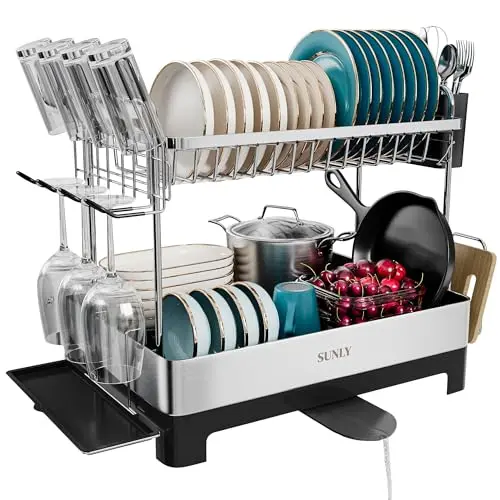
2-Tier Dish Rack – Extra-Large Capacity for Big Households
A two-tier 304 stainless frame measuring roughly 22.5 inches wide and 15 inches tall, so it stacks drying space vertically instead of eating your entire counter. The built-in drainboard and extendable spout send water straight into the sink, and it ships with a bonus roll-up rack that doubles as a trivet.
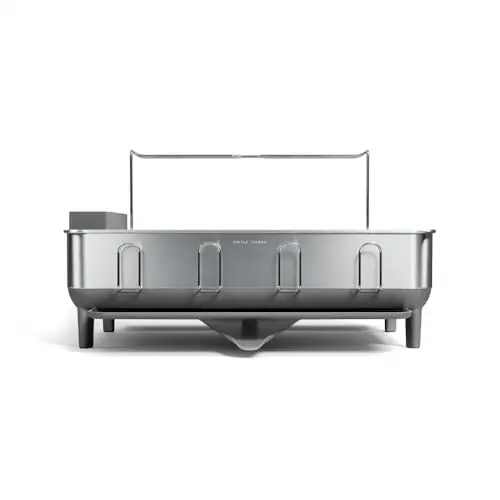
Steel Frame Dishrack – Premium Moisture-Control Drying
A brushed stainless frame built around an engineered drying tray rather than a plain drainboard. Water spreads thin and evaporates instead of pooling, a 360-degree spout rotates to meet any sink, and silicone-tipped dividers protect fine china and stemware.
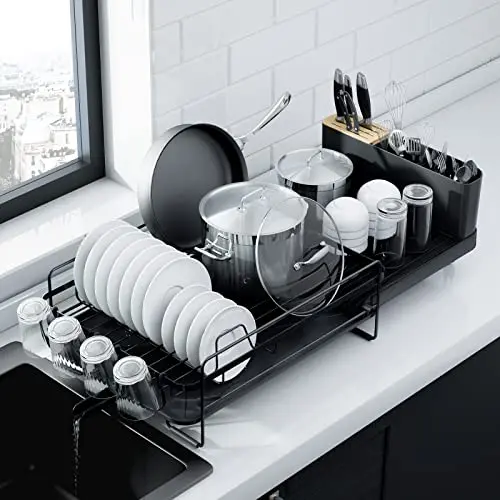
Extendable Dish Drying Rack – Stretches to Fit Long Counters
Adjusts from about 19 inches to nearly 27 inches long, so it can span a long stretch of counter beside a big sink or tuck shorter when you don’t need the space. Comes with cutlery and cup holders, a raised fence, and silicone feet that grip without scratching.
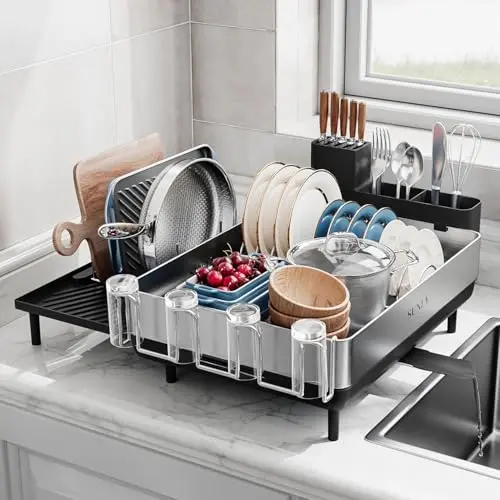
Expandable Dish Rack – Flip-Up Pegs for Pots and Pans
Starts around 20 inches and pulls out another 14 inches of drainboard when a big wash day demands it. Rubber-coated flip-up pegs hold lids, cutting boards, and sheet pans upright instead of forcing you to balance them across the plate slots.
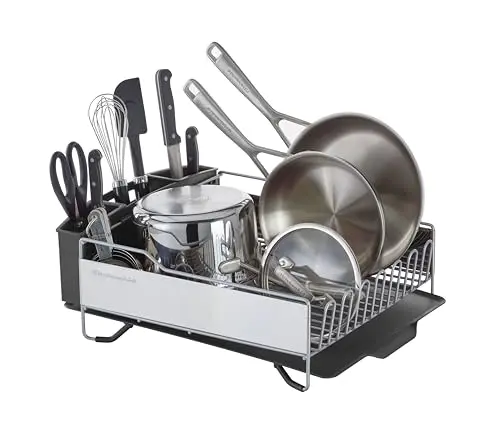
Full Size Dish Rack – Angled Drainboard and Removable Caddy
A full-size satin-coated steel wire rack with an angled drainboard that tips water toward the sink, plus a removable flatware caddy with adjustable compartments and a handle for carrying straight to the drawer.

2-Tier Dish Drying Rack – Auto Drain-to-Sink Capacity
Builds capacity upward instead of outward: plates drain on the top tier, bowls and pans sit below, and an extendable tube carries water to the sink. Snap-fit assembly means no tools, screws, or drilling.
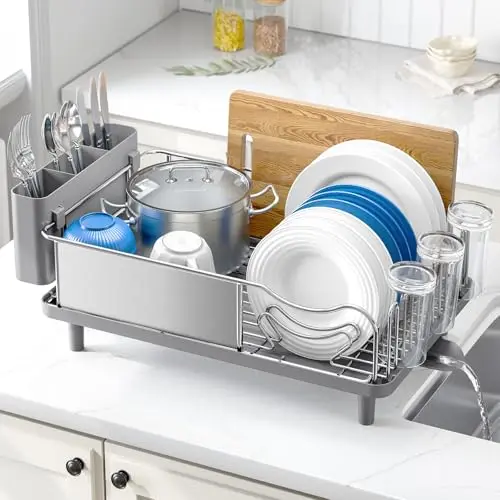
304 Stainless Steel Dish Rack – Rustproof Daily Hand-Washing
A compact-footprint rack built from 304 stainless steel with a sloped drainboard, a removable drip tray, a detachable cup shelf, and a three-slot utensil holder. Tool-free assembly and modular pieces you can rearrange.
How We Evaluated These Extra Large Dish Drying Racks
A few things we can’t tell you: how a rack’s finish holds up after a year of hard water, or how it fits the exact geometry of your counter and sink lip. What we can tell you is how these designs compare on paper and in practice, based on what owners report after living with them. We cross-referenced seven extra large dish drying racks from six distinct brands across five decision axes: usable footprint and load capacity, drainage design, materials and rust resistance, tiering and layout, and assembly and cleaning. We triangulated published specifications, feature sets, and owner feedback where available, then mapped each rack against realistic buyer profiles, from the household washing sheet pans nightly to the two-person kitchen that just wants a wider tray.
The scoring framework weighted real-world fit (70%), meaning how much genuinely usable drying space a rack delivers relative to the counter it consumes, against feature differentiation (30%), meaning the drainage engineering, holder design, and material choices that set one rack apart from another. We have no commercial relationship with any brand here; recommendations track fit and differentiation, not brand preference. If you’re outfitting a big family kitchen, the SUNLY 2-Tier is the natural starting point. If you hand-wash stemware and fine china daily, the simplehuman Steel Frame Dishrack earns its premium positioning.
How to Choose the Right Extra Large Dish Drying Rack
1. Measure Your Counter Before You Fall for a Plate Count
Every extra large rack looks reasonable in a product photo and enormous on a real counter. Before anything else, measure three things: the available width beside your sink, the depth from backsplash to counter edge, and the height clearance to the bottom of your upper cabinets. Two-tier racks in particular need vertical room, and a rack that scrapes a cabinet door will annoy you every single day.
Also check your sink lip. If the rim of the sink sits above the counter line, a drain spout that relies purely on gravity may not clear it. That’s why extendable and swiveling spouts matter more than they sound on the spec sheet.
2. What Extra Large Really Means for a Dish Drying Rack
Manufacturers quote plate counts, but plate counts are marketing. A rack claiming twelve plates may be counting slots you’d never fill because the spacing is too tight. What actually matters is usable drying area, meaning how much space is left after the utensil caddy and cup shelf take their cut.
The other thing extra large racks do differently is direction. Some grow outward across the counter, some build two tiers upward, and some extend only when you need them to. A wide single-level rack is easier to load and unload; a tiered rack holds more per square inch of counter. Neither is better, but one will suit your kitchen better than the other.
3. Drainage Design Decides Whether Your Counter Stays Dry
Drainage is where cheap racks give themselves away. Look for an angled or sloped drainboard that guides water toward a single low point rather than letting it spread across the tray. A swiveling or extendable spout lets you aim the outlet at the sink no matter where the rack sits.
The tray itself matters too. A removable drip tray you can lift out and rinse beats a fixed pan you have to sponge around. And if you see repeated complaints about water pooling on a specific model, take it seriously, because that’s a design issue rather than a fluke. If your sink sits against a high backsplash, the SUNLY 2-Tier and its extendable spout are the safer geometry.
4. Tiered vs. Flat Dish Drying Racks: Which Fits Your Kitchen?
A flat single-level rack is simpler to load and lets tall items like cutting boards and sheet pans stand upright without fighting a shelf. A two-tier rack roughly doubles capacity in the same counter width but demands vertical clearance and makes the lower level slightly more awkward to reach.
Some racks split the difference with flip-up holders that convert flat space into vertical drying when a big pan shows up. If your big wash days are dominated by cookware, the SUNLY Expandable Dish Rack is built around exactly that problem.
5. Materials and Rust Resistance: What to Look For
Satin-coated steel wire and powder-coated carbon steel are the most common builds. Both resist rust well if you dry them off, and both will eventually fail at a weld or a chipped edge. 304 stainless steel costs more and holds up better against hard water and daily use, especially where a cheaper coating would start to flake.
Whatever the material, silicone-tipped dividers and rubber-coated holders are worth seeking out, since bare metal edges chip china and scuff glassware over time. And non-slip feet are not a luxury: a loaded extra large rack that slides while you’re stacking plates is a genuine hazard.
6. Where Extra Large Dish Drying Racks Land on Price
These racks fall into three rough tiers. Entry-level models get you capacity and a drainboard, usually in coated steel with a fixed spout. Mid-range racks add stainless construction, extendable or swiveling spouts, and better holders. The premium tier brings engineered drying surfaces, fine-china-safe dividers, and longer warranties.
What you’re buying as you move up isn’t more space, it’s less maintenance: better drainage, better coatings, fewer workarounds. If you hand-wash stemware or fine china regularly, the simplehuman Steel Frame Dishrack makes the premium tier easy to justify. If you mainly need raw capacity, spend mid-range and put the difference toward a bigger cutting board.
Frequently Asked Questions
1. What's the difference between the SUNLY 2-Tier and the simplehuman Steel Frame Dishrack?
They solve different problems. The SUNLY 2-Tier is a vertical capacity play: two levels, a 50-pound load rating, and a footprint that stays around 22 inches wide. The simplehuman Steel Frame Dishrack is a drying-surface play: a hydrophilic tray that spreads water thin so it evaporates, plus silicone-tipped dividers and a wine glass holder.
If volume is the goal, go with the SUNLY. If you’re hand-washing stemware and fine china and want the counter to look intentional, the simplehuman is the better fit.
2. How does the KitchenAid Full Size compare to the Godboat two-tier rack?
The KitchenAid is the more conventional choice: a full-size flat frame with an angled drainboard and a genuinely good removable flatware caddy. It offers more horizontal breathing room for plates and glasses, but it takes up more counter and owner feedback flags plates leaning rather than standing upright.
The Godboat stacks capacity instead, using a drain tube and a top and bottom level to fit more into less width. It suits tight kitchens better. What it doesn’t offer is the same easy, wide loading surface, and its cup holder has a habit of working loose.
3. How do I know if an extra large dish drying rack will fit my counter?
Measure width, depth, and cabinet clearance before anything else, then add a couple of inches of breathing room on each side so you can actually lift dishes out. Height clearance is the one people forget, and it disqualifies most two-tier racks in kitchens with low upper cabinets.
If your space is long rather than deep, an adjustable rack is the smarter buy. The Kitsure Extendable Dish Drying Rack spans from about 19 inches to nearly 27, so it can grow into the run of counter you have rather than fighting it.
4. Do stainless steel dish drying racks actually stay rust-free?
They hold up far better than coated wire, but the grade matters. 304 stainless steel resists rust and hard-water staining significantly better than cheaper coated steel, which tends to fail first at welds and chipped edges.
Even stainless benefits from a quick towel-dry after a heavy load, and standing water left in a drip tray is the usual culprit behind early spotting. If long-term durability is your priority, prioritize material grade over extra slots.
5. Is a two-tier rack harder to load than a flat one?
Slightly, yes. The top tier is easy, but reaching the back of the bottom level takes a little more care, especially on frames that are 15 inches tall. What you get in return is roughly double the drying area for the same counter width.
A tiered rack makes the most sense when your dish mix is varied, with plates up top and bowls, mugs, and pans below. If you mostly dry big flat things like sheet pans and cutting boards, a flat rack with flip-up holders is usually less fuss.
Final Verdict
For most households upgrading to serious capacity, the SUNLY 2-Tier is the pick. It delivers the most usable drying space per inch of counter, holds a 50-pound load without wobbling, and drains through an extendable spout that clears most sink lips. If your counter is long rather than deep, the Kitsure Extendable Dish Drying Rack stretches to nearly 27 inches and shrinks back down when the big wash is over. And if you hand-wash stemware, fine china, or anything you’d rather not scratch, the simplehuman Steel Frame Dishrack is the premium answer, with silicone-tipped dividers and a drying tray that leaves no puddles behind.
Everything else comes down to geometry. Measure your counter, check your cabinet clearance, and buy the rack that fits the space you actually have. An extra large rack that crowds out your prep area is worse than a smaller one you can live with.
