
Best Hair Dryer Brushes For Thick Hair – 2026 Reviews

Thick hair is a blessing right up until you’re standing in the bathroom with a round brush in one hand and a dryer in the other, twenty minutes in, still working the same section. That’s the moment a hair dryer brush earns its keep – but only if you pick one that can actually move dense hair instead of skating over the top of it.
The trap is that most one-step brushes are tuned for fine-to-medium hair. On thick hair they stall. The barrel is too narrow to grab a real section, the bristles never dig in deep enough to build tension, and the airflow doesn’t reach the underlayer where the water is actually sitting. The brushes that work share three traits: a wide oval barrel, bristles with genuine grip, and enough drying power to finish a section before your arm gives out.
We compared brushes across the major brands to sort out which ones are built for dense hair, which suit shorter thick cuts, and which trade power for portability. None of them will replace a salon blowout. The right one gets closer than you’d expect, and it gets you out of the bathroom faster.
Best Hair Dryer Brushes for Thick Hair – 2026 Reviews
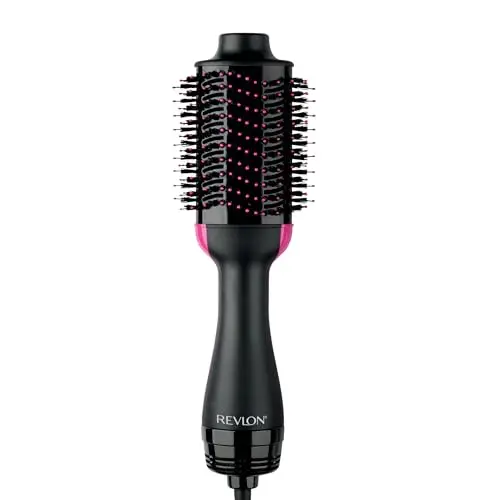
One-Step Volumizer – 2.8-Inch Oval Barrel for Dense, Long Hair
The brush that made this category mainstream, and still the one most thick-haired shoppers land on. A 2.8-inch oval barrel gives you the surface area to wrap a full, dense section, while rounded edges let you lift the roots and turn the ends under. Three settings cover the whole dry-to-finish arc.
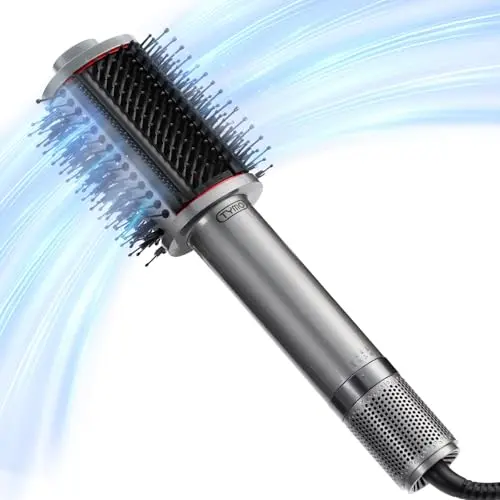
AIRBEAM 4.0 – High-Speed Blowout Brush for Faster Drying
The high-speed outlier in this group. A 110,000 RPM motor and a slim, lightweight body make it the quickest way to move water out of thick hair, with high ion output and a dual-bristle design aimed at a smooth finish.
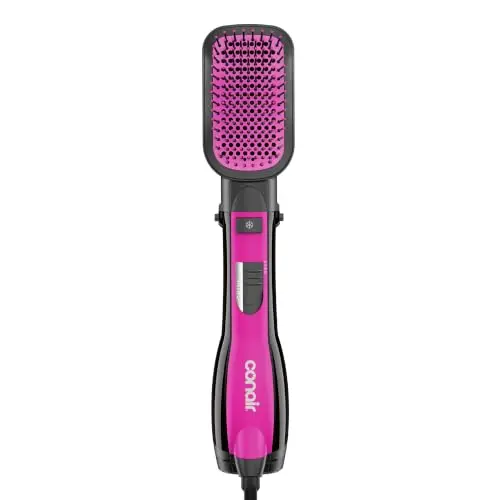
All-in-One Hot Air Brush – Flexible Bristles for Thick, Tangle-Prone Hair
A 1000-watt all-in-one built around 136 flexible, epoxy-tipped bristles designed to detangle dense hair without pulling. Ionic technology, multiple heat settings, and a cool shot make it one of the more complete packages for thick textures.
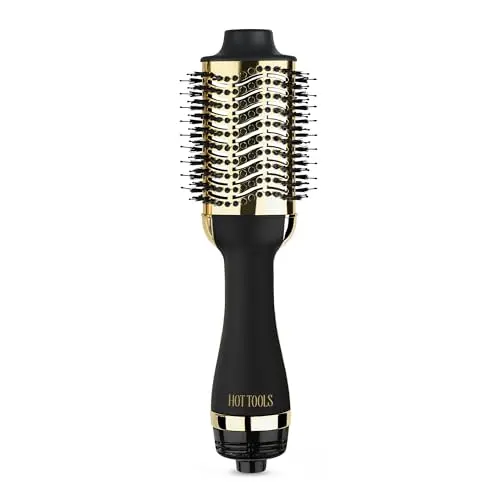
24K Gold Blow Dryer Brush – Even Heat for Bouncy Blowouts
A 24K gold-plated barrel and ionic technology aimed at even heat and reduced frizz, with two heat and speed settings plus a rotating temperature control. A straightforward, slightly heavier route to a bouncy blowout.
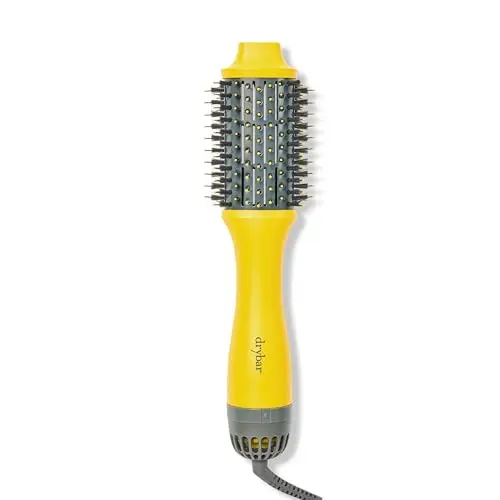
The Double Shot – 2.4-Inch Oval for Glossy, Salon-Shaped Blowouts
Drybar’s premium one-step pairs a 2.4-inch oval barrel with ionic technology and strategically placed vents for maximum airflow. Built for a polished, glossy blowout rather than raw drying speed.
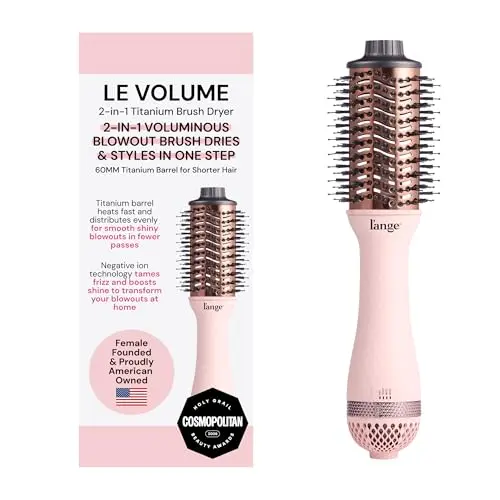
Le Volume 2-in-1 – Lightweight Titanium Blowout Brush
A 60mm titanium oval barrel with 360-degree airflow and adjustable heat, pitched at every hair type. Lightweight enough for long sessions and finished in a soft blush colorway.
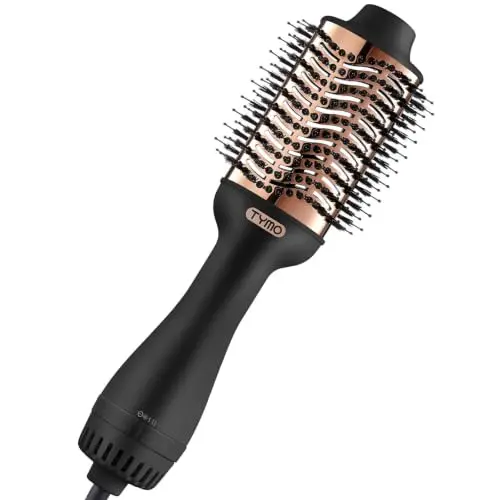
HC300 Blow Dryer Brush – Large Titanium Barrel on a Budget
A titanium-coated 2.85-inch oval barrel with a 1200-watt motor, a 360-degree vent for a wider drying area, and three heat and speed modes. The most affordable route to a genuinely large barrel.
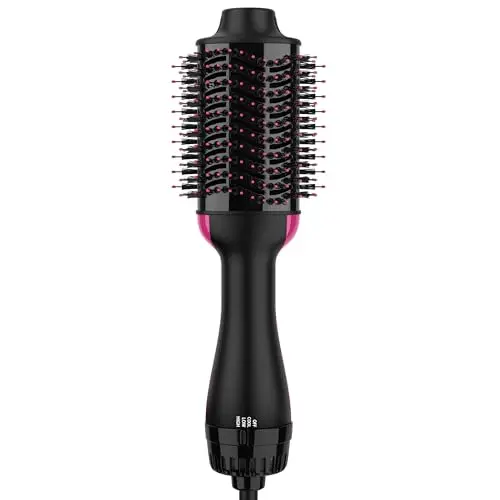
4-in-1 Blowout Brush – Ceramic Titanium Styling for Less
A budget-friendly 1200-watt blowout brush with a ceramic titanium oval barrel, negative-ion technology, and an ALCI safety plug with ETL certification. Three heat and speed settings including a cool option.
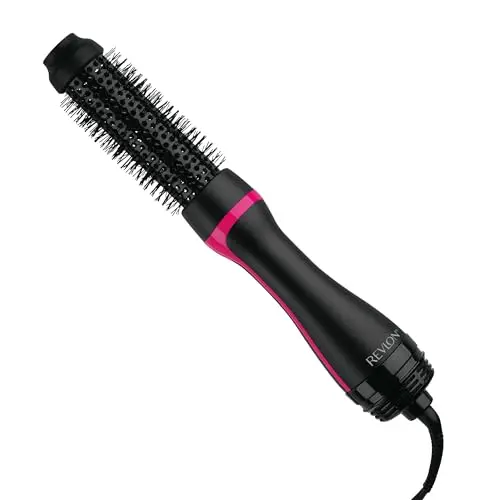
One-Step Root Booster – 1.5-Inch Barrel for Short, Thick Cuts
A smaller-barrel sibling of the classic One-Step, using a 1.5-inch ceramic-coated round brush built for chin-length to medium hair. Ionic technology and three heat settings in a lighter, more maneuverable body.
How We Evaluated These Hair Dryer Brushes for Thick Hair
We didn’t run a full salon blowout on every hair type in a studio. What we did: cross-referenced 9 hair dryer brushes from 7 distinct brands across five decision axes – barrel size and shape, drying power and airflow, bristle grip, heat control, and weight in the hand. We triangulated published specifications, mapped each feature set against what dense hair actually demands, and weighed owner feedback where available to surface the failure points a spec sheet never shows.
Thick hair changes the math. It holds more water, so airflow and wattage matter more than they do for fine hair, and it needs a barrel wide enough to hold a full section plus bristles that build real tension instead of skimming the surface. We scored real-world fit (70%) – how well each brush handles water-heavy, dense sections – against feature differentiation (30%), favoring genuine technical advantages over marketing language. We have no commercial relationship with any brand featured; the ordering tracks fit and differentiation, not brand preference. If you want the safest all-around pick, the One-Step Volumizer is it; if raw drying speed is what you’re after, the TYMO AIRBEAM 4.0 earns the nod.
Two things we can’t tell you: how any of these will feel after a year of daily use, and how they’d behave on hair textures we only know from published specs. What we can tell you is where the common complaints cluster, which barrels genuinely suit dense hair, and which brushes to skip if fast drying is the priority. Where owner feedback was thin, we leaned harder on specifications; where it was rich, the pattern of complaints shaped the verdict.
How to Choose the Right Hair Dryer Brush for Thick Hair
1. Why Thick Hair Needs a Different Hair Dryer Brush
Thick hair isn’t just more of it. Each strand tends to be coarser, and the sheer density means water sits deep near the scalp long after the outer layer feels dry. That changes what a hair dryer brush has to do.
A brush built for fine hair relies on surface airflow. On dense hair it leaves the underlayer damp, so you end up going over the same section three times. The tools that work share two things: enough airflow to push through the section instead of around it, and bristles that create tension at the root. Miss either and you’re back to the round-brush-and-dryer routine you were trying to escape.
2. Barrel Size and Shape: The Biggest Lever for Thick Hair
Barrel size is the single most consequential spec, and it’s where most buyers go wrong. Large oval barrels in the 2.4- to 2.9-inch range give you the surface area to wrap a full, dense section without splitting it three ways. That’s the difference between a five-minute pass and a fifteen-minute one.
Round barrels around 1.5 inches are the right call for short, thick cuts – chin-length to shoulder – where a wide oval physically can’t reach the root. Oval shapes with rounded edges also let you turn ends under or flip them out without reaching for a curling iron. If you’re between sizes, size up: thick hair rewards surface area. The One-Step Volumizer is the clearest example of a barrel sized for this job.
3. Drying Power and Airflow: What Wattage Actually Buys You
Wattage is a rough proxy, not a verdict. Most brushes here sit in the 1000- to 1200-watt range, which is enough for thick hair when the vents are well designed. What separates the leaders is airflow design – how much of the air reaches the hair versus escaping past it.
Wide airflow windows push air into the section rather than around it, and high-speed motors take that further by moving more air per second instead of simply heating it hotter. Heat alone doesn’t dry thick hair faster; it just dries the outside. If speed is your priority, the TYMO AIRBEAM 4.0 is built around exactly that tradeoff.
4. Bristle Grip: How Brushes Handle Dense Sections
Bristles are where cheaper brushes betray you. On dense hair, short tufted bristles do the lifting at the root, while nylon pins glide through the length and offer a little scalp protection. When the two are combined well, you get tension without pulling.
Flexible epoxy-tipped bristles are the other approach, spaced to work through knots rather than fight them – better for thick hair that tangles easily. Whatever the design, the test is simple: does the brush grab a full section, or does it skim the top layer? If it skims, you’ll feel it immediately.
5. Heat Settings, Ionic Technology, and Frizz Control
Thick hair takes more heat exposure simply because it takes longer, so control matters. Look for at least three settings including a cool option – the cool shot isn’t decorative, it’s what closes the cuticle and sets the shape you just built.
Ionic technology is close to universal in this category, and its practical benefit is reduced static plus a smoother-looking surface. Ceramic and titanium coatings are about even heat distribution rather than raw temperature; an uneven barrel creates hot bands that show up as frizz hours later. Sensor-regulated heat, where offered, adds a layer of safety on the higher settings.
6. Hair Dryer Brush Pricing Tiers, Decoded
This category splits cleanly into three tiers, and the gaps are about finish and motor quality more than basic function. Entry-level brushes get you a large barrel, multiple heat settings, and ionic technology – genuinely enough for thick hair. What you’re gambling on is longevity.
Mid-range options buy better heat distribution, stronger bristle designs, and more consistent motors. Premium brushes add polish: smoother finishes, smarter airflow, lighter bodies, and a blowout that looks more salon-shaped. None of that is essential. If you want to spend the least and still get a large barrel, the HC300 is the sensible entry point.
7. Revlon One-Step vs. TYMO AIRBEAM: Which Thick-Hair Brush Wins?
This is the decision most thick-haired shoppers actually face. The Revlon One-Step Volumizer wins on barrel surface area and grip – it’s the more forgiving tool, easier to learn, and its 2.8-inch oval handles dense sections with less sectioning. It’s also heavier and slower to dry.
The TYMO AIRBEAM 4.0 wins on raw drying speed and weight. Its high-speed motor moves more air, so water-heavy hair dries faster, and the slim body is easier to hold through a long session. The tradeoffs are price and unproven long-term reliability. For most people with thick hair, the Revlon is the safer pick; for anyone whose main frustration is time, the TYMO is worth the stretch.
Frequently Asked Questions
1. Is a hair dryer brush actually good for thick hair?
Yes – with one condition. The brush has to be sized and powered for dense hair. A small-barrel brush tuned for fine hair will leave the underlayer damp and take longer than the dryer-and-round-brush method it’s meant to replace.
What makes the difference is barrel surface area, airflow through the section, and bristle tension at the root. Get all three and a one-step brush genuinely shortens the routine on thick hair. For most people, the One-Step Volumizer is the safest starting point because its 2.8-inch oval handles a full section without splitting it.
2. What's the difference between the Revlon One-Step Volumizer and the TYMO AIRBEAM 4.0?
They’re aimed at different priorities. The Revlon One-Step Volumizer is the larger-barrel, more forgiving tool: a 2.8-inch oval with nylon pins and tufted bristles that grip dense sections, three heat settings, and a shape that suits mid-length to long hair. It’s heavier and slower to dry.
The TYMO AIRBEAM 4.0 is the speed machine. A 110,000 RPM motor, a 1.32-pound body, and a dual-bristle design that separates smoothing from lifting. It also folds five tools into one and reaches the root more easily thanks to the slim handle. If drying time is your biggest frustration, the TYMO AIRBEAM 4.0 earns the extra spend; if you want the easier learning curve, go Revlon.
3. How does the Drybar Double Shot compare to the Hot Tools 24K Gold brush?
The Hot Tools brush is the more traditional blowout tool. It leans on 24K gold-plated heat and ionic technology, with two heat and speed settings and a rotating control at the base. On thick, wavy hair it produces a bouncy, long-lasting blowout, and the even heat helps avoid patchy drying.
The Drybar Double Shot is the finish-first option. Its 2.4-inch oval barrel and strategically placed vents are tuned for shine and a salon-shaped result rather than raw power, and the lighter body is easier to hold through a long session. It costs considerably more and durability complaints are more common, so it’s a pick for someone who cares most about the polished look.
4. What barrel size works best for thick hair?
For thick hair, bigger is usually better – up to a point. A 2.4- to 2.9-inch oval barrel gives you enough surface to wrap a full dense section and enough rounded edge to shape the ends. Anything smaller forces you into thin subsections, which defeats the purpose.
The exception is short, thick hair. Chin-length to shoulder cuts are better served by a 1.5-inch round barrel, which can reach the root where a wide oval just can’t. Match the barrel to your length first, then to your density.
5. Can a hair dryer brush replace a blow dryer and round brush entirely?
For most thick hair, yes. A good one-step brush dries and smooths simultaneously, which is what the two-tool method does anyway – just with one hand. What it won’t replicate is the precision of a concentrator nozzle on a dedicated dryer, or the tension you can build with a boar-bristle round brush and a separate airflow source.
If your goal is a smooth, voluminous everyday blowout, a brush is enough. If you regularly chase sleek, flat-iron-adjacent finishes or very precise sectioning, keep the dryer.
6. How do I keep a blowout from falling flat on thick hair?
Three things. First, start on damp, not dripping, hair – towel-dry and detangle first, then section. Second, work root to tip with tension, holding each section briefly at the root before pulling through; that’s where volume is set.
Third, finish each section with the cool shot. It closes the cuticle and locks the shape, and it’s the step most people skip. On thick hair, smaller sections always beat rushing one big one.
Final Verdict
For most people with thick hair, the One-Step Volumizer is the answer. The 2.8-inch oval gives you the surface area dense hair demands, the bristles build real root tension, and it does the whole job in one pass without a steep learning curve. It’s the brush we’d buy first.
If time is your real complaint, the TYMO AIRBEAM 4.0 dries faster than anything else here and weighs less doing it – just go in knowing the long-term record is still being written. Want the prettiest finish and don’t mind paying for it? The Double Shot is the polish pick. And if you’d rather spend the least and still get a genuinely large barrel, the HC300 covers the basics for a fraction of the outlay.
