
Best Hand Coffee Grinders – 2026 Reviews

Grinding coffee by hand is one of those small rituals that sounds like a hassle until you actually do it. There’s no motor whine at six in the morning, no cord to hunt for, and nothing to plug in at a campsite. Just beans, a burr, and about a minute of cranking.
The catch is that hand grinders vary enormously. Two mills that look nearly identical can produce wildly different grounds – one gives you uniform particles and a clean cup, the other throws dust and boulders into the same brew. The variables that matter are the burr set and how well its axle stays aligned, whether the grind adjustment sits on the outside of the body or buried under the catch cup, and whether the thing is built to survive being tossed in a bag.
The other axis is what you brew. Espresso puts far more demand on a grinder than pour over or French press, and a mill that’s excellent for one can be mediocre at the other. We cross-shopped the hand grinder market – from budget starter mills to precision grinders that cost as much as a decent electric – and sorted them by who each one actually suits, rather than crowning a single winner for everyone.
Best Hand Coffee Grinders – 2026 Reviews
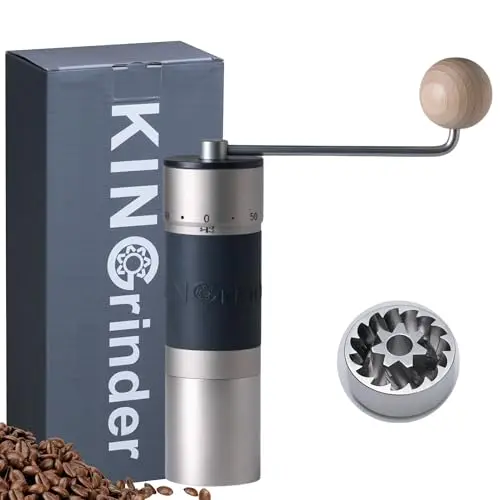
K6 Straight Handle – Espresso-Ready Precision for Less
The K6 is the grinder most people should start with if they want one tool that covers espresso and filter without paying flagship money. Its stainless burr and dual-bearing axle give it the stability to hold a setting, and the external adjustment nut runs 60 clicks per rotation at 16 microns each – enough range for pour over, French press, and a dialed-in espresso shot.
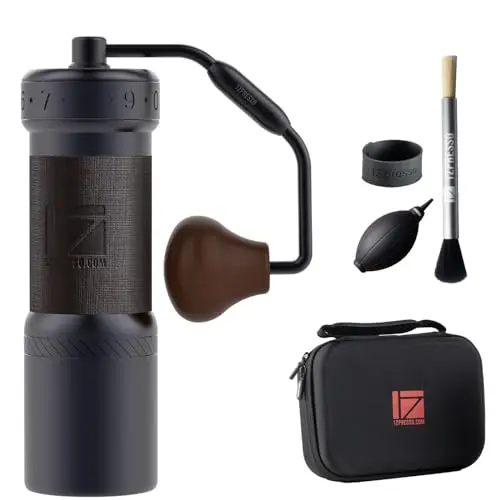
K-Ultra – External Dial Precision With a Travel Case
The K-Ultra is 1Zpresso’s all-rounder, built around a specialized K burr and an external dial with more than a hundred 20-micron clicks in a single rotation. The magnetic catch cup, foldable handle, and included travel case make it the most polished grinder here for people who brew away from home.
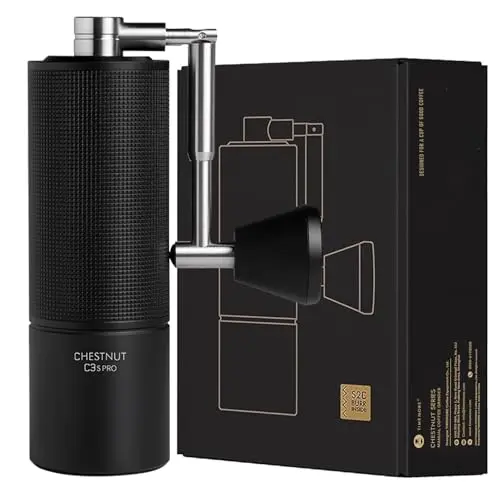
Chestnut C3S Pro – Low-Fines Grinding for Pour Over
The C3S Pro pairs TIMEMORE’s S2C660 hexagonal conical burr with a full aluminum alloy body. The burr geometry is aimed squarely at filter brewing – uniform particles with very little fine powder – and a built-in bearing keeps the crank turning smoothly even at fine settings.

J Series – 48mm Burrs With a Foldable Handle
The J runs a 48 mm stainless conical burr set – larger than most of the competition here – in a compact body with a foldable handle. Adjustment is internal, via 30 clicks per rotation, and 1Zpresso rates the burr for 100 to 200 kg of grinding life.
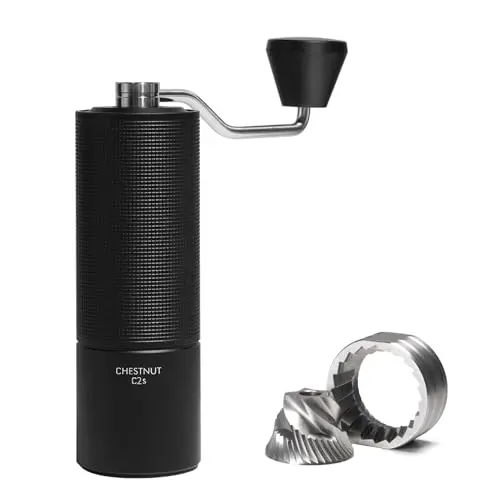
Chestnut C2S – The Full-Metal Workhorse
The C2S fixes the older C2’s weak point by moving to a full metal unibody, so the top cover no longer cracks under load. Inside is a 38 mm stainless conical burr with double-bearing positioning and 36 coarseness levels.
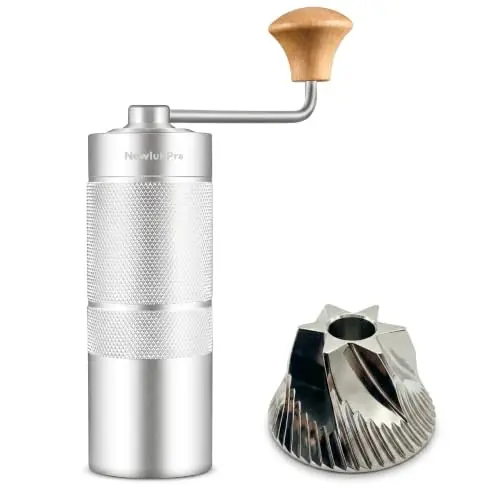
M6 – All-Metal Travel Grinder With 40 Settings
The M6 is built around a sharpened SUS 420 hexagonal core burr in a 38 mm format, held by a double-bearing axle inside an aluminum alloy body with no plastic parts in the grind path. NewlukPro lists 40 settings and ships it in a gift box with a cleaning brush.
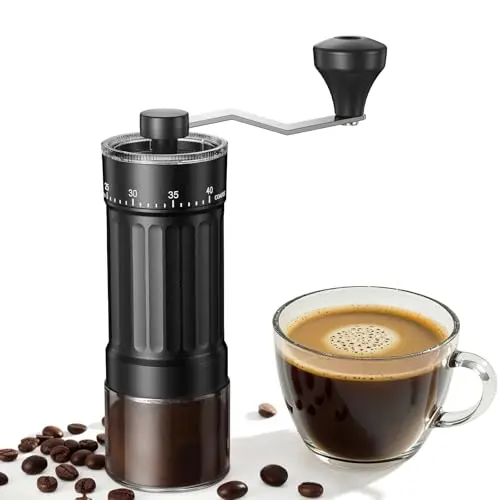
MCG-01 Mini – External Settings on a Starter Budget
The MCG-01 pairs ceramic conical burrs with a 40-position external adjustment ring, which is unusual at this end of the market. It holds 30 g of beans, weighs around 325 g, and breaks down into three main parts for cleaning.
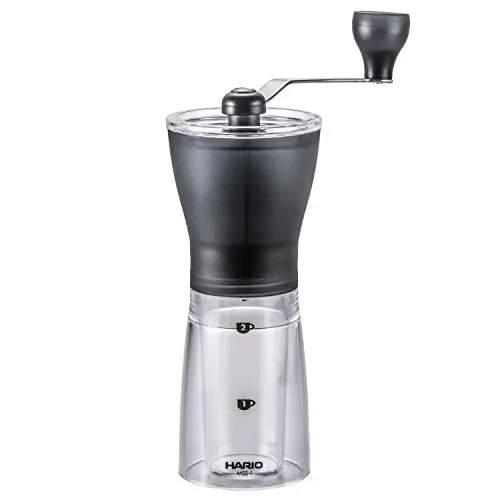
Ceramic Coffee Mill Original – The Slim Classic
The Hario Original is the grinder most people picture when they think of a hand mill: a slim black body, a ceramic burr that won’t rust, a crank handle that lifts off for storage, and a footprint small enough to leave on the counter. Capacity is roughly two cups of ground coffee.
How We Evaluated These Hand Coffee Grinders
We didn’t put these grinders through a lab particle-size analyzer or months of daily brewing. What we did: cross-referenced 8 hand coffee grinders from 6 distinct brands across six decision axes – burr set and axle alignment, adjustment range and repeatability, build materials, capacity and ergonomics, espresso versus filter suitability, and portability. We triangulated published specifications, feature sets, and owner feedback where available, then mapped each model against representative buyer profiles, from the camper grinding one cup at a time to the home barista chasing a repeatable espresso shot.
The scoring framework weighted real-world performance (70%) – how consistently a grinder delivers the particle size its adjustment claims, and how much effort it asks of your arm – against feature differentiation (30%) – burr geometry, adjustment mechanism, and travel-ready design. Brand recognition carried no weight. We have no commercial relationship with any maker here, and recommendations track fit and differentiation rather than brand preference.
A few things we can’t tell you: how a burr set holds alignment after a year of two-cups-a-day use, or whether a plastic-bodied mill survives a decade in a drawer. What we can do is tell you which grinder matches which brewing method and travel pattern, based on specs and accumulated owner experience. If you brew both espresso and filter, the KINGrinder K6 is the most direct answer; if you want the most refined adjustment and a travel case, the 1Zpresso K-Ultra serves you better.
How to Choose the Right Hand Coffee Grinder
1. Burr Quality Is What Separates a Good Hand Coffee Grinder From a Cheap One
Every hand grinder does the same basic job: crush beans between two burr surfaces. What changes is how precisely those surfaces are machined, how well they stay aligned, and how much fine dust they throw off along with the uniform particles. A conical burr set cut from hardened steel – look for hardness figures in the 55-58 HRC range – will hold its edge far longer than a soft stamped one, and CNC machining matters more than the material name on the box.
Ceramic burrs are the other common option. They won’t rust, tolerate rinsing, and run cool, which is why you’ll find them in classic mills and budget designs. They’re also more brittle. Neither material is automatically better – a well-machined ceramic burr beats a sloppy steel one – but for espresso-level consistency, steel is generally the safer bet.
2. External vs Internal Adjustment: The Daily-Ritual Difference
This is the spec that shapes how a grinder feels in daily use. External adjustment puts a numbered ring or dial on the outside of the body, so you can move between settings without opening anything. Internal adjustment lives under the catch cup, usually as a nut you twist while counting clicks.
The practical difference is repeatability. External dials let you write down a setting, come back a week later, and land in the same place. Internal nuts work fine if you brew one way and rarely change, but they’re a hassle for anyone switching between pour over and espresso regularly. Resolution matters too – 16 to 20 microns per click is fine enough for dialing espresso; coarser steps limit you to filter.
3. Match Your Hand Coffee Grinder to Your Brewing Method
Espresso is the demanding one. It needs a fine, tightly clustered particle size, and a grinder that drifts between settings will have you chasing shots all morning. If espresso is the goal, prioritize external adjustment and a burr rated for the full range – the KINGrinder K6 and 1Zpresso K-Ultra both clear that bar.
Pour over and drip are more forgiving but reward uniformity. Too many fines and you get a slow, muddy drawdown and a bitter edge. Burr designs aimed at filter – hexagonal geometries that cut rather than crush – tend to produce cleaner cups. French press and cold brew are the least fussy: coarse is coarse, and almost anything here will manage it.
4. Build Materials, Weight, and Handle Ergonomics
Aluminum bodies shrug off knocks and stay rigid, which keeps the burr aligned. Plastic bodies are lighter and cheaper, but they flex, and the top cover is usually the first thing to fail. Bearings are the quiet hero: a double-bearing axle keeps the burr centered and makes the crank spin smoothly, while a single bearing or none at all lets the burr wobble.
Weight is a trade. A mill around 630 g feels planted on the counter but adds bulk to a pack. Anything under about 350 g travels easily but may need a second hand to steady it. Handle shape matters more than most shoppers expect – a foldable crank saves space and stops tipping, but a longer or knurled handle gives better leverage on light-roast beans.
5. Common Hand Coffee Grinder Pitfalls
The most common regret is buying a grinder that can’t move between brew methods. A mill with fifteen clicks total will make fine filter coffee and little else. The second is plastic in the load path – a top cover or handle that cracks within months turns a bargain into a replacement.
Then there’s speed. Hand grinding a full 30 g dose for espresso takes real time, often a couple of minutes on cheaper burrs, and light-roast beans make it harder. If you routinely brew for a household, an electric burr grinder usually makes more sense; a hand grinder is best for one or two cups at a time.
6. What Hand Coffee Grinders Cost Across the Market
Budget-tier hand grinders get you a working ceramic or steel burr and a small capacity, often with fiddly adjustment. Mid-range is where the value sits: proper stainless burrs, external dials, and bodies that hold alignment – the TIMEMORE Chestnut C3S Pro is a good example of that jump.
Premium grinders cost as much as a solid electric burr grinder. What you’re buying is tighter tolerances, more adjustment resolution, and thoughtful details like magnetic catch cups and travel cases. Whether that’s worth it depends on how much you care about dialing in espresso by taste.
Frequently Asked Questions
1. What's the difference between the KINGrinder K6 and the 1Zpresso K-Ultra?
Both are espresso-capable grinders with external adjustment, so the difference comes down to refinement. The K6 uses 16-micron click steps over 60 clicks per rotation and a straight handle; it’s the value pick and covers filter and espresso comfortably. The K-Ultra doubles down on precision with 20-micron clicks across more than a hundred positions, adds a magnetic catch cup, a foldable crank, and a travel case, and holds a slightly larger dose.
If you brew espresso occasionally and filter most days, the K6 is the sensible spend. If you’re dialing shots by taste and want the smoothest workflow, the premium is real – see the K-Ultra.
2. How does the TIMEMORE Chestnut C3S Pro compare to the 1Zpresso J?
They’re aimed at different brewers. The C3S Pro is a filter specialist: its S2C660 hexagonal burr is tuned to minimize fine powder, and the full aluminum body keeps it cool through a long grind. The 1Zpresso J counters with a larger 48 mm burr, which grinds faster with less arm effort, plus a foldable handle and a burr rated for 100 to 200 kg.
The deciding factor is adjustment. The J uses an internal nut, so changing settings is a two-handed job. The C3S Pro’s adjustment is also at the base, but its burr shines for pour over. Filter-focused drinkers should lean TIMEMORE; anyone grinding daily for multiple methods will appreciate the J’s speed.
3. Are hand coffee grinders really as slow as people say?
Slower than electric, yes – but the gap is smaller than the reputation suggests. A well-machined 38 to 48 mm burr will get through a 20-30 g dose in roughly 20 to 60 seconds depending on the beans and how fine you’re grinding. Budget mills with smaller burrs and ceramic cores take longer, sometimes two minutes for a full hopper.
Light roasts are the hard case – denser beans resist the burr more. If you grind a single dose for one cup each morning, the difference is a minute of your day. If you’re grinding a full pot for a family, that’s when hand grinding stops making sense.
4. Can a hand grinder pull a genuinely good espresso shot?
Yes, provided the grinder was designed for it. Espresso needs two things from a hand grinder: a burr that reaches fine enough particle size and an adjustment mechanism with enough resolution to move in small, repeatable steps. Grinders in the 16 to 20 micron per click range clear that bar; a mill with a dozen coarse clicks does not.
The other factor is burr stability. Wobble at fine settings shows up as channeling and inconsistent shot times. That’s why dual-bearing designs and factory-calibrated burrs are worth the extra spend if espresso is the goal.
5. Do you need to spend more for a hand grinder that lasts?
Not necessarily, but the cheap end is where durability complaints cluster. The recurring failure points are plastic top covers, handles that crack at the joint, and single-bearing axles that develop play. Spending into the mid-range buys you an all-metal body, a stainless burr rated for 100 kg or more of beans, and often a one-year warranty.
The premium tier is different – you’re paying for precision and workflow rather than longevity. A mid-range grinder with proper bearings will outlast a budget one by years; a premium grinder mainly makes the daily ritual more pleasant.
Final Verdict
For most people, the KINGrinder K6 is the hand grinder to buy. It has the external adjustment, the burr range, and the build rigidity to handle espresso and filter without asking you to disassemble anything, and it lands in a price band that’s easy to justify.
If your budget is tighter or you’re mostly brewing while traveling, the CEVING MCG-01 gives you external settings and a genuinely packable body for very little. Filter-focused drinkers who want cleaner cups should look at the TIMEMORE Chestnut C3S Pro, whose low-fines burr is tuned exactly for that job. And if the ritual itself matters to you – the feel of the dial, the snap of the catch cup – the 1Zpresso K-Ultra is the one worth stretching for.
