
Best Handheld Coffee Grinders – 2026 Reviews

A handheld coffee grinder has one job: make fresh coffee possible when a wall outlet isn’t. But the category splits quickly once you start grinding. Some mills feel like a chore after the first cup; others turn beans into a consistent bed for espresso or pour-over with a few smooth turns. The difference usually comes down to burr quality, adjustment repeatability, and whether the body is actually comfortable to hold while you crank.
For handheld grinders, portability isn’t just about weight. A folding handle, a secure catch cup, and a capacity that matches your brew size matter more than a spec sheet suggests. You’ll also want to know whether the adjustment system is external or internal, because that changes how easy it is to switch between espresso and French press. Grind consistency is the other dividing line; a pretty body doesn’t help if the burr wobbles or the settings drift.
We looked across the market at metal-bodied all-rounders, espresso-focused precision mills, and budget travel grinders. The goal is to help you pick the right handheld coffee grinder for your counter, backpack, or office drawer, not to crown one brand. Start with the brew method you use most, then weigh capacity and travel ergonomics against the grind control you actually need.
Best Handheld Coffee Grinders – 2026 Reviews
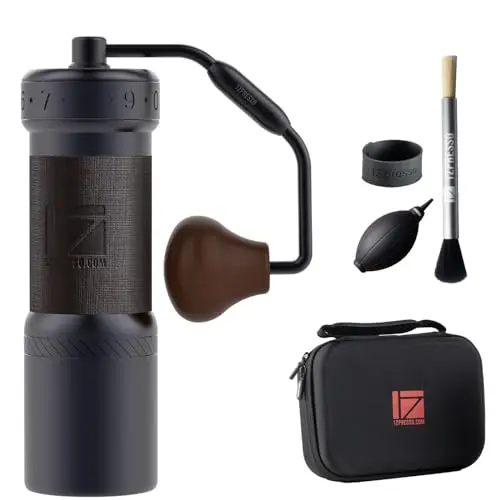
K-Ultra – All-Around Hand Grinder
The K-Ultra is the most complete all-round handheld grinder in this lineup. Its external dial gives more than 100 clicks at 20-micron steps, the magnetic catch cup holds a practical 35 to 40 grams, and the foldable handle makes it easier to pack. It ships with a travel case and cleaning tools.
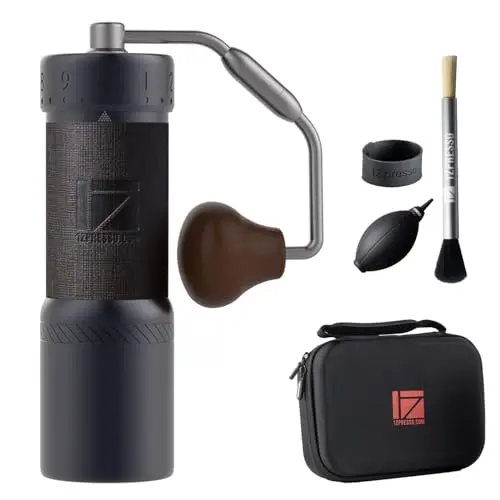
J-Ultra – Espresso-Focused Precision
The J-Ultra is tuned for espresso and other fine grinds. Its external adjustment moves in tiny 8-micron clicks, the magnetic catch cup holds 35 to 40 grams, and the handle folds for travel. A coated burr is designed to bring out sweetness in espresso.
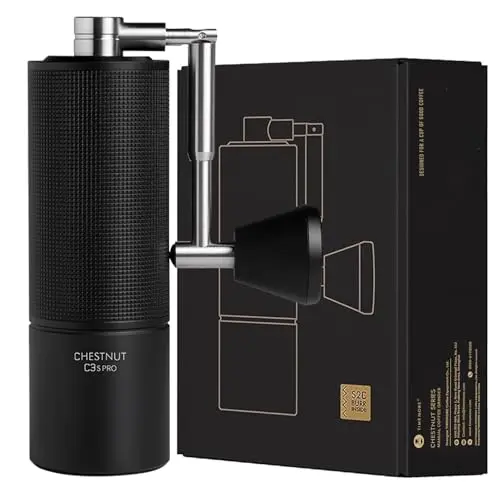
Chestnut C3S Pro – Full-Metal All-Rounder
The Chestnut C3S Pro pairs a full-metal aluminum body with Timemore’s S2C hexagonal conical burr. It offers about 36 grind settings, a foldable crank handle, and a compact 25-gram capacity. It’s aimed at pour-over, French press, and everyday hand grinding.
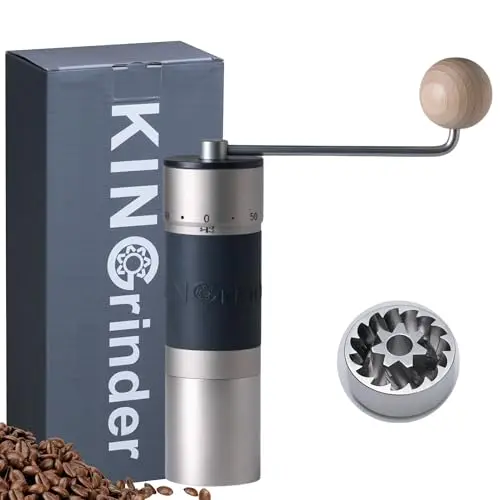
K6 – Versatile Metal Workhorse
The K6 is a full-metal handheld grinder with a stainless burr, dual-bearing shaft, and external adjustment at 16 microns per click. It handles a 25-to-35-gram hopper and is built for pour-over, espresso, and travel.
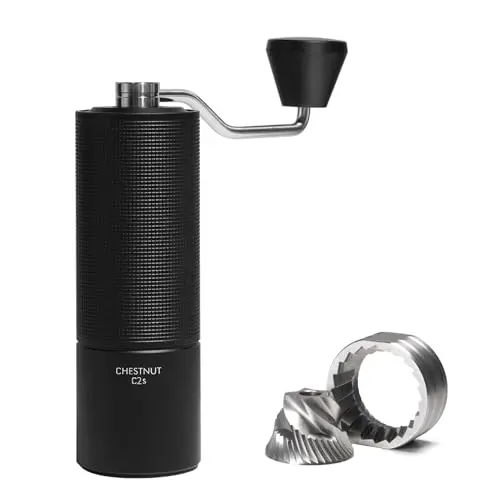
Chestnut C2S – Proven Pour-Over Value
The Chestnut C2S is the updated version of Timemore’s well-known hand grinder, now with a full-metal unibody and a 38 mm stainless conical burr. It offers about 36 settings, double-bearing shaft positioning, and a 25-gram capacity.
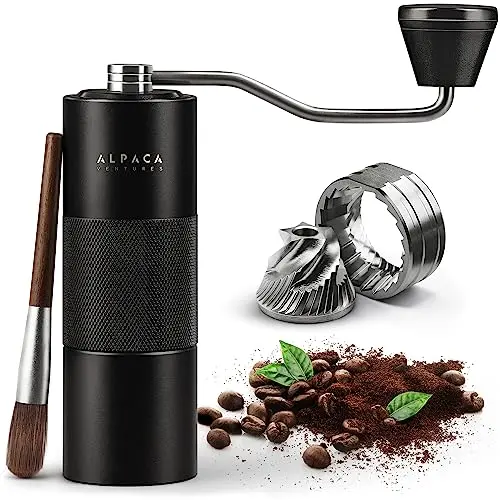
AV1 – Compact 45-Click Hand Mill
The Alpaca AV1 uses a hardened 420 stainless conical burr and a 45-click adjustment dial in a compact aluminum body. It holds about an ounce of beans, uses dual bearings, and includes a cleaning brush but no travel case.
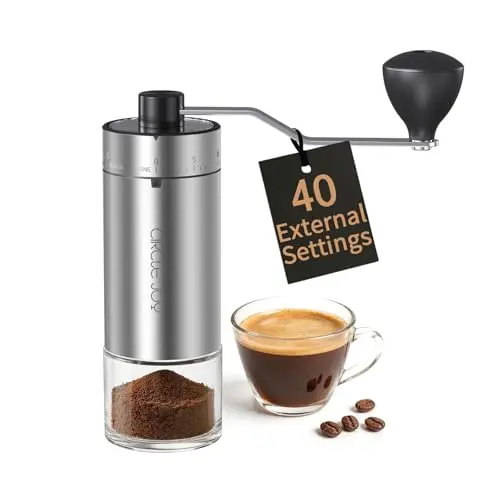
KMDJ-KCT-W2-SL – Long-Handle Travel Mill
The Circle Joy mini grinder combines a stainless steel body, ceramic conical burr, and 40 external grind settings in a compact travel format. It has an extra-long handle, a clear glass grounds hopper, and a 30-gram capacity.
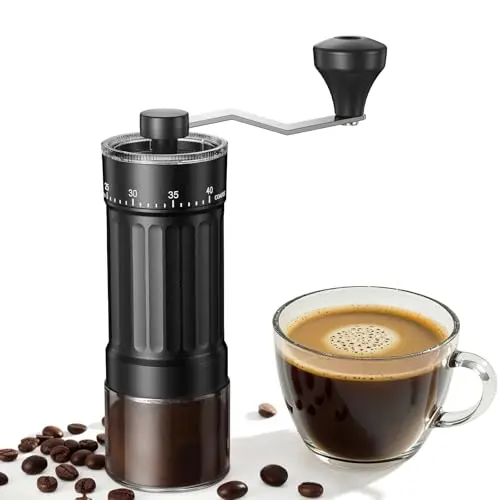
MCG-01 – Budget Mini Hand Grinder
The Ceving MCG-01 is a lightweight mini hand grinder with 40 external settings and a ceramic conical burr. It holds 30 grams of beans, weighs about 325 grams, and breaks down for brush cleaning.
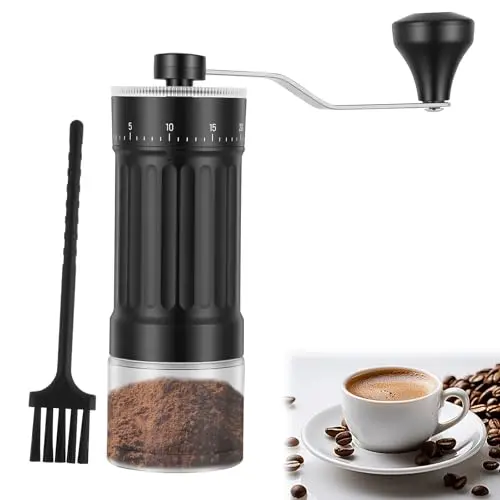
KFXMJ-001 – Entry Travel Mill
The HZBSGZR mini grinder is an inexpensive hand mill with 40 settings, a ceramic conical burr, and a glass viewing jar. It has a 30-gram capacity, an ABS body, and no power requirement.
How We Evaluated These Handheld Coffee Grinders
We didn’t run controlled kitchen lab tests or long-term reliability trials. What we did: cross-referenced 9 handheld coffee grinders from seven brands across six decision axes – burr material, grind-adjustment range, capacity, portability, cleaning routine, and brew-method fit. We triangulated published specifications, feature sets, and owner feedback where available, then mapped each option to representative buyer profiles for hand grinding. We weighed real-world fit and performance at 70% against feature differentiation at 30%, with extra weight on repeatable adjustment and burr consistency because those decide whether a handheld grinder feels precise or frustrating. We focused on how each grinder behaves in the hand, not just on paper: how the crank turns under load, whether the catch cup stays put, and how easy it is to return to a previous setting after switching brew methods. Where owner feedback was available, we used it to flag recurring ergonomic or durability concerns rather than treating it as a score. We also considered the cleaning routine, because a grinder that is annoying to brush out tends to get used less often. We have no commercial relationship with the brands featured; recommendations track fit and differentiation, not brand preference. If you want the most complete all-round package, the 1Zpresso K-Ultra is the natural starting point; if espresso is the priority, the 1Zpresso J-Ultra makes more sense. A few things we can’t tell you: actual long-term burr wear or how every handle feels in your hand after months of use. What we can: compare the published specs, feature tradeoffs, and owner-feedback patterns that shape a sensible buying decision.
How to Choose the Right Handheld Coffee Grinder
1. What Makes a Coffee Grinder Truly Handheld
A handheld coffee grinder should be easy to hold, easy to pack, and stable enough that the crank doesn’t fight you. The key details are a foldable handle or a handle that detaches, a catch cup that stays put, and a body size that matches your grip. A mill that weighs more than it needs to for its capacity often ends up staying home.
Handheld doesn’t automatically mean travel-ready. If you plan to toss it in a bag, check whether the hopper lid stays secure and whether the catch cup is metal or glass. A 30 to 40 gram capacity is usually the practical range: enough for a cup or two, but not so much that grinding becomes a workout.
2. Burr Quality and Grind Consistency: The Core Decision
The conical burr is the part that turns beans into grounds, and it sets the ceiling on consistency. Stainless steel burrs generally hold an edge well, while ceramic burrs can run cooler but may feel less precise at very fine settings. What matters most is burr alignment and a stable shaft, because a sharp burr that wobbles still produces uneven grounds.
Grind consistency shows up in the cup: fewer boulders and fewer fines mean more predictable extraction. For pour-over, you want a repeatable medium grind; for espresso, small adjustment changes need to produce small shifts in flow. If you want the most complete all-round package, the 1Zpresso K-Ultra is the most flexible starting point in this lineup.
3. Grind Adjustment: External Clicks vs Internal Dialing
External adjustment is one of the biggest convenience upgrades in this category. Instead of removing the catch cup and turning a nut inside the burr chamber, you twist a dial on the outside and watch the clicks. That makes it much easier to switch from espresso to French press and back without losing your place.
Look at the size of the steps. Grinders with micron steps offer more precision, which matters for espresso and Turkish coffee. Grinders with fewer, wider steps can still be fine for filter brewing. The real test is repeatable settings: can you return to the same number and get the same grind? Audible clicks and a stable adjustment ring help.
4. Capacity, Weight, and Travel Reality
A 25-gram capacity is enough for a single large mug or a small pour-over, while a 30 to 40 gram hopper can cover two cups or a larger batch. Capacity cuts both ways: bigger means fewer refills, but it also means more beans to crank through if you only brew one cup.
Body weight matters as much as packed size. A heavier grinder can feel more stable on the counter, but it’s less pleasant on a hike. For a metal-bodied travel grinder with a practical capacity, the Timemore Chestnut C3S Pro is a sensible pick, while the mini grinders here are easier to stash for one-cup trips.
5. Espresso, Pour-Over, and French Press: Matching the Grinder to Your Brew
Your main brew method should drive the choice. An espresso-focused burr and fine adjustment range matter more than a large hopper if you chase repeatable shots. For pour-over, a grinder that produces a clean medium grind with limited fines is more useful, and a wider adjustment range helps you tune the brew.
French press and cold brew are more forgiving, so a simpler grinder can work well. But if you regularly switch methods, external adjustment saves time and reduces frustration. If espresso is the priority, the 1Zpresso J-Ultra is the pick here, while the K-Ultra is the more versatile option.
6. Premium vs Budget Handheld Coffee Grinders: Where the Money Goes
The premium tier tends to buy tighter tolerances, more adjustment clicks, better burr alignment, and nicer materials. Budget mini grinders can still make good coffee, especially for French press or casual pour-over, but they often trade precision and long-term durability for a lower entry point.
Spend more if you want espresso-level control, a magnetic catch cup, or a travel case. Stay budget-minded if you brew one cup at a time and don’t need to dial in a specific shot. The middle of the market is where most buyers land: metal bodies, proven burrs, and enough adjustment for everyday brewing.
Frequently Asked Questions
1. Are all handheld coffee grinders actually portable enough for travel?
Not automatically. A grinder can be small and still be awkward to pack if the handle doesn’t fold, the catch cup is loose, or the body is heavy for its capacity. Look at packed dimensions, handle design, and whether a travel case is included. A 30-gram mini grinder is easier to stash than a full-size mill, but it may be slower for multiple cups. If you mostly brew one cup at a time, a compact model can be the better travel companion; if you regularly grind for two or more, a larger 35-to-40-gram mill may save time.
2. What's the difference between the 1Zpresso K-Ultra and the Timemore Chestnut C3S Pro?
The K-Ultra is the more flexible all-rounder. It offers 100+ external clicks at 20-micron steps, a magnetic catch cup that holds 35 to 40 grams, and a folding handle with a travel case. The C3S Pro uses a 36-setting adjustment system, a S2C hexagonal burr, and a 25-gram capacity in a full-metal body. The K-Ultra is better if you switch often between espresso and filter; the C3S Pro is the more straightforward pour-over and travel value.
3. What's the difference between the KINGrinder K6 and the Timemore Chestnut C2S?
The KINGrinder K6 is the more precision-focused option, with 16-micron clicks and a stainless steel burr in a full-metal body. It also uses a dual-bearing design and a straight handle, with a 25-to-35-gram hopper. The C2S is a simpler pour-over grinder with a 38 mm burr, 36 settings, and a 25-gram capacity. Choose the K6 for espresso flexibility; choose the C2S for straightforward filter brewing.
4. Can a budget handheld coffee grinder handle espresso?
It can produce fine grounds, but repeatable espresso is harder. Budget ceramic burrs often have a wider particle spread and fewer micron-level steps. For occasional espresso, a budget mini is workable; for dialing in a specific shot, an espresso-focused grinder with fine adjustment and stable burr alignment is worth it. The 1Zpresso J-Ultra is the pick here if espresso is your main brew, while the K-Ultra covers espresso and filter in one tool.
Final Verdict
For most buyers, the 1Zpresso K-Ultra is the handheld grinder to choose. It combines wide external adjustment, a practical magnetic catch cup, and a foldable handle in one package that works for filter, French press, and espresso. If espresso is your daily target, the 1Zpresso J-Ultra is the more specialized pick, with finer micron-level adjustment and a burr tuned for sweet, precise shots.
If you want a metal-bodied all-rounder at a more accessible tier, the Timemore Chestnut C3S Pro gets most of the way there with a proven burr and a compact footprint. And for a true budget travel mill, the Circle Joy mini grinder is easy to recommend for single-cup brewing. Start with the brew method you use most, then choose the grinder whose capacity and adjustment system match your routine.
