
Best Headboard Pillows – 2026 Reviews

There’s a particular kind of bedtime frustration that starts with a pillow wedged between the mattress and the wall-or worse, on the floor. A headboard pillow is the unglamorous fix that keeps the gap closed and gives you something supportive to lean against when you’re reading or watching TV in bed. But the category splits into two very different jobs: some models are slim wedges that fill the mattress-to-headboard gap, while others are thick triangular backrests built for sitting up.
Before you pick one, decide which problem you’re solving. Gap fillers need the right height and length for your bed, plus foam that won’t flatten out. Backrest pillows need enough density to support your upper body without feeling like a rock. Cover fabric, pocket placement, and how the pillow expands after shipping are the details that separate a useful purchase from a return.
We looked across brands and model types to find the headboard pillows that make the most sense for different beds and routines. The guide below focuses on fit, support, and the practical details you’ll live with every night.
Best Headboard Pillows – 2026 Reviews

Bed Wedge Pillow for Headboard Gap – King-Size Gap Filler with Pockets
A king-size gap filler designed to close the space between mattress and headboard, with a curved top, side pockets, and a washable cover.

Headboard Wedge Pillow – Jacquard Gap Filler with Charging Pocket
A king-size headboard wedge with a jacquard cover, side pockets, and a cable access hole for keeping devices charged nearby.

King Size Bed Wedge Pillow – Triangle Gap Filler with Pockets
A budget-friendly triangle wedge that fills gaps up to several inches, with high-density foam and reinforced side pockets.
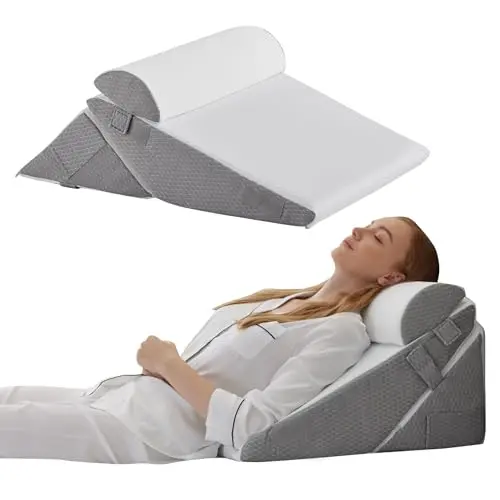
Wedge Pillow Set for After Surgery – Adjustable 9 & 12 Inch Support
A modular wedge set with an adjustable 9- or 12-inch base, an independent head and neck bolster, and a washable cover for recovery, reflux, or sitting up in bed.

Headboard Pillow Queen – Flannel Backrest for Sitting Up
A queen-size triangular backrest with a flannel cover, shredded foam fill, and side pockets for reading or watching TV in bed.

Headboard Pillow Queen – Triangular Backrest with Side Pockets
A structured triangular headboard pillow with polyurethane foam, button details, and side pockets for sitting up in bed.
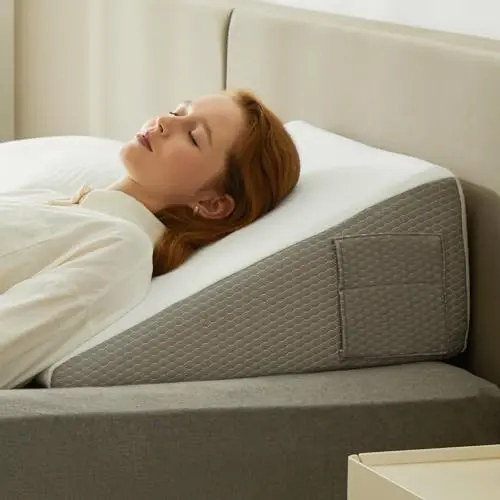
Wedge Pillow 10 Inch – Cooling Gel Memory Foam Bed Wedge
A broad 10-inch wedge with cooling gel memory foam, a high-density base, a built-in handle, and side pockets for sleeping or sitting up.
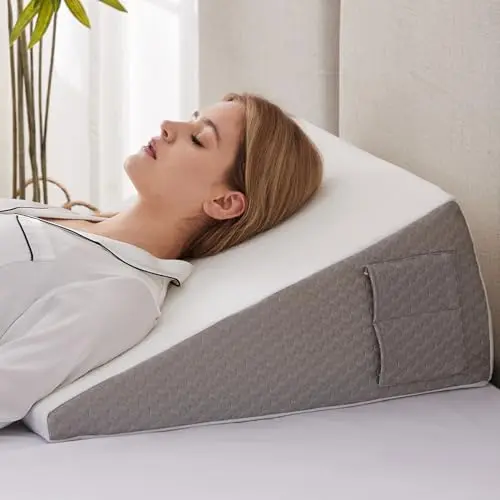
Wedge Pillow for Acid Reflux – Jacquard Cover Bed Wedge
A traditional bed wedge with high-density foam, a jacquard pillowcase, two pockets, and multiple height options for elevation.
How We Evaluated These Headboard Pillows
We didn’t sleep on each of these night after night or run compression-recovery lab tests. What we did: cross-referenced 8 headboard pillow models from 7 distinct brands across five decision axes – gap-fill capacity, foam density and recovery, cover care, pocket utility, and sitting-up support. The lineup spans slim gap fillers, triangular backrests, and adjustable wedge sets, so we compared each against the bed setup it was actually designed for. We triangulated published specifications, feature sets, and owner feedback where available, then mapped each option against representative buyer profiles for this category. We also weighed how covers remove, how pockets are positioned, and whether the fill is described as high-density foam, memory foam, or shredded foam. Where owner feedback was thin, we leaned more heavily on published specs and the pillow’s stated dimensions.
The scoring framework weighted real-world performance (70%) – how well each pillow handles its stated job – against feature differentiation (30%) – unique design details and use-case specificity. We audited the lineup for fit and practicality rather than brand reputation; recommendations track how each pillow performs for its intended bed setup. That matters because a gap filler and a backrest pillow solve different problems. We have no commercial relationship with any of the brands featured. If you want a straightforward gap filler, the Vekkia is the pick; if you want a more finished look with a jacquard cover, the Kolbs is the stronger match.
How to Choose the Right Headboard Pillows
1. Start With the Job: Gap Filler vs. Backrest Pillow
The phrase headboard pillow covers two different products. A gap filler is a slim wedge that sits between the mattress and headboard to stop pillows and remotes from falling through. A backrest pillow is a thicker triangular cushion you lean against when sitting up. Some models try to do both, but most are better at one job. If your pillow ends up on the floor every morning, start with a gap filler. If you want to read or watch TV in bed without stacking pillows behind you, start with a backrest.
2. Measure the Gap and Bed Width for a Headboard Pillow
Gap fillers are sized by height and length. The height needs to match the space between your mattress and headboard-too short and it won’t close the gap; too tall and it can push your pillow out of position. Length matters too: a king-size wedge spans a wide bed, while a queen-size wedge suits a narrower frame. Measure both before ordering, and check whether the pillow is designed to fit gaps up to a specific number of inches.
3. Foam Density, Firmness, and Cover Care
High-density foam is the spec to look for in a gap filler because it resists sagging and keeps its shape. Memory foam adds conforming comfort but can feel softer and slower to rebound. Backrest pillows often use shredded foam or fiber fill, which lets you reshape the pillow but may need occasional fluffing. Whatever the fill, look for a removable cover that is machine washable; it’s the feature you’ll appreciate most over time.
4. Vekkia vs. Homemate: Which Gap Filler Fits Your Bed?
The Vekkia and Homemate are both gap-filling wedges, but they suit different priorities. The Vekkia has a curved top and denser foam, which makes it the better choice for a primary bed where you want the filler to disappear under your pillow. The Homemate is a simpler triangle wedge with a softer feel and a lower price tier. If you want the more polished gap filler, go with the Vekkia. If you just need to close the gap on a budget, the Homemate is the practical route.
5. When a Wedge Is the Wrong Shape
Not every bed needs a wedge. If your headboard sits flush against the mattress, a slim gap filler has nothing to do. If you want adjustable elevation for reflux or recovery, a modular wedge set like the Bedluxe Set is more useful than a fixed triangle. And if you mostly want a soft place to lean while reading, a backrest pillow will feel better than a dense gap filler. Match the shape to the problem; otherwise you’ll end up with a support pillow that fights your sleeping position.
Frequently Asked Questions
1. What's the difference between the Vekkia and Homemate headboard pillows?
Both are gap-filling wedges, but they approach the job differently. The Vekkia uses a curved top and high-density foam intended to sit under your pillow without a hard ridge; it’s the more polished gap filler and the one I’d pick for a primary bed. The Homemate is a simpler triangle wedge with a softer feel and a lower price tier. If you want set-and-forget support, go with the Vekkia. If you just need to close the gap cheaply, the Homemate is the budget route.
2. Kolbs vs. Bedluxe: which headboard pillow is better for sitting up?
The Kolbs is a king-size gap filler with a jacquard cover and a charging-cable pocket; it’s best if your main goal is hiding the mattress-headboard gap in a nicely finished way. The Bedluxe Set is the better sitting-up pillow because its adjustable base and independent bolster let you change the incline for reading, reflux, or recovery. Choose the Bedluxe Set if you want modular support; choose the Kolbs if you want a clean gap-fill look and don’t need adjustability.
3. Do headboard pillows actually stop pillows from falling?
Yes, when they’re sized and placed correctly. A gap filler works by taking up the space between the mattress and headboard, so your sleeping pillow has nowhere to slide. The key is matching the wedge height to your actual gap and choosing foam that recovers rather than compresses flat. A backrest-style headboard pillow solves a different problem-it gives you something to lean against-but it won’t necessarily close a deep gap. Decide which issue you have before buying.
4. How long does a compressed headboard pillow take to expand?
Most of these pillows ship vacuum-compressed and need 24 to 48 hours to reach full shape. Some brands suggest patting or squeezing the foam to help it redistribute, and cooler rooms can slow the process. Don’t judge the firmness or loft on the first night; give it a couple of days. If it still looks uneven, check the brand’s expansion instructions before assuming the pillow is defective.
5. Can you wash a headboard pillow cover?
In this lineup, yes-most models have a removable cover with a zipper, and the covers are machine washable. Check the care tag before washing, use a gentle cycle, and let the cover air-dry or tumble on low to avoid shrinking. Don’t put the foam core in the washing machine; spot-clean it and let it air out instead. A washable cover is one of the most practical features for a pillow that sits against your bedding every night.
Final Verdict
For most buyers, the Vekkia is the headboard pillow that makes the most sense: it closes the gap, adds useful pockets, and stays out of the way. If you want a more finished look and a jacquard cover, the Kolbs is the premium pick. If you’re shopping on a tighter budget, the Homemate covers the basics for less. And if you need adjustable elevation for reflux, recovery, or sitting up, the Bedluxe Set is the most flexible route. The right choice comes down to whether you want a slim gap filler, a backrest, or a modular support system-pick the job first, then the pillow.
