
Best Home Air Purifiers For Smoke – 2026 Reviews

Smoke is the one air quality problem that doesn’t wait for you to be ready. A wildfire burning three states away can push a gray haze into your neighborhood overnight, and suddenly that cracked kitchen window is a liability. Even indoor sources – a wood stove, a candle habit, a neighbor’s fire pit – leave behind fine particles and a smell that settles into upholstery for days.
That’s why shopping for a home air purifier specifically for smoke is different from buying one for dust and pollen. Smoke is two problems wearing one coat: an enormous load of fine particulate matter, often PM2.5 and smaller, plus a cocktail of gases and volatile organic compounds that carry the smell. A purifier that handles one but not the other leaves your room feeling only half-fixed.
The picks below come from a cross-brand survey of what’s currently on the market, spanning compact bedroom units to large-room machines that move serious air volume. We’ll walk through which filter stacks actually make a dent in smoke, how coverage claims get calculated, and where a cheap unit genuinely is enough.
Best Home Air Purifiers for Smoke – 2026 Reviews
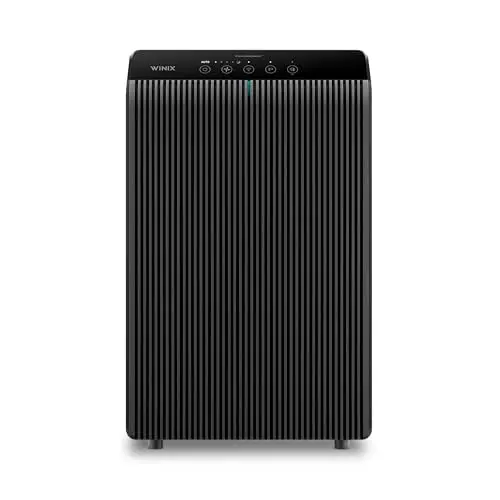
5510 – True HEPA and Heavy Carbon for Smoke
The 5510 is the current generation of Winix’s large-room purifier, and it’s the one we’d point a smoke-plagued household toward first. A True HEPA stage rated to capture particles as small as 0.01 microns pairs with a genuinely substantial high-deodorization carbon filter – the part most competitors treat as an afterthought. Published coverage runs to 1,881 square feet in an hour.
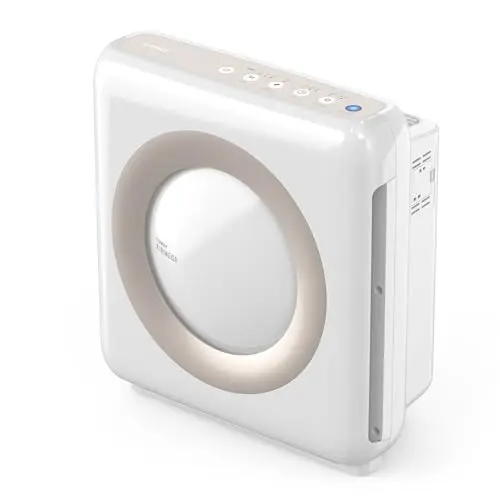
Mighty AP-1512HH(W) – Quiet Four-Stage Smoke Control
The AP-1512HH has been the reference point for home purifiers for years, and its four-stage system – washable pre-filter, deodorization filter, bipolar device, and HEPA – still handles smoke competently. Rated for spaces up to 1,748 square feet in an hour, with a real-time air quality indicator and auto mode.
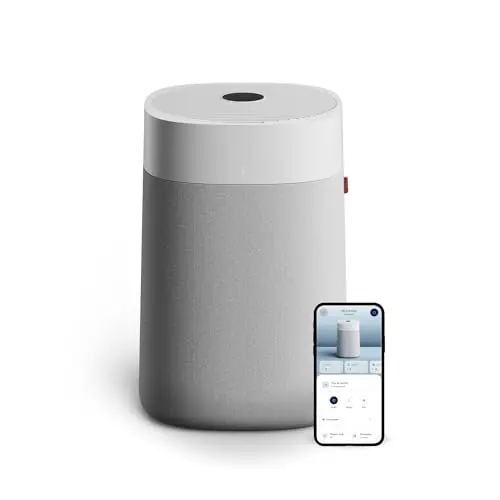
Blue Pure 211i Max – Large-Room Airflow
If smoke season means a large open living area, the 211i Max is built for volume. Blueair’s HEPASilent dual filtration moves air fast enough to cycle 3,235 square feet in an hour, and 360-degree intake means it isn’t fussy about placement.
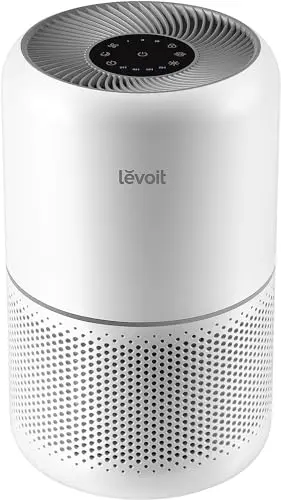
Core 300-P – Verified Smoke CADR on a Budget
The Core 300-P is the value benchmark for smoke: an AHAM Verifide unit with a published 143 CFM smoke CADR, a three-stage filter including carbon, and a sleep mode that drops to 24 dB. It’s rated to cycle 1,073 square feet once per hour.
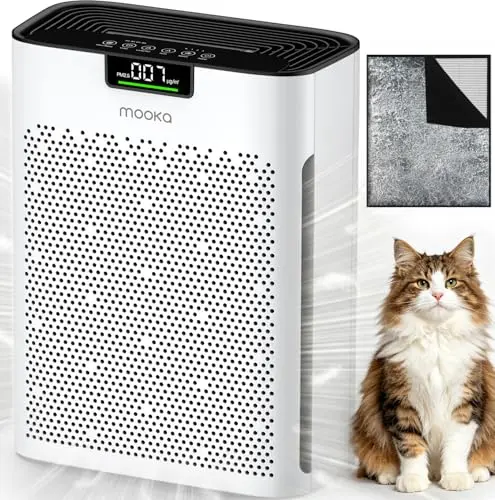
KJ190H – PM2.5 Display and Auto Mode
The KJ190H packs a numeric PM2.5 display and auto mode into a compact frame, with a three-stage filter that uses activated carbon pellets rather than a carbon-sprayed sheet. Washable pre-filter, four fan speeds, and a 20 dB sleep mode.
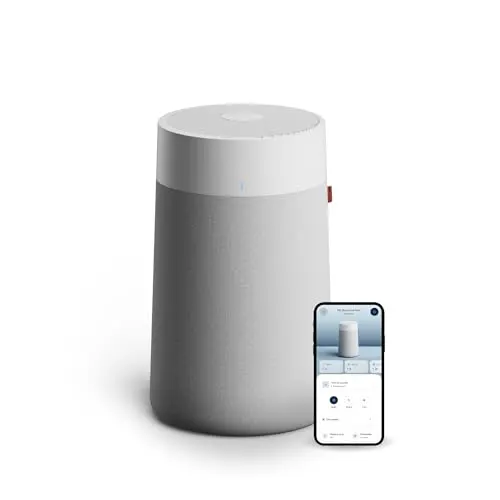
Blue Pure 311i Max – Smart Mid-Room Filtration
The 311i Max is the smaller sibling of the 211i, rated to clean 2,107 square feet in an hour with the same HEPASilent dual filtration and app control, at a claimed 23 dB minimum.
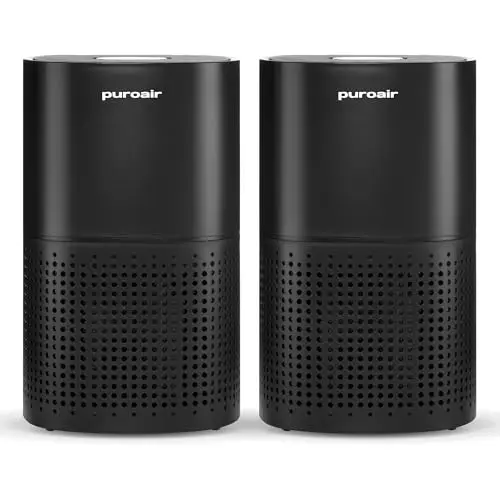
Puro Air 240 – Two-Room Coverage with Auto Sensing
A two-pack of 1,000 square foot purifiers with a three-layer filter, PuroIQ particle sensor, auto mode, and 360-degree intake. Selling as a pair makes it a plausible whole-home entry point.
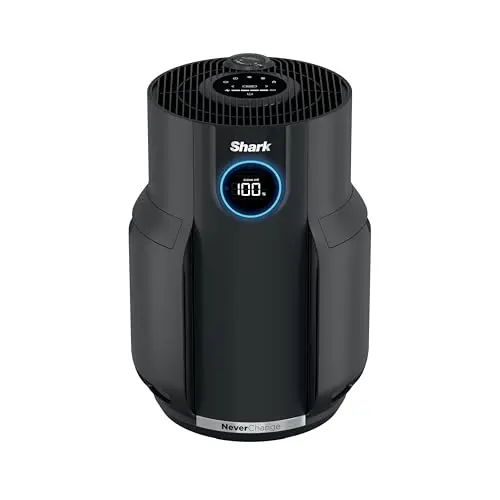
NeverChange HP152 – Long-Life Filter, Scent Cartridge
Shark’s NeverChange filtration promises years without replacement filters, paired with HEPA-exceeding media and an Odor Neutralizer cartridge. Coverage runs to 650 square feet in an hour, with a CleanSense IQ display.
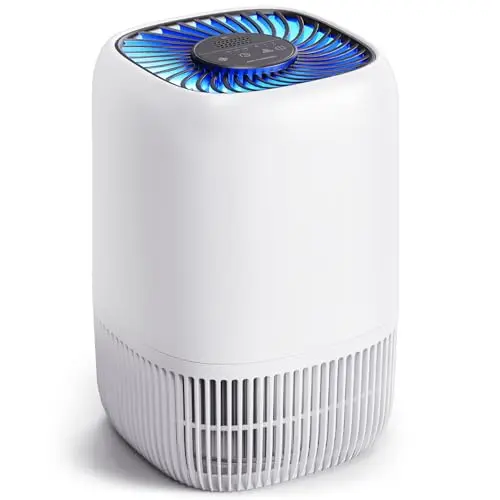
DH-JH12 – Tiny Footprint Entry Pick
A genuinely tiny purifier – under seven inches wide – with a 360-degree intake, three speeds, a timer, and an aromatherapy tray. Rated to 1,076 square feet per hour under lab conditions.
How We Evaluated These Home Air Purifiers for Smoke
We didn’t run particle counters in a smoke-filled room or measure decay rates with a laser photometer. What we did: cross-referenced nine home air purifiers from eight distinct brands across six decision axes – smoke CADR and published coverage, filter stack composition, carbon and odor-stage substance, sensor and auto-mode behavior, noise floor at higher fan speeds, and long-term filter cost. We triangulated manufacturer specifications, certification listings from AHAM and CARB, and aggregated owner feedback where available, then mapped each unit against representative buyer profiles for smoke events.
The scoring framework weighted real-world performance (70%) – how convincingly each purifier handles both the particulate load and the smell of smoke in a realistically sized room – against feature differentiation (30%) – sensor quality, app control, filter longevity, and footprint. We have no commercial relationship with any brand here, and recommendations track fit and differentiation rather than brand preference. If you want the strongest carbon-plus-HEPA combination for a whole room, the Winix 5510 is the one we’d point to. If a quiet bedroom unit matters more, the Mighty AP-1512HH(W) earns its place.
Where a coverage number looked inflated relative to a unit’s size and airflow, we treated it as a maximum rather than a recommendation. Where owner feedback was thin or split, we said so instead of papering over it. Smoke is a two-part problem, and a purifier that scores well on particles but ignores gases only half-solves it – that distinction shaped every ranking below.
How to Choose the Right Home Air Purifier for Smoke
1. Why Smoke Needs More Than a HEPA Filter
Smoke is two problems wearing one coat. The first is fine particulate matter – the PM2.5 and smaller particles that give smoke its haze and travel deep into your lungs. The second is a mix of gases and volatile organic compounds that carry the acrid smell and linger in soft furnishings long after the visible haze clears.
A HEPA filter is very good at the first problem and essentially useless at the second. It traps particles mechanically and electrostatically; gases sail straight through. So if you’re buying specifically for smoke, look for a substantial carbon stage, not a thin sheet of carbon-impregnated fabric. That single spec separates purifiers that genuinely help during a smoke event from ones that just make the room feel busier.
2. Smoke CADR and Coverage: Reading Air Purifier Ratings Honestly
CADR – clean air delivery rate – is the number worth trusting, and it’s reported separately for smoke, dust, and pollen. Smoke CADR is the one that matters here. It’s expressed in cubic feet per minute, and higher is better, but it’s meaningless without a room size attached.
The ‘up to X square feet’ figure on most listings is calculated at one air change per hour, which is a low bar. A big number on a small purifier usually means it can technically cycle that volume once in sixty minutes at full blast. For real relief you want several air changes per hour in the room you’re actually sitting in. A unit rated for a large room will handle a bedroom very well; the reverse is not true. If open-plan square footage is your constraint, the Blue Pure 211i Max is built for that job.
3. Carbon Filtration for Smoke Odor: Weight Matters More Than Claims
Carbon is where budget purifiers cut corners, and smoke is where you notice. Activated carbon pellets offer far more usable surface area than a carbon-sprayed fiber sheet, and they last longer before saturating. Some manufacturers disclose carbon weight in grams; that’s the honest version. Others mention ‘activated carbon filter’ with no quantity, which usually means the minimum.
For wildfire smoke specifically, a heavier carbon bed buys you more hours before odor breakthrough. It also helps with cooking fumes, pet odor, and off-gassing from new furniture. Remember that carbon saturates rather than clogs, so it can stop working on smell long before the HEPA media needs changing.
4. Sensors, Auto Mode, and What They Actually Detect
Most built-in air quality sensors in home purifiers are particulate sensors – usually optical, counting particles that pass a beam. They’re good at noticing smoke arriving. They’re not gas sensors, which means a unit can read ‘clean’ while a room still smells of smoke.
That’s why auto mode is helpful for particulate spikes but not a substitute for judgment on odor. A handful of units go further with numeric PM2.5 readouts, giving you actual feedback instead of a color changing. If you like data, that display is worth having; if you’d rather set it and forget it, a plain auto mode plus a light-activated sleep setting is plenty.
5. Home Air Purifiers for Smoke: Noise, Placement, and Running Costs
During a smoke event you’ll run the unit at high fan speed for hours, sometimes days. That changes what matters. Noise at maximum becomes the spec you live with, not the sleep-mode figure on the box. Check the top-end decibel rating, not just the quiet one.
Placement is simpler than people expect: give the unit clearance on all sides and don’t hide it behind furniture. Units with 360-degree intake are easier to position than front-intake designs. And budget for consumables – a washable pre-filter meaningfully extends HEPA life, and replacement filter costs over two or three years can rival the purchase price itself.
6. Winix 5510 vs Coway AP-1512HH: Two Approaches to Smoke Control
These two are the closest call in this lineup, and they solve smoke differently. The Winix 5510 leans on a heavier deodorization carbon filter and a True HEPA stage rated to 0.01 microns, with app control and a larger coverage envelope. It’s the better choice if smell is as much a problem as haze.
The Mighty AP-1512HH(W) counters with a proven four-stage design, a smaller footprint, and a reputation for quiet, trouble-free running. It won’t touch the Winix on odor capacity, but it fits into rooms the Winix would dominate. If you want one machine for a bedroom that happens to face a smoky street, the Coway is the more livable answer.
Frequently Asked Questions
1. Do home air purifiers actually help with wildfire smoke indoors?
Yes, meaningfully – with caveats. A purifier with a True HEPA or HEPA-grade filter will reduce airborne smoke particles in the room it serves, and that’s the component linked to the health effects people worry about most. What it won’t do is replace sealing your windows or running your HVAC on recirculate.
It also won’t fully address smell unless the unit carries a real carbon stage. Treat a purifier as one layer of a smoke plan, not the entire plan.
2. What's the difference between the Winix 5510 and the Coway AP-1512HH?
The Winix 5510 is the heavier-duty smoke machine: a larger carbon filter, True HEPA rated to 0.01 microns, bigger coverage, and app control. It’s built for living spaces where odor is part of the problem.
The Coway AP-1512HH is the more compact, quieter option, with a four-stage stack and a long track record for reliability. Its carbon stage is smaller, so it suits bedrooms and moderate smoke better than a living room during a heavy wildfire event.
3. How big an air purifier do I need for a smoky room?
Size to the room you actually occupy, not the whole house. Look at the smoke CADR figure and aim for a unit that can deliver several air changes per hour in your square footage – not one. A bedroom typically doesn’t need a large-room machine; an open-plan living and kitchen area does.
Ignoring the one-air-change-per-hour math behind coverage claims is the most common buying mistake in this category.
4. Do I need a carbon filter for smoke, or is HEPA enough?
HEPA handles the particles, and that’s the bulk of the health concern. But smoke odor and VOCs pass straight through HEPA media, so if the smell bothers you – and it usually does – you want a genuine carbon stage. Pelletized carbon outperforms carbon-impregnated fabric and lasts longer before saturating.
If you’re choosing between a unit with better particle performance and one with better carbon, and odor is your main complaint, weight the carbon.
5. What's the difference between the Levoit Core 300-P and the MOOKA KJ190H?
The Core 300-P has the stronger verified paper trail: an AHAM Verifide 143 CFM smoke CADR, a 24 dB sleep mode, and a well-established filter supply. It’s the safer pick if you want a known quantity in a bedroom.
The MOOKA KJ190H gives you a numeric PM2.5 display and pelletized carbon at a lower tier, which is genuinely useful during a smoke event. Its coverage claim is optimistic relative to its size, so treat it as a small-room unit.
6. Can an air purifier remove the smell of smoke from a house?
It can reduce it in the room the unit serves, mainly through carbon adsorption of the gases responsible. It won’t eliminate smoke smell that’s already soaked into carpet, curtains, and upholstery – that needs cleaning and ventilation.
Some units use a scent cartridge to mask odor instead. That’s a different thing entirely, and worth knowing before you buy if masking isn’t what you want.
Final Verdict
For most households dealing with smoke, the Winix 5510 is the answer. It pairs real particle filtration with a carbon stage heavy enough to make a difference on smell, and it moves enough air for a living room without needing a second unit. If your smoke problem is a bedroom rather than a whole floor, the Core 300-P gets you verified smoke performance and a genuinely quiet sleep mode for far less commitment.
And if the room in question is a large open-plan space, the Blue Pure 211i Max is purpose-built for that volume – just don’t expect it to erase odor the way the Winix does. Match the machine to the room you’re actually sitting in, and the rest sorts itself out.
