
Best Humidifiers For Bronchitis – 2026 Reviews

It usually hits around two in the morning: the cough that won’t settle, a throat that feels scraped raw, and a bedroom so dry you can hear yourself breathe. If you’re shopping for a humidifier in the middle of bronchitis, you’re not chasing a spa-like mist. You want moisture that actually reaches the room, runs all night, and doesn’t turn into another chore when you’re already exhausted.
The category is messier than it looks. Warm mist units boil water and push out steam, which feels soothing on an irritated throat and leaves no white dust on the furniture. Cool mist ultrasonic units run quieter and are safer around kids, but they ask more of you on water quality and cleaning. Neither type is universally better – the right call depends on which tradeoff you can live with at three in the morning.
Two things separate the machines that earn their counter space from the ones that end up in a closet. First, real output matched to your room: a bedside unit won’t do much in an open-plan space, and an oversized one will soak the nearest wall. Second, whether you’ll genuinely clean it, because mineral scale and mold turn a helpful appliance into a counterproductive one fast. We compared options across several brands with those two axes in mind, then layered in noise, runtime, and controls.
Best Humidifiers for Bronchitis – 2026 Reviews
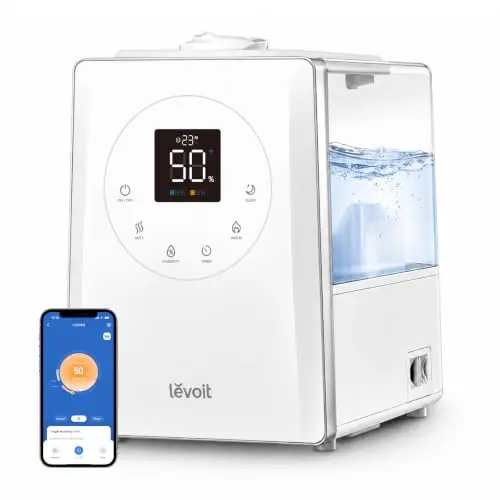
LV600S – Warm and Cool Mist for Congested Nights
The most flexible machine in this lineup: a 6L top-fill tank rated for rooms up to 753 square feet, with your choice of warm or cool mist depending on what your throat tolerates. A smart sensor drives Auto Mode so it holds a target humidity level instead of cycling blindly, and Sleep Mode kills the display lights and drops output noise under 28 dB.
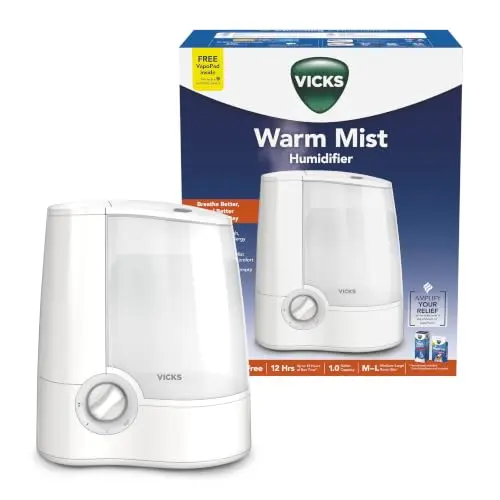
Warm Mist V745 – Filter-Free Steam Relief
A 1-gallon warm mist unit that boils water into steam, so it runs filter-free and leaves no white dust behind. It’s rated for rooms up to roughly 600 square feet, shuts off automatically when the tank empties, and accepts Vicks VapoSteam or VapoPads for a menthol vapor option. The tank lifts off for filling.

DR-HHM001S – Auto Humidity with App and Voice Control
A 4L cool mist humidifier with real smart-home ambitions: an onboard sensor runs Auto Mode, and you can adjust mist level, timers, and lighting from the DREO app, Alexa, or Google. A dual-intake design pushes more mist than the compact body suggests, and the top-fill tank runs up to 36 hours on low.
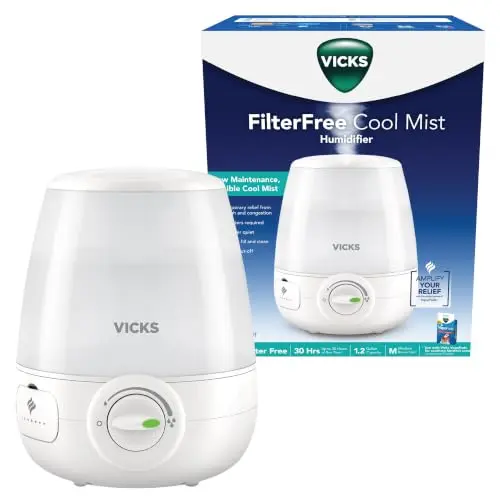
Filter-Free Ultrasonic V4600 – Long-Run Cool Mist
A 1.2-gallon cool mist ultrasonic unit with a filter-free design and up to 30 hours of runtime per fill. It’s aimed at bedrooms and nurseries, runs quietly, and the tank lifts off cleanly for refilling without wrestling the whole unit.
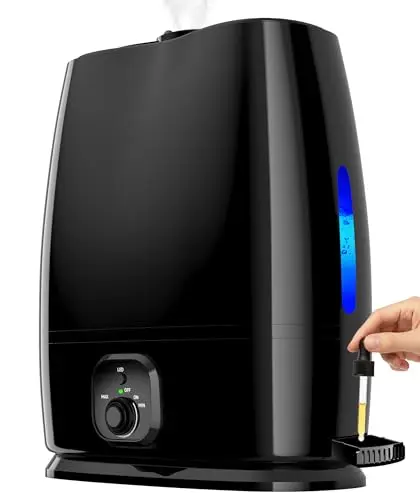
6L Ultrasonic – Several Nights Per Fill
A 6L ultrasonic cool mist humidifier rated for rooms up to 500 square feet, with a long runtime on the low setting. A 360-degree nozzle spreads mist around the room, the top-fill tank opens wide for cleaning, and there’s a tray for essential oils if you like a scent at night.
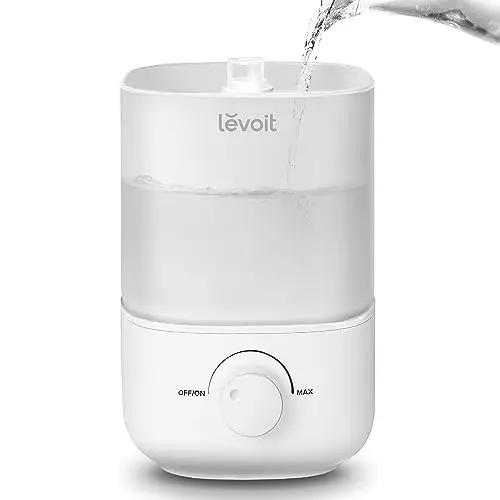
Classic 160 – Quiet Top-Fill on a Budget
A compact 2.5L cool mist humidifier rated for rooms up to about 219 square feet, with a top-fill design and a genuinely simple control scheme – one knob for output, one rotating nozzle for direction. It runs up to 25 hours on low and quiets down nicely for a nursery.
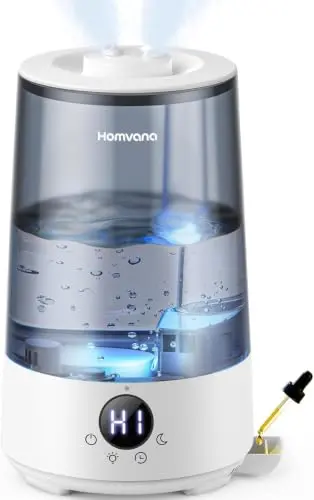
H101 – Whisper-Quiet Bedside Mist
A 3.6L cool mist humidifier built for bedside duty, with a claimed noise floor under 23 dB, a 7-color night light, and a top-fill tank that opens wide for cleaning. There’s an aroma pad for essential oils and a 360-degree nozzle for aiming mist.
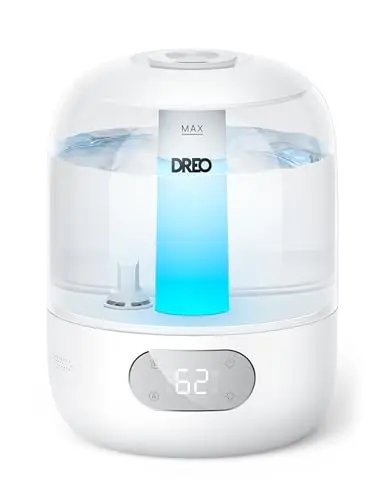
DR-HHM006 – Compact 3L with Aroma and Timer
A 3L cool mist humidifier with a 30-hour sleep-mode runtime, a claimed 26 dB noise floor, and a 360-degree rotating nozzle that projects mist upward. It covers around 300 square feet and includes an aroma pad tray plus adjustable ambient lighting.
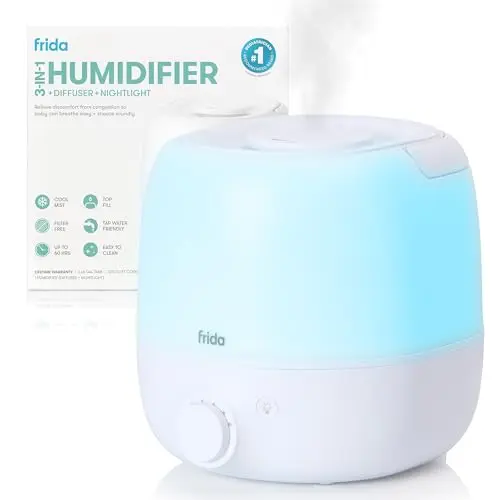
3-in-1 Cool Mist – Nursery Humidifier, Diffuser, and Nightlight
A 0.66-gallon cool mist humidifier, diffuser, and nightlight in one unit, rated for rooms up to 320 square feet. The low setting stretches to a claimed 60 hours, a low-water light tells you when to refill, and a carry handle makes it easy to move between rooms.
How We Evaluated These Humidifiers for Bronchitis
We didn’t run controlled humidity-lab measurements or multi-month reliability trials. What we did: cross-referenced nine humidifier models from six distinct brands across five decision axes – mist type, room coverage and output, runtime per fill, cleaning and maintenance burden, and noise and controls. We mapped published specifications against manufacturer claims, audited filter and cartridge requirements, and weighed owner feedback where available to catch the gaps between the spec sheet and nightly reality.
The scoring framework weighted real-world fit for congestion-heavy nights (70%) – whether a unit can hold a bedroom at comfortable humidity without constant refills or attention – against feature differentiation (30%): the things that separate one machine from the next, such as warm versus cool mist, smart sensing, night lighting, and how serviceable the tank actually is. We have no commercial relationship with any of the brands here; recommendations track fit and differentiation, not brand preference. If you want maximum flexibility, the LV600S covers both mist types; if you’d rather have straight steam, the Vicks Warm Mist is the more direct answer.
One caveat worth stating plainly: a humidifier is a comfort device, not a treatment. Nothing here replaces medical care for bronchitis, and the goal is a room that’s easier to sleep in, not a cure.
How to Choose the Right Humidifier for Bronchitis
1. Warm Mist vs. Cool Mist: Which Helps Bronchitis Symptoms More?
Warm mist units boil water and release steam, which feels soothing on a raw throat and, because the water is boiled, tends to leave almost no white dust on furniture. They’re usually filter-free and often accept menthol vapor additives. The tradeoff is burn risk – a warm mist unit is not the right pick for a toddler’s floor-level room, and it adds ambient heat to a small space.
Cool mist ultrasonic units run quieter, use less power, and are the safer default around kids and pets. They do ask more of you on water quality, since minerals in tap water get atomized into the air. For bronchitis specifically, there’s no clear winner: warm feels better to many people, cool is easier to sleep in and safer around children. If you want to hedge, the LV600S does both from one tank.
2. Match Humidifier Output to the Room You'll Actually Sleep In
The square-foot rating on the box is the single most useful number to compare, because an undersized unit runs wide open all night and never quite gets there. A 200-square-foot bedroom and an open-plan living space are different problems. If you sleep with the door shut, a compact bedside unit can work fine; with the door open to a hallway, you’ll want something rated well above the room’s actual size.
Then look at the relationship between tank capacity and runtime. A large tank with modest output buys you several nights between fills, which is the metric that matters when you’re ill. A small tank with high output means refilling at 3 a.m. Mist projection height and nozzle rotation matter too – a rotating nozzle helps distribute output around a room instead of soaking the nearest wall or headboard.
3. Cleaning, Filters, and Water Quality: The Part Nobody Enjoys
Every humidifier here needs emptying and air-drying, realistically on a daily basis during an illness. Mold and mineral buildup are the two failure modes, and both are a direct function of how easy the tank is to reach. Wide-opening top-fill tanks win this fight; narrow-neck designs get skipped and then get gross.
Filter-free designs save money and shopping trips, while filter-based and cartridge-based units trade that convenience for less white dust. If your tap water is hard, distilled water is the simplest fix and also the cheapest way to extend the life of any machine on this list. The Vicks V4600 is a straightforward filter-free example – no replacement schedule, but you’ll still want to rinse the tank regularly.
4. Noise, Night Lights, and Sleep-Friendly Humidifier Features
A decibel rating in the low-to-mid 20s is effectively silent in a bedroom; anything that gurgles or gushes audibly will get switched off at 2 a.m. and never switched back on. Look for a sleep mode that turns off display lights as well as dimming output, because a bright LED on a nightstand is its own sleep problem.
Auto shut-off is non-negotiable for overnight use – it protects the unit when the tank empties and it’s the feature that lets you stop worrying. A dim nightlight and a rotating nozzle are small conveniences that add up. The Homvana H101 is the quietest small-room option we looked at in this group.
5. How Much Should You Spend on a Humidifier for Bronchitis?
The budget tier gets you a compact bedroom unit with a top-fill tank, a quiet sleep mode, and auto shut-off – which is genuinely enough for one sick person in one room. The mid-range step up mostly buys capacity and runtime, so you’re refilling less often and covering a bigger space.
The premium tier adds hybrid warm-and-cool mist, humidity sensing, and app or voice control. That’s worth paying for if you want the machine to hold a target humidity while you sleep and you’ll actually use the controls. It’s not worth it if you just want a quiet box making mist in a small bedroom.
6. Humidifier Safety Basics for Sick Rooms, Kids, and Overnight Use
Aim for 40-60% relative humidity and stop there. Over-humidifying a closed bedroom encourages condensation on windows and walls, which is exactly the environment you don’t want. Place the unit on a hard, level surface a few feet from the bed and away from upholstery and curtains so mist can disperse.
Be conservative with essential oils in a room where someone is already coughing – irritant risk is real, especially for kids. Keep warm mist units out of reach, run cords away from walkways, and clean the tank before and after an illness rather than after. Placement and a clean tank do more for a sick room than any single feature on the box.
Frequently Asked Questions
1. Is a warm mist or cool mist humidifier better for bronchitis?
Neither is clinically better, and both do the same basic job: adding moisture to dry air so a room is easier to sleep in. Warm mist feels soothing on an irritated throat and typically leaves no white dust, but it adds heat and a burn consideration around kids. Cool mist is quieter, safer in a nursery, and easier to run all night without the room feeling stuffy.
If you want steam specifically, the Vicks Warm Mist is the most direct option here – filter-free, with menthol vapor compatibility. If kids share the room, go cool mist.
2. What's the difference between the Levoit LV600S and the Vicks Warm Mist Humidifier?
They solve the same problem differently. The LV600S is a hybrid warm-and-cool unit with a much larger tank, 753 square feet of coverage, a smart sensor, and app control – it’s the more capable machine and the more expensive one. The Vicks Warm Mist is steam only, smaller, mechanically simple, filter-free, and compatible with Vicks vapor additives. Choose the Levoit if you want flexibility and automation; choose the Vicks if you want steam, no app, and a lower outlay.
3. How do the DREO DR-HHM001S and Everlasting Comfort 6L compare for overnight use?
Both are cool mist and both are built for long unattended runs. The DR-HHM001S wins on control: an onboard sensor drives Auto Mode, and you can adjust from your phone or by voice without getting out of bed. The Everlasting Comfort 6L wins on raw capacity – the larger tank means fewer refills, and the 360-degree nozzle gives you more aiming flexibility. If you want the machine to manage itself while you sleep, DREO. If you want to fill it and forget it for several nights, Everlasting Comfort.
4. How long should I run a humidifier when I have bronchitis?
Overnight is the highest-value window, since dry air and mouth breathing make coughing worse when you’re lying down. Running it through the night in the bedroom, then again during the day in whichever room you’re resting in, covers the practical need. Watch the relative humidity rather than the clock: 40-60% is the target band, and pushing past that just creates condensation. Empty and air-dry the tank between runs so you’re not blowing mold spores into a room where someone is already sick.
5. Do I need distilled water in a humidifier?
It’s not mandatory, but it’s the simplest way to avoid white dust settling on furniture and to slow mineral buildup inside the tank. Cool mist ultrasonic units are the ones most affected, because they atomize whatever is dissolved in the water. If your tap water is hard, distilled is worth the small hassle – and it extends the life of the machine, which matters given how many units in this category fail early. Filter-free models still need rinsing and periodic descaling.
Final Verdict
For most people dealing with bronchitis, the LV600S is the sensible default: warm or cool mist from one tank, real coverage for a large bedroom, and a smart sensor that holds humidity while you sleep. If you want the closest thing to steam relief without buying filters, the Vicks Warm Mist is more direct and costs less. If you’d rather not think about settings at all, the DREO DR-HHM001S adjusts on its own and reports back to your phone. And if you’re outfitting one bedroom on a tight budget, the Levoit Classic 160 does the job quietly with a top-fill tank that’s actually cleanable. Whatever you pick, empty and dry it daily – that habit outranks every spec on this page.
