
Best Humidifiers For Grow Tent – 2026 Reviews

A grow tent can look dialed in – lights, exhaust, oscillating fan – and still stall if the air is too dry. Seedlings crisp at the edges, clones slow to root, and flowering plants throw mixed signals when humidity swings faster than the exhaust can correct it. The humidifier is the part of the environment that often gets added last, which is why so many growers end up with a bedroom unit that fights the tent instead of working with it.
The two axes that separate a good grow-tent humidifier from a mediocre one are control method and placement flexibility. A humidistat or VPD controller keeps moisture steady without constant fiddling; a hose or targeting pipe lets you keep the reservoir outside the canopy. Tank size, noise, and cleaning ease matter too, but they are secondary to whether the unit can hold the right range in the first place.
This guide surveys the cross-brand market for grow-tent humidifiers and routes you toward the right fit for a small propagation tent, a sealed flowering room, or a budget setup that just needs more moisture. No single brand owns this category, and the best pick depends on how much automation and routing you actually need.
Best Humidifiers for Grow Tent – 2026 Reviews
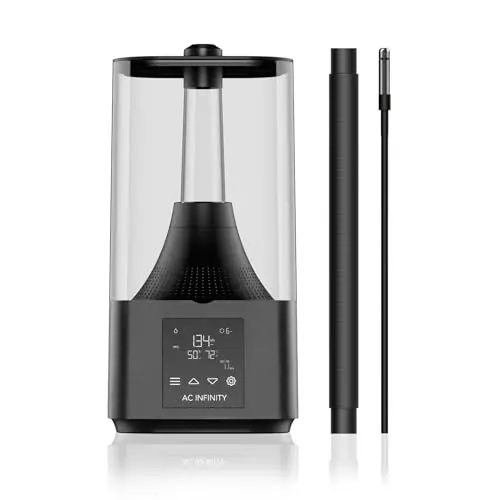
CLOUDFORGE T3 – VPD Control for Grow Tents
The CLOUDFORGE T3 is built for grow spaces rather than bedrooms. It pairs a 4.5L tank with 10-level ultrasonic output, VPD and humidity triggers, timers, and a backlit display that can be hidden during dark cycles. The extendable hose and flexible targeting pipe let you place the unit outside the tent and aim moisture where the canopy needs it.
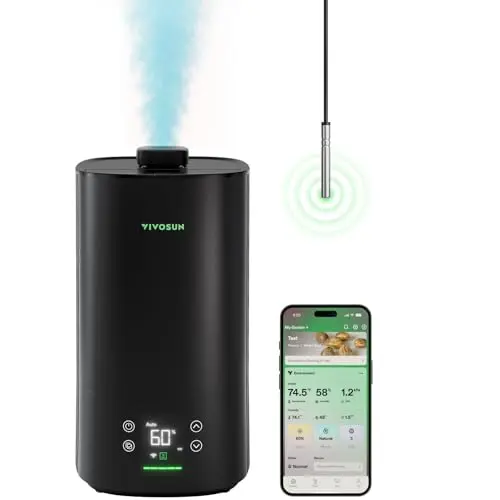
AeroStream H05 – WiFi VPD Control for Growers
The AeroStream H05 is a 5L smart humidifier designed around the Vivosun grow ecosystem. An external temperature and humidity probe feeds 1% humidity resolution into the app, where you can set VPD targets, timers, and grow recipes. Phantom mode blanks the screen during dark periods, and the included vapor outlet and flexible hose let you run the unit inside or outside the tent.
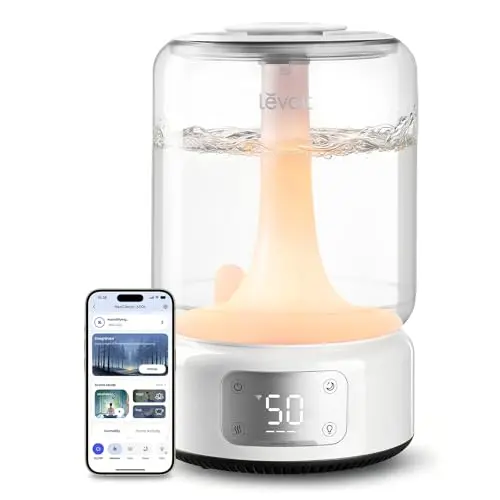
NeoClassic 650S – Large-Room Smart Humidity
The NeoClassic 650S is a 6.2L top-fill humidifier with smart app control and a precise auto mode. It is rated for large rooms up to 536 sq ft and can run for up to 62 hours on a fill. The detachable tray is designed for easier cleaning, and the silver-ion-treated material is intended to resist microbial growth. It also supports essential oils and a blue-light-safe night light.

6L Humidifier – Budget Humidistat Tank
The Breezome 6L is a top-fill ultrasonic humidifier with a built-in humidistat, a 60-hour runtime on low, and an essential oil tray. It is rated for rooms up to 500 sq ft and uses a demineralization cartridge. The sleep mode is designed to keep noise low, and the unit shuts off automatically when the tank runs dry.

8L Large Humidifier – High-Capacity Humidity Control
The Lacidoll 8L is a high-capacity top-fill humidifier with a 45% to 95% humidistat, three mist speeds, a 12-hour timer, and a remote control. It is rated for large rooms up to 800 sq ft and uses a leak-proof top-fill design. A sleep mode dims the panel, and the 360 nozzle lets you direct mist. It is filter-free and includes an essential oil tray.

Smart 4L Humidifier – App and Voice Control
The Dreo Smart 4L is a top-fill ultrasonic humidifier with app, voice, and touch control. It uses enhanced humidity sensing for auto mode, offers a 36-hour runtime on low, and runs as quietly as 28dB. The dual-intake design is intended to push mist farther into the room, and the nightlight can serve as a visual humidity cue. Optional demineralization and clean-mist cartridges are available separately.
How We Evaluated These Humidifiers for Grow Tent
We did not run these humidifiers through a full grow cycle in a sealed tent. What we did: cross-referenced 6 humidifier models from 6 distinct brands across five decision axes – humidity control method, tank capacity and runtime, hose and placement flexibility, cleaning and leakage risk, and smart or VPD compatibility. We triangulated published specifications, feature sets, owner feedback where available, and use-case fit for grow tents ranging from small propagation spaces to larger flowering rooms. We also did not measure output with a hygrometer in a sealed room or run long-term durability trials. What we can tell you is how the published specs, control logic, and owner-reported pain points line up with the demands of a grow tent.
The scoring framework weighted real-world grow-tent fit (70%) – how well each humidifier maintains target humidity without constant intervention – against feature differentiation (30%) – VPD logic, probes, hose routing, and controls that actually matter in a tent. We mapped each option against a simple buyer profile: sealed tent vs. passive tent, small canopy vs. large canopy, and app-controlled vs. manual operation. We have no commercial relationship with any of the brands featured; recommendations track fit and differentiation, not brand preference. If you want the most purpose-built controller, the CLOUDFORGE T3 is the closest match; if you prefer app-based recipes and a remote probe, the AeroStream H05 is the better fit.
How to Choose the Right Humidifiers for Grow Tent
1. Why Humidity Control Matters in a Grow Tent
In a grow tent, humidity is not a comfort setting; it is part of the plant’s environment. Low humidity can slow transpiration and leave leaves crisp at the edges, while swings between wet and dry air make it harder to keep VPD in range. The right humidifier for a grow tent should hold a target rather than just add moisture when you remember to refill it. That is why humidistat control or VPD logic matters more here than in a bedroom.
2. Tank Size and Runtime for Grow Tent Humidity
Tank size sets how often you interrupt a grow cycle to refill. A small 2L to 2.5L tank can work in a propagation tent, but a larger canopy drinks moisture faster. Mid-size 4L to 6L tanks are the practical middle ground, while 8L-class reservoirs stretch refill intervals in bigger rooms. Runtime claims are usually based on low output, so compare them as a range, not a promise. If you want a capacity-first option, the Lacidoll 8L is the pick here.
3. VPD, Humidistats, and Smart Humidifier Controls for Growers
VPD control is the grower-specific upgrade. It uses temperature and humidity together to estimate plant stress, then adjusts mist output to stay near a target. A remote humidity probe is more useful than a sensor built into the humidifier because it reads the canopy, not the corner where the unit sits. App control and grow-system compatibility are convenience features, but they become genuinely useful when they let you set recipes or check alerts without opening the tent. If you want that level of control, the CLOUDFORGE T3 is the most purpose-built option; the AeroStream H05 is the better fit if you prefer a phone-first workflow.
4. Placement, Hose Routing, and Mist Direction in a Grow Tent
Placement is where many bedroom humidifiers fall short. A unit inside the tent takes up floor space, competes with pots and trays, and can spray directly on leaves. A hose or flexible targeting pipe lets you keep the reservoir outside and aim vapor at the canopy. If you cannot route a hose, look for a 360-degree nozzle and a footprint that fits beside your containers. Keep the mist path away from lights, fans, and exposed cords.
5. Leakage, Cleaning, and Maintenance for Grow Tent Humidifiers
Leaks are the most common complaint in this category, and a wet tent floor is a real problem. Prioritize a top-fill design with a leak-resistant seal, then plan to clean the tank and base regularly. Wide openings and detachable trays make that job shorter. In hard-water areas, a demineralization cartridge or filter-free design can reduce white dust on leaves and equipment. If you want a budget-friendly humidistat tank, the Breezome 6L is the value route, but check the seal and keep it on a tray.
6. Budget vs. Premium Grow Tent Humidifiers
Budget humidifiers usually trade VPD logic and hose routing for a simple humidistat and a smaller tank. Premium grow-tent models add probes, app recipes, and placement flexibility. The middle ground is a large bedroom humidifier with precise auto mode and a top-fill tank; it can work well in a passive tent if you can place it inside. Decide which matters more: automation and routing or capacity and cleaning ease. That choice will narrow the field faster than any spec sheet.
Frequently Asked Questions
1. Do I need a grow-tent-specific humidifier, or can a bedroom model work?
A bedroom humidifier can work in a grow tent if it has a humidistat or auto mode, a tank size that matches your canopy, and a placement plan that keeps mist off the leaves. The gap appears when you need VPD control, a remote probe, or a hose to keep the unit outside the tent. For a small passive tent, a precise bedroom model is often enough. For a sealed room with cycling equipment, a grow-specific controller is worth the step up.
2. AC Infinity CLOUDFORGE T3 vs. Vivosun AeroStream H05: Which is better for a grow tent?
The CLOUDFORGE T3 leans toward VPD triggers and hose routing, with a controller-style interface and a 4.5L tank. The AeroStream H05 leans toward app-based recipes, a remote humidity probe, and integration with the Vivosun grow system. If you want set-and-forget VPD control with a physical controller, choose the CLOUDFORGE T3. If you prefer phone-first scheduling and already use Vivosun gear, the AeroStream H05 is the better fit.
3. Levoit NeoClassic 650S vs. Breezome 6L: Which fits a smaller grow tent?
The NeoClassic 650S is the more polished large-room humidifier, with a 6.2L tank, 5% auto accuracy, and a detachable cleaning tray. The Breezome 6L is the budget route, with a built-in humidistat and a simpler top-fill tank. For a smaller tent where you can place the unit inside, the Breezome’s lower cost may be enough. If you want better cleaning access and more precise auto mode, the NeoClassic 650S is the stronger pick. Neither has a hose or VPD logic.
4. How do I route a humidifier hose into a grow tent?
Keep the humidifier outside the tent, run the flexible hose through a sealed port or vent opening, and aim the outlet toward the canopy rather than directly at leaves. Use a drip loop so condensation cannot run back into the unit, and keep the hose away from hot lights. A targeting pipe helps distribute mist more evenly. Check that the hose does not block the tent’s exhaust or intake path.
5. What size humidifier tank do I need for a grow tent?
Tank size depends on canopy size, tent volume, and how dry your lung room is. A 2L to 2.5L tank can suit a small propagation tent, while a 4L to 6L tank is a safer middle ground for a medium canopy. An 8L-class tank reduces refills in larger rooms but takes up more space. Match the tank to your refill tolerance, not just the square-foot rating.
Final Verdict
For most grow tents, the CLOUDFORGE T3 is the answer. It combines VPD control, a targeting hose, and a 4.5L tank in a package that is actually designed for growers. If you already use Vivosun gear or prefer app-based recipes, the AeroStream H05 is the smarter ecosystem pick. Budget-conscious growers with a smaller tent can start with the Breezome 6L and accept a simpler humidistat, no hose, and more leakage risk. And if capacity is the priority in a larger room, the Lacidoll 8L gives you the biggest reservoir and a wide humidity range. Choose the AC Infinity for control, Vivosun for app integration, Breezome for value, or Lacidoll for capacity.
