
Best Humidifiers For Indoor Plants – 2026 Reviews

You buy a calathea, it sulks. You buy a humidifier, it runs dry by morning and the leaf tips still crisp. The gap between owning a humidifier and actually keeping plants happy usually comes down to two things: how much moisture a unit can put out over a full day, and whether you can hold a humidity range instead of guessing at it.
Plant spaces are their own category. They want cool mist rather than warm, steady output across a long runtime so humidity doesn’t swing while you’re at work, and a nozzle you can aim at a shelf of ferns rather than a bedsheet. Tank size and cleaning access matter more here than in a bedroom, because mineral scale and biofilm build faster when a unit runs constantly next to living things.
We compared the current market side by side – big-tank workhorses, compact bedside units, and app-driven models with sensors – and sorted them by how well they handle a plant collection rather than how they look on a nightstand. Some of these are built for whole rooms. Others are sized for a single shelf. Here’s how they stack up.
Best Humidifiers for Indoor Plants – 2026 Reviews
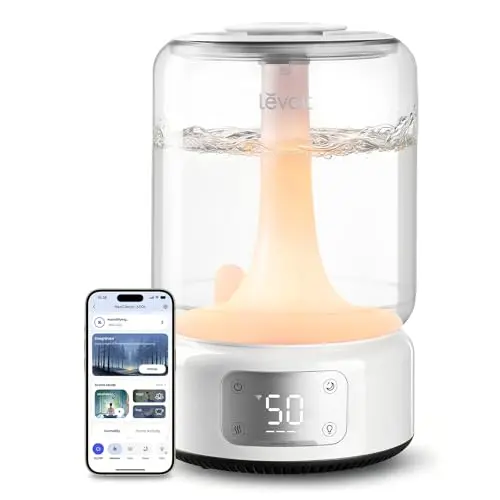
NeoClassic 650S – Precision Mist for Plant Rooms
A 6.2L top-fill ultrasonic humidifier built for large rooms, with an app layer, a precise auto mode, and a detachable tray that makes descaling less of a chore. Its coverage rating and mist output sit at the top of this group.

Smart 4L Humidifier – App-Steered Humidity
A 4L smart humidifier with app and voice control, an auto mode tuned for accurate humidity sensing, and optional demineralization and clean-mist cartridges that cut down on white dust – a real consideration when you’re misting around foliage.
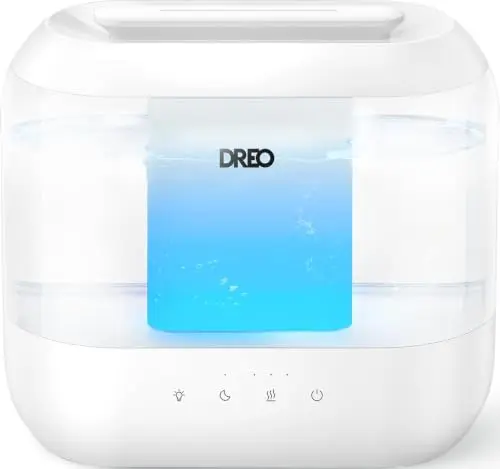
HM311 4L Humidifier – Big Output, No App Needed
A touch-controlled 4L humidifier using the same dual-intake mist system as its smart sibling, minus the app. Tall mist plume, top-fill convenience, and an ambient nightlight – a straightforward workhorse for a plant corner.

6L Humidistat Humidifier – Steady Humidity on Autopilot
A 6L top-fill humidifier with a built-in humidistat, a long runtime claim, and an aroma tray. The humidistat reads real-time humidity and works toward a target, which is exactly what a plant room wants.
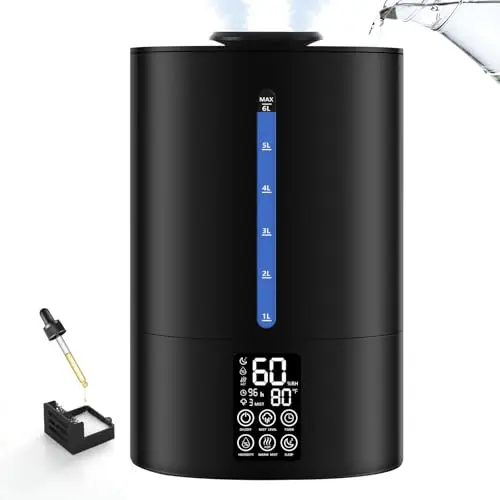
6L Warm and Cool Mist – Two Modes for Every Season
A 6L top-fill humidifier that switches between warm and cool mist, with three mist levels, a sleep mode, and an essential oil diffuser. Aimed at large rooms and indoor plant spaces.
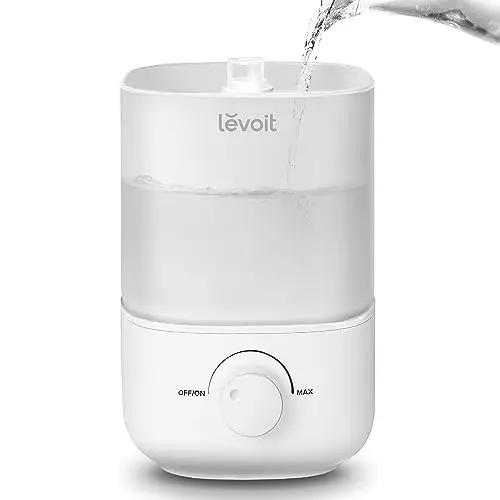
Classic 160 – Simple Mist for Small Corners
A compact 2.5L top-fill humidifier with one knob, a 360-degree nozzle, and a very low noise floor. Simple by design, and one of the easiest units here to fill and clean.
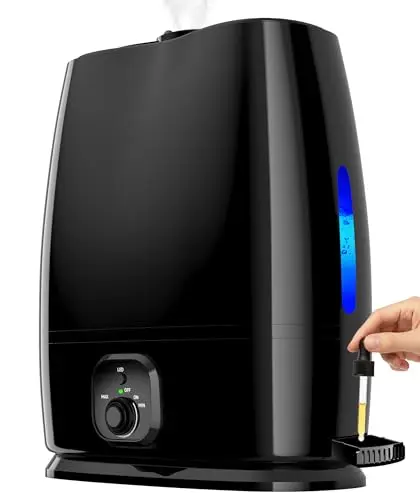
6L Large Humidifier – Filterless and Long-Running
A 6L filterless ultrasonic humidifier with a long runtime claim, a 360-degree nozzle, an essential oil tray, and whole-room coverage. No filters to buy and no cartridges to replace.

H7140 Smart Humidifier – Voice Control and Glow
A 3L smart humidifier with app and voice control, RGB lighting, and the option to pair with a separate thermo-hygrometer for automated humidity targets.

2.5L Top Fill – Timer Control in a Small Footprint
A 2.5L top-fill humidifier with a 2/4/8-hour timer, soft night lights, and a long runtime claim for its size. Compact enough for a desk or a shelf corner.
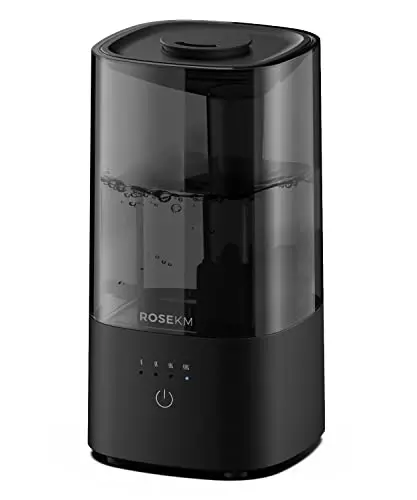
2L Compact Humidifier – Quiet Bedside Mist
A 2L bedside humidifier with four mist levels, a 360-degree nozzle, an auto-dimming indicator, and a five-year warranty. Quiet and small enough for a nightstand or a plant shelf.
How We Evaluated These Humidifiers for Indoor Plants
This review didn’t involve running each unit through weeks of continuous misting in a sealed grow room. It’s built on published specifications, manufacturer feature documentation, and aggregated owner feedback where available. We cross-referenced 10 humidifier models from 7 distinct brands across six decision axes – tank capacity and runtime, mist output and coverage, humidity control precision, noise level, cleaning and maintenance design, and fit for plant-specific use like foliage-safe mist dispersion.
We triangulated advertised tank sizes against claimed runtimes to see which units actually hold output over a long stretch, mapped nozzle and mist-character claims against how people describe real-world dispersion, and weighed cleaning design heavily, since humidifiers that are hard to descale are the ones that end up in a closet. Where owner feedback was uneven across the lineup, we leaned on the specifications and said so.
The scoring framework weighted real-world fit (70%) – how well a unit serves a plant collection day after day – against feature differentiation (30%) – sensor accuracy, cartridge options, app control, and other advantages that separate one model from the next. We have no commercial relationship with any brand here; recommendations track fit and differentiation, not brand preference. If you’re humidifying a large room of foliage, the Levoit NeoClassic 650S is the most capable option in this group; for a shelf-sized setup you can steer from your phone, the DREO Smart 4L is the better match.
How to Choose the Right Humidifiers for Indoor Plants
1. Why Indoor Plants Need a Different Humidifier Than a Bedroom
Tropical houseplants evolved in air that stays damp. Move them into a heated or air-conditioned room and the relative humidity drops well below what they’re built for, which shows up as crispy leaf edges, brown tips, and stalled new growth. A humidifier for indoor plants has to do something a bedroom unit doesn’t: hold a steady number for hours at a time and aim it at foliage rather than a sleeper.
That shifts the priority order. Consistent output beats peak output. A nozzle you can aim matters more than a pretty housing. And cleaning access matters more here than anywhere, because a unit running daily around living plants collects mineral scale and biofilm quickly – and blowing that back into the air is worse than dry air.
2. Tank Size and Runtime: How Much Mist Your Plant Count Actually Needs
Small tanks mean frequent refills, and frequent refills mean skipped days. A 2L tank is a nightstand compromise. A 4L tank covers a bedroom or a plant corner for a day-plus. A 6L tank is where you stop thinking about water for a couple of days. Runtime figures assume low output, so read them as a ceiling rather than a promise.
Output rate is the other half of the equation. Something rated around 200 mL/h is fine for a shelf; a unit pushing 300 mL/h or more is what you want in a room where the door opens and closes all day. Match those two numbers to your space and the rest of the spec sheet gets a lot less important.
3. Cool Mist vs Warm Mist Humidifiers for Indoor Plants
Cool mist is the default for plants, and for good reason: it doesn’t raise the temperature around the leaves, it’s safe to run beside a shelf, and it’s what most ultrasonic units do by default. Warm mist has its place – it feels better in a cold room and won’t chill a space – but it draws more power and you want to keep the nozzle from blasting hot vapor directly at foliage.
If you like having both, the Coolfiqu 6L switches between cool and warm on a single touch and gives you three mist levels to work with. Run it on cool around your plants and save the warm setting for evenings when the room itself is the priority.
4. Humidity Control: Knobs, Humidistats, and App Automation
A plain knob gives you output levels and nothing else – fine if you’re home and can adjust by feel. A humidistat reads the room and works to a target, which is a meaningful upgrade for plants because humidity swings are the thing you’re trying to flatten. App-connected units add schedules and remote checks, and some pair with a separate thermo-hygrometer for genuine auto mode.
Be honest about which one you’ll actually use. A well-placed sensor and a target setting beats a fancy app you open twice.
5. White Dust, Hard Water, and Keeping Leaves Clean
Ultrasonic humidifiers aerosolize whatever is in your water. With hard tap water that means a fine white mineral dust that settles on leaves, glass, and dark furniture – the opposite of what you want around plants. A demineralization cartridge is the cleanest fix, which is why the DREO Smart 4L stands out; it’s designed to take one.
No cartridge? Use distilled or filtered water, or accept a weekly wipe-down of the foliage. Water quality is the most overlooked variable in plant humidification.
6. Cleaning and Descaling: The Maintenance Reality
Every ultrasonic humidifier needs a weekly rinse and a periodic descale, full stop. The difference between a unit that lasts and one that grows a science experiment is access – wide tank openings, removable trays, and bases without tight corners. A dishwasher-safe tray is a real convenience; a tank you can only reach with a bottle brush is not.
Skip this and you’ll get a musty smell, reduced output, and eventually a dead atomizer. Budget five minutes a week.
7. Levoit NeoClassic 650S vs DREO Smart 4L: Precision vs Flexibility
Both are the smartest options here, and they solve the problem differently. The Levoit NeoClassic 650S leads with capability – a 6.2L tank, the highest output in this group, and an auto mode that holds a target within a tight sensor tolerance, plus silver-ion treated material aimed squarely at the biofilm problem that comes with constant running.
The DREO Smart 4L leads with modularity: optional cartridges for mineral dust, an app that handles schedules and cleaning reminders, and a smaller footprint that fits on a shelf. Pick the Levoit if you’re humidifying a whole plant room; pick the DREO if finer control over water quality matters more than raw capacity.
Frequently Asked Questions
1. Do humidifiers actually help indoor plants?
They do, with a caveat. Most tropical houseplants come from environments where the air stays moist, and a heated or air-conditioned room pulls relative humidity well below that. Raising it consistently supports transpiration and reduces the crispy-tip problem dry air causes.
The caveat is consistency. A blast of mist for an hour doesn’t replicate a humid climate; steady output across a full day does. That’s why tank size and humidity control matter more than peak output for plant duty.
2. What's the difference between the Levoit NeoClassic 650S and the DREO Smart 4L?
Size and philosophy. The Levoit is the bigger machine – a 6.2L tank, roughly 320 mL/h of output, coverage up to a genuinely large room, a tight-tolerance auto mode, and silver-ion protection built into the tank material.
The DREO is smaller at 4L but more flexible: optional demineralization and clean-mist cartridges, app and voice control, and a modular body that comes apart for cleaning. If your plant room is large, the Levoit’s extra capacity wins. If water quality is your worry, the DREO’s cartridge system is the more useful feature.
3. How long should a humidifier run for a plant collection each day?
Longer than you’d think, and ideally on a schedule rather than in bursts. Plants respond to average humidity across the day, so several hours of steady low output beats a short blast of heavy mist.
Practically: run it through the daylight hours and overnight if the room is heated, and check with a hygrometer rather than guessing. If condensation forms on windows, you’ve overshot – back off the output before you shorten the runtime.
4. What's the difference between the BREEZOME 6L and the Coolfiqu 6L?
Both hold six liters and claim long runtimes, but they aim at different buyers. The BREEZOME 6L leans on a built-in humidistat that reads real-time humidity and holds a target – the closest thing to set-and-forget in this group. The Coolfiqu leans on versatility, with warm and cool mist modes and three mist levels.
For a plant room where you want a specific number held, the BREEZOME is the more logical pick. If you want warm mist in winter and cool mist the rest of the year, the Coolfiqu gives you both.
5. Can a small humidifier handle a full plant shelf?
Often yes. A shelf, cabinet, or grow tent is a small enclosed volume, and a 2L to 3L unit can move the humidity in that space meaningfully – especially one with an aimable nozzle. Owners of cabinet setups report compact units doing real work there.
What you lose is runtime. Expect more refills, and pick a model with top-fill access so refilling stays painless – the Levoit Classic 160 is the easiest to live with at that size. For an open room rather than an enclosure, step up to a 4L tank at minimum.
Final Verdict
For most plant keepers, the Levoit NeoClassic 650S is the answer. It puts out more moisture than anything else here, holds a humidity target with real precision, and its silver-ion treated tank and dishwasher-safe tray make constant running less of a chore. If you’d rather not spend at the top of the range, the DREO HM311 delivers a genuinely strong mist plume and a long runtime for a mid-tier price, and it’s the one we’d hand to someone building their first proper plant corner. And if you want the option of warm mist in winter, the Coolfiqu 6L is the flexible pick – just run it on cool around foliage. Match tank size to your space, aim the nozzle at the leaves rather than the wall, and clean the thing on a schedule. That’s most of the battle.
