
Best Humidifiers For Infant Rooms – 2026 Reviews

You notice it around 2 a.m. – the dry cough, the stuffy nose, the baby who won’t settle. A humidifier is one of the few nursery purchases that can make a rough night measurably easier. The wrong one adds a hum you can hear through a wall, a display that lights up the ceiling, or a tank you dread scrubbing at six in the morning.
An infant’s room judges a humidifier on different terms than your living room does. The space is small and closed, and the person sleeping in it can’t move away from a draft or a damp patch. That means quiet operation, a genuinely dim or switchable light, a tank you can reach into with a brush, and safety basics like auto shut-off all matter more than raw mist output. Over-humidifying a small room is its own problem – condensation on windows and walls is exactly what you don’t want three feet from a crib.
We looked at what the big names and the budget upstarts get right and wrong on those nursery-specific terms: decibel ratings in sleep mode, real coverage in a 120-square-foot room, how far your hand actually reaches into the tank, and whether BPA-free materials and dry-run protection are spelled out or glossed over. Here’s how the field sorts out.
Best Humidifiers for Infant Rooms – 2026 Reviews
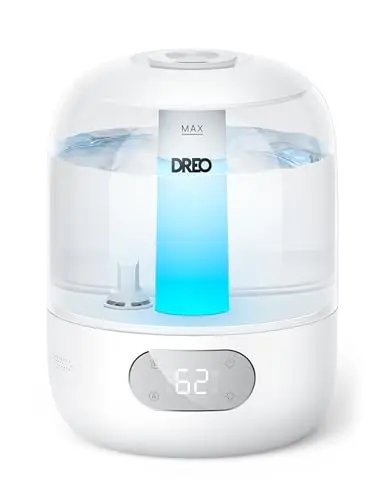
DR-HHM006 – Humidity Control for the Nursery
A 3-liter cool-mist humidifier built around control rather than guesswork. The DR-HHM006 pairs a digital display with a humidistat and a timer, so you can set a target and let it hold there instead of nudging a knob all night. Sleep mode drops output to a whisper and kills the lights, while the 360-degree nozzle projects mist up to 40 inches so it disperses instead of settling on a crib sheet.
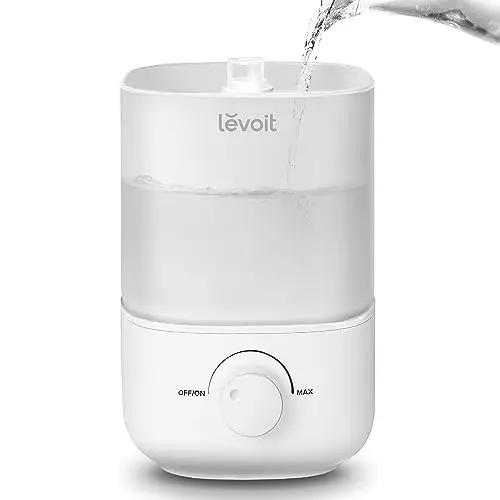
Classic 160 – Top-Fill Simplicity for Nurseries
The stripped-down Levoit: one knob, one nozzle, one job. The 2.5-liter top-fill tank lifts off in a single step and the wide opening makes rinsing it genuinely quick, which matters more than any smart feature when you’re doing it half-asleep. Auto shut-off, BPA-free materials, and a two-year warranty cover the basics without adding anything to break.
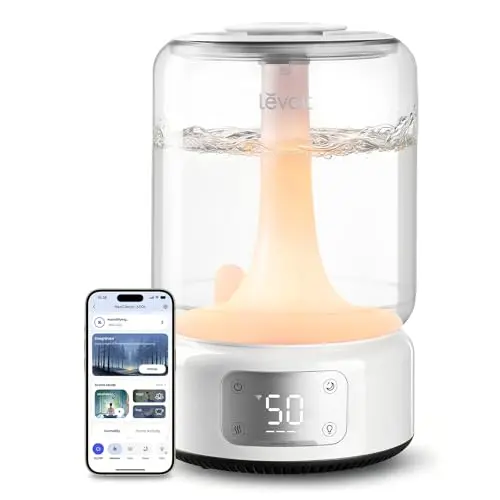
NeoClassic 650S – Smart Large-Room Humidity
The large-room option: a 6.2-liter tank, 320 ml/h output, and app control with an auto mode that holds humidity within a tight window. The detachable tray is dishwasher-safe on the top rack, and silver ions in the water-contact material are rated to resist microbial growth for up to 28 days between deep cleans. Overkill for a shoebox nursery, ideal for a shared bedroom.
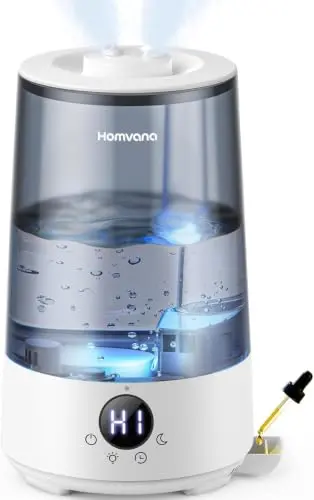
H101 – 23dB Quiet for Light Sleepers
Homvana’s 3.6-liter unit goes after the one thing that wakes light sleepers: noise. It’s rated at 23dB with a display-off sleep mode, and the 5.3-inch tank opening plus top-fill layout keep the maintenance loop short. A three-year warranty is a genuine outlier at this end of the market.
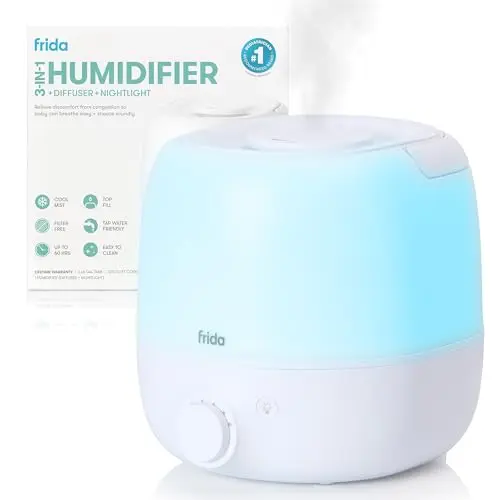
3-in-1 – 60-Hour Nursery Companion
Frida’s nursery-focused unit bundles three things parents end up buying separately: cool mist, an essential-oil diffuser pad, and a night light. The 0.66-gallon tank stretches to roughly 60 hours on low, and a carry handle means you can fill it at the bathroom sink instead of hauling water down the hall. A low-water indicator and auto shut-off handle the safety side.
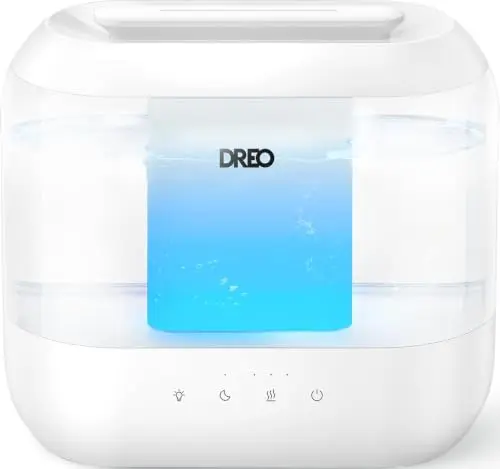
HM311 – Supersized Mist for Bigger Rooms
The HM311 trades subtlety for volume. A 4-liter tank, dual-intake design, and 4-inch outlet push a mist column up to 40 inches tall, covering up to 300 square feet for as long as 36 hours. It’s the pick when your nursery is really a converted primary bedroom and the crib sits at the far end of it.
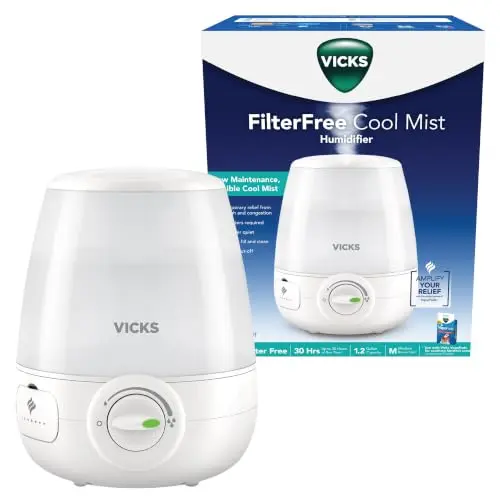
V4600 Filter-Free – Simple Congestion-Season Mist
The old reliable of the category: a 1.2-gallon tank, up to 30 hours per fill, and no filters to buy or replace. Vicks markets it as recommended by pediatricians, and the filter-free design means one less consumable to track through cold season. No night light, no diffuser, no app – just moisture.
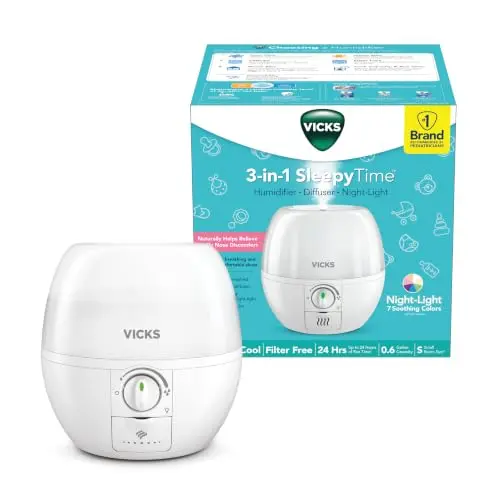
SleepyTime 3-in-1 – Humidifier, Diffuser, and Night Light
A compact nursery unit that leans into routine. The 0.6-gallon tank covers a small room for up to a day, the color-changing night light doubles as a sleep cue, and the diffuser pad accepts VapoPads or essential oils. Filter-free, touch-controlled, and small enough to sit on a dresser top.
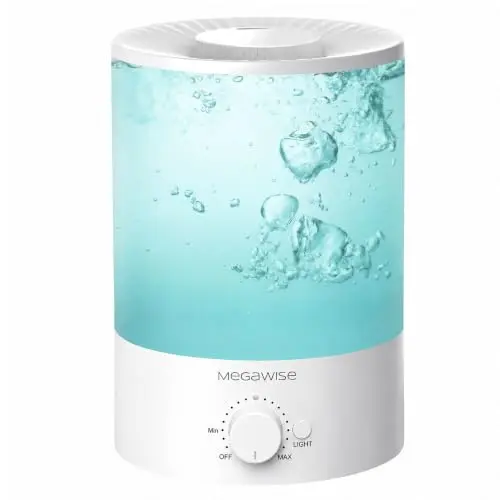
GJQ8 – Budget 3.5L with Night Light
A budget 3.5-liter with more features than its footprint suggests. Rotary mist control, a 360-degree nozzle, a seven-color night light, and auto shut-off with a red low-water alert cover the nursery basics. Rated at 24dB, which is quiet enough to sit against a nursery wall without complaint.
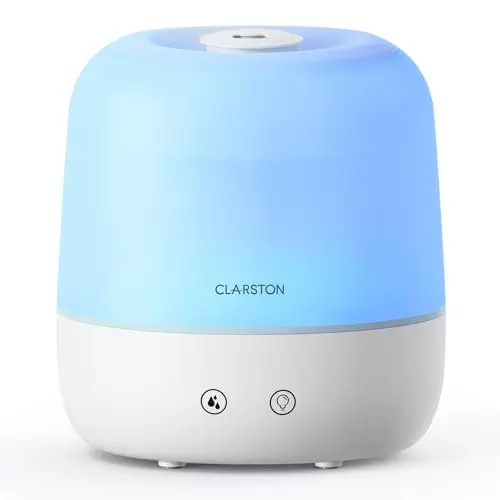
10056 – Compact Tank, Wide-Mouth Cleaning
A compact 2-liter designed around maintenance. The 6-inch tank opening is the widest in this roundup, so you can actually get a brush into every corner, and the unit tops out at 24dB with a full lights-off mode. Twenty-five hours on low from a tank that’s light enough to carry with one hand.
How We Evaluated These Humidifiers for Infant Rooms
We didn’t see these humidifiers through a full winter of night feeds, and we can’t tell you how any specific unit will hold up after six months of nightly use. What we did: cross-referenced 10 humidifier models from 7 brands across six decision axes – sleep-mode noise, tank capacity and stated runtime, real coverage against a typical nursery footprint, cleaning access and mold risk, safety features like auto shut-off and BPA-free materials, and night-light behavior in a dark room. We triangulated published specifications, mapped each feature set against how a humidifier actually gets used at two in the morning in a small closed room, and weighed owner feedback where available so recurring problems surfaced before they became surprises on your nightstand.
The scoring framework weighted real-world nursery fit (70%) – how well a unit behaves in a dark, quiet room of roughly 100 to 150 square feet – against feature differentiation (30%) – the extras that genuinely change ownership, like a humidistat, a dishwasher-safe tray, or a diffuser pad. We have no commercial relationship with any of the brands featured; recommendations track fit and differentiation, not brand preference. If you’re setting up a nursery and want the unit that does the thinking for you, the DREO DR-HHM006 is your match. If you want the simplest thing that works, the Levoit Classic 160 is the one.
How to Choose the Right Humidifiers for Infant Rooms
1. What Makes a Humidifier Right for an Infant Room
An infant’s room is the hardest environment a humidifier will ever work in. It’s small, closed, and occupied by someone who can’t move away from a draft, a bright light, or a damp patch on the carpet. That flips the priorities: control matters more than raw output, and quiet operation outranks almost every other spec on the box.
The practical target is a humidity level in the 40-50% range – comfortable for breathing and low enough that condensation doesn’t form on windows and walls. Hitting that in a 120-square-foot room takes far less mist than the manufacturer’s coverage claim suggests, which is why a smaller, controllable unit usually beats a big one that only runs full blast.
2. How Quiet Should a Nursery Humidifier Be?
Every humidifier here quotes a sleep-mode decibel rating, and they cluster between 23dB and 28dB. That spread sounds trivial on paper; in practice, a few decibels at two in the morning is the difference between a baby who resettles and one who doesn’t. Ultrasonic models dominate this category for exactly that reason – no fan whine, just a soft water sound.
Two things the spec sheet won’t tell you. Those ratings are almost always measured on the lowest setting, so noise climbs the moment you turn the mist up. And light matters as much as sound – a bright display or a night light you can’t shut off is its own wake-up trigger. If your baby wakes at every sound, the Homvana H101 is the quietest option we compared.
3. Tank Size and Runtime: Refill Reality in an Infant Room
Runtime claims in this category are measured on the lowest mist setting, so treat them as a ceiling rather than an expectation. A 0.6-gallon tank rated for 60 hours will need filling every second or third night once you run it on medium in a dry house. A 6-liter tank rated for 62 hours might genuinely last a week.
There’s a tradeoff nobody puts on the box: bigger tanks are heavier when full. Carrying four or five liters of water down a hallway one-handed at night is its own problem. For a true nursery under 150 square feet, a 2 to 3.5-liter tank with a carry handle is the sweet spot; for a shared primary bedroom, capacity wins. The Frida 3-in-1 is the outlier worth knowing about – a modest tank with a handle and the longest low-setting runtime we saw.
4. Cleaning Access Is the Real Differentiator
Mold is the failure mode that ends most humidifier ownership, and it’s almost entirely a function of design. Tanks with narrow necks, sealed bases, and hard-to-reach corners get skipped during the weekly clean, and then get thrown out. Look for a wide tank opening and a detachable base or tray, plus a top-fill layout that doesn’t require flipping a full tank upside down over a carpet.
The habit matters as much as the hardware: empty and air-dry the tank daily, then do a deeper clean weekly. Some manufacturers make that dramatically easier. The Levoit NeoClassic 650S has a detachable tray that’s dishwasher-safe on the top rack, and the Clarston’s 6-inch opening is the most brush-friendly design here. Distilled water also cuts down on the white mineral dust that accumulates around ultrasonic units.
5. Cool Mist, Warm Mist, and Safety Around a Crib
Every humidifier in this roundup is cool mist ultrasonic, which is the safer choice near a crib: no heating element, no hot water, no burn risk if a toddler gets curious. Warm-mist and steam vaporizers have their place during a bad cold, but they’re a different risk category in a room where a baby sleeps.
The safety features that actually matter are auto shut-off when the tank runs dry, BPA-free materials in the water path, and a low-water indicator so you’re not guessing at two in the morning. Keep the unit on a hard, level surface a few feet from the crib rather than on carpet or a shelf above it, and route the cord where nobody can pull it.
6. What Each Price Tier Actually Buys You
Budget-tier humidifiers give you a knob, a night light, and a top-fill tank. They work – ultrasonic mist isn’t expensive to manufacture – but you’re accepting less control and more unit-to-unit variability in mist output. Mid-range is where most nursery buyers should land: quieter sleep modes, better tank access, and the occasional humidistat.
Premium buys control and maintenance convenience more than better mist: app pairing, humidity sensors, dishwasher-safe components, and larger capacities. If you’ll run the humidifier eight months a year in a room you also sleep in, that’s money well spent. If it’s three months of congestion season in a ten-by-ten nursery, it isn’t.
Frequently Asked Questions
1. What's the difference between the Levoit Classic 160 and the DREO DR-HHM006?
They’re opposite philosophies at similar size. The Classic 160 is a 2.5-liter knob-and-nozzle unit: quiet, top-fill, BPA-free, and about as simple as a humidifier gets. The DR-HHM006 adds a humidistat, a digital display, a timer, and a 3-liter tank, so it can hold a target humidity instead of running until you switch it off.
If you want a baby’s room pinned to a specific humidity level, the DREO DR-HHM006 is the better tool. If you’d rather fill it, switch it on, and forget it, the Levoit is simpler and the easier one to recommend to a first-time parent.
2. Is the Frida 3-in-1 a better nursery choice than the Vicks SleepyTime?
Both bundle a night light and a diffuser, so the decision comes down to scale and maintenance. The Frida 3-in-1 has a 0.66-gallon tank, up to 60 hours on low, a carry handle, and coverage up to 320 square feet – but mold in the water chamber is the recurring knock against it, so the daily empty-and-dry can’t slide.
The Vicks SleepyTime is smaller and simpler at 0.6 gallons and roughly a day of runtime, with VapoPad compatibility that parents specifically want during cold season. Bigger room: Frida. Small nursery and congestion season: SleepyTime.
3. How humid should an infant's room be?
Aim for 40-50% relative humidity. Below that, dry air aggravates congestion and dry skin; above it, you get condensation on windows, damp walls, and a much friendlier environment for mold. A humidifier with a humidistat – the DR-HHM006, or the NeoClassic 650S in auto mode – does that for you instead of relying on guesswork.
If your unit only has a knob, a cheap hygrometer on the dresser is the best accessory you can buy. Check it in the morning; if the windows are wet, dial the mist back.
4. Are cool mist humidifiers safe for babies?
Cool mist is the standard choice for nurseries because there’s no heating element and no hot water to spill. The features worth confirming are auto shut-off when the tank runs dry, a BPA-free water path, and a design that doesn’t pool water where it can stagnate.
Most units in this roundup list dry-run protection, but check the spec sheet before you buy if that’s a must-have. The Vicks V4600 is the exception where a night light and humidity control simply aren’t part of the package – it’s a deliberately basic machine.
5. How often do you need to clean a humidifier in a nursery?
Empty and rinse the tank daily, and do a deeper clean with a brush and a mild descaling solution weekly. Mold and mineral buildup happen fast in a warm, closed room, and once biofilm forms in the corners it’s genuinely hard to remove.
Units with a wide tank opening and a detachable base turn the weekly clean into a five-minute job instead of a twenty-minute one, which is the difference between a habit and a skipped chore. If you know you’ll be inconsistent, buy for cleaning access over features.
6. Do I need a humidifier with a night light for a baby's room?
Not strictly – but if you buy one, the light should be dimmable or switchable, because a bright display defeats the purpose of a dark room. A low-intensity night light in red or amber can work as a sleep cue, and being able to kill all illumination is the feature to insist on.
Several units here handle this well: the DR-HHM006 shuts the display off entirely in sleep mode, the Clarston has a full lights-off mode, and the Homvana’s night light is dim enough to leave running. If a light can’t be turned off, treat it as a dealbreaker.
Final Verdict
For most infant rooms, the DREO DR-HHM006 is the humidifier to buy. A humidistat paired with a 26dB sleep mode is exactly the combination a nursery needs: the room stays in a comfortable range without you checking it, and nothing lights up or hums at two in the morning.
If the budget is tighter, the Levoit Classic 160 gets you quiet, top-fill simplicity and a BPA-free build for less, and it’s the easiest tank in the entry tier to clean. For a shared bedroom where the baby’s corner is really a large room, the Levoit NeoClassic 650S earns its premium with a 6.2-liter tank and a dishwasher-safe tray. And if your nursery is small and you’re chasing maximum silence, the Homvana H101 is the quietest unit we compared.
