
Best Humidifiers For Whole Home – 2026 Reviews

A whole home doesn’t dry out evenly. A single bedroom unit can keep one door closed, but hallways, upstairs rooms, and open living spaces need moisture delivered at a different scale. The useful split isn’t just tank size; it’s coverage, moisture output per day, and whether the unit ties into the home’s HVAC system or stands alone.
The strongest picks in this category solve different versions of the same problem. Furnace-mounted evaporative units condition the air as it moves through the ductwork, while floor-standing evaporative and ultrasonic models target open-plan spaces or homes without ducted HVAC. Controls matter too: a manual humidistat, a digital auto humidistat, and app-based scheduling each suit a different household rhythm.
We cross-shopped the market for humidifiers marketed as whole-home or large-space solutions, then separated true whole-house hardware from room-scale units with ambitious coverage claims. The goal is to help you match a model to your square footage, installation comfort, and maintenance tolerance rather than chase the biggest tank.
Best Humidifiers for Whole Home – 2026 Reviews
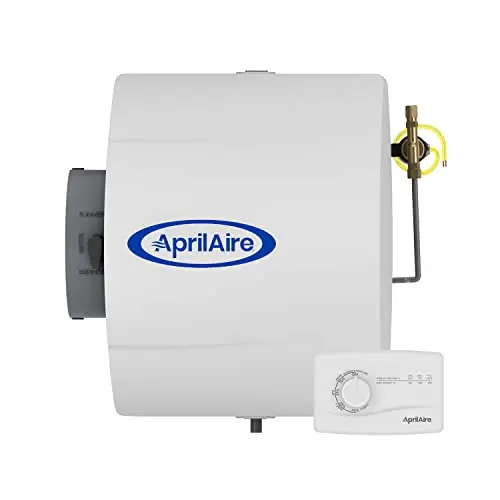
600M – Whole-House Furnace Humidifier
The AprilAire 600M is a furnace-mounted evaporative humidifier built for ducted homes that need moisture delivered through the HVAC system. It pairs a manual humidistat with a water panel, valve, and transformer for a complete whole-house install.
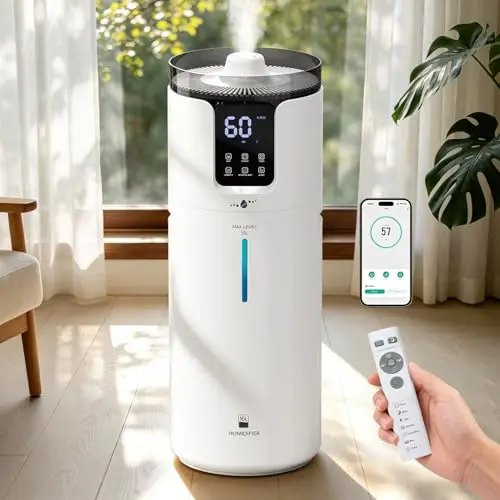
LCD-JSQ-J19WA – Smart Whole-Home Mist
The Lacidoll LCD-JSQ-J19WA is a floor-standing ultrasonic humidifier with a 16-liter tank, app and voice control, and a 360-degree nozzle. It’s aimed at open-plan homes and large rooms up to 1,500 square feet.
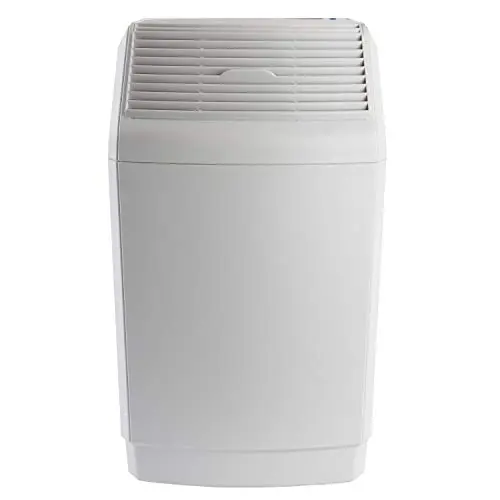
Space Saver 831000 – Large-Room Evaporative
The AIRCARE Space Saver is a floor-standing evaporative humidifier with a 6-gallon tank, digital controls, and coverage rated up to 2,700 square feet. It uses a wick filter and includes casters for moving between rooms.
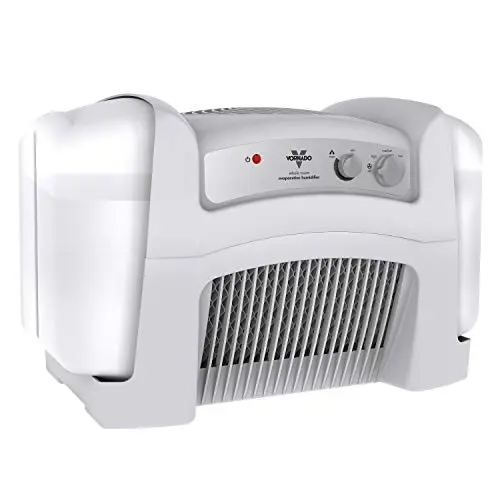
Evap40 – Budget Evaporative Workhorse
The Vornado Evap40 is a dual-tank evaporative humidifier rated for rooms up to 1,000 square feet. It uses wick filters and Vornado’s Vortex circulation to move mist-free moisture through a bedroom, living room, or smaller open space.
How We Evaluated These Humidifiers for Whole Home
We didn’t install these units in a test house, run ductwork measurements, or track humidity over a full heating season. What we did: cross-referenced 4 humidifier models from 4 distinct brands across 5 decision axes – coverage area, daily moisture output, installation and maintenance, control and humidistat behavior, and runtime and noise. We triangulated published specifications, feature sets, owner feedback where available, and use-case fit for whole-home shoppers. We also audited the practical details that separate a true whole-house solution from a large-room unit with ambitious marketing: whether it ties into ducts, how much water it moves per day, and how much routine care it demands. We mapped each model against representative home profiles – ducted suburban houses, renters without HVAC access, and open-plan spaces where a floor unit has to carry the load – and we did not run controlled humidity decay tests or room-by-room moisture mapping.
The scoring framework weighted real-world whole-home fit (70%) – how well each model delivers moisture across a house or large open plan – against feature differentiation (30%) – unique control, installation, and maintenance advantages. We have no commercial relationship with any brand here; recommendations track fit and differentiation, not brand preference. If your home has forced-air HVAC, the AprilAire 600M is the most direct whole-house match. If you need duct-free coverage with app control, the Lacidoll LCD-JSQ-J19WA serves that role better.
How to Choose the Right Humidifiers for Whole Home
1. What Whole-Home Humidification Actually Requires
A whole-home humidifier is less about the word whole on the box and more about how moisture reaches the rooms you actually use. If your home has forced-air HVAC, the AprilAire 600M is the pick because it adds humidity to heated air as it moves through ductwork, so every vent becomes a distribution point. Floor-standing evaporative or ultrasonic units need open air paths and a realistic square-footage match; they work best in open-plan spaces or homes without ducted HVAC.
Start with coverage area, then compare daily moisture output and tank capacity. A big tank with modest output can still mean frequent refills, while a high-output unit in a tight, closed-off house may overshoot. The useful question is how much water the unit can add per day and whether it can distribute that moisture beyond one room.
2. Coverage Area and Moisture Output: The First Filters
Coverage ratings are a starting point, not a guarantee. Manufacturers often quote a best-case square footage for a tightly built space, so treat the top number as a ceiling rather than a comfortable everyday target. Match the rating to your open living area and the rooms that share air with it, not the full finished square footage of a closed-door floor plan.
Moisture output matters just as much. Evaporative models are often rated in gallons per day, while ultrasonic models may quote milliliters per hour. Those units aren’t directly interchangeable, but both tell you how hard the machine can work. If you have a large open plan, prioritize output and circulation; if you have a smaller sealed room, a lower-output unit with a good humidistat may be easier to control.
3. Evaporative vs. Ultrasonic Humidifiers for Whole Home Use
Evaporative humidifiers use a wick or water panel and a fan to add invisible moisture. They’re the traditional choice for whole-house and large-room duty because they can move a lot of water without a visible mist plume. The tradeoff is filter replacement and fan noise. Ultrasonic humidifiers use a vibrating element to create cool mist; they’re often quieter, but they can leave mineral dust and usually prefer distilled water.
For ducted homes, a furnace evaporative unit is the most seamless route. For duct-free homes, an evaporative floor unit is often the most forgiving in hard water. If quiet operation and smart controls matter more than raw water throughput, the Lacidoll LCD-JSQ-J19WA is the pick, though it’s still a floor-standing appliance rather than a ducted solution.
4. Installation, Refilling, and Maintenance Realities
A furnace humidifier is a permanent install: water line, drain, humidistat, and duct connection all need to be right. That’s why the AprilAire approach appeals to homeowners who want the system out of sight and out of the daily refill loop. Floor-standing units are easier to place, but you’ll handle water more often and clean tanks on a schedule.
Look at front or top filling, tank removability, and whether the unit uses a replaceable wick. Those details decide whether maintenance is a five-minute habit or a chore you postpone. If you have hard water, factor in filter or pump care early; it’s the most common hidden cost in this category.
5. Controls, Humidistats, and Smart Features
A humidistat is the thermostat of humidity: set a target and let the unit cycle. Manual humidistats are simple and durable, digital auto humidistats add convenience, and app or voice control adds scheduling and remote checks. None of that changes the fundamental job, but it does change how much attention the unit asks from you.
Prioritize auto shutoff and a clear low-water indicator before app extras. Smart features are useful when they solve a real problem, like adjusting humidity from bed or scheduling a bedroom unit. If you want the simplest permanent setup, manual control is not a downgrade.
6. Vornado Evap40 vs. AIRCARE Space Saver: Which Whole-Home Role Fits?
These two evaporative floor units look similar in concept but serve different sizes of job. If you need a smaller open area or a supplemental unit, the Vornado Evap40 is the pick: a 4-gallon dual-tank design rated to 1,000 square feet with Vortex circulation and three speeds. It fits a bedroom, a smaller open living area, or a house that already has some humidity control.
If one floor unit has to carry a large open room, the AIRCARE Space Saver is the pick. It moves up to 2,700 square feet with a 6-gallon tank and digital auto humidistat. The tradeoffs are footprint, split noise feedback, and tank durability concerns. Neither is a substitute for a ducted whole-house humidifier in a large closed-floor-plan home, but both can anchor a duct-free whole-home strategy if your square footage is realistic.
Frequently Asked Questions
1. What's the difference between the AprilAire 600M and Lacidoll LCD-JSQ-J19WA for a whole home?
The AprilAire 600M is a furnace-mounted evaporative humidifier that uses ductwork to distribute moisture; it’s the better fit for a home with forced-air HVAC and a permanent install. The Lacidoll LCD-JSQ-J19WA is a floor-standing ultrasonic unit with a 16-liter tank, app and voice control, and coverage rated to 1,500 square feet. Choose the AprilAire 600M for ducted whole-house coverage and less day-to-day refilling; choose the Lacidoll for a duct-free setup, quieter operation, and smart controls. Neither is one-size-fits-all: installation access, square footage, and water quality decide the better fit.
2. Vornado Evap40 vs. AIRCARE Space Saver: which is better for a whole home?
The Vornado Evap40 is rated to 1,000 square feet and uses a 4-gallon dual tank with Vortex circulation; it’s best as a bedroom or smaller open-area unit. The AIRCARE Space Saver is rated to 2,700 square feet with a 6-gallon tank and digital auto humidistat, so it can carry a larger open room. For a true whole-home role, the AIRCARE covers more ground; for a smaller space or supplement, the Vornado is easier to live with. Consider noise tolerance, floor space, and filter replacement before deciding.
3. Do I need a whole-home humidifier or just a large-room model?
A true whole-home humidifier is usually ducted or permanently installed, while a large-room model is a portable appliance with a coverage ceiling. If your home has forced-air HVAC and multiple dry rooms, a furnace humidifier is the more complete solution. If you have one open living area or no duct access, a large-room evaporative or ultrasonic unit can be enough. Match coverage rating, daily output, and maintenance tolerance to your actual floor plan rather than the label.
4. Can I install a whole-home humidifier without an HVAC professional?
A furnace-mounted unit involves a water supply, drain, duct opening, and electrical connection, so professional installation is the safer route unless you’re experienced with HVAC work. Floor-standing models only need a level spot, power, and water access. If you want the renter-friendly route, the Vornado Evap40 makes more sense as a floor unit; for a ducted install, plan for pro help. Budget for filter changes, water quality, and seasonal cleaning either way.
Final Verdict
For most buyers with forced-air HVAC, the AprilAire 600M is the answer: it turns the ductwork into a whole-home delivery system and keeps daily refilling out of the routine. If you don’t have ducts but still want a whole-home feel, the Lacidoll LCD-JSQ-J19WA brings the big tank, quiet operation, and app control that make a floor-standing unit easier to live with. And if you’re covering a smaller open space or adding humidity to one zone, the Vornado Evap40 is the budget-friendly evaporative pick. The AIRCARE Space Saver sits between those roles for larger open rooms. Match the unit to your square footage and installation reality, and the choice becomes much clearer.
