
Best Industrial Air Purifiers – 2026 Reviews

Drywall dust has a way of finding every room in the house, and a box fan with a furnace filter stops being funny once the renovation drags into week three. An industrial air purifier is the tool that actually keeps up: it moves serious air volume, holds a serviceable filter stack, and can run in a containment zone without being treated like furniture.
The gap between a mediocre scrubber and a good one comes down to two things: usable airflow and filtration you can maintain. CFM gets the attention, but a machine with a clogged pre-filter or an awkward filter door loses effectiveness fast. For industrial work, you also want stackability, daisy-chain outlets, and a housing that survives being loaded in and out of a truck.
We looked across the commercial air scrubber market to compare how the leading units handle dust, smoke, odors, and job-site abuse. The goal is simple: help you choose the right industrial air purifier for your work, not the one with the loudest spec sheet.
Best Industrial Air Purifiers – 2026 Reviews
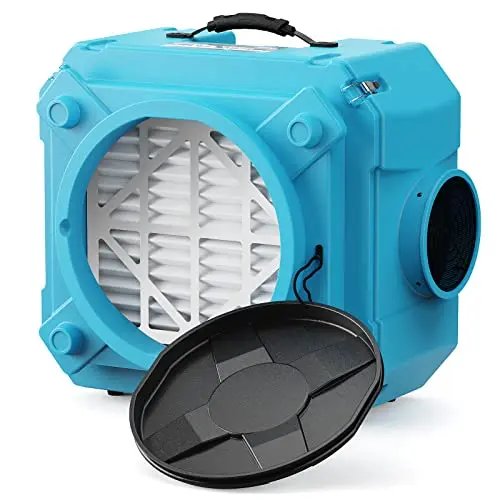
Clean Shield HEPA 550 – Three-Stage Commercial Air Scrubber
The Clean Shield HEPA 550 is a stackable negative-air workhorse built for restoration crews, remodelers, and commercial spaces that need serious particulate control. It pairs a MERV-10 pre-filter and carbon layer with a HEPA final stage, so it can tackle dust and odors without extra add-ons.
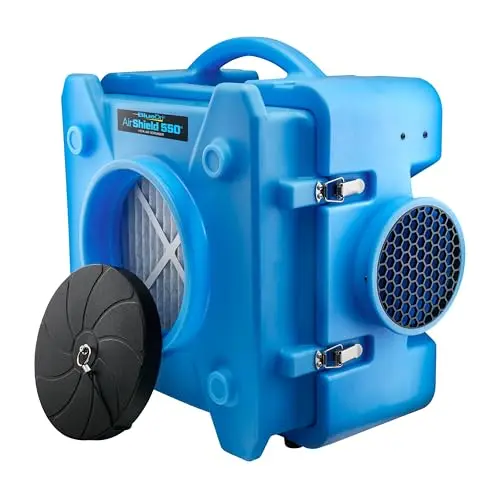
Air Shield 550 – High-CFM HEPA Air Scrubber
The Air Shield 550 is a straightforward HEPA scrubber with strong airflow and a tough single-piece housing. It’s aimed at water, fire, and sewage remediation as well as construction dust, with an optional carbon filter for odor-heavy jobs.
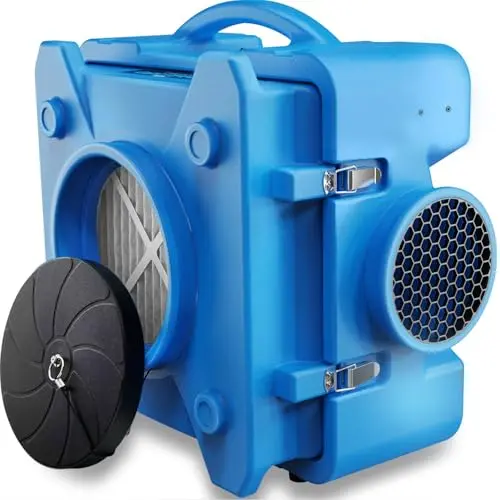
Shield-550 – Stackable Negative Air Machine
The Shield-550 is a stackable negative-air machine aimed at renovation, restoration, and whole-home cleanup. Its three-stage filtration includes a MERV-10 pre-filter, carbon layer, and HEPA filter, and the lighter build makes it easier to move between rooms.
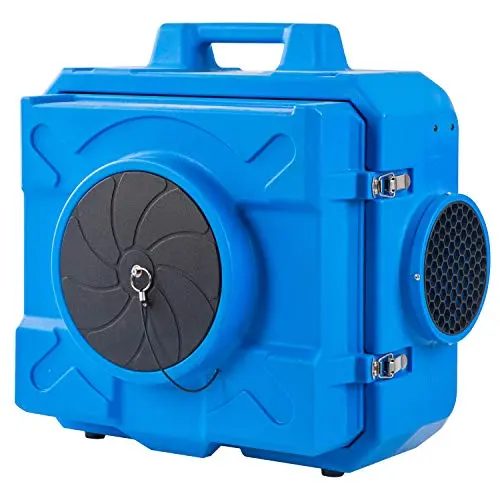
HEPA500 – Variable-Speed Jobsite Air Scrubber
The HEPA500 is a jobsite-focused air scrubber with variable-speed airflow, a rotomolded shell, and practical service features. It’s built to move between renovation and restoration jobs without a complicated setup.
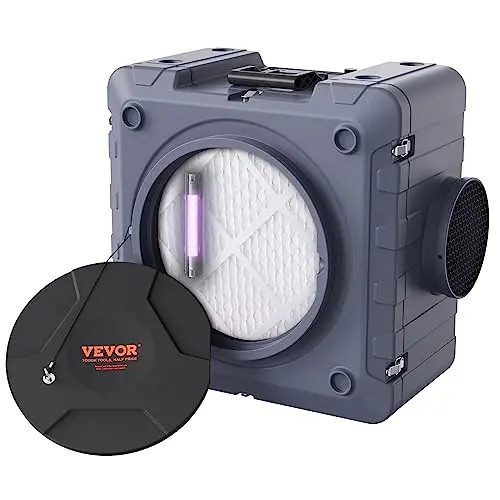
800 CFM Air Scrubber – UV-C and H13 Filtration
The VEVOR 800 CFM scrubber adds UV-C light to a three-stage MERV-10, carbon, and H13 HEPA filtration stack. It’s aimed at buyers who want maximum airflow and built-in odor treatment for renovation, painting, and restoration work.
How We Evaluated These Industrial Air Purifiers
We didn’t run controlled airflow or particle-count lab tests on these machines. What we did: cross-referenced 5 industrial air purifier models from 5 distinct brands across six decision axes – maximum airflow, filtration stages, negative-air and ducting capability, build and portability, noise tradeoffs, and warranty support. We audited published specifications, feature sets, and field feedback where available, then mapped each unit against real job-site profiles like restoration crews, remodelers, and commercial facility managers. We also weighed how easy each machine is to stack, move, and service between jobs, because an air scrubber that’s awkward to deploy tends to stay in the truck. We treated airflow as a practical number rather than a bragging right, and we looked for filtration stages that a crew can actually service without a fight.
The scoring framework weighted real-world job-site fit (70%) – how well each air scrubber delivers usable airflow, filtration, and serviceability – against feature differentiation (30%) – unique advantages like UV-C treatment, stackability, or extended warranty coverage. We have no commercial relationship with any brand here; recommendations track fit and differentiation, not brand preference. The goal is not to crown the biggest spec sheet, but to match the machine to the room, the debris, and the way a crew actually works. If you want the most complete restoration setup, the Clean Shield HEPA 550 is the match; if you need a lower-cost variable-speed unit, the HEPA500 makes more sense.
How to Choose the Right Industrial Air Purifiers
1. What Separates an Industrial Air Purifier From a Consumer Unit
An industrial air purifier is built around moving large volumes of air through serviceable filters, not around quiet bedroom operation. The defining traits are high CFM, multi-stage filtration, and a housing that can survive being loaded into a truck. Consumer units often prioritize looks and silence; industrial scrubbers prioritize negative-air capability, daisy-chain outlets, and filter access.
If you’re cleaning up after drywall dust, smoke, or sewage remediation, the machine needs to turn over the room’s air repeatedly. That’s where airflow and filter loading matter more than decorative features.
2. Airflow and Filtration: The Core Industrial Air Purifier Specs
Start with CFM and filtration efficiency. A 500-550 CFM scrubber is the common workhorse range, while an 800 CFM unit can move more air but often brings more noise. HEPA filtration should be rated for 99.97% of particles at 0.3 microns; a MERV-10 pre-filter keeps that HEPA stage from clogging too fast.
If you want a balanced three-stage setup, the Clean Shield HEPA 550 is the pick. For a simpler variable-speed machine, the HEPA500 is the practical choice.
3. Why Stages of Filtration Matter on a Job Site
A single HEPA filter can do the fine work, but it will clog faster without a pre-filter. A MERV-10 stage catches sawdust and drywall grit, the carbon layer handles odors and fumes, and the HEPA stage traps the fine particulate. That stack is what makes a scrubber useful for paint fumes, smoke, and pet dander as well as construction dust.
Carbon filtration is not a substitute for ventilation, but it helps in enclosed spaces where odors linger.
4. Ducting, Stacking, and Daisy-Chaining in Industrial Air Purifiers
Stackability and daisy-chain outlets separate a crew-friendly scrubber from a one-room appliance. Stacking saves floor space in a drying chamber, and daisy-chaining lets you run multiple units from one circuit within the rated electrical load. Check the inlet and outlet sizes if you plan to duct the machine; not every unit includes ducting.
Think through the electrical load before chaining several scrubbers together. A tripped breaker in the middle of a restoration job is an avoidable delay.
5. Noise, Portability, and Power on Real Job Sites
Industrial scrubbers are not quiet appliances. A machine that’s tolerable on low speed can be unpleasant at maximum airflow, especially in a house with occupants nearby. Weight matters too: a lighter unit is easier to carry up stairs, while a heavier rotomolded shell may take more abuse.
Look for a handle, a stable footprint, and a filter-change indicator. Those small details decide whether the machine gets used or stays parked.
6. How Much Industrial Air Purifier Do You Actually Need?
Match the machine to the room volume and the contamination level. A 550 CFM scrubber is a sensible baseline for many restoration and renovation jobs; an 800 CFM unit makes more sense in larger open spaces or when you need maximum air exchanges. For tight rooms, a smaller or variable-speed unit may be easier to manage.
If maximum airflow is the priority, the 800 CFM Air Scrubber is the pick. Otherwise, choose based on filtration stages, service access, and warranty support rather than the biggest number on the box.
Frequently Asked Questions
1. What makes an air purifier truly industrial?
The short answer is airflow, filtration, and serviceability. An industrial air purifier needs enough CFM to turn over a job-site room repeatedly, a multi-stage filter stack that can handle heavy particulate, and a housing that survives transport. Features like daisy-chain outlets and stackability are clues that a unit was designed for commercial work rather than a bedroom.
2. Clean Shield HEPA 550 vs Air Shield 550: which industrial air purifier fits a restoration job?
Both are 550 CFM-class scrubbers, but they solve different problems. The Clean Shield HEPA 550 ships with a three-stage filter stack that includes carbon, plus stackable construction and a 10-year limited warranty. The Air Shield 550 is a strong HEPA-first machine with daisy-chain capability and a tough housing, but its carbon filter is optional.
For odor-heavy restoration work, the Clean Shield’s included carbon stage is the more complete setup. For straightforward dust control, the Air Shield 550 is still a serious contender.
3. Shield-550 vs HEPA500: which is the better value for a renovation site?
The Shield-550 leans toward full three-stage filtration and a 10-year limited warranty, while the HEPA500 emphasizes variable-speed control and easy filter access at a lower price tier. If you want odor control included and a longer warranty, the Shield-550 is the stronger fit.
If you mainly need adjustable airflow for dust control and want to spend less upfront, the HEPA500 is the practical pick.
4. Can an industrial air purifier run continuously in a home?
It can, but the experience is different from a residential purifier. Industrial scrubbers move more air and usually run louder, even on lower settings. In a home, use one during renovation or smoke cleanup, often as a negative-air setup, then switch to a quieter unit for everyday living. Check the circuit load if you’re running it alongside other equipment, and keep the filter-change indicator in view so you don’t overload a clogged filter.
5. How often do industrial air purifier filters need changing?
There’s no universal schedule. Pre-filters load up fastest on drywall dust and sawdust, while HEPA filters last longer but still need replacement when airflow drops or the indicator stays on. Carbon filters should be swapped when odors return. In heavy renovation work, check filters daily; in lighter commercial use, weekly checks are more realistic.
Final Verdict
For most industrial jobs, the Clean Shield HEPA 550 is the answer – it pairs 550 CFM airflow with a three-stage filter stack, stackable construction, and a 10-year limited warranty. That combination makes it the easiest scrubber to recommend for restoration crews and contractors who want odor control included.
If budget is tighter, the HEPA500 gets you variable-speed airflow and easy filter service at a lower price tier. And if maximum airflow is the priority, the 800 CFM Air Scrubber is purpose-built for larger spaces, with UV-C treatment and H13 filtration.
Pick the Clean Shield for the most complete package, the HEPA500 for value, and the VEVOR for raw airflow.
