
Best Industrial Coffee Grinders – 2026 Reviews

An industrial coffee grinder is overkill for most kitchens-until it isn’t. If you’re pulling repeated espresso shots, grinding for farmers-market cold brew, or outfitting a small office or cafe prep station, the grinder becomes the bottleneck fast. The difference between a home burr grinder and something closer to commercial-grade isn’t one spec; it’s the combination of burr size and geometry, motor torque, heat management, metal build, and how cleanly the machine doses and handles static.
For this category, we focused on grinders sold with commercial-grade or industrial-style claims and checked whether the hardware backs that up. The strongest options share large burrs, low-retention pathways, and controls that let you repeat a dose without eyeballing it. We also weighed practical stuff: hopper size, portafilter fit, cleaning access, and whether the grinder is realistic for a small business versus a serious home setup.
Below, we break down the cross-brand field by build, burr type, dosing workflow, and brew-method range so you can choose the right industrial coffee grinder for your volume and counter space.
Best Industrial Coffee Grinders – 2026 Reviews
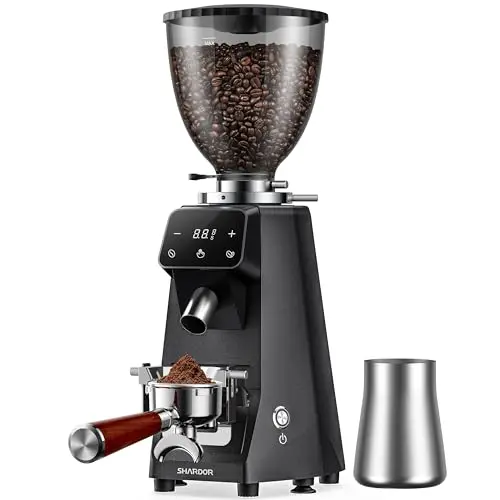
CG305B – Commercial-Grade Flat Burr
The CG305B is the most commercial-grade build in this lineup: a 64mm flat burr set, 350W motor, die-cast aluminum housing, and a fully aluminum grinding chamber. It’s designed for repeatable dosing with 100 programmable settings and an LED touchscreen, plus an adjustable portafilter cradle for direct grinding.
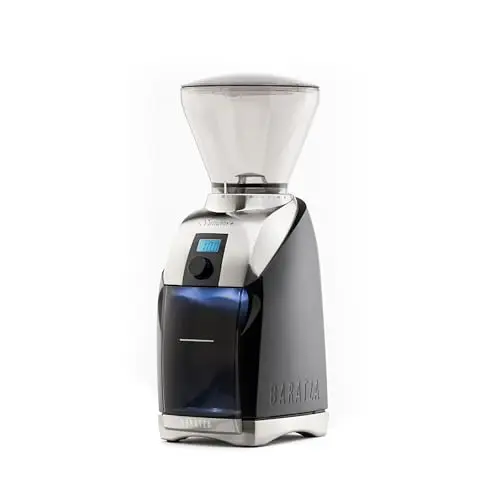
Virtuoso+ – Precision Multi-Brew Grinder
The Virtuoso+ is the proven all-rounder: 40 grind settings, commercial-grade conical burrs, a 40-second digital timer, and a backlit grounds bin. The metal top and base give it a sturdier feel than entry-level grinders, and the wide setting range covers espresso through French press.
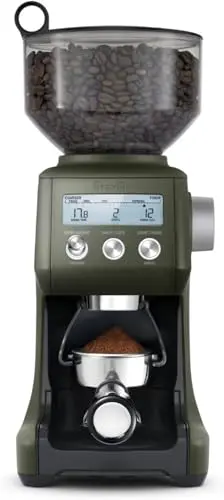
Smart Grinder Pro – Programmable Espresso Dosing
The Smart Grinder Pro is built around espresso workflow: 60 settings, programmable dosing in 0.2-second increments, and direct grinding into a portafilter. It includes two portafilter cradles, an airtight grounds container, and a backlit LCD for repeatable shots.

CG301 – 64mm Flat Burr Workhorse
The CG301 brings a 64mm flat burr set and 100 grind settings at a more accessible tier. It has an all-metal grinding chamber, anti-static system, stainless steel cup, and a removable magnetic discharge pipe for cleaning. The 260W motor and precision timer cover espresso through cold brew.
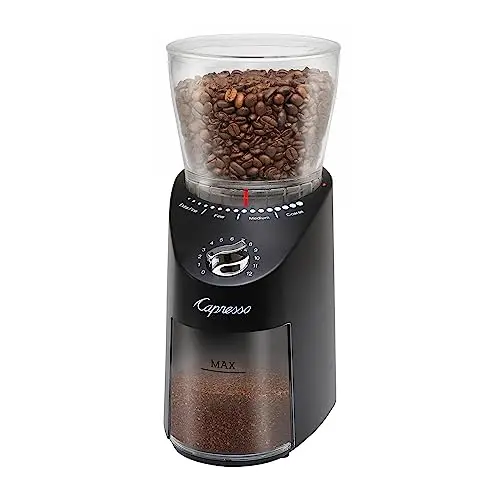
Infinity Plus – Low-Speed Conical Grinder
The Infinity Plus is a quieter, lower-speed conical burr grinder with 16 settings spanning Turkish to coarse cold brew. Its gear-reduction motor is designed to reduce friction and heat, and the 11-ounce bean hopper and removable 4-ounce grounds container keep the footprint simple.
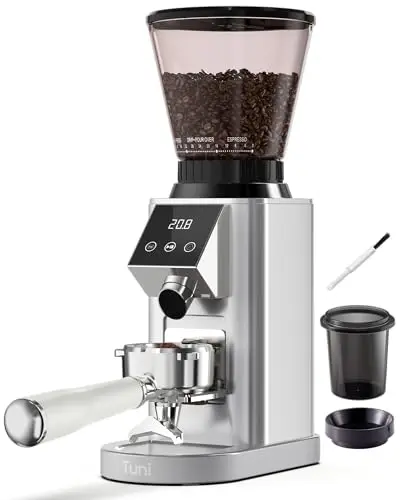
G1 – Compact Anti-Static Burr Grinder
The Tuni G1 packs 48 grind settings, a patented anti-static 40mm conical burr, a 0.5-second timer, and an LED touchscreen into a compact stainless steel body. It includes a detachable portafilter holder for 54-58mm handles and a dosing cup for larger batches.
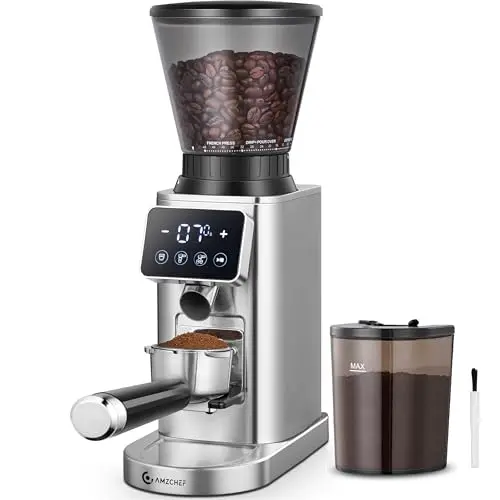
CG209-SV – Low-Retention Conical Grinder
The AMZCHEF CG209-SV is a 48-setting conical burr grinder with a 0.5-second LED timer, anti-static grinding, and a stainless steel body. It fits 51-54mm and 58mm portafilters, holds 10.6 ounces of beans in a UV-blocking hopper, and includes a cleaning brush.
How We Evaluated These Industrial Coffee Grinders
We didn’t run controlled lab grind tests or long-term reliability trials. What we did: cross-referenced 7 industrial coffee grinder models from 6 distinct brands across six decision axes-burr size and type, motor power and heat management, build materials, grind-setting range, dosing and workflow, and cleaning and retention. We triangulated published specifications, feature sets, and owner feedback where available, then mapped each model against realistic small-volume commercial and serious-home use cases. We also audited the little details that separate a smooth workflow from a frustrating one: hopper capacity, portafilter cradle fit, static control, and how easy the burr chamber is to access.
Because ‘industrial” gets used loosely in this category, we weighted real-world performance (70%)-whether the hardware supports repeatable grinding at the volume you’re likely to ask of it-against feature differentiation (30%)-burr geometry, dosing controls, anti-static design, and brew-method flexibility. We benchmarked each model for consistency and workflow rather than brand reputation, and we have no commercial relationship with any brand featured. If you want the most commercial-grade build here, the CG305B is the closest match; if you prioritize proven multi-brew consistency, the Virtuoso+ is the safer pick. What we can’t tell you is how every unit will hold up after a year of cafe-level service; what we can do is show you which designs are built with that workload in mind.
How to Choose the Right Industrial Coffee Grinder
1. What Makes an Industrial Coffee Grinder Different From a Home Grinder
In this category, ‘industrial” is often a marketing shorthand for commercial-grade burrs, a stronger motor, a metal housing, and controls built for repeatable dosing. A true industrial grinder is a different class of machine, but for a small cafe prep station, office, or high-volume home setup, the practical target is a grinder that can handle back-to-back doses without overheating or drifting out of adjustment.
The biggest tells are burr size and material, motor torque, and heat management. A grinder with large flat burrs and a beefier motor generally handles tighter dose spacing than a small conical home model. Build quality matters too: metal grinding chambers and anti-static pathways tend to make daily use cleaner and more stable.
2. Burr Size and Geometry in Heavy-Duty Coffee Grinders
Burr geometry is the core of coffee grinder performance. Flat burrs are often associated with a more uniform particle distribution for espresso, while conical burrs can be forgiving and easier to live with across brew methods. What matters most is whether the burr set is large enough and aligned well enough to deliver consistent grind size at your intended setting.
If you want flat-burr performance without the premium tier, the CG301 is the value-oriented route. For a more commercial-grade flat-burr build, the CG305B is the step-up pick. Conical options like the Virtuoso+ and Tuni G1 remain strong choices if you value brew-method flexibility and simpler day-to-day operation.
3. Motor, Heat, and Retention on Industrial Coffee Grinders
Motor power and low-retention design matter more as volume rises. A low-speed, high-torque motor creates less heat, which helps preserve aroma and keeps the grind from drifting during repeated doses. Retention-the grounds left inside the chamber-is the other half of the equation; lower retention means less stale coffee sneaking into your next dose.
Look for anti-static systems, removable discharge paths, and grind chambers you can actually access. These details don’t show up in a spec sheet headline, but they determine whether an industrial coffee grinder feels clean and repeatable after the honeymoon phase.
4. Dosing, Static, and Workflow for Commercial-Grade Use
For espresso-focused use, programmable dosing and direct portafilter grinding are worth prioritizing. The Smart Grinder Pro is the clearest example here: its Dosing IQ system and included portafilter cradles make repeatable shots easier. If you switch between espresso and filter coffee, a wide grind-setting range and a clear timer matter just as much as burr size.
Static control is the unglamorous feature that keeps a commercial-grade workflow tidy. Anti-static cups, stainless steel grounds containers, and silicone bellows or removable chutes all reduce mess. The less coffee that clings to the chute, the less you waste and the more consistent your doses become.
5. Build Quality, Cleaning, and Counter Footprint
Build quality separates a grinder that survives daily use from one that feels fragile after a few months. Die-cast aluminum housings, all-metal grinding chambers, and stainless steel bodies are the materials to look for. They add weight and stability, and they usually mean better heat dissipation under load.
Cleaning access is just as important. Removable hoppers, magnetic discharge pipes, and included brushes make routine maintenance less of a chore. The CG305B is the most heavy-duty build in this lineup, while compact models like the Tuni G1 trade some mass for a smaller counter footprint.
6. How to Match Grinder Capacity to Your Volume
Match the grinder to your actual volume, not an imagined cafe rush. A large hopper and high-capacity grounds container help if you’re grinding multiple doses at once, but they also take up counter space. For lighter use, a smaller hopper and a quiet low-speed motor may be the better tradeoff.
If you’re mostly brewing for one or two people, the Infinity Plus is a reasonable lower-volume choice with a quieter motor. If you’re dosing espresso repeatedly, prioritize timer precision and portafilter fit over hopper size. The right industrial coffee grinder is the one that matches your workflow, not the one with the longest feature list.
Frequently Asked Questions
1. What makes a coffee grinder industrial rather than just commercial-grade?
In this market, ‘industrial” usually means a grinder is built around commercial-grade burrs, a stronger motor and heat-management system, a metal grinding chamber, and dosing controls meant for repeatable use. True industrial machines are larger and built for continuous production; the models here are better understood as small-volume commercial or prosumer grinders.
Look for large burrs, low retention, and a housing that won’t flex under load. Those traits matter more than a ‘commercial-grade” label on the box.
2. SHARDOR CG305B vs Baratza Virtuoso+: which is better for low-volume commercial use?
The CG305B is the more industrial-feeling machine: 64mm flat burrs, a 350W motor, and a die-cast aluminum housing give it an edge for back-to-back espresso dosing. The Virtuoso+ counters with proven conical burrs and simpler brew-method switching.
If your priority is heavy-duty build and flat-burr espresso performance, choose the CG305B. If you want a safer all-rounder for low-volume commercial use and filter coffee, the Virtuoso+ is the more forgiving pick.
3. Breville Smart Grinder Pro vs SHARDOR CG301: which handles espresso and filter coffee better?
The Smart Grinder Pro is the more espresso-focused tool: 60 settings, Dosing IQ, and included portafilter cradles make repeatable shots easier. The CG301 is the flat-burr value pick, with 100 settings and an all-metal chamber that suits filter coffee and espresso alike.
For a single grinder that switches between espresso and drip, the Smart Grinder Pro is the more convenient workflow. If flat-burr grind quality is your priority and you don’t mind a simpler interface, the CG301 is the stronger value.
4. Can an industrial coffee grinder handle Turkish, cold brew, and French press?
Yes, if the grind-setting range extends fine enough for Turkish and coarse enough for cold brew. The Capresso Infinity Plus covers Turkish through percolator and cold brew with 16 settings, while the Breville Smart Grinder Pro and SHARDOR CG301 offer finer adjustment for espresso and filter brewing.
For Turkish specifically, check the burr set and the lowest setting rather than assuming every ‘industrial” grinder can go fine enough. Burr alignment and low retention matter more than the number of settings alone.
5. How often should you clean an industrial coffee grinder?
For daily use, brush out the discharge chute and grounds bin at least weekly, and do a deeper clean of the burr chamber monthly. If you’re grinding oily dark roasts or dosing espresso multiple times a day, weekly burr brushing is smart. Removable magnetic chutes and included brushes make the job much faster.
Skip harsh cleaners inside the burr path; a dry brush and a quick vacuum are usually enough. Consistent cleaning protects grind consistency and keeps retention from building up.
Final Verdict
For most buyers who need a true industrial-leaning grinder, the CG305B is the answer. It pairs 64mm flat burrs and a 350W motor with a die-cast aluminum housing and 100-step dosing, so it feels purpose-built for repeatable, higher-volume grinding. If you want the safest proven all-rounder, the Virtuoso+ is the more forgiving choice for switching between espresso and filter coffee. Espresso-focused workflows will appreciate the Smart Grinder Pro for its programmable dosing and portafilter cradles. And if your volume is lighter or you want a quieter, budget-friendly option, the Infinity Plus gets the basics right without commercial-grade bulk. Match the grinder to your actual daily dose count, and you’ll end up with a machine that feels industrial where it matters-without paying for capacity you’ll never use.
